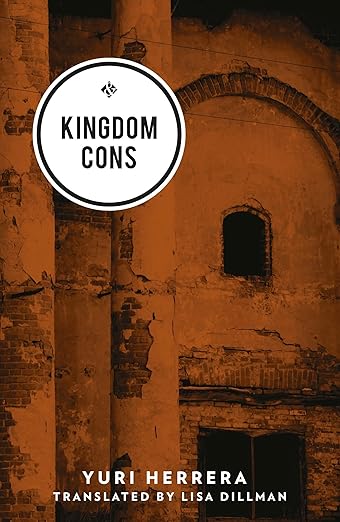
It’s been years since I read Yuri Herrera’s Signs Preceding the End of the World but I remember being impressed by it. Published in translation by the always interesting AndOtherStories, his debut novel Kingdom Cons (2008, transl. Lisa Dillman 2017) is a fable of just over 100 pages.
It is told from the point of view of Lobo, whose parents left him an accordion when they went to ‘the other side’ which I took to mean the USA. He makes his living singing on the streets and in cantinas, until one day he sees The King.
He decides he wants to be part of the Court, and so he goes to the King’s palace:
“The royalty of a king determined these things: the man had settled among simple folk and turned the filth to splendour. Approached from afar, the palace exploded from the edge of the desert in a vast pageantry of gardens, gates and walls. A gleaming city on the fringes of a city in squalor, a city that seemed to reproduce its misfortune on street after street.”
The King takes a shine to him, and so Lobo becomes The Artist, part of the coterie. Frequently referred to as a ‘fool’ or ‘clown’, he is the court jester, a musician placing The King in folk ballads.
“The Artist bowed again and followed the man, fit to burst into tears and blinded by bright lights and his future.”
Also in court are The Heir, The Manager, The Journalist, The Doctor, The Witch and other courtiers. The Artist falls for the daughter of The Witch, but there is much he doesn’t know about her, and how things run at Court, although he starts to piece them together.
Of course, this isn’t a medieval centre of rule, but a modern day drug cartel. We see the politics between cartels, the violence and power struggles at a step removed, but they are there. (The only violence I found difficult was the killing of a bird, which isn’t directly depicted.)
I didn’t find the fairytale/fable framing to be obfuscating or sanitising what was taking place. Instead. I thought it was a clever move by Herrera to show how embedded cartels are in society, how they draw on long-established societal structures, and how there is wider complicity. It is an inventive way of approaching a story so frequently told.
Kingdom Cons is a quick read, almost a short story. The characters are deliberately lightly sketched, presenting as long-established archetypes to emphasise how the running of the cartel is nothing new. It is powerful in its demonstration of how mythology endures, questions who should be mythologised, and the use that is made of myths.
“It’s as if there is no right to beauty, he thought, and he thought that the city ought to be set alight from its foundations, because in each and every place where life sprouted up through the cracks, it was immediately abused.”
Starting with an obvious choice, Signs Preceding the End of the World by Yuri Herrera (2009, tr. Lisa Dillon 2015), published by the wonderful &Other Stories Press – I wrote about another of their Mexican novels here. Herrera looks at the illegal immigrant experience through Makina, seeking out her brother at the behest of her mother, and desperate to return home.
“You’re going to cross and you’re going to get your feet wet and you’re going to be up against real roughnecks; you’ll get desperate of course, but you’ll see wonders and in the end you’ll find your brother, and even if you’re sad, you’ll wind up where you need to be.”
Makina’s journey is both physical and mythical. As she travels through her homeland she has to ask men with pseudonyms for different types of help to get her across the border. The places she visits have similarly folkloric names: ‘The Place Where The Hills Meet’, ‘The Big Chilango’, ‘The Place Where People’s Hearts Are Eaten’ and across the border ‘The Place Where The Wind Cuts Like A Knife’. By not grounding Signs Preceding the End of the World in recognisable names and places, Herrera expands the simple journey to something much larger. Any tale of illegal immigration is going to have particular political resonances, but Herrera makes his heroine an Odysseus character and her trials a quest. While the tale is not surreal, there is a sense, as in myths and fables, that anything could happen:
“She looked into the mirrors: in front of her was her back: she looked behind but found only never-ending front, curving forward, as if inviting her to step through its thresholds. If she crossed them all, eventually, after many bends, she’d reach the right place; but it was a place she didn’t trust.”
Herrera is a writer who invents neologisms (definitely worth reading the interesting Translator’s Note for this novel) and so is fascinated by language. Through Makina’s journey he tracks the way that boundaries of countries, self and language are all permeable, and how this creates a modern, constantly shifting society:
“Makina senses in their tongue not a sudden absence but a shrewd metamorphosis, a self-defensive shift. They might be talking in perfect latin tongue and without warning begin to talk in perfect anglo tongue and keep it up like that, alternating between a thing that believes itself to be perfect and a thing that believes itself to be perfect, morphing back and forth between two beasts until out of carelessness or clear intent they suddenly stop switching tongues and start speaking that other one.”
Signs Preceding the End of the World is a fascinating, multi-layered novel, at once a story for our times but also engages with enduring, expansive themes. Hugely impressive.
And now I pause for thought to wonder if there are enough pictures of kittens in barrels to get me through a single news bulletin right now:
Secondly, Our Endless Numbered Days by Claire Fuller (2015) which I was alerted to last year by the many bloggers who loved this debut novel (written when the author was in her 40s – I must remember to tell my friend C who is coming to terms with the fact that she’s missed her window for those ‘30 Under 30’ type lists). I’m not going to buck the trend on this – I found it a compulsive read which I whizzed through to its gut-wrenching conclusion.
Peggy lives with her parents in the kind of north London middle-class bohemia that keeps Mini Boden in business. Peggy doesn’t wear Mini Boden though, as it’s 1976 and her mother is busy being a concert pianist while her father gets into arguments with his friends in the North London Retreaters group. This collection of (male) survivalists are convinced nuclear war is imminent. A personal crisis forces Peggy’s father to act on his rhetoric, and he takes her to Germany, to live entirely isolated in “Die Hutte”, in the middle of a forest. We know this fairytale has unravelled horribly from the opening line, told 9 years later by Peggy who is back in Highgate after a long absence:
“This morning, I found a black and white photograph of my father at the back of the bureau drawer. He didn’t look like a liar.”
The lie Peggy’s father told is astronomical: that the rest of the world has disappeared and they are the only two left living.
“ ‘We’re not going to live by somebody else’s rules of hours and minutes anymore,’ he said. ‘When to get up, when to go to church, when to go to work.’
I couldn’t remember my father ever going to church, or even to work.”
What follows is a narrative that moves back and forth between Peggy’s life in Die Hutte and that in 1985 Highgate with her mother and brother she never knew, Oskar. Fuller handles this extremely well, and I didn’t find the chopping back and forth disruptive or gimmicky. While not a thriller, Our Endless Numbered Days is definitely a page-turner, as Peggy’s comments drip-feed us information about what has gone on: there has been a fire, she has no hair, part of her ear is missing, her teeth are rotten, there is a man called Reuben involved in some way… and her father is no longer around.
The writing style is simple, and I found this a quick read, but the ideas are complex. Fuller is interested in the fantasies we tell ourselves and others in order to survive and the dangers inherent in not questioning these (insert heavy-handed political parallel here). She is interested in the price paid by powerless members of society when the powerful seek fulfilment by disregarding the needs of others (insert… well, you get the idea) and she is interested in the psychological fallout from childhood and our parents. I saw the twists a mile off, and sometimes Peggy’s voice wavered, but this may have been intentional and it really didn’t matter. Peggy’s complex fairytale was both extreme and subtle, quite a feat.
“Oskar rapped his knuckles on the thick white ice which had risen like a soufflé out of a bucket hanging on a nail beside the back door. I recognised it, it was the bucket my father and I had used…Oskar laughed and turned the handle twisting it hard; his mouth twisting too with the effort. The tap snapped off. And for the first time since I had come home I cried – for the music, for Reuben, but most of all for the waste of a bucket.”
To end, goodbye to a poet and musician whose work is bringing me some comfort – as always – in these troubled times:

 madame bibi lophile recommends