A desperate scrabbling attempt to get a final post written for Women in Translation Month!

Daunt Books are such an interesting publisher and I was keen to read Natalia Ginzburg having heard wonderful things in the blogosphere, so I swooped on All Our Yesterdays (1952, transl. Angus Davidson 1956) when it turned up in my local charity bookshop. I think I’d read somewhere that this wasn’t the best place to start with this author, but I absolutely loved it.
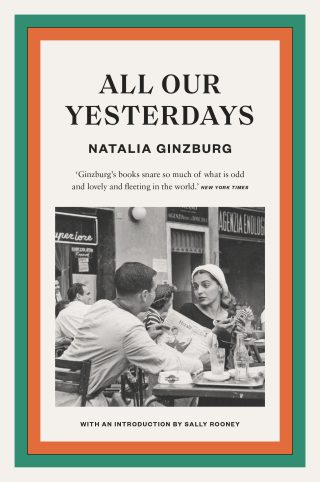
The novel follows two families living in a northern Italian town from the 1930s, through the war years to peacetime. Although the blurb on the French flaps of my edition suggests Anna, the daughter of the poorer family, is the protagonist, really Ginzburg follows them all to a greater or lesser extent, with no overarching plot other than the sequence of years.
Although this approach sounds like a shortcoming, it works so well. It’s not a documentary novel but it gestures towards this with an omniscient neutral(ish) viewpoint and only reported speech. This felt unusual to read, but is so clever in capturing the everyday experiences of those living through extraordinary circumstances.
Anna’s siblings are Concettina, Ippolito, and Giustino. Concettina is popular with boys but struggles to find a purpose in life; Ippolito channels his energies into anti-Fascist activities with his friend from the richer family across the road:
“Emanuele and Ippolito did not even know Italy, they had never seen anything except their own little town, and they imagined the whole of Italy to be like their own little town, an Italy of teachers and accountants with a few workmen thrown in, but even the workmen and the accountants became rather like teachers in their imagination.”
Their lives are equally dictated by world events and by commonplace ones. Anna falls pregnant by her boyfriend and marries an eccentric older man, Cenzo Rena, moving with him to the southern village of Borgo San Costanzo. Her affair with her self-involved, callow boyfriend was no great passion, and while her marriage to Cenzo Rena attracts approbation, he is a warmer, more generous man than the one her own age.
“She was alone with Giuma’s face that gave her a stab of pain in her heart, and every day she would be going back with Giuma amongst the bushes on the river bank, every day she would see again that face with the rumpled forelock and the tightly closed eyelids, that face that had lost all trace both of words and of thoughts of her.”
These are people destined to be on the outskirts of war. Cenzo Rena holds a lot of sway in his local area and does help Jewish people fleeing the Nazi occupation, but on the whole the story of All Our Yesterdays is not one involving soldiers or revolutionaries. It is about ordinary people and for them the conflicts of war are reported facts not lived experience. The latter for them includes a lot of mundanity:
“And the bread in town was rationed and was a kind of soft, grey dough that you couldn’t ever digest, the bread was like the soap and the soap was like the bread, both washing and eating had become very difficult.”
Yet this doesn’t mean the story isn’t affecting, or that the characters avoid tragedy. There are some truly tragic events that are hugely affecting. Ginzburg manages to be even-handed in her treatment of her characters but not detached. Her writing is warm but unsentimental as she demonstrates that flawed people are as worthy of love and mourning as idealised ones.
In case I’ve made it sound unremittingly serious, I should mention that there humour in All Our Yesterdays too. There are romantic entanglements that are treated with a degree of levity, and eccentric housekeepers/family retainers with various foibles. All life is here.
I can’t think of another writer who approaches Ginzburg’s style, and looking back on it I can’t explain how she does what she does. This was a story that snuck up on me, the deceptively simple storytelling drawing me in more than I realised until I was totally immersed. An extraordinary novel.
“Fanfares of trumpets usually announced only small, futile things, it was away fate had of teasing people. You felt a great exultation and heard a loud fanfare of trumpets in the sky. But the serious things of life, on the contrary, took you by surprise, they spurted up all of a sudden like water.”
To end, of course there’s a very famous song I could post on the theme of Yesterday, but instead, to continue the mix of despair alongside levity: have you seen a parrot singing Creep by Radiohead?
 madame bibi lophile recommends
Thanks for this review. although the parrot’s singing was excruciating to listen to!
I read ‘All Our Yesterdays’ recently (after heavenali reviewed it and enjoyed it) and I really thought it was excellent. The way Natalia Ginzburg tells the story, just the cadence of her prose really made it a very immersive experience. I have also read ‘The Dry Heart’ by Ginzburg this month, which is more of a novella. Initially, I was not sure I wanted to read it having read the synopsis, but after the first few pages, again, the prose drew me in so I just kept on reading. If you are not put off by the plot, then I would recommend it too.
LikeLiked by 1 person
Haha! I really liked the parrot, mainly how he always turned to the camera whenever he joined in 😀
Great to hear you enjoyed this too. Immersive is exactly right, I found myself sinking into her writing. Thank you for the recommendation of The Dry Heart, I’ll look out for it as I definitely want to read more by Ginzburg.
LikeLike
Yes, I thought the parrot looked beautiful and had lots of character; I just did not appreciate his singing! It was a great clip.
I hope you do enjoy A Dry Heart too.
LikeLiked by 1 person
Understandable 😀
LikeLike
You’ve just added to my curiosity about Ginzburg, can’t wait to get started!
LikeLiked by 1 person
That’s great Jane! Really hope you enjoy her.
LikeLiked by 1 person
I am so keen to read Ginzburg, all the reviews I read sound so good. That parrot is hysterical!
LikeLiked by 1 person
I’m definitely keen to read more by her now. I hope you enjoy her Cathy!
The parrot really makes me laugh, he seems to know exactly what’s happening 😀
LikeLiked by 1 person
I would have snapped this up too Madame B – I’m keen to read her, particularly as she’s getting such plaudits!
LikeLiked by 1 person
Just based on this I think you’d really like her Kaggsy. I hope so! I’ll look forward to hearing how you find her when you get to her.
LikeLiked by 1 person
Hooray! I’m so glad to see you discovering the joys of Natalia Ginzburg first hand. She really is the most marvellous writer.
This is her richest, most immersive novel, but the others all have something compelling to offer, too. I’m also really glad to see you mentioning her humour here as it’s a somewhat underappreciated quality in her writing. She can be very funny, in a sly / dry way.
Keep a lookout for Valentino and Sagittarius on your travels as I suspect you’ll enjoy those, too!
LikeLiked by 1 person
Yes that’s a great description of her humour Jacqui, she’s not overtly funny but there’s definitely a subtle humour that runs through this novel. Thank you so much for the recommendations, I will look out for them both!
LikeLike
Oh, no, even parrots can sing better than me! I loved the way it did the harmonies… 😂
LikeLiked by 1 person
He’s a better singer than me too FF 🤣
LikeLiked by 1 person
All Our Yesterdays was my first Ginzburg too. I did really enjoy it, but perhaps other readers have loved it more than I did. I thought the characters were wonderful though and it remains very memorable.
LikeLiked by 1 person
Yes I’m sure it will stay with me. Have you read others by her since Ali, that you enjoyed more?
LikeLiked by 1 person
Not read anything else by Ginzburg yet, but I’m sure I will.
LikeLiked by 1 person
Yes, me too!
LikeLiked by 1 person
I’ve only read a couple of Ginzburg’s novels/novellas, but I loved them. So astute, concise… unexpectedly emotional with such spare prose. And who doesn’t love singing birds. /claps
LikeLiked by 1 person
Unexpectedly emotional is exactly right – she sneaks up on you! Great to hear you love her writing, I’m looking forward to reading more.
LikeLike
I still haven’t started on Ginsburg but must try and trace something by her soon. Your review has made me want to all the more. The parrot was fun–I love how they or dogs love joining in the singing 🙂
LikeLiked by 1 person
I hope you enjoy her Mallika, I’ll be interested to hear your thoughts! It’s always great when pets join in 😀
LikeLike
I just finished my first Ginzburg (Family Lexicon) and have this one to read, so pleased to hear you enjoyed it, looking forward to getting into it, I might start reading her fiction with her debut The Dry Heart.
LikeLiked by 1 person
I hope you enjoy this when you get to it Claire! Since I posted this review I found a copy of The Dry Heart in a charity bookshop so that’s my next stop with Ginzburg too 🙂
LikeLiked by 1 person
Pingback: “Everything that mattered had happened already” (Natalia Ginzburg) | madame bibi lophile recommends
Pingback: “I am merely the canvas on which women paint their dreams.” (Rudolph Valentino) | madame bibi lophile recommends