Novella a Day in May 2026 – No.30

I enjoy satire but I think it can be hard to sustain, becoming bitter and distancing. Perfection by Vincenzo Latronico (2022, transl. Sophie Hughes 2025) judged this just right – at only 115 pages it is quick and incisive.
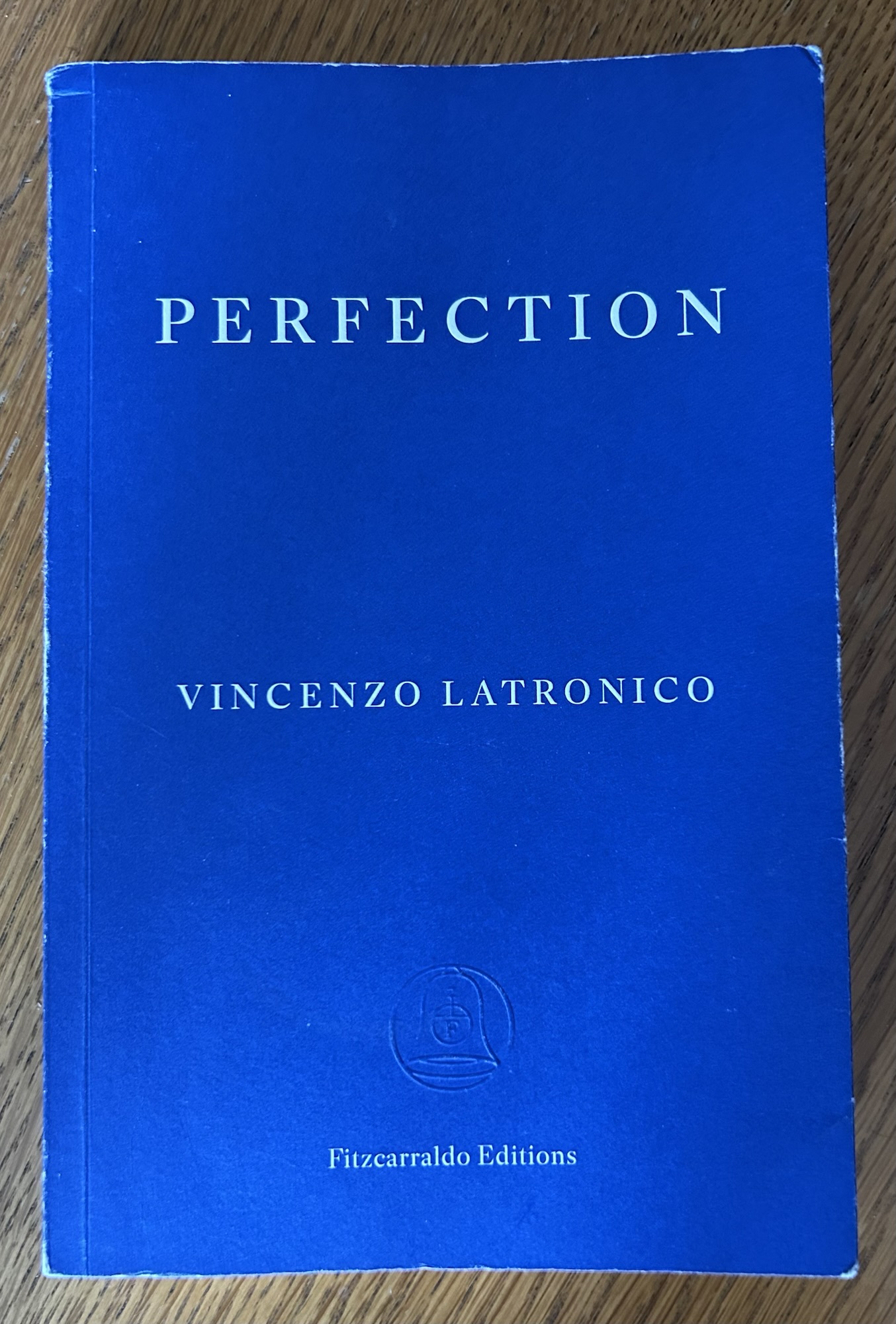
Anna and Tom have emigrated from an unnamed southern European country to Berlin, drawn by its cool reputation and cheap housing (at that time). The novella opens with an interiors magazine style description of their home, all verdant plants, string lights, mason jars, marble pastry table, and on and on and on… an overwhelming piling up of what they own and how they’ve styled it.

The next chapter gives the reality of living in that space: the clutter, the cleaning, the dust, the constantly accumulating mugs and tissues:

“It wasn’t order they so desperately craved, but something deeper and more essential. […]

In itself, chaos could be joyful, creative; But in that context, it only seemed to signal impermanence.”

Therein lies the problem. Anna and Tom are millennials who have grown up with the internet from its early iterations, they are constantly online looking at images, and feel very insecure when they can’t curate their reality like an Instagram post.

“Anna and Tom spent much of their first year in Berlin carefully constructing this mythology. And it wasn’t personal to them; its value lay precisely in its universality…. it was the topic of countless lifestyle articles and documentaries, and circulated on the Facebook timelines and Instagram feeds of an entire generation.”

They remain entirely ignorant of Berlin beyond cool places to socialise, and Germany itself. Their work is carried out online, their friends are just like them. They don’t learn German, they use Google translate.

“It never occurred to them, for example, that the distinction between Alt- and Neu- buildings in property listings had been drawn by the Allied bombings.”

Telling the story in the third person is entirely right: Anna and Tom have no innate sense of self, no inner life. They don’t know who they are if they are not viewed externally. While Latronico relates this very much to a specific online generation:

“They lived a double life. There was the tangible reality around them, and there were the images, also all around them.”

I also felt it was long-established folly to believe that what you own is who you are. Apparently Perfection was inspired by Things: A Story of the Sixties by Georges Perec, which shows how this conflict between image and reality, consumerism in a search for meaning did not arrive with the internet!

Advertising, which is both implicit and explicit in Anna and Tom’s world, is constantly promoting the idea that worth as a human is determined by money spent. You are your sofa/kitchen/car… But then, advertising also encourages consumers to constantly find themselves wanting, because there is always more money to be made by selling more stuff:

“The collective upheaval of the 20th century was over and the vestiges had been translated into the language of individualism—that is, of consumerism. Freedom had turned into abundance.”

Of course Tom and Anna aren’t happy. Their reality will always be messy at the edges, unlike a cropped image. They are also entirely incapable of working out why they aren’t happy. Content, well-adjusted people won’t spend as much money chasing illusion, so these answers won’t be sold online.

In an attempt to find meaning, they are clicktivists. I felt this was where Latronico was most scathing, whereby they and everyone in their bubble tells themselves they are socially engaged and responsible, just so long as it doesn’t mean any real action needs to be taken in their own lives, which could inconvenience them in any way:

“They identified as feminists and spoke out against social injustices, which in practise meant they were willing to express outrage at instances of racism or sexism that took place in New York. […] in practise, their social commitment amounted to using Uber only if it was snowing and always leaving tips in cash. They didn’t eat tuna.”

But for the most part I didn’t think Latronico despised Anna and Tom, I thought he felt for them as they struggled against what is essentially existential despair, without any tools to manage this. They were baffled that where they lived, what they owned, where they ate, and the holidays they took weren’t working. How could this be, when all those things looked great in online posts?

Perfection is short and snappy. It manages to be pinpoint specific and universal. Another fascinating read from Fitzcarraldo Editions!

“I think of a writer as a river: you reflect what passes before you.” (Natalia Ginzburg)

A desperate scrabbling attempt to get a final post written for Women in Translation Month!

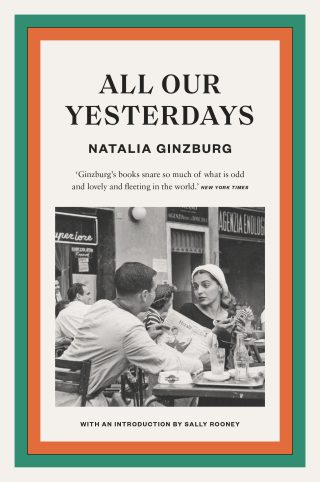
Daunt Books are such an interesting publisher and I was keen to read Natalia Ginzburg having heard wonderful things in the blogosphere, so I swooped on All Our Yesterdays (1952, transl. Angus Davidson 1956) when it turned up in my local charity bookshop. I think I’d read somewhere that this wasn’t the best place to start with this author, but I absolutely loved it.

The novel follows two families living in a northern Italian town from the 1930s, through the war years to peacetime. Although the blurb on the French flaps of my edition suggests Anna, the daughter of the poorer family, is the protagonist, really Ginzburg follows them all to a greater or lesser extent, with no overarching plot other than the sequence of years.

Although this approach sounds like a shortcoming, it works so well. It’s not a documentary novel but it gestures towards this with an omniscient neutral(ish) viewpoint and only reported speech. This felt unusual to read, but is so clever in capturing the everyday experiences of those living through extraordinary circumstances.

Anna’s siblings are Concettina, Ippolito, and Giustino. Concettina is popular with boys but struggles to find a purpose in life; Ippolito channels his energies into anti-Fascist activities with his friend from the richer family across the road:

“Emanuele and Ippolito did not even know Italy, they had never seen anything except their own little town, and they imagined the whole of Italy to be like their own little town, an Italy of teachers and accountants with a few workmen thrown in, but even the workmen and the accountants became rather like teachers in their imagination.”

Their lives are equally dictated by world events and by commonplace ones. Anna falls pregnant by her boyfriend and marries an eccentric older man, Cenzo Rena, moving with him to the southern village of Borgo San Costanzo. Her affair with her self-involved, callow boyfriend was no great passion, and while her marriage to Cenzo Rena attracts approbation, he is a warmer, more generous man than the one her own age.

“She was alone with Giuma’s face that gave her a stab of pain in her heart, and every day she would be going back with Giuma amongst the bushes on the river bank, every day she would see again that face with the rumpled forelock and the tightly closed eyelids, that face that had lost all trace both of words and of thoughts of her.”

These are people destined to be on the outskirts of war. Cenzo Rena holds a lot of sway in his local area and does help Jewish people fleeing the Nazi occupation, but on the whole the story of All Our Yesterdays is not one involving soldiers or revolutionaries. It is about ordinary people and for them the conflicts of war are reported facts not lived experience. The latter for them includes a lot of mundanity:

“And the bread in town was rationed and was a kind of soft, grey dough that you couldn’t ever digest, the bread was like the soap and the soap was like the bread, both washing and eating had become very difficult.”

Yet this doesn’t mean the story isn’t affecting, or that the characters avoid tragedy. There are some truly tragic events that are hugely affecting. Ginzburg manages to be even-handed in her treatment of her characters but not detached. Her writing is warm but unsentimental as she demonstrates that flawed people are as worthy of love and mourning as idealised ones.

In case I’ve made it sound unremittingly serious, I should mention that there humour in All Our Yesterdays too. There are romantic entanglements that are treated with a degree of levity, and eccentric housekeepers/family retainers with various foibles. All life is here.

I can’t think of another writer who approaches Ginzburg’s style, and looking back on it I can’t explain how she does what she does. This was a story that snuck up on me, the deceptively simple storytelling drawing me in more than I realised until I was totally immersed. An extraordinary novel.

“Fanfares of trumpets usually announced only small, futile things, it was away fate had of teasing people. You felt a great exultation and heard a loud fanfare of trumpets in the sky. But the serious things of life, on the contrary, took you by surprise, they spurted up all of a sudden like water.”

To end, of course there’s a very famous song I could post on the theme of Yesterday, but instead, to continue the mix of despair alongside levity: have you seen a parrot singing Creep by Radiohead?