One of the benefits of taking part in events like the 1961 Club, hosted by Kaggsy and Simon this week, is that it encourages me to finally get to novels languishing in the TBR, such as Revolutionary Road by Richard Yates.
I have enjoyed Richard Yates when I’ve read him previously but I also know that I kept putting off Revolutionary Road because he can be so bleak. And it is bleak, good grief. But Yates is such a great writer that reading this was never a slog, and I whizzed through his first novel.
The two protagonists, married couple April (“A tall ash blonde with a patrician kind of beauty”) and Frank Wheeler (“the kind of unemphatic good looks that an advertising photographer might use to portray the discerning consumer of well-made but inexpensive merchandise”) are just shy of thirty and living in suburban Connecticut in 1955.
Frank would probably take issue with the authorial description above, as he sees himself as “an intense, nicotine stained, Jean-Paul Sartre sort of man,”.
Frank and April are monumentally smug and pretentious, seeing themselves as living in suburbia with two children, a job in the city for him and role as a homemaker for her, but somehow above it all and different to their neighbours, all of whom are doing exactly the same:
“Intelligent, thinking people could take things like this in their stride, just as they took the larger absurdities of deadly dull jobs in the city and deadly dull homes in the suburbs. Economic circumstance might force you to live in this environment, but the important thing was to keep from being contaminated. The important thing, always, was to remember who you were.”
A crisis early on forces April to feel that she cannot continue. She feels their life needs enormous change and that she is to blame for holding Frank and his immense mind back.
“this idea that people have to resign from real life and ‘settle down’ when they have families. It’s the great sentimental lie of the suburbs, and I’ve been making you subscribe to it all this time. I’ve been making you live by it!”
What she fails to realise is that her husband is deeply ordinary, no great thinker, and with no discernible talent at anything so far. So her plan that they move to France and she work while he simply lives off her while he decides what to do, is fundamentally flawed.
Yates expertly portrays these two young people bound up in each other’s idea of who they are; feeding one another’s vanities and delusions. They become excited at the plan and for a while it rejuvenates their relationship:
“He felt tense and keyed up; the very act of sitting on a coffee table seemed an original and wonderful thing to do.”
However, the reader is more aware than April that her husband is not entirely convinced of the plan. Deep down, he knows his inadequacy, and his play-acting.
“he found he had made all his molars ache by holding them clamped too long for an effect of grim-jawed determination by candlelight”
When April finds herself pregnant again, Frank sees a way out. They will have to stay in suburbia to raise their third child. April disagrees, and the strain and tension in their marriage gradually tightens to breaking point…
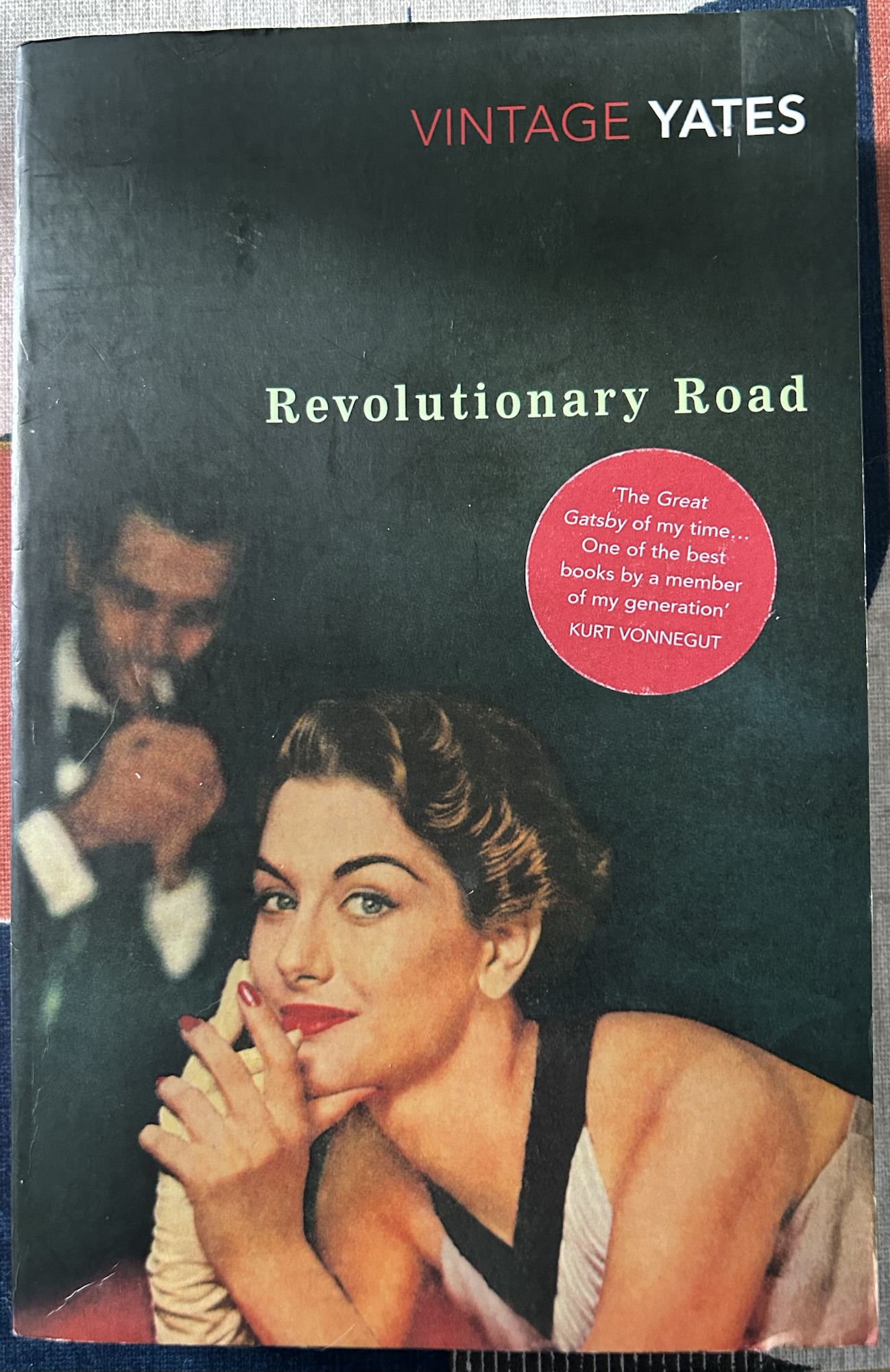
Revolutionary Road is an absolute masterpiece and it is astonishing that it was Yates first novel. The characterisation is unblinking; the post-war American Dream with all its materialistic conformity is minutely dissected.
What I found so clever was that having found April and Frank vain, shallow, and condescending for almost all the novel, by the end I felt desperately sad and sorry for both of them. Yates has written a tragedy, and suggested it is occurring daily behind the manicured lawns and bright smiles of middle-class, mid-century America.
“It was invincibly cheerful, a toyland of white and pastel houses whose bright, uncurtained windows winked blandly through a dappling of green and yellow leaves. Proud floodlights were trained on some of the lawns, on some of the neat front doors and on the hips of some of the berthed, ice-cream colored automobiles.”
To end, a trailer for the 2008 adaptation, which I know I’ve seen but don’t really remember. Time for a rewatch:
 madame bibi lophile recommends
There’s no getting away from the bleakness of this one which, weirdly, I read decades ago in Kathmandu! I thought Kate Winslet was particularly good in the film adaptation.
LikeLiked by 1 person
It really is so bleak! I’ll have to rewatch the film now.
LikeLiked by 1 person
I found the film a disappointment but I thought the book was brilliant.
LikeLiked by 1 person
I’ll be interested to rewatch the film now, I don’t remember it at all. I can imagine they are very difficult characters to convey on screen.
LikeLiked by 1 person
I think there are some books that they should just leave them alone!
LikeLiked by 1 person
I have never actually read Richard Yates despite his having been on my radar for a while. Your review persuades me I should tarry no longer. I will make sure I stack up a cosy comforting book as an antidote to the bleakness ro read afterwards.
Thank you again for an inspiring review; this club week is causing my tbr to mushroom! (I’m half way through Tell Me A Riddle though).
LikeLiked by 1 person
He really is a great writer, this is so impressive regardless but especially for a first novel.
I hope you enjoy him, despite the bleakness.
Definitely an author to stack up a cosy afterwards though!
LikeLike
I’d hoped to get to this for 1961 Club as it has been languishing on my shelf too, but it’s not going to happen. Sounds like I should move it up the pile though…
LikeLiked by 1 person
I think you might like this one Cathy. It’s really well written and incisive on middle America at that time.
LikeLiked by 1 person
I read this so long ago I remember little about it – except that I was highly impressed by it. As others have said, I seem to recall that the film was less so. I also recommend Evan S. Connell’s 1959 novel Mrs Bridge, which is in a similar vein (and its sequel Mr Bridge).
LikeLiked by 2 people
I’ve been meaning to read Mrs Bridge, thank you for the nudge! I’ll seek out a copy and the sequel.
LikeLike
This one marked me profoundly, so bleak but so good.
LikeLiked by 1 person
It really is, isn’t it? Astonishing for a first novel too, so accomplished.
LikeLike
He’s a gap for me, but your description of reading this debut is why I still intend/hope to read his books (and see the films). I hadn’t recognised that this was actually his first novel, which as you say, makes the accomplishment even more striking.
If you ever do find a copy of Mr. And Mrs. Bridge, it’s another on the shelf with my Olivia Manning (I actually bought them on the same second-hand excursion)! Let me know 🙂
LikeLiked by 1 person
I hope you enjoy him when you get to him 😊
I’ll definitely let you know when I get a copy of Mr & Mrs Bridge!
LikeLike
Excellent review Madame B – I read Yates pre-blog so can remember little about him, although yes, I do recall him being somewhat bleak! But you make me want to give him another go!!
LikeLiked by 1 person
Thanks Kaggsy! I hope you enjoy him (if that’s the right word) if you try him again. It has encouraged me to explore him further as I’ve only read a couple of his novels.
LikeLiked by 1 person
You put your finger on it right there, that Frank is deeply ordinary. I’m reviewing this on Friday, and I think I say that Frank has developed the reputation as a thinker merely by talking people into submission. I think I implied that he wasn’t, but your statement goes right to the truth.
LikeLiked by 1 person
It sounds like we had a similar response to this character! I’ll look forward to reading your review.
LikeLiked by 1 person
It’s out on Friday.
LikeLiked by 1 person
This is the only Yates’ I’ve read for some reason because I thought it was fantastic too, thank you for reminding me not just of how great it is but also that I must read more by him and Mrs Bridges!
LikeLiked by 1 person
Great to hear you liked this too Jane! Hopefully we’ll both like Mrs Bridges too.
LikeLiked by 1 person
A masterpiece indeed! Ripped my heart out and stomped on it! I watched the film after reading the book, and I must say I think it’s one of the truly great adaptations.
LikeLiked by 1 person
It is heart-wrending! I’m interested to see how I find the film now.
LikeLiked by 1 person