Douglas Bruton is a relatively recent discovery for me, thanks to the blogosphere. It was only last year that I read With or Without Angels, Hope Never Knew Horizon, and Blue Postcards. His writing weaves real lives with fiction and is strongly concerned with art, human relationships, and the quality of silence that exists in these. He is sparsely poetic, unpretentious and experimental without being alienating. I knew I would start NADIM this year with his 2025 novella, Woman in Blue published by Fairlight Books.
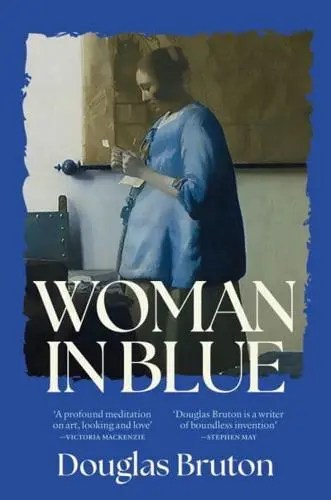
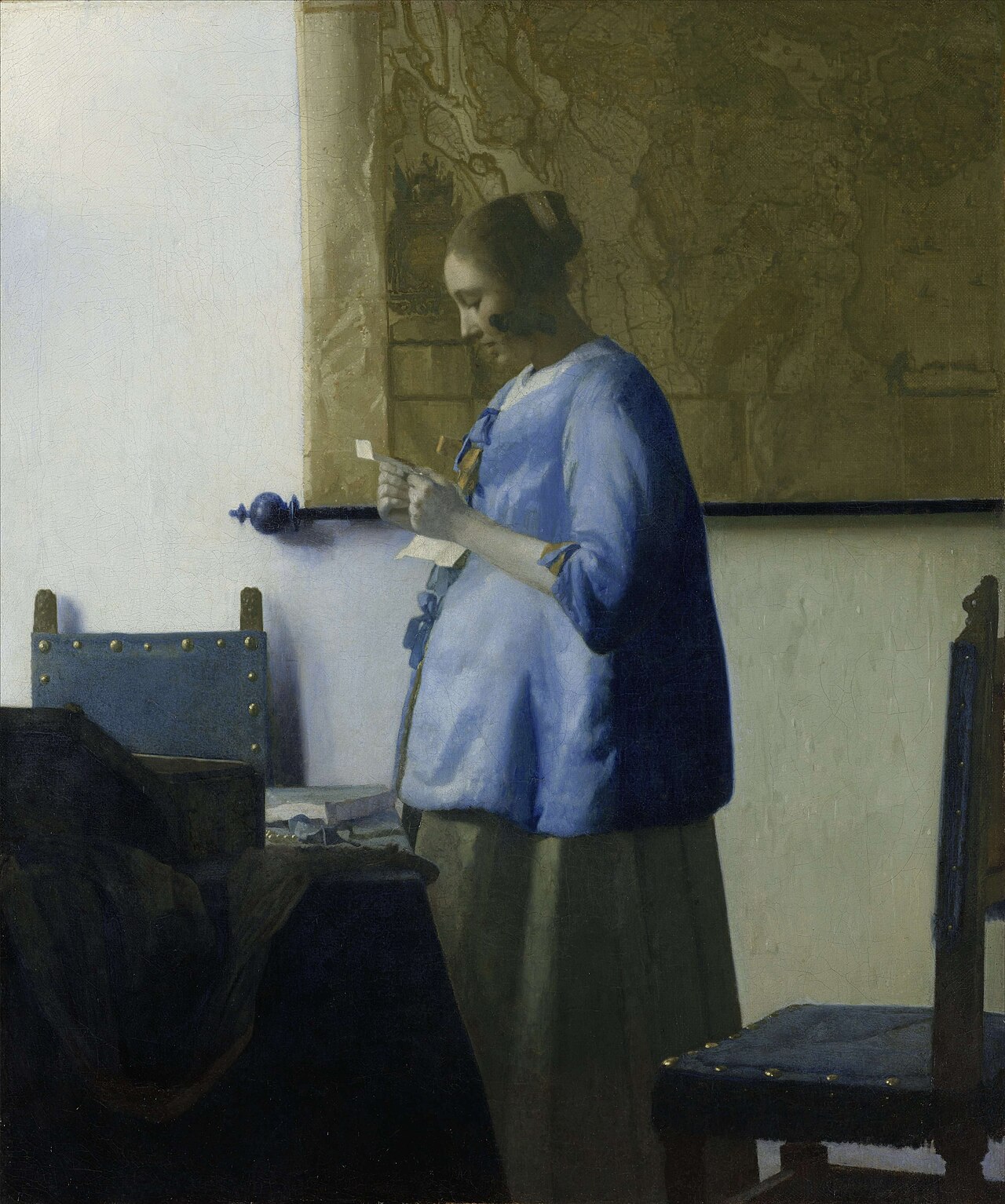
The novella takes its title from the seventeenth century portrait by Vermeer of the same name, sometimes also called Woman Reading a Letter, housed at the Rijksmuseum in Amsterdam. The unnamed male narrator is a writer living in the city with his wife. He visits the museum daily to gaze at the painting.
“There is almost no sound in the gallery, for I am the first. Then it is just the Woman in Blue and me, and I come upon her as though I have turned a corner in a house and seen her through an open door.”
He becomes obsessed with the painting, and yet somehow it isn’t pitiful or creepy. He is trying to understand, and the enigma of the painting means he is always fully aware of the limits of his understanding.
“Things belong in their own time and space and taking them out of that time changes everything.”
His chapters are interspersed with the chapters of Angelieke, the model for the painting. As she describes the process of being painted by Vermeer, she also exists metaphysically, able to comment on all the people who come to visit her portrait, including the other narrator.
If this sounds overly whimsical, it really isn’t. I think this is due to Bruton giving Angelieke the most grounded, earthy voice in the novel. She is from a poor family, she needs money. She sees Vermeer and knows how to attract him. She holds the most agency and the most knowledge. This means that while she is necessarily objectified by Vermeer in the act of painting, and by the narrator in the act of viewing, she is never diminished.
Bruton carefully balances plot driven aspects around the male narrator and his wife, and Angelieke and her family, with wider considerations about viewpoint, acts of art, acts of love.
I think ‘tender’ is always the word I arrive at when writing about Bruton, and Woman in Blue is no exception. But I think I could also mention his elegance and beauty. Both these qualities can be distancing, but in his writing they never are. He closely examines lives and evokes them with such care and compassion that we are always placed alongside.
“Watching the woman in blue reading her letter it is as though I stop existing and I’m just the pared-back pure act of looking.”


What a brilliant start! I love Bruton’s work, and this is a favourite.
LikeLiked by 1 person
Definitely starting on a high! It’s your enthusiasm for Bruton that definitely contributed to me picking him up, so many thanks Susan 😊
LikeLiked by 1 person
Simon Thomas picked Blue Postcards as one of his best books of the year, and “tender” sounds nice, something you don’t apply to too many writers these days. I guess I’m going to have to track down some Bruton.
LikeLiked by 1 person
That’s true – he definitely ploughs his own furrow. I hope you enjoy him if you get to him!
LikeLiked by 1 person
Thanks!
LikeLiked by 1 person
So, though, does he have a thing about blue or something?
LikeLiked by 1 person
Very likely I think!
LikeLiked by 1 person
A great start! I have this one and another Bruton in my pile of possibles – like you and other bloggers, he has been such a brilliant discovery for me in the past year or so. This one sounds inventive and beautiful, like the other two I’ve read by him.
LikeLiked by 1 person
Oh great! I’ll look forward to hearing how you find this one when you get to it. Inventive and beautiful is exactly right.
LikeLike
I loved blue postcards by him
So pleased see there are some more to read at some point look forward to seeing your choices this month
LikeLiked by 1 person
Blue Postcards is just wonderful, great to hear you loved that one. I hope you enjoy his others if you get to them.
LikeLiked by 1 person
After starting with Hope Never Knew Horizon last year, I went on to read Blue Postcards, With or Without Angels and Woman in Blue almost one after the other. I love Bruton’s writing and the way he weaves fact, fiction and art together in such a clever way so that you learn about a piece of art, social history and also care very much about the characters.
Woman in Blue was my least favourite but I have still been eagerly awaiting the next Bruton book ever since finishing it. I’m really hoping there might be another in the pipeline for us all to enjoy soon.
LikeLiked by 1 person
Lovely to hear how much you enjoy him too! As you say, so much there but he never loses sight of his characters.
I will join you in eagerly awaiting his next book!
LikeLike
Starting well! This has gone on the list.
LikeLiked by 1 person
Hooray! Hope you enjoy it Cathy.
LikeLiked by 1 person
I haven’t read anything by Bruton yet, but everything here is tempting, I love this painting and gazed at it in Amsterdam as well!
LikeLiked by 1 person
I hope you enjoy him if you try him Jane!
How lovely to have seen the painting – this has definitely made me want to visit the Rijksmuseum.
LikeLiked by 1 person
So glad you’re doing this again Madame B, and good luck. What a wonderful book to start with, though. Bruton is just wonderful – a very special writer I think and ‘tender’ is a wonderful word to describe his writing. I hope he has a new book soon!
LikeLiked by 2 people
Thanks Kaggsy! Not sure how I’ll get on but I’ll give it a go 😀
Fingers crossed for a new Bruton book soon!
LikeLiked by 1 person
A tempting beginning! Try not to damage my TBR too much this year, please!
LikeLiked by 1 person
Haha! I’ll do my best 😉
LikeLiked by 1 person
I love novels about art and/or artists, so this one definitely goes on the TBR (although it’s not my very favorite Vermeer, I also love this particular painting). I’ve already reaped the benefit of you monthly project (I’ve added some titles to my own list); good luck for the rest of the month!
LikeLiked by 1 person
If you like novels about art I think you’ll really enjoy this one! So glad some of my choices are being added to your list, I hope you enjoy them.
LikeLiked by 1 person
Pingback: With or Without Angels by Douglas Bruton – #ABookADayInMay – Day 5 – Stuck in a Book
Susan and Simon, Kaggsy, and you (and, I think, Jacqui) convinced me to try him and this was among the three I ordered (I’ve only read one so far). It seems like he manages to come right up to the line, where it could be overly sentimental (twee, I think you say?), but then he swerves so that it’s affecting without gushing.
LikeLiked by 1 person
Yes I would totally agree! He’s so close to twee but it never gets that far, so he’s really moving in what he writes.
LikeLike