Earlier this year I read Tillie Olsen’s Tell Me a Riddle for the 1961 Club. I was so impressed I was encouraged to finally get Yonnondio: From the Thirties off the shelf for this month of novellas. Olsen started writing this during the Great Depression when she was only 19, but she put it aside to raise her family and later published it in 1974, although it remains unfinished.
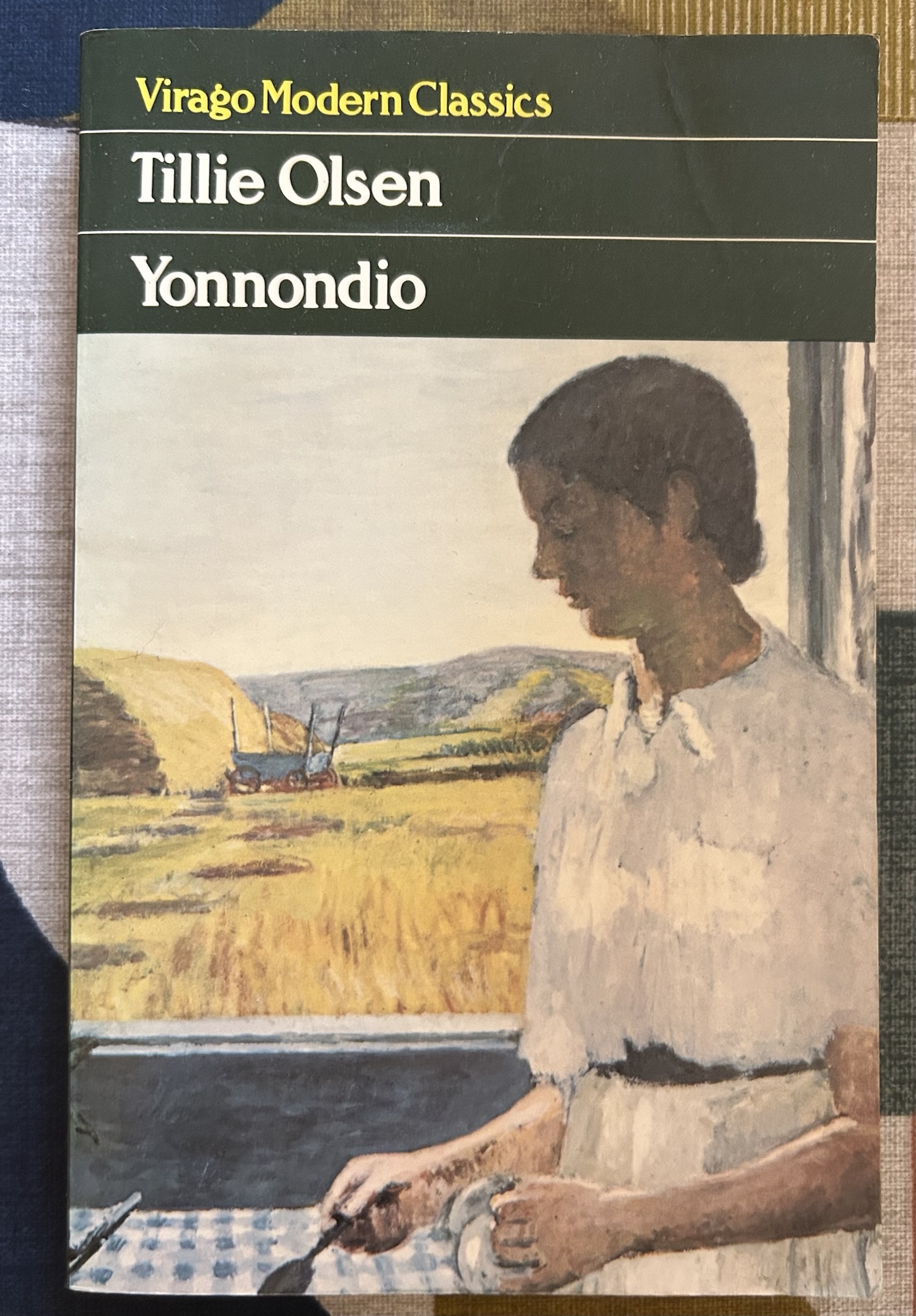
I only write about books I recommend, and I do recommend Yonnondio because it brilliantly evokes the grinding poverty of itinerant workers in 1930s America. But good grief, it is bleak. Unrelentingly, grindingly bleak. Which is the whole point, but it did make it a bit of a slog at times, even for such a short book.
It opens with the Holbrook family living in Wyoming. The father Jim works in the mine, where the prospect of mine collapse/explosion looms large over the whole town. His wife Anna is raising their family of four children (more by the end) on no money, not helped by the fact that Jim drinks a lot of his wages.
“Mazie pushed her mind hard against things half known, not known. ‘I am Mazie Holbrook,’ she said softly. I am a-knowen things. I can diaper a baby. I can tell ghost stories. I know words and words. Tipple. Edjication. Bug dust. Supertendent. My poppa can lick any man in this here town. Sometimes the whistle blows and everyone starts a-running. Things come a-blowen my hair and it is soft, like the baby laughing.”
It is a terrifying event with Mazie which stops Jim going to the bars and the family move to South Dakota to work as tenant farmers. Here they achieve the nearest they have to happiness, with Jim working outdoors, the children enjoying school, and Mazie drawing the attention of their elderly neighbour who recognises her intelligence and lends her books.
“After a long while Anna would laugh, a strange mirthless laugh, and rise to go into the house. Then Jim, too, would follow, knocking the ashes out of his pipe onto the vine, giving a last broad look over the night and the earth. Sometimes seeing them sit so in the night, a sharp unhappiness would pierce the golden haze in Mazie’s heart; but the blur of days descending so swiftly would wash it out again.”
However, as they were warned, tenant farmers work themselves ragged to earn practically nothing and usually end up owing money. As this occurs, Mazie’s books are sold and the family move again to Omaha. Now they are in a city, near a slaughterhouse which we are repeatedly told, makes the whole area stink of vomit. The family really seem doomed now – the children hate school and all become ill, Anna has a miscarriage, Jim is drinking again.
Olsen brilliantly portrays the hopelessness of the Holbrook’s situation. All they want is to earn enough money to feed their family and live comfortably – not too much to ask. Anna is desperate for her children to increase their chances through education, but the moving around risks this. The casual domestic violence, illness and stress also incrementally destroys the children, even when they don’t fully understand it:
“Ben saw too – but in the confused, entangled way of a small child whose mind is a prism through which the light shatters into a thousand gleams and shadows that can never come whole. Say rather, a weight, an oppression dragged always in his chest; a darkening shadow hovered over his days in that in moments descended on pierced sharp claws on his heart. Only he did not know why or how – he but knew there was a darkening where there had been light, he but felt there was a weight where there had been a lightness.”
Where the novel finishes actually offers a glimmer of hope, but this wasn’t the intended ending. In Yonnondio, Olsen has written a powerful portrait of the failure of society to allow all its members the potential to thrive. She demonstrates how poverty degrades and brutalises, and how the biggest impact is inevitably felt by the most vulnerable. I’m glad I read it but I’m also hoping I have a comic novella somewhere on the shelves to help me recover, maybe some Wodehouse…


Gosh, yes this does sound bleak – good but bleak. I can take bleak if I’m in the right frame of mind but some authors are too much. Thomas Hardy is a blind spot of mine because of the crushing sadness in all of his books. This sounds as if it could have similarities, with that poverty killing any chance of escape or a good life. Definitely time for some Wodehouse…
LikeLiked by 1 person
If you’re in the right frame of mind for bleak I do recommend this because its so well done. But definitely only if you’re in the right mood! At least it’s short, unlike Hardy 😀
LikeLiked by 1 person
Even bleaker than it sounds given how young Olsen was when she started it. I do hope you have an antidote on your tbr shelf.
LikeLiked by 1 person
It’s really astonishing for one so young! But I believe she remained very politically engaged through her whole life. I’m definitely hunting through the stacks for a palate-cleanser though…
LikeLiked by 1 person
Ooof. Yeah, I can’t really deal with bleak any more, I don’t think. Well done for persevering!
LikeLiked by 1 person
Thanks Simon! It is well written but unrelenting!
LikeLike
Gosh, I see it’s very very bleak! And I definitely would need a comic antidote as a follow up read. However, I did enjoy reading Tell Me a Riddle despite the bleakness so, in the right mood, I would go for this too I think.
LikeLiked by 2 people
I’m glad I’ve not put you off completely! It is so well written, in the right mood it’s definitely worth reading.
LikeLike
I think I would have to be in the right frame of mind for this one!
LikeLiked by 1 person
Absolutely! Not one for when you’re feeling fragile in any way!
LikeLiked by 1 person
This sounds really interesting, I think the thing about Steinbeck’s Joad family is that they manage to keep some form of dignity in spite of the gruelling harshness of the depression, I wonder if this is different because it’s written by a women and showing how poverty grinds away at any hope? Lovely Bertie!
LikeLiked by 1 person
It did put me in mind of TGOW, although it’s been years since I read it. This definitely shows the domestic impact on Anna and the children.
LikeLiked by 1 person
Pingback: Novella a Day in May 2026 – No.18 | madame bibi lophile recommends
I so hope you have some emergency Wodehouse on hand – maybe a double dose will be necessary!
LikeLiked by 1 person
Thanks FF – I think I’ve recovered now 🤣
LikeLiked by 1 person
I like the language in the excerpts you’ve shared; I definitely want to read this, but I will keep your warning in mind.
LikeLiked by 1 person
It is very well done, you just need to be in a robust mood!
LikeLike