Stefan Zweig is a favourite writer of mine, I find him so insightful and compassionate. I also really like Pushkin Press Classics published in the smaller editions with the French flaps, so I was pleased to find just such a copy of his 1927 novella Twenty-four Hours in the Life of a Woman (transl. Anthea Bell 2003).
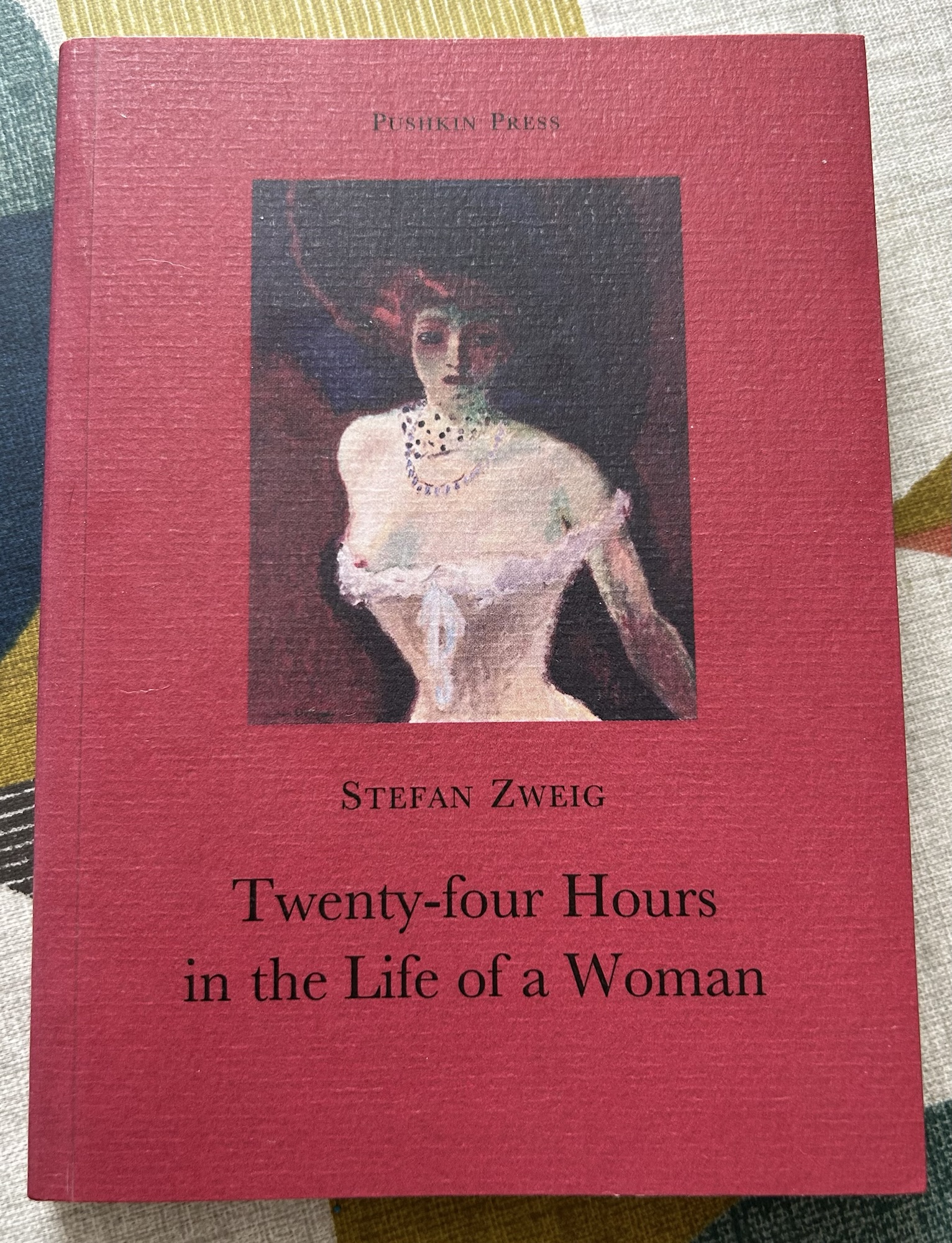
It opens at a guesthouse on the French Riviera, “ten years before the war” with the unnamed first-person narrator remembering the arrival of an attractive single man who quickly absconds with Henriette, the wife of a manufacturer. Her absence causes quite a stir:
“Silently, one by one, as if put to shame by so shattering an emotional outburst, we crept back to our rooms, while that stricken specimen of mankind shook and sobbed alone with himself in the dark as the building slowly laid itself to rest, whispering, muttering, murmuring and sighing.”
The narrator takes a more liberal view of Henriette’s conduct, which puts him at odds with the other guests. I enjoyed Zweig’s gentle humour here:
“Well, it’s of no importance here to go back in every detail over the stormy course of an argument conducted between soup and dessert: only professionals of the table d’hôte are witty, and points made in the heat of a chance dispute at table are usually banal, since the speakers resort to them clumsily and in haste.”
The narrator’s assertion that “I’d rather understand others than condemn them.” attracts the attention of Mrs. C, who from the way she’s initially described sounded easily in her nineties, but as it turns out is sixty-seven! She deliberately builds an intimacy with the narrator in order to tell her story, and he becomes the silent interlocutor to her tale.
“It is intolerable to spend one’s whole life staring at a single point in it.”
She describes how, at the age of forty-two, grieving her husband and with her sons fully grown, she arrived at Monte Carlo.
“I came there out of tedium, out of the painful emptiness of the heart that wells up like nausea, and at least tries to nourish itself on small external stimulations.”
She is not a seasoned gambler, but her husband enjoyed the casinos so she visits, and there becomes consumed by the vision of a young man compulsively placing bets.
“His face spoke the same fantastically extravagant language of extremes as the hands”
[…]
“A fear of something dreadful, something I had felt invisibly enveloping the young man like a miasma from the first moment.”
What follows is a character study of Mrs C and a portrait of addiction which is entirely believable. With his characteristic humanity, discernment and understanding, Zweig considers the supressed tragedies of people’s lives and how we continue to live.
Twenty-four Hours in the Life of a Woman possibly felt more dramatic on initial publication – for twenty-first century readers nothing especially unpredictable takes place. But that is not to diminish it in any way. The evocation of strong feeling, and of trauma, is so sensitively realised that it remains a deeply affecting read.
This story has been filmed several times, including a made for television version with Ingrid Bergman. However, in its depiction of the glamour, seediness, seductions and betrayals of gambling, it also reminded me of a film I saw recently with lovely JacquiWIne, Bay of Angels:
 madame bibi lophile recommends
Oh yay! Didn’t realise the date. Time to get my notebook out and make a list of all the titles you make me want to read in May 🙂
LikeLiked by 1 person
Excellent! NovNov always causes my TBR to spiral so this is reassuring to me 😊
LikeLiked by 1 person
It’s very fortunate I have decided no longer to worry about my ever expanding tbr. This one has gone straight onto the list. I already have another Zweig book on my reservation list at the library but this one might have to be a purchase as they don’t have it and I love those Pushkin Press books too!
LikeLiked by 1 person
Haha! Yes I think for my sanity I should give up any TBR anxiety too!
I hope you enjoy this and your other Zweig when you get to them. He’s such a wonderful writer.
Those editions feel like such a treat to read!
LikeLike
Oh no, this is just a month of book shopping! I haven’t seen that Demy film either so today is a two for one bundle!
LikeLiked by 1 person
Haha! Glad I’ve tempted you 😊
The film is great Jane, I hope you enjoy it.
LikeLiked by 1 person
Oh marvellous – I love Zweig too, although I’m not sure if this is one I’ve actually read (so I need to investigate. As you say, although his subject matter might not be shocking nowadays, he writes so beautifully!
LikeLiked by 1 person
I hope you enjoy this if it is a new read Kaggsy. He really is such a beautiful writer.
LikeLiked by 1 person
Those quotes alone have persuaded me to read this one.
LikeLiked by 2 people
Hooray! So glad I’ve persuaded you on this one.
LikeLiked by 1 person
I love Zweig but haven’t heard of this one – and didn’t know any of them had been filmed. Sounds excellent!
LikeLiked by 1 person
I was surprised just how many times this one had been filmed! It is excellent, he’s an exceptional writer.
LikeLike
Like you, I’m very fond of Stefan Zweig; your review sent me rushing to my “Zweig stash” (mostly NYRB editions but also including several works issued by Pushkin Press as well). I was happy to find Twenty-Four Hours included in Pushkin’s Selected Stories (same Anthea Bell translation). It’s been some time since I dipped into Zweig’s work (and I haven’t read this one at all) — you’ve reminded me of what a marvelous writer he is!
LikeLiked by 1 person
Great to hear how much you like Zweig too! NYRB and Pushkin have been so effective in making him more readily available in translation. I hadn’t realised Pushkin Press had done a selected stories though – I’ll look out for it!
LikeLiked by 1 person
I’ve just requested a new Pushkin selection of Zweig that appeared on NG the other day, so you’ve whetted my appetite nicely!
LikeLiked by 1 person
Ooh, I hope you enjoy it FF!
LikeLiked by 1 person
Oh, how interesting! I’ve enjoyed other novellas by Zweig, e.g. Burning Secret and Journey into the Past, but the one you’ve reviewed here is completely new to me. I’m also very intrigued by the resonances with Bay of Angels – wasn’t it wonderful to see that film on the big screen? Anyway, I’m going to keep an eye out for this book in the secondhand shops as I’m guessing it’s out of print…
LikeLiked by 1 person
I think you’d enjoy this one Jacqui! It definitely had echoes of Bay of Angels, which was just wonderful on the big screen. If I see another copy of this I will snap it up for you 🙂
LikeLike
I’ve not read much Zweig, but I think he would make a delightful reading project, so I’ve started to gather a few with that in mind. And it’s fun to find films that coincide!
LikeLiked by 1 person
Oh yes, a great project! They adapted Letter From an Unknown Woman from his work, Joan Fontaine gives a stunning performance.
LikeLike