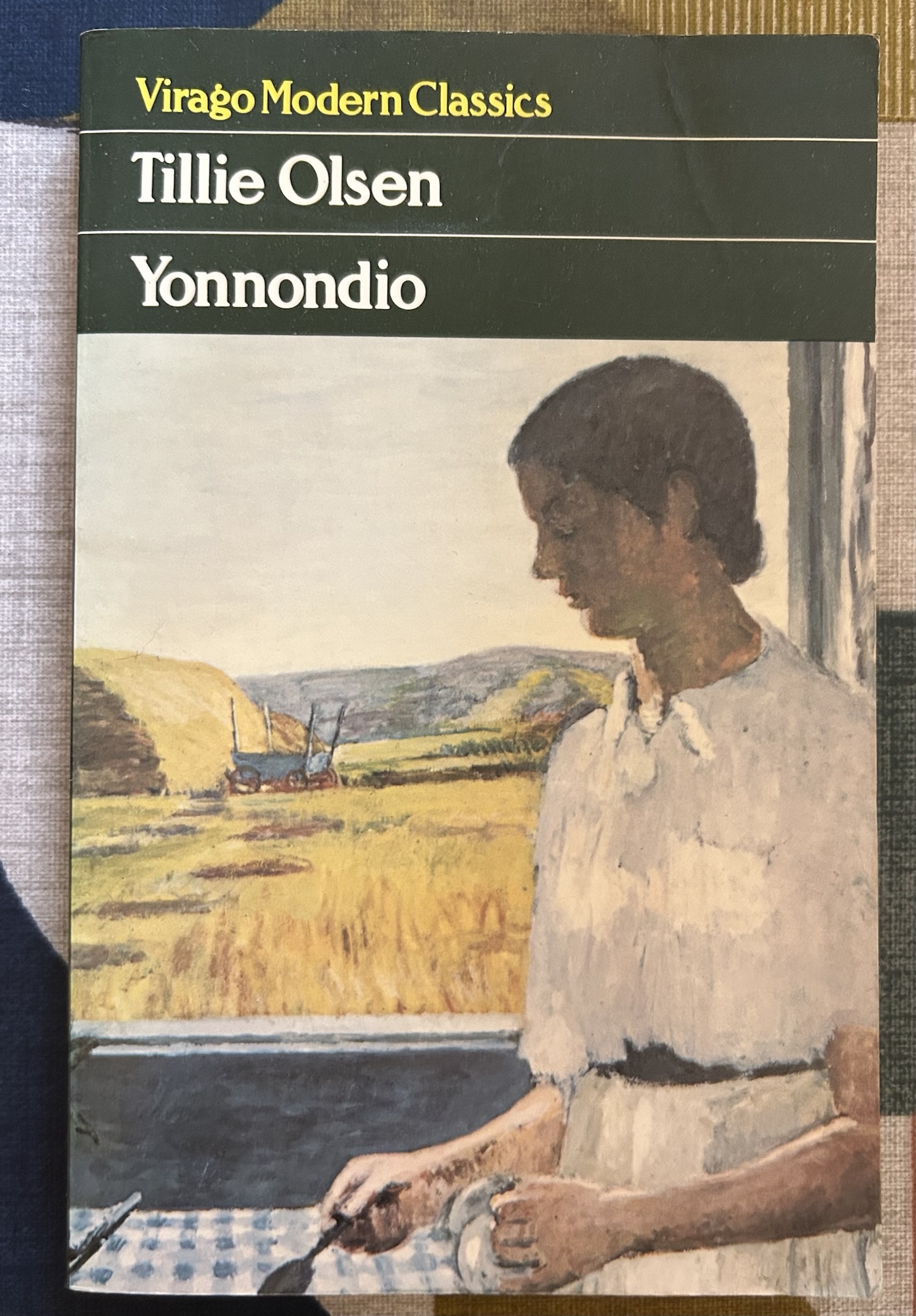
Earlier this year I read Tillie Olsen’s Tell Me a Riddle for the 1961 Club. I was so impressed I was encouraged to finally get Yonnondio: From the Thirties off the shelf for this month of novellas. Olsen started writing this during the Great Depression when she was only 19, but she put it aside to raise her family and later published it in 1974, although it remains unfinished.
I only write about books I recommend, and I do recommend Yonnondio because it brilliantly evokes the grinding poverty of itinerant workers in 1930s America. But good grief, it is bleak. Unrelentingly, grindingly bleak. Which is the whole point, but it did make it a bit of a slog at times, even for such a short book.
It opens with the Holbrook family living in Wyoming. The father Jim works in the mine, where the prospect of mine collapse/explosion looms large over the whole town. His wife Anna is raising their family of four children (more by the end) on no money, not helped by the fact that Jim drinks a lot of his wages.
“Mazie pushed her mind hard against things half known, not known. ‘I am Mazie Holbrook,’ she said softly. I am a-knowen things. I can diaper a baby. I can tell ghost stories. I know words and words. Tipple. Edjication. Bug dust. Supertendent. My poppa can lick any man in this here town. Sometimes the whistle blows and everyone starts a-running. Things come a-blowen my hair and it is soft, like the baby laughing.”
It is a terrifying event with Mazie which stops Jim going to the bars and the family move to South Dakota to work as tenant farmers. Here they achieve the nearest they have to happiness, with Jim working outdoors, the children enjoying school, and Mazie drawing the attention of their elderly neighbour who recognises her intelligence and lends her books.
“After a long while Anna would laugh, a strange mirthless laugh, and rise to go into the house. Then Jim, too, would follow, knocking the ashes out of his pipe onto the vine, giving a last broad look over the night and the earth. Sometimes seeing them sit so in the night, a sharp unhappiness would pierce the golden haze in Mazie’s heart; but the blur of days descending so swiftly would wash it out again.”
However, as they were warned, tenant farmers work themselves ragged to earn practically nothing and usually end up owing money. As this occurs, Mazie’s books are sold and the family move again to Omaha. Now they are in a city, near a slaughterhouse which we are repeatedly told, makes the whole area stink of vomit. The family really seem doomed now – the children hate school and all become ill, Anna has a miscarriage, Jim is drinking again.
Olsen brilliantly portrays the hopelessness of the Holbrook’s situation. All they want is to earn enough money to feed their family and live comfortably – not too much to ask. Anna is desperate for her children to increase their chances through education, but the moving around risks this. The casual domestic violence, illness and stress also incrementally destroys the children, even when they don’t fully understand it:
“Ben saw too – but in the confused, entangled way of a small child whose mind is a prism through which the light shatters into a thousand gleams and shadows that can never come whole. Say rather, a weight, an oppression dragged always in his chest; a darkening shadow hovered over his days in that in moments descended on pierced sharp claws on his heart. Only he did not know why or how – he but knew there was a darkening where there had been light, he but felt there was a weight where there had been a lightness.”
Where the novel finishes actually offers a glimmer of hope, but this wasn’t the intended ending. In Yonnondio, Olsen has written a powerful portrait of the failure of society to allow all its members the potential to thrive. She demonstrates how poverty degrades and brutalises, and how the biggest impact is inevitably felt by the most vulnerable. I’m glad I read it but I’m also hoping I have a comic novella somewhere on the shelves to help me recover, maybe some Wodehouse…
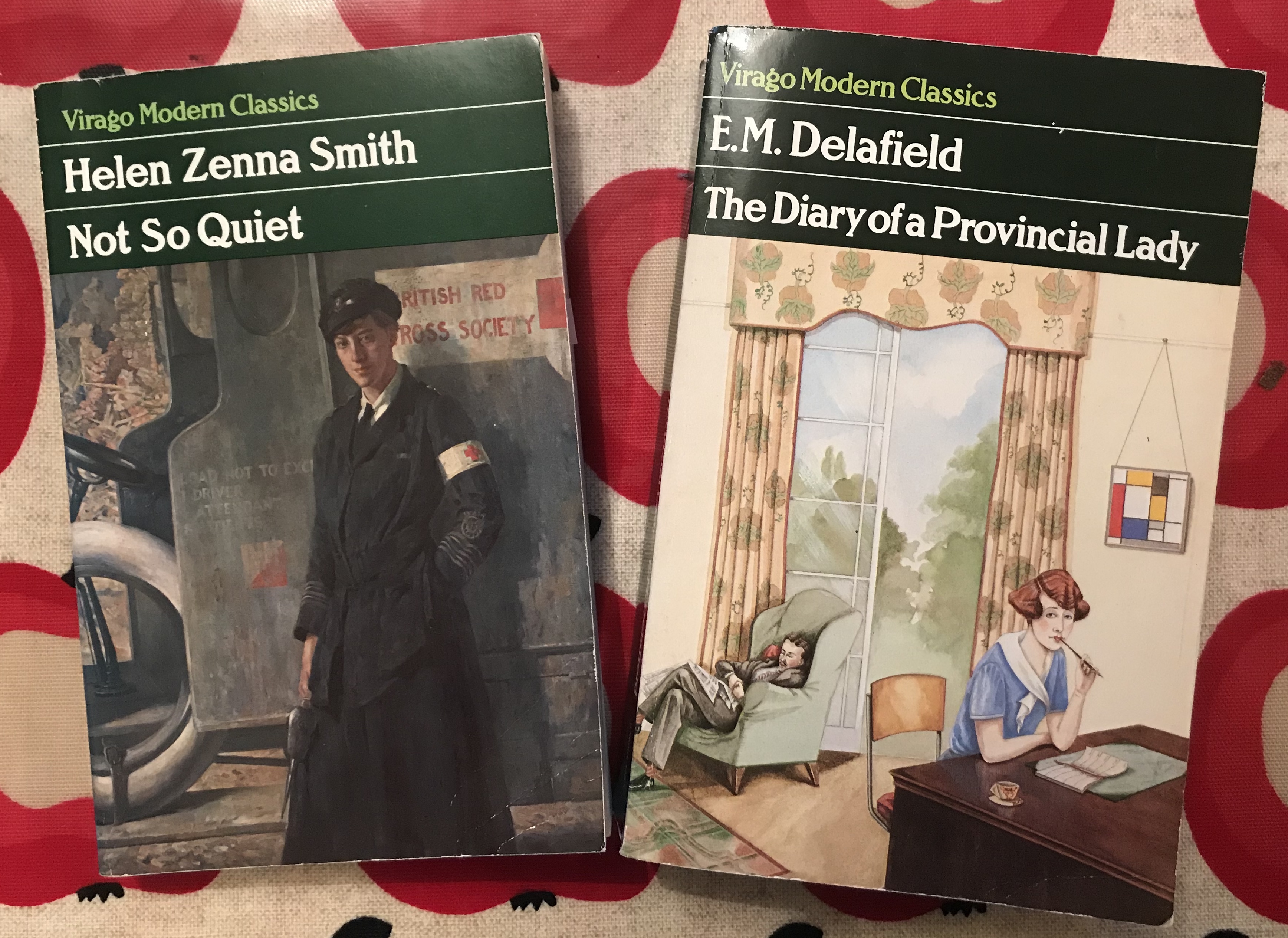
The two novels I’ve chosen are lovely Virago Modern Classics both concerned with the role of women in society, specifically the work that they do, but beyond that they could not be more different. I’ll begin with a scathing indictment of war, before moving on to some light relief via a comic presentation of upper middle-class privilege…
Helen Zenna Smith’s Not So Quiet was written as a response to Remarque’s All Quiet on the Western Front, from a female perspective. It is a work of fiction but Smith aims to narrow the gap between fiction and reality by calling the narrator Helen Smith and writing from a first person perspective.
Helen has gone to France to volunteer as an ambulance driver, leaving behind her comfortable middle-class existence, much to the delight of her jingoistic mother. Helen and the other young women she works with share no such illusions, as her friend Tosh points out:
“No Smithy, you’re one of England’s Splendid Daughters, proud to do their bit for the dear old flag, and one of England’s Splendid Daughters you’ll stay, until you crock up or find some other decent excuse to go home covered in glory. It takes nerve to carry on here, but it takes twice as much to go home to flag-crazy mothers and fathers…”
In this short novel Smith documents the experience of war for those not engaged in trench warfare but shockingly, dangerously close to it. Her gaze is unflinching:
“We hate and dread the days following on the guns when they boom without interval. Trainloads of broken human beings: half-mad men pleading to be put out of their misery; torn and bleeding and crazed men pitifully obeying orders like a herd of senseless cattle, dumbly, pitifully straggling in the wrong direction, as senseless as a flock of senseless sheep obeying a senseless leader, herded back into line by the orderly, the kind sheep-dog with a ‘Now then, boys, this way. That’s the ticket, boys’, instead of a bark; men with faces bleeding through their hasty bandages; men with vacant eyes and mouths hanging foolishly apart dropping saliva and slime; men with minds mercifully gone; men only too sane, eyes horror-filled with blood and pain…”
Not So Quiet is not a plot driven novel as such. Instead it documents one woman’s experience, and how she is utterly destroyed by it. In addition to the horror of the men used as machine gun fodder, she sees England’s Splendid Daughters live infested with fleas, eating slop, needing illegal abortions and desperately trying to find some reprieve. For a whole generation the war wreaked absolute devastation of land, industry, mind, body and soul.
“We young ones doomed to live on without belief in anything human or divine again are the ones to be pitied.”
Not So Quiet is not a subtle novel. By that, I don’t mean it is badly written, its extremely well written. Smith is furious, and not interested in presenting a considered, moderate view. Some things do not warrant a moderate response, and the horrors of war are one of those. The world she depicts is unrelenting and nightmarish.
“I become savage at the futility. A war to end war, my mother writes. Never. In twenty years it will repeat itself. And twenty years after that. Again and again, as long as we breed women like my mother and Mrs. Evans-Mawnington. […]
Oh, come with me, Mother and Mrs. Evans-Mawnington. Let me show you the exhibits straight from the battlefield. This will be something original to tell in your committees, while they knit their endless miles of khaki scarves,…. something to spout from the platform at your recruiting meetings. Come with me. Stand just there.”
Reading Not So Quiet recently meant I was reading within a context of our Prime Minister pandering to the fascist fringe using inflammatory language around Brexit. This offensive rhetoric encourages people to forget that the EU was set up to promote peace and co-operation in Europe, after two twentieth century wars tore it apart. I wish more people would read things like Not So Quiet to remind themselves of experiences they’ve been lucky enough not to have to live through.
”What is to happen to women like me when this war ends … if it ever ends. I am twenty-one years of age and I know nothing of life but death, fear, blood, and the sentimentality that glorifies these things in the name of patriotism”
Deep breath… enough politics from me. But I hope I’ve shown how No So Quiet is still a relevant novel and an urgent one.
Secondly, a chance to recover with a light, fun novel about no greater tribulation than how to plant indoor bulbs. The Diary of a Provincial Lady by EM Delafield is not fluffy though – it is witty and incisive about social mores and the knots people, especially genteel British people, tie themselves in to avoid appearing rude. Again, it’s not a hugely plot driven novel, having been written as a weekly serial for Time and Tide magazine. It documents the titular lady’s experience of genteel middle-class life, with her disinterested husband Robert falling asleep behind The Times, son Robin away at boarding school, and daughter Vicky in the charge of Mademoiselle, the French governess.
“Robert takes the boys back after dinner, and I sit in hotel lounge with several other mothers and we all talk about our boys in tones of disparagement, and about one another’s boys with great enthusiasm.
Am asked what I think of Harriet Hume but am unable to say, as I have not read it. Have a depressed feeling that this is going to be another case of Orlando about which was perfectly able to talk most intelligently until I read it, and found myself unfortunately unable to understand any of it.”
One ongoing source of tension in the Provincial Lady’s life is her aristocratic neighbour, Lady Boxe, who is self-dramatizing and unable to conceive of any situation other than her own:
“Why not just pop into the train, enquires Lady B., pop across France, and pop out into Blue Sky, Blue Sea, and Summer Sun? Could make perfectly comprehensive reply to this, but do not do so, question of expense having evidently not crossed Lady B.’s horizon. (Mem.: Interesting subject for debate at Women’s Institute, perhaps: That Imagination is incompatible with Inherited Wealth. On second thoughts, though, fear this has a socialistic trend.)
The Lady’s days seemed to be filled with social events she finds tedious, writing innumerable letters, negotiating with servants and managing debt in a most peculiar way:
“Robert startles me at breakfast by asking if my cold—which he has hitherto ignored—is better. I reply that it has gone. Then why, he asks, do I look like that? Refrain from asking like what, as I know only too well. Feel that life is wholly unendurable, and decide madly to get a new hat.
Customary painful situation between Bank and myself necessitates expedient, also customary, of pawning great-aunt’s diamond ring, which I do, under usual conditions, and am greeted as old friend by Plymouth pawnbroker, who says facetiously, And what name will it be this time?
Visit four linen-drapers and try on several dozen hats. Look worse and worse in each one, as hair gets wilder and wilder, and expression paler and more harassed. Decide to get myself shampooed and waved before doing any more, in hopes of improving the position.”
The Diary of a Provincial Lady could so easily be tedious but its so well written that instead it is an utter delight. I would generally have very short patience with well-to-do ladies with very little to fill their days, but the Provincial Lady knows that a lot of what she expected to concern herself with is completely frivolous, and she’s taking an askance view of it all, while not really putting anyone down (not even Lady B).
“Lady B. amiably observes that I, at least, have nothing to complain of, as she always thinks Robert such a safe, respectable husband for any woman. Give her briefly to understand that Robert is in reality a compound of Don Juan, the Marquis de Sade, and Dr. Crippen, but that we do not care to let it be known locally.”
The Diary of a Provincial Lady is a quick read, and one that can be dipped into, given its episodic, diary structure. It’s a welcome bit of escapism in these troubled times!
“Lady Frobisher, who would be so delighted if Robert and I would come over for tea whilst there is still something to be seen in the garden. (Do not like to write back and say that I would far rather come when there is nothing to be seen in the garden, and we might enjoy excellent tea in peace—so, as usual, sacrifice truth to demands of civilisation.)”
Jacqui has also reviewed The Diary of a Provincial Lady for the 1930 Club and you can read her excellent post here.
To end, I was tempted to choose a clip from Anna Christie as it was released in 1930 and I love Greta Garbo. But instead I’ve gone for this anthem about female working life from the only person who can convincingly rhyme ‘kitchen’ with ‘ambition’:
Our Spoons Came From Woolworths – Barbara Comyns (1950, 195 pages)
Our Spoons Came From Woolworths is the first Barbara Comyns I’ve read, attracted by the whimsical title and it being a Virago. I’m so glad I picked this up. Our Spoons Came From Woolworths was a compelling read, and not nearly as whimsical as I had assumed.
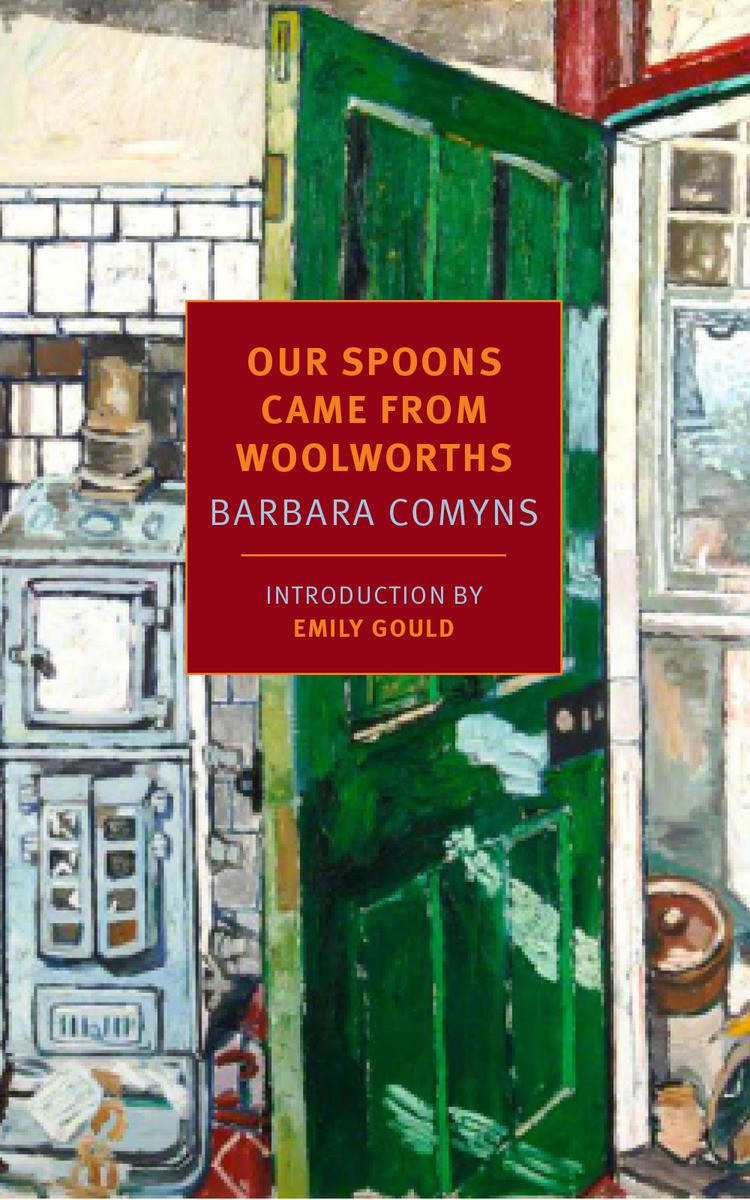
The NYRB edition
It tells the story of Sophia’s marriage at a young age to Charles, an artist, in the 1930s. They are painfully naïve, and Charles especially has no idea about money:
“He said Eva had told all her relations about the coming baby, and they had asked him masses of questions about how he was going to support a wife and family. They had given him some money, though, four pounds in all. I was glad to hear this as we only had one golden guinea left in the dresser drawer, but my gladness did not last long, because it turned out he had already spent the money on some paints, brushes, books and an enormous walnut cake from Fullers.”
With the arrival of the baby, the poverty becomes even more pressing. Charles is monumentally selfish and self-absorbed, but not quite despicable. He’s just clueless and self-centred, and this means his actions are inadvertently cruel. Although the situation is quite desperate, Comyns’ voice is matter-of-fact and never asks for sympathy. There is a light, almost surreal humour present:
“Charles said he had borrowed some money to send telegrams to his relations saying we had a boy of six ounces. I told him it was six pounds not ounces, but he said a few pounds either way wouldn’t make any difference. But Charles’ telegrams caused a huge sensation, and his family was most disappointed when in due course they discovered we had quite a normal baby.”
But the humour always highlights the bigger picture, such as Charles’ disregard and disinterest in his children. While Comyns is unsentimental, this does not mean she is unaware of the power of her story. She has plenty to say about the role of women in interwar Britain and the hypocrisies that meant they were expected to marry and then make the best of it, with little means of support beyond their husbands. She also shows how this is bound up in sexual politics, with male infidelity so much more accepted than female, yet women deserving an equal right to happiness:
“Some time later, when I realised I had been unfaithful, I didn’t feel guilty or sad, I just felt awfully happy I had had this experience, which if I had remained ‘a good wife’ I would have missed, although, of course, I wouldn’t have known what I was missing. I felt quite bewildered. I had …been a kind of virgin all the time. I wondered if there were other women like this, but I knew so few women intimately it was difficult to tell.”
The story is also an indirect plea for a welfare state. What Sophia and her children endure would not be life-threatening after the end of the Second World War, with a social safety net established to protect them from absolute destitution and starvation.
But I worry now I’ve made Our Spoons Came From Woolworths sound very heavy, which it isn’t. Comyns knows how to say serious things with a lightness of touch that is quite remarkable. You’re not left in any doubt as to Sophia’s desperation, but it remains a hopeful novel about human resilience. It’s generally thought to be thinly-disguised biography (Comyns was married to the painter John Pemberton between 1931-5 and had two children with him) and Comyns makes her point about these types of stories – concerning women and poverty – desperately needing to be heard at a time when no-one really wanted to listen, in deadpan comic style:
“This book does not seem to be growing very large although I have got to Chapter Nine. I think this is partly because there isn’t any conversation. I could just fill pages like this:
‘I am sure it is true,’ said Phyllida.
‘I cannot agree with you,’ answered Norman.
‘Oh, but I know I am right,’ she replied.
‘I beg to differ,’ said Norman sternly. That is the kind of stuff that appears in real people’s books. I know this will never be a real book that business men in trains will read, the kind of business men that wear stiff hats with curly brims and little breathing holes in the side. I wish I knew more about words.”
Although I understand from other bloggers that Comyns’ other novels are very different, I am now officially an ardent fan.