“I love cats because I enjoy my home; and little by little, they become its visible soul.” (Jean Cocteau)

Once again, I completely failed to read I Am a Cat for the fab event Reading the Meow 2026 hosted by Mallika at Literary Potpourri. It’s just such a whopper! Next year I’m going to make a start in March 😊

I decided I’d see if I could find something shorter in the TBR in order to take part, and was hunting about in golden age crime. Mallika had also suggested looking for a short story, and so checking In the Teeth of Evidence by Dorothy L Sayers (1939) came up trumps, because the final story in the collection is The Cyprian Cat. My cheesy 1980s edition even has some Big Cats on the cover:
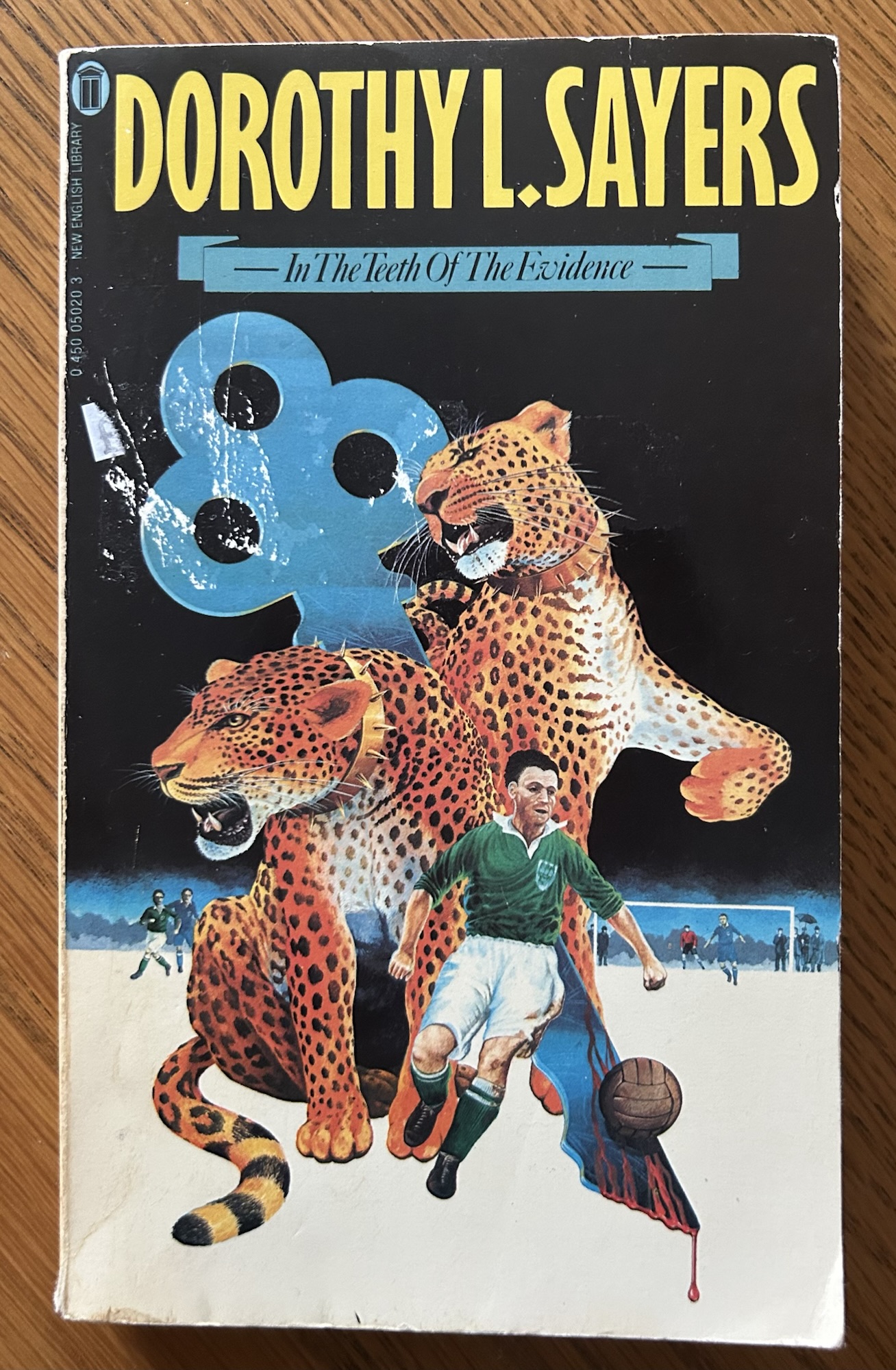
It’s a very short tale, only 13 pages in my edition. It takes the form of a monologue, with a man in serious trouble for seemingly having shot at a cat (there’s no animal cruelty in the story, despite his horrible plans) and speaking to his K.C as silent interlocutor. It opens:

“It’s extraordinarily decent of you to come along and see me like this, Harringay. Believe me, I do appreciate it. It isn’t every busy K.C. who’d do as much for such a hopeless sort of client. I only wish I could spin you a more workable kind of story, but honestly, I can only tell you exactly what I told Peabody. Of course, I can see he doesn’t believe a word of it, and I don’t blame him. He thinks I ought to be able to make up a more plausible tale than that—and I suppose I could, but where’s the use?”

He and his old schoolfriend Merridew both seemed to be following the bachelor life, until Merridew marries a woman fifteen years younger than him. She has never left the Norfolk village in which she was raised, but about a year after the nuptials, they all arrange to meet in Somerset.

Describing the train journey down, we learn of the narrator’s extreme aversion to cats:

“I found a horrible feeling creeping over me that there was a cat in the compartment somewhere. I’m one of those wretched people who can’t stand cats. I don’t mean just that I prefer dogs—I mean that the presence of a cat in the same room with me makes me feel like nothing on earth. I can’t describe it, but I believe quite a lot of people are affected that way. Something to do with electricity, or so they tell me. I’ve read that very often the dislike is mutual, but it isn’t so with me. The brutes seem to find me abominably fascinating—make a bee-line for my legs every time. It’s a funny sort of complaint, and it doesn’t make me at all popular with dear old ladies.”

He passes the time staring at the attractive young lady opposite him, who of course turns out to be Merridew’s new wife. And so they spend time together as planned, the peaceable atmosphere only spoilt by the titular feline, and others, at night:

“Every night the garden seemed to be haunted by them—the Cyprian cat that I had seen the first night of my stay, and a little ginger one and a horrible stinking black Tom were especially tiresome, and one night there was a terrified white kitten that mewed for an hour on end under my window. I flung boots and books at my visitors till I was heartily weary, but they seemed determined to make the inn garden their rendezvous. The nuisance grew worse from night to night; on one occasion I counted fifteen of them, sitting on their hinder-ends in a circle, while the Cyprian cat danced her shadow-dance among them, working in and out like a weaver’s shuttle.”

Sayers builds an increasingly tense atmosphere of oppressive summer heat and the narrator being driven to distraction by the nighttime caterwauling.

But how did he end up shooting a gun? And why is what happened so implausible? Well, you can read the story online here. Sayers leaves plenty unexplained in this unnerving tale, although I know what I think happened… Lord Peter Wimsey would never believe it!

“You have a grand gift for silence, Watson. It makes you quite invaluable as a companion.” (Sherlock Holmes/Sir Arthur Conan Doyle)

Yesterday I was vegging out in front of the TV, when I saw something that got me very excited:

Sherlock’s back!  Sherlock’s back!  Sherlock’s back!

OK, now I’ve composed myself, let’s have a discussion about books.  Sherlock’s back!

I’ve gone the obvious route for my first choice, one of the original Sherlock Holmes stories, The Hound of the Baskervilles by Sir Arthur Conan Doyle.  I chose it because I think this was the first story that made me aware of Sherlock Holmes, watching an old black and white film version starring Basil Rathbone on TV (my mother told me the books were much better and the portrayal of Watson was rubbish – how right she was).  The story is not long, but it crams a great deal in, and is a fast-paced, creepily gothic read.  The story is narrated by Holmes’ loyal companion Dr Watson, who remains loyal despite being on the receiving end of such back-handed compliments from Holmes as: “It may be that you are not yourself luminous, but you are a conductor of light. Some people without possessing genius have a remarkable power of stimulating it. I confess, my dear fellow, that I am very much in your debt.” Charming.  The two are employed by Dr Mortimer to investigate the death of Sir Charles Baskerville, and potential danger to his heir, Sir Henry Baskerville.  Henry has inherited a huge pile in the middle of Dartmoor, and rumours of a supernatural, vicious hound that roams the moor abound.  The eerie atmosphere is beautifully evoked, such as Watson’s first view of Baskerville Hall:

“We had left the fertile country behind and beneath us. We looked back on it now, the slanting rays of a low sun turning the streams to threads of gold and glowing on the red earth new turned by the plough and the broad tangle of the woodlands. The road in front of us grew bleaker and wilder over huge russet and olive slopes, sprinkled with giant boulders. Now and then we passed a moorland cottage, walled and roofed with stone, with no creeper to break its harsh outline. Suddenly we looked down into a cuplike depression, patched with stunted oaks and firs which had been twisted and bent by the fury of years of storm. Two high, narrow towers rose over the trees. The driver pointed with his whip.

“Baskerville Hall,” said he.

[…]

The avenue opened into a broad expanse of turf, and the house lay before us. In the fading light I could see that the centre was a heavy block of building from which a porch projected. The whole front was draped in ivy, with a patch clipped bare here and there where a window or a coat of arms broke through the dark veil. From this central block rose the twin towers, ancient, crenelated, and pierced with many loopholes. To right and left of the turrets were more modern wings of black granite. A dull light shone through heavy mullioned windows, and from the high chimneys which rose from the steep, high-angled roof there sprang a single black column of smoke.

“Welcome, Sir Henry! Welcome to Baskerville Hall!””

The story really is expertly crafted, and it’s understandable why Sherlock Holmes endures.  Doyle succeeds in writing pacey, interesting, atmospheric tales that keep you hooked until the end.  And of course, at the centre of it all is one of the most intriguing characters ever created: a brilliant mind for whom no detail is insignificant, and whose genius means he is stimulated in ways that the rest of us may not fully comprehend: “He burst into one of his rare fits of laughter as he turned away from the picture. I have not heard him laugh often, and it has always boded ill to somebody.”

I’ll stop right there before I give away any spoilers as to the mystery.  On to my second choice, Whose Body? by Dorothy L Sayers (1923, my copy 2003, Hodder & Stoughton).  Sayers is one of the authors identified with the Golden Age of Detective Fiction, and this novel is the first to feature Lord Peter Wimsey, an aristocratic amateur detective, who likes to “go off Sherlocking” and went on to feature in many more novels and short stories by Sayers.

I found this novel hugely enjoyable.  It was well-paced (maybe flagging a little towards the end, but maybe I’m just used to Hollywood-style rapid denouements) it was witty, and didn’t take itself too seriously, with a few meta-comedy moments at the expense of detective fiction: “Sugg’s a beautiful, braying ass,” said Lord Peter.  “he’s like a detective in a novel…”; “Its  only in Sherlock Holmes and stories like that , that people think things out logically.”

As the meta moments suggest, Sayers is a clever novelist.  But I never felt she was trying to prove how clever she was.  The story, of a body found in a bathtub and a missing family friend (events Lord Peter believes are connected), remains believable and accessible. Sayers has a confident voice in her first novel, and an interesting turn of phrase: “His long, amiable face looked as if it had generated spontaneously from his top hat, as white maggots breed from Gorgonzola.”

I have one proviso to this recommendation: I found offensive the anti-Semitic remarks made by some characters in Whose Body? . The inter-war period was obviously a time that saw a growth in fascism throughout Europe with devastating consequences, and Sayers is probably just putting in her characters’ mouths the repugnant views that were expressed at the time.  According the Wikipedia page on Sayers, she was surprised at accusations of anti-Semitism in Whose Body?, stating the only characters “treated in a favourable light were the Jews!”  Certainly those who express anti-Jewish views are generally portrayed as old-fashioned and/or stupid, but it still makes for uncomfortable reading in this day and age.

I don’t want to end on a negative, so for all you fellow bibliophiles out there, here is a description of Lord Peter’s favourite room:

“Lord Peter’s library was one of the most delightful bachelor rooms in London. Its scheme was black and primrose; its walls were lined with rare editions, and its chairs and Chesterfield sofa suggested the embraces of the houris.  In one corner stood a black baby-grand, a wood fire leaped on a wide old-fashioned hearth, and the Sevres vases on the chimney-piece were filled with ruddy and gold chrysanthemums.”

I for one could spend hours in that room.

Normally I finish with a picture of the books, but they have disappeared, nowhere to be found.  ‘Tis truly a mystery: who could I call on, that is up to the task of solving this curious case…..?

Image

(Image from http://www.bbc.co.uk/programmes/b018ttws )