Well, I knew it would happen eventually and possibly not for the last time this month – work demands and home renovation chaos meant I didn’t post my NADIM yesterday. I did manage to read a novella and finished it around 10pm but I was soooooo tired and also achy from hoicking furniture around in a manner that would have health and safety professionals fainting clean away, that I decided my bed was calling.
The novella was Eurotrash by Christian Kracht (2021, transl. Daniel Bowles 2024). This is the first by Kracht I’ve read but apparently it forms a sort-of sequel to his 1995 novel Faserland, presenting as auto-fiction about a writer called Christian who wrote that novel (and in a running joke, is consistently mistaken for Daniel Kehlmann.)
The novella follows Christian and his mother, whom he finds “thoroughly objectionable”, taking a road trip across Switzerland. She has recently been discharged from residential mental health care, and has asked him to visit her in her apartment where she self-medicates on a heady mix of cheap wine, vodka and phenobarbital.
“Perhaps today, rather than just pretending, I would succeed in accepting her as she was, and then, for once, not vanished down the bottomless rabbit hole of memory, but be amenable to the moment, to her delusions, to which I could simply open myself. What on earth did she want?”
Christian is deeply angry about his family history, which includes his grandfather being Nazi and a father who worked for a right-wing media mogul. He’s also furious about Zurich, about trappings of wealth, about seemingly everything. Wherever he turns he finds things morally abhorrent, and he doesn’t seem mistaken in this.
“It had been put into my mind that the circumstances of my childhood and youth were in some way special or extraordinary, where in reality they were steeped not only in bourgeois mediocrity—for that I’d have been able to accept—but also in profound menace.”
His mother adds to this when she decides to cash in her stocks and shares for a trip to Africa, and it seems she is quite wealthy from investing the arms trade. She and Christian travel around Switzerland with 600k in a shopping bag, driven by an accommodating taxi driver, encountering various immoral people from where they have to make their escapes. They also keep trying and failing to give the money away.
As the novella continues, it becomes more metafictional, with Christian describing a scene he wasn’t privy to:
“It was as if I had floated out of my brain and taken a walk, as ether, had flowed out of the plot I had been part of, even, and as if it had thereby become possible for me to be omnipresent, which, in the end, I was anyway, in my story.”
And then his mother summarising Eurotrash thusly:
“Your mother. Takes her along to some saccharine melodrama, tragedy, comedy, whatever, starring yours truly. Promises her who knows what, seeing that she’s got to drink herself to oblivion constantly and choke down pills for her unendurable pain. And then he blames everything on Switzerland, the Nazis, and the Second World War.”
I probably wasn’t in quite the right mood for Eurotrash, being really very tired, and I remained ambivalent about it for most of the book. A lot of the blurbs pitch it as a dark comedy, but aside from a few moments I didn’t find it particularly funny, due to how bitterly cynical and disillusioned Christian is.
However, I kept reading because Kracht’s style is so readable, and ultimately at the end it genuinely surprised me by being quite tender and moving, despite my reservations (personal, not literary) about the set-up for the final scene. So all in all I’m glad I persevered!
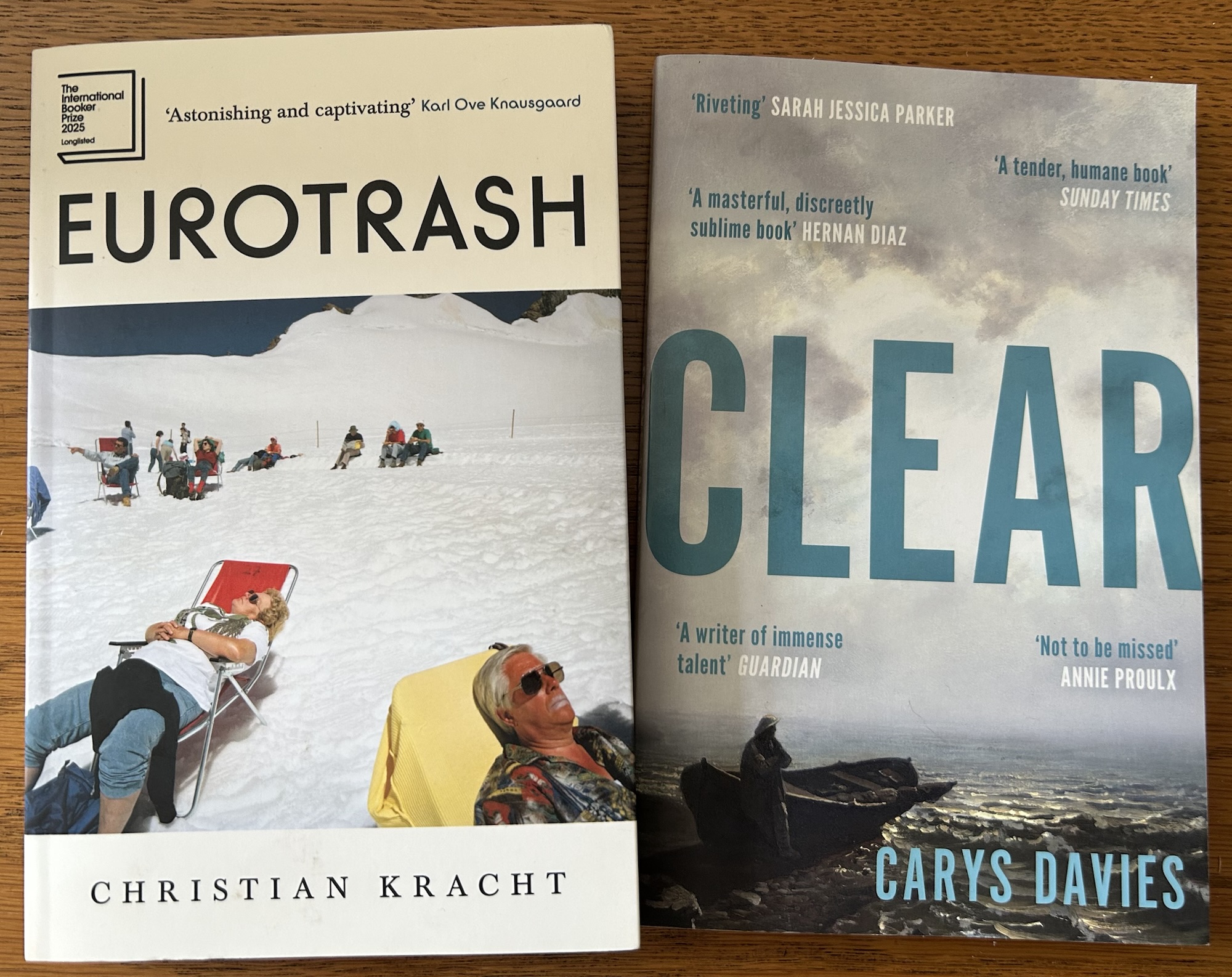
And then today I read Clear by Carys Davies (2024). I think I was the only person in the bookish blogosphere who didn’t get on with Davies’ debut novel West, but on the strength of this I might give it another try because I absolutely loved Clear.
Set in 1843, it takes the clearances as its starting point. Landowner Lowrie is going to evict Ivar from the island somewhere between Scotland and Norway where he is the sole remaining inhabitant, and where he has lived his whole life.
“Walking along the bank between the two low waters and the lightly moving wind, he thought about that, the pleasure of it—sitting with Pegi and quietly knitting; Pegi very still, his hands barely moving as they worked the needles; the only other motion a cobweb quivering in the atmosphere near the ground.”
Into his solitary, quiet existence comes John Ferguson, a minister who has left the Scottish Church to join the Free Church, and as a consequence has no money. This puts him in a vulnerable position and he ends up being employed by Lowrie to tell Ivar he will have to leave. Lowrie assures John that Ivar will not be disadvantaged by the move, something John’s feisty wife Mary sincerely doubts:
“Thinking of reports she’d read in the newspapers over the years of people in Sutherland and Wester Ross and the Hebrides who had not, in fact, done well for themselves; who had wanted very much to stay where they were and farm, instead of seeing their houses burned or reduced to rubble and the land they’d worked for generations laid under sheep.”
Things become further complicated when John is seriously injured on his first day and his belongings destroyed by the sea, including the few words he had written down to try and speak with Ivar in Norn. As Ivar cares for him, the two men start to build a fragile bond despite having no common spoken language.
“It was so long since anyone […] had looked at him properly, and if he’d been asked to describe his feelings he might have reached for that word in his language that described what happened when a rock is covered and uncovered by the sea – when, briefly, the water rises up and submerges it completely before it falls away again and reveals it.”
Clear is beautifully written, poetic and precise. It builds a carefully tender portrait of an emerging relationship between two people whose lives are so entirely different. And ultimately it surprised me by becoming a real page-turner! An absolute stunner.

