Novella a Day in May 2026 – No.19

The Children’s Bach by Helen Garner (1984) was apparently hailed as one of four perfect short novels in the English language. If I was Helen Garner I would sigh with frustration at such accolades being on the jacket – how is any novel going to live up to that?  But it is excellently written, and in a nice W&N Essentials edition too.
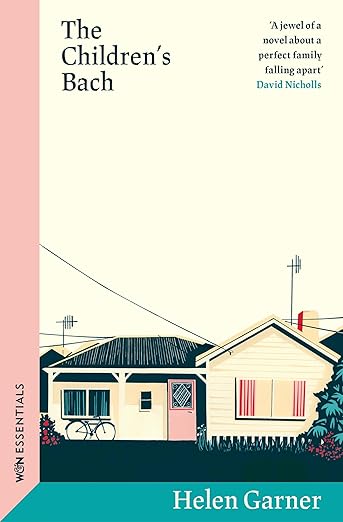
The story revolves around Dexter and Athena, a happily married couple with two children, Arthur and Billy.

“They were friends. They lived in a sparsely furnished house near the Merri Creek: its walls were cracking, its floor sloped and its doors hung loosely in their frames.”

Dexter meets an old friend Elizabeth, who has caring responsibilities she wishes she didn’t: her much younger, chaotic sister Vicki. Dexter is pleased to see her, although its unclear if it is Elizabeth herself he’s pleased to see, or what she represents:

“Dexter was mad about the past. He believed in it, it sustained him, he used it to knit meaning into the mess of everything.”

Elizabeth is living a very different life with her sort-of boyfriend Philip. It is the steadiness of what Dexter and Athena represent in contrast that draws Vicki from her sister and Philip, towards those with a more conventional set-up:

“She loved the notes they left for each other, the drawings and silly rhymes, the embarrassing singing, the vegetable garden, the fluster under which lay a generous order, the rushes of activity followed by periods of sunny calm: Vicki was in love with the house, with the family, with the whole establishment of it.”

But Athena and Dexter aren’t too good to be true. There are pressure points in any relationship and without malice, Vicki, Elizabeth and Philip start to force these open.

We follow Dexter and Athena into a more unstable world where the structures they have surrounded themselves with begin crumble. What I thought was a masterstroke was that Garner doesn’t portray this in a linear fashion. We jump forwards, there are gaps, not everything is spelled out. It stops what is in some ways a very ordinary story from becoming pedestrian, and it reflects the way the characters continue along their lives until something jolts them out of routine.

The characters are well realised without being cliches too. Athena is a loving homemaker, but she isn’t self-sacrificing. I found shocking this casual admission about her son Billy, who has an unspecified disability:

“I’m just hanging on till we can get rid of him.”

And Elizabeth, more freewheeling and self-focussed, surprises herself when Vicki moves out:

“She went home on the tram and was surprised to find a small lack in herself, a blankness where the unwelcome responsibility had been.”

Garner isn’t interested in what is easy. She is so skilled at presenting complex human beings while not seeming to take a view on them: they are as they are. I think I preferred The Spare Room of the two Garner’s I’ve read, but that is more to do with themes that I’m interested in rather than the novella itself. Either way, I’m keen to read more of the fiction and non-fiction by this skilled, clear-sighted writer.
Novella a Day in May 2022 No.10

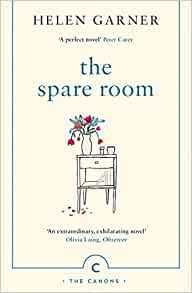
The Spare Room – Helen Garner (2008) 195 pages

The Spare Room was on my radar for a long time before I read it, as the themes are ones that mean a lot to me. I’ve spent nearly all my working life in cancer care and palliative care in one form or another, and so a novella about a friend caring for a dying person was always going to be of interest.

It also means I’m hard to please – anything vaguely sentimental or factually inaccurate is going to annoy me. I thought Helen Garner got everything spot-on.

The novel opens with Helen preparing her spare room for a friend to stay:

“I made it up nicely with a fresh fitted sheet, the pale pink one, since she had a famous feel for colour, and pink is flattering even to skin that has turned yellowish.”

She is still shocked by Nicola’s frail appearance when she picks her up. She knows her friend has terminal cancer and is with her in Melbourne to attend an alternative clinic. However, it quickly becomes clear that Helen will provide a more involved caring role than she anticipated.

An unspoken tension between the friends is that Helen is highly sceptical of the treatments Nicola is putting her faith in:

“ ‘Don’t worry,’ she said. ‘It’s the treatments causing the pain – that’s how I know they’re working. It’s just the toxins coming out.’

[…]

I held my peace. The ozone smelt delicious, very subtle and refreshing, like watermelon, or an ocean breeze. I sat on a chair in the corner and pulled the lid off my coffee.”

Garner brilliantly captures all the negotiations that take place, the bargaining between Helen and Nicola about what is acceptable and what will not change.Helen doesn’t try to talk her friend out of the treatments that she thinks are a total swizz, but she does try and get her to accept pain relief. Nicola flatly refuses to see the palliative care team – who would support Helen in such a physically and emotionally stressful situation – because she associates them with giving up.

“What was all this anger? I needed to be kinder to her. Dying was frightening. But it was easier to imagine being tender when I had a packet of slow-release morphine capsules in my bag.”

Nicola doesn’t recognise the immense pressure she puts on Helen, and on other friends, by expecting them to care for her as she refuses statutory care services. The story is compassionate to all involved, showing the immense love the women have for one another, and how this can sit alongside selfish actions. Neither Helen or Nicola are self-sacrificing angels, quietly enduring the unendurable. Instead they are kind, funny, angry, confused and scared – recognisably human.

“I longed to slip her shoes off, to draw a cotton blanket over her. But was scared to touch her. I was afraid of her weakness, afraid of her will. So I stepped out of the room and closed the door behind me.”

It’s such an impressive achievement by Garner to capture a complex emotional story without minimising it or retreating into cliché and sentiment. The Spare Room is a truly affecting exploration of death and dying. It shows how grief begins before the person dies, and the pain and joy that can exist alongside each other in such moments.

“Oh, I loved her for the way she made me laugh. She was the least self-important person I knew, the kindest, the least bitchy. I couldn’t imagine the world without her.”