I had an interesting experience reading The Gulls Fly Inland by Sylvia Thompson (1941). The blurb on the back made it sound like a thwarted-lovers type story. This wouldn’t really pique my interest but the war setting and reliability of Handheld Press’ choices meant I decided to give it a go.
Around page 70, I wondered why I was enjoying it, when the characterisation of the love interest, Vernon, was practically non-existent. I knew basically nothing about him. Yet I was enjoying the novel because in fact, it was more to my taste than I’d expected, portraying families and changing interwar society with an elegiac tone. I returned to the novella, and a few pages on there was this:
“I have been reading what I have written since I began. So far I think I have made better portraits of people I have loved less. […] Whatever I have written of Vernon seems true, but like a conventional photograph; not evocative. […] Perhaps I have only added up little characteristics, but failed to explain him.”
Well, that acknowledgement won me over entirely!
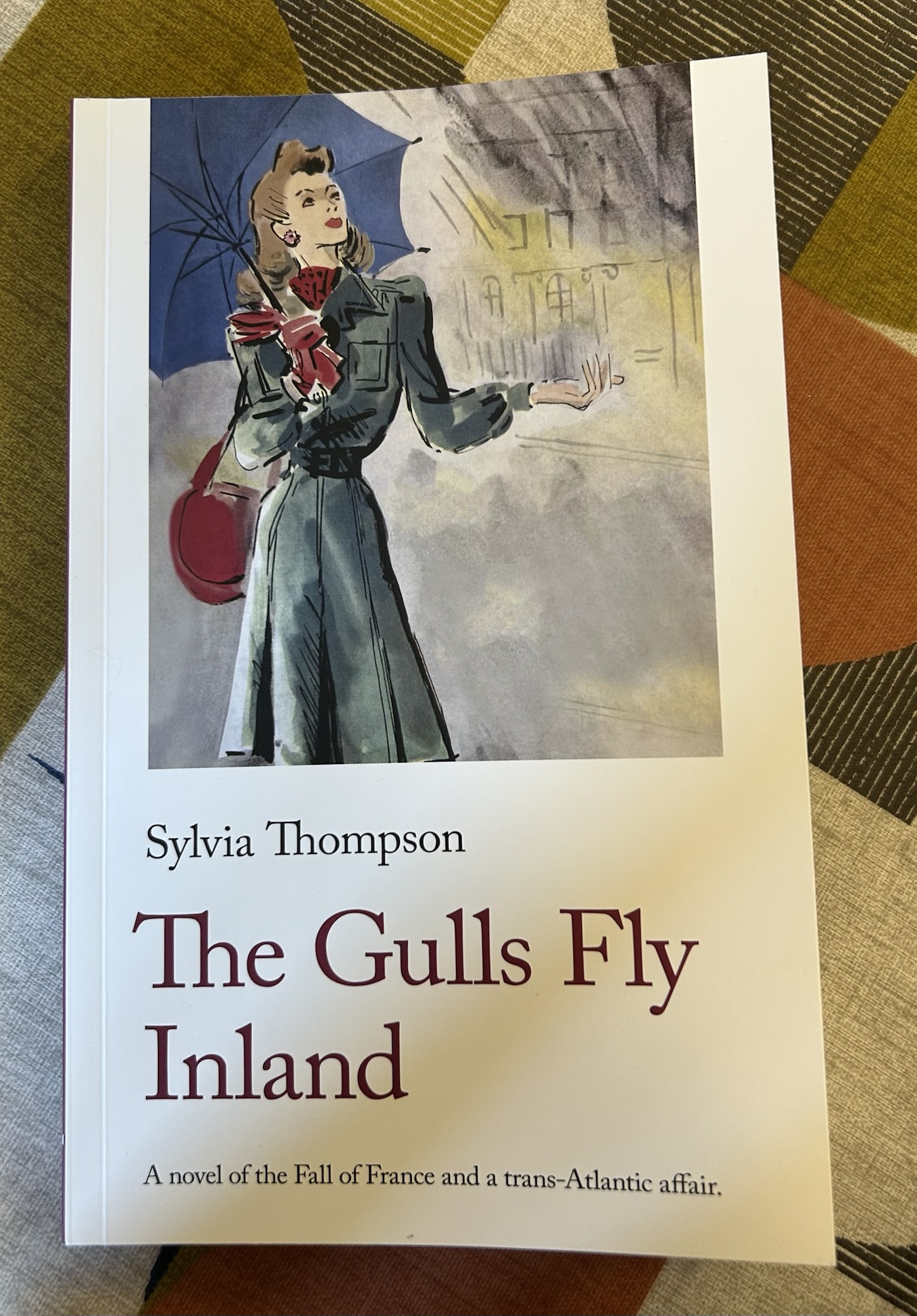
The Gulls Fly Inland takes the form of a diary written by Blanche Lancret, a young French woman exiled to England by the Second World War. She begins on 3 October 1939, and writes not only of her current circumstances but of her past, her friends and family, and her romance with Vernon, brother of her American schoolfriend Annabelle.
Throughout the diary, as she pines for Vernon, she also pines for France, Europe, and a time she knows is lost forever:
“For, as my father gave me one Paris, and my schooldays another, Vernon gave me still another; and the roots of the third Paris are those we followed together […] in this Paris, which is the one I have still in my heart, there are corners made significant by our moments of brilliant feeling as by sudden effects of floodlight.”
Blanche’s life is one of reasonably wealthy privilege. At the start of the novel she has Annabelle’s baby, her goddaughter, Camilla Blanche, living with her, while the rest of the Annabelle’s children recover from chickenpox. But of course she doesn’t have to care for a baby, the nanny has come too. She and Annabelle met at boarding school, and Blanche spends her holidays on the French Riviera with my favourite character, her mother’s half-sister Tante Julie.
“For I knew, by now, that my aunt, though never actually demi-mondaine, did not take part in any reputable social life; and did not desire to. I did not understand then her greatest distinction, which is that she lives according to her own values; and of all the artificial values respects only money and fashion.”
I also found Tante Julie’s love interest, Otto Behrens, more fully realised than Vernon:
“I was charmed by his brown bird-lidded eyes which shone clear with his natural goodness of heart, for unlike many worldly people he loves his world.”
Blanche’s father is loving but incapacitated by grief for his wife who died of pneumonia. He lives in Venice, physically and somewhat emotionally distant. And so the impact of the war will be felt across the continent in a very personal way for Blanche.
As time goes on, we see a maturing of Blanche, from schoolgirl to young woman who is increasingly aware of the world, politically and socially.
“Suddenly seduced, as happens to me from time to time, by England, or at any rate by the England which I have been able to enjoy—that is, which ignores a dozen Englands which I either do not know or do not wish to experience; industrial England, political England, England expressed in Midland towns, in dockyards, in suburbs, in slums.”
The Gulls Fly Inland is a very subtle novel. The sadness of what it portrays crept up on me, as Blanche’s friends and family gradually accept that their lives are changing forever, by forces beyond their control. There is love in many guises here: romantic, familial, between friends, for place and for time. It is truly moving, and of course, at the time of writing, Sylvia Thompson did not know what the outcome of the conflict would be.
Although sad, the resilience and strength of the characters means it is not depressing. There are sparks of humour too, as Blanche can be a witty and slightly spiky narrator:
“What Annabelle says is often self-evident, but she gives the sentence to you like a present, prettily tied up with a ribbon of your favourite colour.”
So The Gulls Fly Inland wasn’t at all the book I expected, and so much the better for it – but for those of you without wizened hearts like mine, rest assured there are some romantic moments too!
To end, a wartime classic apt for Blanche and Vernon, and I chose a version sung by an American group in honour of Vernon:
 madame bibi lophile recommends
As the publisher, I am delighted that you enjoyed our last novel!
LikeLiked by 1 person
Kate, thank you so much for stopping by! I was so sorry to see Handheld Press go. I have lots of your titles in the TBR pile having gone a bit mad in your sale when I realised you wouldn’t be around much longer, so thank you for this delightful novel and for all the delights I have yet to come.
LikeLiked by 1 person
Yes, that sale was wild. I think I sold over 600 books in the first day! Postscript took all the stock that was left, so The Gulls Fly Inland may still be available through them. It’s a fabulous novel, I couldn’t believe how good it was, and how completely forgotten Sylvia Thompson was.
LikeLiked by 1 person
I’m so glad the sale was a success! And I’ll look on Postscript for the ones I missed in a half-hearted effort at restraint, thank you.
Sylvia Thompson is fascinating – the excellent introduction to your edition really brought her to life. What a character she sounds!
LikeLiked by 1 person
Lovely review! I also read a Handheld book – Ann Stafford’s Army Without Banners – originally published before the author knew the outcome of the war. It certainly added something to my reading experience.
LikeLiked by 2 people
Ooh, I think that might be one in the TBR, I will go and have a hunt!
LikeLiked by 1 person
It’s basically a recruiting call for volunteers but done with good humour. She cowrite Business As Usual which I loved. I hope you have a copy if you haven’t already read it.
LikeLiked by 1 person
Oh yes, I do have a copy! Business as Usual sounds great.
LikeLiked by 1 person
Gulls Fly Inland has been on my radar since Kaggsy reviewed it in July 2024 (gosh so long ago!). You have rewhetted my appetite and I am going to renew my efforts to find a copy. I think I would really enjoy it.
LikeLiked by 1 person
If your library can’t get it, I’ve just checked Postscript Books as Kate mentioned, and they have it for £5.99 https://www.psbooks.co.uk/handheld
However you get it, I hope you enjoy it!
LikeLike
Thanks Madame Bibi. My library does now have a copy of this one so I will place a reservation as soon as I have space (my list is full at the moment because I often have the maximum books on order at once!). I appreciate the link though and I am now tempted to splurge on some more tempting titles!
LikeLiked by 1 person
I read this when it came out, Madame B, and I thought it was remarkable. Apart from anything else, it really does capture what it was like to live through those changing times.
LikeLiked by 1 person
It really does! I can’t imagine the stress and worry. How people endured is so moving and she really demonstrates that.
LikeLiked by 1 person
What an interesting review! I think I’d like to read this one.
LikeLiked by 1 person
So glad it appeals! I hope you enjoy it if you get to it.
LikeLike
I’ve had a copy of this for a couple of years (probably since reading Kaggsy’s review!). I’m now reminded that it’s time to pull it off the shelf and read it myself!
LikeLiked by 1 person
I really hope you enjoy it!
LikeLike
Oh you’ve made this sound irresistible! And the fact it isn’t a traditional romance makes it much more interesting my eyes, too.
LikeLiked by 1 person
and a copy is on its way to me now!
LikeLiked by 1 person
Hooray! I hope you really enjoy it.
LikeLike
So glad it appeals! It’s such an interesting portrayal of the first years of the war.
LikeLike
A lovely reminder of a book I very much enjoyed. As you say, there’s something very poignant about a novel written and published during this period when the outcome of WW2 was still very uncertain…
LikeLiked by 1 person
Absolutely, still five years of war to live through, so much to endure.
LikeLike
This sounds another great find, but it’s the Inkspots that stop me in my tracks! When my son was about 8 or younger they were his favourite band and he played them constantly!
LikeLiked by 1 person
How lovely Jane! I also really liked doo-wop when I was a child! Still do actually 😊
LikeLiked by 1 person
I like how it’s a ribbon of your favourite colour, that detail saving it from feeling like only a cliche (not that characters don’t speak in cliches sometimes, just like real people). This one is on my TBR, thanks to the Postscript sale. (And add me to the list of people who loved Business as Usual!)
LikeLiked by 1 person
I hope you enjoyed it when you get to it! I’m looking forward to Business As Usual 😊
LikeLike