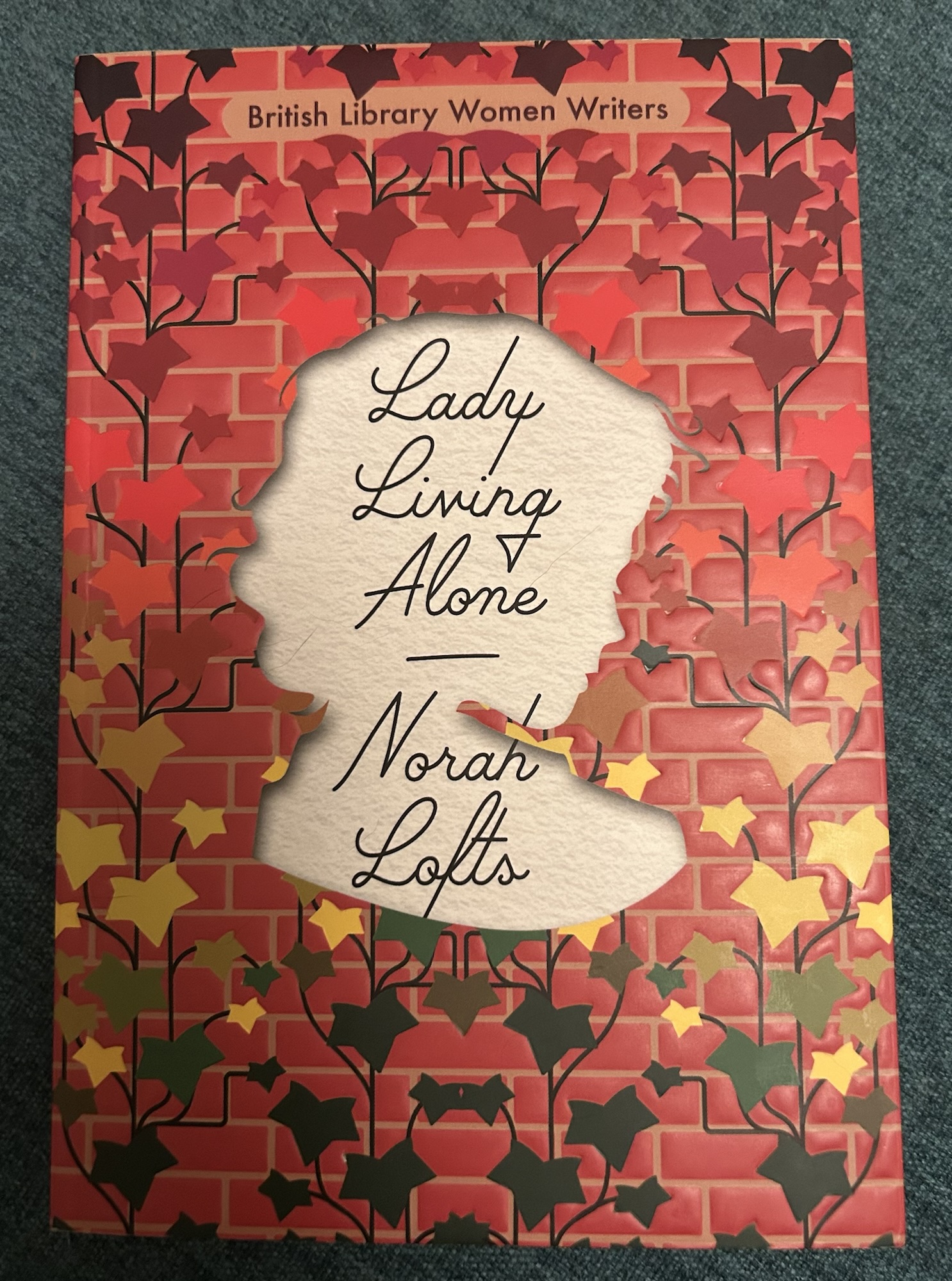
The British Women Writer’s Series is doing such a wonderful job rediscovering lost gems, and Lady Living Alone by Norah Lofts (1945) is no exception. I really enjoyed this witty, tense novel from a new-to-me writer, and it was in a typically lovely series cover too:
Set in the 1930s, the wonderfully-named Penelope Shadow is three years older than the century and living with her widowed sister-in-law, her nephew and niece. She fails at every job she attempts, until she hits on the idea of writing. Her historical novels featuring bold heroines are moderately successful, until one of them becomes hugely successful.
“Miss Shadow herself was one of those women who is never described without the diminutive: the sweet little thing, a funny little thing, poor little thing, and, of course, after ‘Mexican Flower’, a clever little thing.”
Penelope’s inability to manage day-to-day routines means she is consistently under-estimated. But when her sister-in-law plans to remarry and emigrate, Penelope realises she needs help. I wondered if this wry observation was a piece of self-satire by Lofts:
“For behind Penelope Shadow stretched a long, long line of scribes and daubers, adults in their own peculiar world, but children in this one, vague, feckless, thoughtless creatures always sheltering, consciously or unconsciously, behind some sensible, practical person.”
Penelope has a phobia of being in a house alone after dark, and so she wants a live-in housekeeper. After a series of failures in this regard and following a Gothic interlude in a guesthouse, she leaves with a young, good-looking waiter:
“For Penelope had secured a treasure. There was no other word for it. She had won not only a housekeeper who could cook, and a cook who could housekeep, she had, all in one person, a nurse, a mentor, a chauffeur, a chambermaid, butler and steward.”
But there is an underlying sense that all is not as it seems with Terry Munce. This is compounded when she is visited by her more worldly, pragmatic writer friend, who genuinely sees Penelope as she is, and yet has not taken to Terry at all:
“Miss Fletcher was enchanted, not with the pretty young prodigy whom she had at first taken Penelope to be, but with the odd, contradictory, unpredictable person that she really was.”
As the story progresses, Lofts shifts Lady Living Alone from a domestic comedy of manners with an endearingly eccentric heroine, into a tense domestic noir, with an eccentrically vulnerable heroine.
She also uses Penelope’s situation to make some pointed observations about the legal position of women at this time.
“She knew, even as she settled down to her own job, in her own house, that she was not her own woman in the same way that she had been”
(The supporting material in the BLWW series is always helpful and the timeline; Preface from Alison Bailey as Lead Curator; and Afterword from Simon Thomas, Series Consultant, provide useful context on this issue.)
Such is Lofts skill that the shift in tone and wider political points never jar. I found Lady Living Alone immediately engaging, and then absolutely compulsive as I whizzed through it without any sense of how events might play out. I’m trying to avoid spoilers so that anyone who hasn’t read it might have the same experience, and so I’ll end the post here!


I’ve never heard of this writer but this does sound great!
LikeLiked by 1 person
I didn’t know her either, but I thought she wrote really well!
LikeLike
I think it must have been me at the time but I really struggled to get into this one and found it annoying. After reading your review , I am almost sure it was me, not the book (especially as I love nearly all the other BLWW books) and I really should try it again.
LikeLiked by 1 person
Some books just don’t work for us even when we really want them to! I hope it’s more successful for you though, if you do give it another try.
LikeLike
Your ‘following a Gothic interlude in a guesthouse’ observation is intriguing!
LikeLiked by 1 person
Haha! Its quite an episode 😁
LikeLiked by 2 people
In my mind, Norah Lofts sits on a shelf with Mary Stewart, Anya Seton, and Elizabeth Goudge, but maybe I’m on the wrong track. Either way, as an installment in this particular series, even if a new-to-you author, you knew you had a good thing coming to you. And, hey, you’re almost two weeks in!
LikeLiked by 1 person
Yes BLWW are a great series!
I think the second half of the month is when it could all grind to a halt, but it’s good to nearly be two weeks in for sure!
LikeLike
Ah I am so glad you liked this one! As Marcie says, Lofts is known (in some circles) for her historical romances – but also did a line in this sort of novel, which is much more up my street. I was so pleased we managed to get it into the series.
LikeLike
This one has been on my wishlist since Kay reviewed it a few weeks ago, so I’m delighted to get your confirmation that it’s a goodie! I shall bump it up the priority list!
LikeLiked by 1 person
Hooray! Hope you enjoy it FF 😊
LikeLiked by 1 person
Ooooh, thanks for not spoilering as I have this one TBR – and it sounds excellent!!
LikeLiked by 1 person
Great! I hope you enjoy it Kaggsy!
LikeLiked by 1 person
I’m ready to read this right now! the name Terry Munce has scoundrel (of some sort) written all over it!
LikeLiked by 1 person
Absolutely 🤣
LikeLiked by 1 person
Lovely review, Madame Bibi! Like you, I really enjoyed how this shifted from social comedy to domestic noir – the latter reminder me a little of one of Celia Fremlin’s ‘woman in peril’ style stories. So glad you liked it!
LikeLiked by 1 person
Thanks Jacqui! That’s very encouraging to hear the Fremlin comparison as I’d like to read more by her.
LikeLike
I really enjoyed this one, even when it took a turn I wasn’t quite expecting!
LikeLiked by 1 person
Yes it does take quite a shift! Great to hear you enjoyed this too Liz.
LikeLiked by 1 person