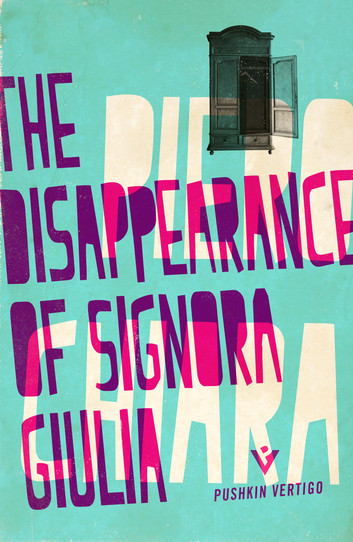
The Disappearance of Signora Giulia – Piero Chiara (1970, trans. Jill Foulston 2015) 122 pages
The Disappearance of Signora Giulia was initially published in an Italian newspaper as a serial and is now available in English translation thanks to Pushkin, as part of their Vertigo imprint. It is a quick, snappy crime thriller that does not aim for trite resolution but rather an exploration beneath the surface of a life to the murky depths.
Corrado Sciancalelpre is “blessed with a special form of intuition, that peculiar mental agility that enables great policemen to delve into the minds of criminals.”
Thankfully, he is also happy married and liked in the town in northern Lombardy where he works – no tortured alcoholic with a secret past here.
A powerful lawyer, Esengrini, asks Sciancalelpre to investigate the titular vanishing of his wife. Every Thursday, Guilia has been going to Milan to visit their daughter at boarding school, but now she has failed to return and two bags of her things are missing too. Sciancalelpre agrees and what follows is essentially a police procedural, but the short length of the story ensures the pacing remains tight.
Sciancalelpre is resolutely unsentimental but not without sympathy. The more he investigates, the more he feels for the missing woman:
“He didn’t say ‘Poor Signora Giulia to Esengrini when he visited him in his office every few days towards evening. With Esengrini, he spoke only of the undeniably disappointing results of a search conducted throughout the whole of Italy with Signora Giulia’s photo.”
It’s impossible to say much more about a crime novella without including spoilers. Suffice to say there are plenty of red herrings, people and relationships who are not what they seem. The Disappearance of Signora Giulia is a diverting read, when you’re in the mood for a crime novel you’ll finish quickly. It is not a simple tale though, and the resolution is a complex one that leaves questions unanswered. This wasn’t a source of frustration but rather felt realistic.
I really enjoyed this, Chiara’s first novel to be translated into English despite his huge popularity in Italy, and I hope there will be many more translations to follow.
This is the first in a series of occasional posts where I’ll be looking at works from Le Monde’s 100 Books of the Century. Please see the separate page (link at the top) for the full list of books and an explanation of why I would do such a thing. I set myself the challenge in January and I’m only beginning to blog about it now; this does not bode well for my completing this challenge before I see in a century of my own…
Six Characters in Search of an Author is a play by Luigi Pirandello, originally written in Italian and performed in 1921 (my copy translated by Frederick May, 1954). It’s a play about itself, about the theatre, and although philosophical and reflective, it’s also very silly.
“Life is full of things that are infinitely absurd, things that, for all their impudent absurdity, have no need to masquerade as truth, because they are true”
“What the devil are you talking about?”
A producer is putting on a play with a group of actors, who are only identified by their roles: Leading Lady/Leading Man/Ingénue and so on. As we are presented with what appears to be a rehearsal, there is a sense of the play being simultaneously constructed and deconstructed in front of us. The ideas are complex and it’s definitely not a play to approach when you’re tired and/or in need of escapism, but Pirandello undercuts the potentially pretentious self-reflexive philosophising with a good dose of humour, having the Producer complain early on:
“We’re reduced to putting on plays by Pirandello? And if you understand his plays…you’re a better man than I am! He deliberately goes out of his way to annoy people, so that by the time the play’s through everybody’s fed up…actors, critics, audience, everybody!”
Well, you can’t say he didn’t warn us. The rehearsal of the play by Pirandello is interrupted by the arrival of six characters – Father, Mother, Step-daughter, Son, Boy and Little Girl. They want the Producer to help them, as “the author who created us as living beings, either couldn’t or wouldn’t put us materially into the world of art.” They start to tell their story while the actors look on, and the stage directions tell us: “The CHARACTERS should not, in fact, appear as phantasms, but as created realities, unchangeable creations of the imagination and, therefore, more real and more consistent than the ever-changing naturalness of the ACTORS.” As the actors and characters interact (and bitch at each other and argue about representation) the play presents complex philosophical questions about truth, reality and identity, and whether any of us really has any idea what on earth is going on:
“Each one of us has a whole world of things inside him… and each one of us has his own particular world. How can we understand each other if into the words I speak I put the sense and value of things as I understand them within myself… while at the same time whoever is listening to them inevitably assumes them to have the sense and value that they have for him…. We think we understand each other… but we never really do understand!”
In this way, Pirandello admirably manages to interrogate the relationship of theatre to representation, reality to illusion, art to life. There are lots of meta-moments (the whole play is really one big metatheatrical experience); my favourites were where he drew attention to the play’s own limitations, studiously ignoring the Producer’s directive that “When you’re here you have to respect the conventions of the theatre!” and a great moment where the Son walks off, refusing to act because “I’m a dramatically unrealised character”.
Six Characters in Search of an Author is a hugely complex work and at the same time a short, humorous play. I really enjoyed it, but I also think I could re-read it and each time think that I understood nothing from my previous readings. I also wouldn’t be surprised if someone entirely hated it, and they would not be alone: apparently the playwright had to leave the premiere performance through a side-exit to avoid the throng of haters. If you’re a writer, actor, theatre-lover or philosophy enthusiast, you’ll find a lot to interest you in Six Characters in Search of an Author. If you like Waiting for Godot or Rosencrantz and Guildenstern are Dead, then this play could be for you.
Phew! After all that deep reflection on the nature of theatre and our existence, I think it must be time for shark cat on a Roomba: