Colette Week: Day 7 – The Last of Cheri (1926)

I thought it would be apt to finish Colette Week with a novel concerned with endings: The Last of Cheri (La Fin de Cheri). Here’s a reminder of my decidedly kitsch edition because it’s just so bad:
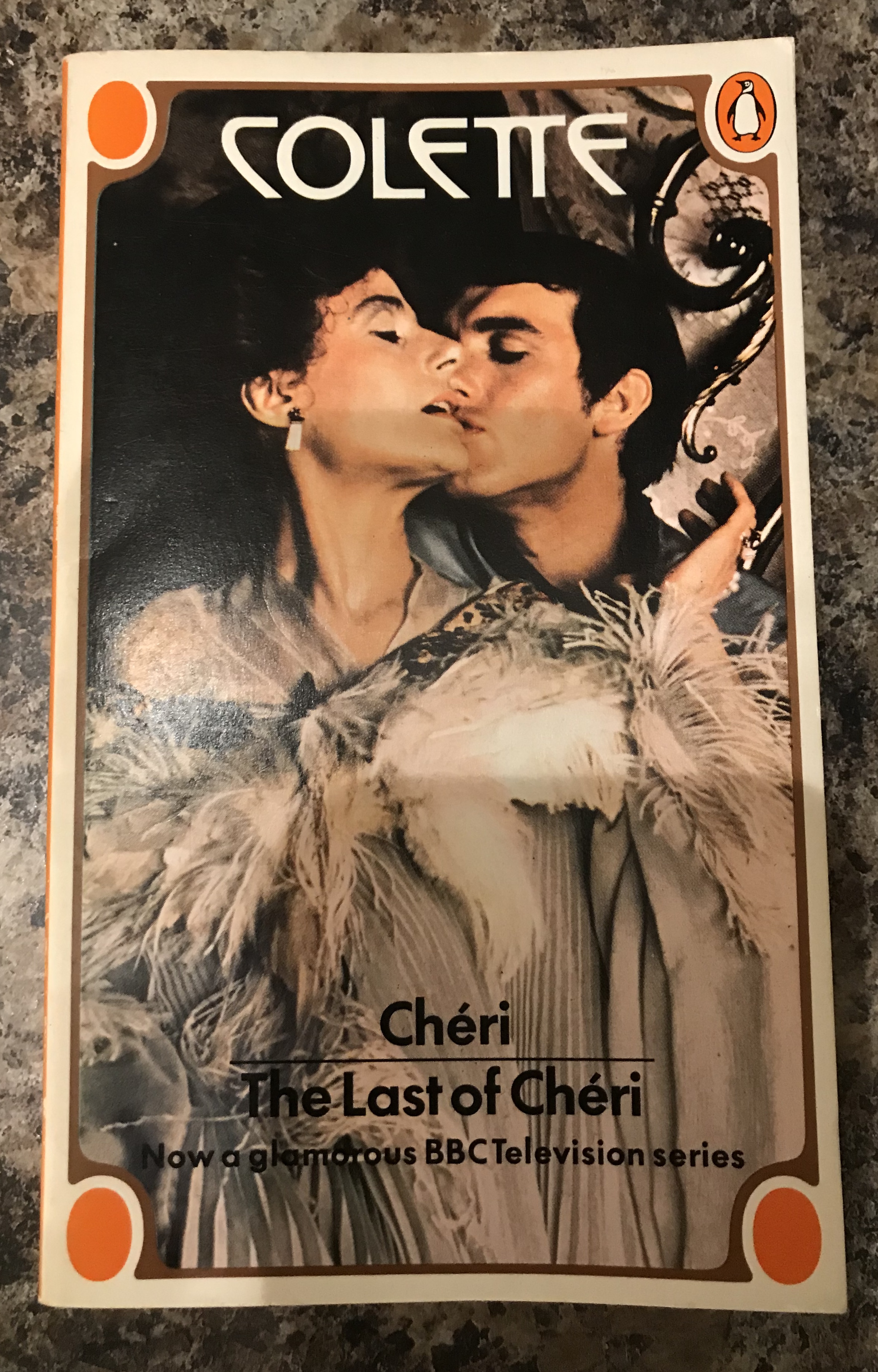
Thankfully I’m not quite so shallow as to let a hideous cover affect my enjoyment of Colette’s glorious writing (almost shallow enough, but not quite). The Last of Cheri is set 6 years later than Cheri, just after the end of World War I. He is no longer quite the callow youth he was: his affair with Lea and his experience of fighting in the trenches have left him cynical and damaged.

“he had come to scorn the truth ever since the day when, years ago, it had suddenly fallen from his mouth like a belch, to spatter and wound one whom he had loved.”

But, as the French wisely say, plus ça change, plus c’est la même chose. Cheri is still directionless, still without anything to live for beyond himself. Meanwhile his mother and wife have found purpose in war. Edmee is a nurse and consumed by her work at the hospital and extra-marital affairs, which Cheri agrees to.

“Cheri pulled out the small flat key on the end of its thin gold chain. ‘Here we go. In for another carefully measured dose of love. …’”

Cheri’s old friend Desmond is here too, still reprehensible, but like the women in Cheri’s life, having found purpose, setting up a popular nightclub where people try and forget what they and France have been through:

“They danced at Desmond’s, night and day, as people dance after war: the men, young and old, free from the burden of thinking and being frightened — empty-minded, innocent; the women, given over to a pleasure far greater than any more definite sensual delight, to the company of men: that is to say, to physical contact with them, their smell, their tonic sweat, the certain proof of which tingled in every inch of their bodies — the certainty of being the prey of a man wholly alive and vital, and of succumbing in his arms to rhythms as personal, as intimate, as those of sleep.”

If Cheri was told primarily from Lea’s perspective, The Last of Cheri is from Cheri’s perspective and Colette captures this wonderfully. Given that Cheri is so lost and directionless, the novella never appears so. The writing is insightful without being heavy-handedly psychological, and although set in town, Colette’s feel for the natural world remains:

“He noticed that the rosy tints of the sky were wonderfully reflected in the rain-filled gutters and on the blue backs of the low- skimming swallows. And now, because the evening was fresh, and because all the impressions he was bringing away with him were slipping back perfidiously into the recesses of his mind – there to assume their final shape and intensity — he came to believe that he had forgotten all about them, and he felt happy.”

This feeling of happiness is brief though, and occurs after a distressing meeting with Lea, so the reader knows Cheri is deluding himself. Like everyone else, Lea has moved on and is in a very different place, happy and fulfilled.

Poor Cheri. He is utterly lost and ricochets around without any idea as to how to remedy his emptiness. The crisis of meaning of a rich, good-looking playboy could test the reader’s patience, but Colette’s writing meant I had real sympathy for him. His life from the start meant he didn’t stand much of a chance:

“His childhood as a bastard, his long adolescence as a ward, had taught him that his world, though people thought of it as reckless, was governed by a code almost as narrow-minded as middle-class prejudice. In it, Cheri had learned that love is a question of money, infidelity, betrayals, and cowardly resignation. But now he was well on the way to forgetting the rules he had been taught, and to be repelled by acts of silent condescension.”

So, that’s the end of Colette week on the blog. I’ve really enjoyed submerging myself in her writing this week and I hope I’ve managed to convey just a tiny bit of how good she is. She has a deep understanding of people and a wonderful sympathy with the natural world. I find her evocative and capable of great artistry but with a real lightness of touch. Plus she wrote a lot of novellas, which always gets my vote 😊 She was a prolific writer so there’s plenty more to explore, which I’m really looking forward to.

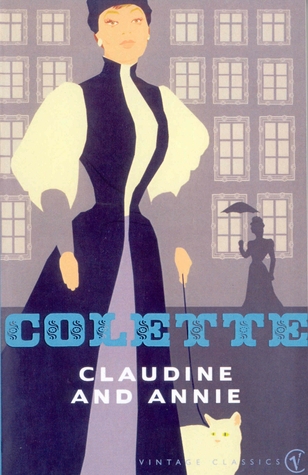
Image from here

Colette Week: Day 6 – Cheri (1920)

I’m ending the week with Colette’s two novels about a beautiful young man, Cheri and The Last of Cheri (tomorrow). Before we go on, look at this awful book cover:

It’s the nearest I’ve come to being embarrassed to read a book in public (I still did it though 😀 )

My aesthetic qualms aside, let’s get back to Cheri. It’s a beautifully written, minutely observed novel and so the quotes are lengthy, as I inadequately attempt to give a sense of Colette’s mastery.

Fred Peloux, known to most as Cheri, is in his mid-twenties and his lover, Lea, is nearing 50.

“At the age of forty-nine, Leonie Vallon, called Lea de Lonval, was nearing the end of a successful career as a richly kept courtesan. She was a good creature, and life had spared her the more flattering catastrophes and exalted sufferings. She made a secret of the date of her birth; but willingly admitted — with a look of voluptuous condescension for Cheri’s special benefit — that she was approaching the age when she could indulge in a few creature comforts. She liked order, fine linen, wines in their prime, and carefully planned meals at home. From an idolised young blonde she had become a rich middle-aged demi-mondaine without ever attracting any outrageous publicity.”

They have been together for six years, since Cheri was 19. His mother, Charlotte, was also a courtesan and Cheri’s paternity is unknown. His beauty is astonishing but his personality is lacking.

‘Why is he so ugly when he laughs? — he who’s the very picture of beauty!’ She thought for a moment, then finished aloud: “It’s because you look so ill-natured when you’re joking. You never laugh except unkindly — at people, and that makes you ugly. You’re often ugly.”

Charlotte is determined to get Cheri married, and Lea claims she is at ease with this; she never anticipated her relationship with Cheri would be a long one. Charlotte and Lea have an antagonistic relationship but one of mutual understanding.

“They had known each other for twenty-five years. Theirs was the hostile intimacy of light women, enriched and then cast aside by one man, ruined by another: the tetchy affection of rivals stalking one another’s first wrinkle or white hair. Theirs was the friendship of two practical women of the world, both adepts at the money game; but one of them a miser, and the other a sybarite. These bonds count. Rather late in their day, a stronger bond had come to link them more closely: Cheri.”

Cheri marries a young woman named Edmée, but it is not a love match. He ends up listless and unhappy, disappearing for 3 months to live in Paris with his friend/hanger-on Desmond, denying his jealousy regarding the rumour that Lea has left the city with a new lover. It is an existence entirely empty and wholly unsatisfying to him. Cheri is worshipped for his looks and youthful energy but he is a deeply inadequate human being. His is an unexamined life, without purpose or meaning.

“For a moment he gave way to self-pity and self-contempt. How many good things had he missed by leading such a pointless life — a young man with lots of money and little heart! Then he stopped thinking for a moment, or possibly for an hour. Next, he persuaded himself there was nothing in the world he wanted, not even to go and see Lea.”

In this short novel Colette documents the evolving relationship between Lea and Cheri, and its sad conclusion. It is an insightful character study of the main protagonists, and an unblinking dissection of a relationship that is doomed to failure despite the deep love between Cheri and Lea. It will not survive societal pressures, nor the lack of humanity and compassion within Cheri.

“An undecipherable thought appeared in the depths of his eyes; their shape, their dark wallflower hue, their harsh or languorous glint, were used only to win love, never to reveal his mind. From sheets crumpled as though by a storm, rose his naked body, broad- shouldered, slim-waisted; and his whole being breathed forth the melancholy of perfect works of art.”

Cheri has been adapted quite a few times (hence my awful book cover). Here’s the trailer for the 2009 film directed by Stephen Frears:

Colette Week: Day 5 – Ripening Seed (1923)

I’ve a stinking cold Reader, please bear with me if this post is even more rambling and incoherent than usual…

Ripening Seed (original title: Le Ble en Herbe trans. Roger Senhouse 1955) has a subtitle on my old orange Penguin edition ‘An idyllic tale of a modern Daphnis and Chloe’, which I think is misleading. I didn’t find the tale idyllic; Colette is far too psychologically astute for that. So although its about a young couple discovering themselves and their love for each other over a long hot summer, its about pain as well as joys, and how the two can be hard to disentangle. It has similarities to Daphnis and Chloe, but departs from that story too.

Vinca “the Periwinkle, with eyes the colour of April showers” and Philippe who “radiated intolerance and a sort of traditional despair…for the period when body and soul are like buds ready to burst into flower” have known each other for years as their families holiday together in Brittany each year. Now Vinca is 15 and Philippe is 16, their feelings are starting to change toward one another. So far, theirs is a chaste romance, full of high adolescent feeling but without physical expression.

I’m not really in the market for teen romance – even Romeo and Juliet tries my patience – but Colette held me with this. Her evocative depictions of nature are to the fore as she captures a hot coastal summer:

“An offshore breeze wafted the scent of the new-mown after-crop, farmyard smells, and fragrance of bruised mint: little by little, along the level of the sea, a dusty pink was usurping the domain of blue unchallenged since the early morning […] the bleat of a goat and the tinkle of the cracked bell round its neck were enough to make the corners of his mouth quiver with anguish and his eyes fill with tears of pleasure. He did not let his eyes linger on the rocks where Vinca was roaming”

I also didn’t mind Vinca and Philippe’s contrariness towards one another. It seemed very believable for two young people who don’t know what to do with their feelings.

“There were still times when they could forget their love, despite the force that daily increased its tentacle hold and slowly but surely sapped their mutual trust and gentleness; and despite their very love itself, though it was changing the essence of their tender affection as coloured water changes the complexion of the rose that drinks it.”

Philippe is seduced by the older Mme Dalleray and so for the latter half of the novel the reader is waiting for the fallout from this sexual awakening away from Vinca. The title in French is from the phrase ‘manger son blé en herbe’/’to eat the wheat that has just sprouted’. In other words, people who are impatient end up denying themselves the benefit of a situation they should have let develop. As I mentioned at the start of this post, this is a story that deals with the pain of love as much as the joys…

Ripening Seed is a novella (122 pages in my edition) focused on building atmosphere and capturing a moment in time for two young protagonists. It’s beautifully written and Colette drew me into Vinca and Philippe’s world from the start.

Le Ble en Herbe has been adapted for the screen a few times (of course it has, young good-looking people in love a cinematic mainstay). Here’s a clip from the 1954 version:

Colette Week: Day 4 – Claudine and Annie (1903)

In Claudine and Annie, original title Claudine s’en va (trans. Antonia White 1962), we hear someone else’s impression of the free-spirited heroine, as the novel is told from the point of view of Annie, a very different woman to Claudine.

“I don’t know anything…except how to obey. He has taught me that and I achieve obedience as the sole task of my existence…assiduously…joyfully.”

He is her husband, Alain, who she has loved since childhood and has left her for many months in order to travel to Brazil and claim a legacy. We never meet Alain but he seems fairly repulsive, including saying that she shouldn’t take his rare compliments to heart, as:

“It is my own work I’m admiring; a lovable child, fashioned little by little into and without great difficulty into an irreproachable young woman and an accomplished housewife.”

He is controlling and has left her a list of instructions, including:

“Only one call on Renaud and Claudine, too fantastically unconventional a couple”

Thankfully, for those of us who are so fond of Claudine from the previous novels, Annie ends up disregarding this advice. She and Claudine get on well, spending time together as Claudine is part of Marthe’s, Annie’s sister-in-law, social circle.

“I was animated by an indiscreet curiosity, as if, by questioning Claudine, I was about to discover the secret, the ‘recipe’ of her lucky disposition that detached her from everything, and made her indifferent to gossip, petty quarrels, even to conventions.”

Claudine is attracted to Annie, but she and Renaud have an agreement to just have two people in their marriage since the Rezi drama, so nothing romantic occurs. From Annie we learn they are a devoted and very happy couple. Annie’s marriage, by contrast, is crumbling:

“Shattered, I searched obstinately for one memory in our past as a young married couple that could give me back the husband I believed I had. Nothing, I could find nothing – only my whipped child’s submissiveness, only his cold condescending smile.”

Marthe and her social set are not a happy bunch (apart from Renaud and Claudine). There are infidelities, relentless bitching, worries about money… and yet Annie has her eyes opened to the nature of her relationship with Alain and she cannot turn back.  Realistically, Annie is not ecstatic at her new life; she only knows it must happen.

“In those days which seem strangely far away I was more meek than terrified and almost happy in a timid, colourless way. Is my lot any better today, wandering hither and thither, demoralised yet more self-willed? It’s a very arduous problem for such a tired brain.”

Although I missed Claudine in this novella as the focus is very much on Annie, I still enjoyed this greatly. It was entertaining to see a character we know so well from a first-person point of view depicted through the eyes of Annie. I thought the voice of Annie was distinct from Claudine and of course I was rooting for her to leave Alain.

The story is fairly slight, but at just over 100 pages it is well-paced and suits its novella length. The final sentence was pitch perfect and such a satisfying ending to Annie’s story despite – or perhaps because of – many  unanswered questions.

And so I bid farewell to Claudine and I’m so sorry to see her go. Tomorrow, a stand-alone novella – is it any wonder I love Colette so much when her novels are so blissfully short? 🙂

Colette Week: Day 3 – Claudine Married (1902)

*This post contains spoilers for Claudine in Paris and Claudine Married*

Claudine Married, original title Claudine en menage (trans. Antonia White 1960), continues the story of Claudine after she and Renaud return from honeymoon. It begins:

“Definitely, there is something wrong with our married life. Renaud knows nothing about it yet; how should he know?”

Claudine is finding it hard to adapt to married life, much as she loves her husband. It’s hardly surprising, given that she is young and inexperienced – though not naïve – and has married a man twice her age. She is growing up, and I found her more likable in this novel than the previous two, as she acknowledges her cruelty and disregard for others’ feelings in the past, particularly poor Luce. But she still has her childlike moments:

“Without listening to him, I suddenly put the ruby in my mouth, ‘because it ought to melt and taste like a raspberry fruit drop’! Renaud, baffled by this new way of appreciating precious stones, bought me sweets the following day. Honestly, they gave me as much pleasure as the jewel.”

The start of the novel has some particularly unsavoury scenes to my twenty-first century sensibilities, when Claudine and Renaud return to her old school and sexually tease/demand kisses from the young adolescents there. It was really unpleasant, but thankfully soon over, and Renaud’s voyeuristic enjoyment of Claudine’s lesbian encounters sets the scene for later in the novel.

Claudine has to learn to adapt to a shared life, and she struggles with this. Renaud is not quite what she hoped he would be:

“I hoped so ardently that Renaud’s will would curb mine, that his tenacity would eventually overcome my fits of rebellion; in short, that his character would match the expression of his eyes, accustomed to command and fascinate. Renaud’s will, Renaud’s tenacity! He is suppler than a flame, just as burning, just as flickering; he envelopes me without dominating me, Alas! Are you to remain your own mistress forever, Claudine?”

They are also temperamentally incompatible: Renaud is urbane and sociable and enjoys travelling while Claudine likes being at home in the country.

“There is nothing nomadic about me, except my mind.”

They enjoy their sex life, but even at these moments of closeness there are distances to be traversed:

 “To him [sexual] pleasure is something gay and lenient and facile, whereas it shatters me and plunges me into a mysterious despair that I seek and also fear.”

Colette is candid about sex in Claudine Married. It is not portrayed explicitly but it is dealt with directly. This includes when Claudine meets the charming Rezi:

 “All her movements, the turn of her hips, the arching of her neck, the quick raising of her arm to her hair, the sway of her seated body, all described curves so nearly circular that I could see the design of interlacing rings, like the perfect spiral of seashells, that her gentle movements left traced on the air.”

They begin an affair, fully endorsed by Renaud, who provides somewhere for them to go. This is partly because he is titillated by it, and partly because his view of sex is phallocentric and so he does not take same-sex attraction between women seriously (while he is homophobic towards his gay son):

“You women can do anything. It’s charming and of no consequence whatever…”

The change from menage to menage a trois with the shallow Rezi has disaster written all over it, and Claudine knows it:

“I know that common sense, because it is my own particular brand; it allows me, precisely one minute before fatal blunders, to enjoy the lucid pleasure of telling myself: ‘This is a fatal blunder.’”

When the inevitable blow comes, Claudine returns to her beloved Montigny and Colette’s beautiful depictions of nature are once more to the fore:

“I had been able to bathe my bear hands and trembling legs in thick, deep grass, sprawl my tired limbs on the dry velvet of moss and pine-needles, rest without a thought in my head, baked by the fierce, mounting sun…I was penetrated with sunlight, rustling with breezes, echoing with crickets and birdsong, like a room open on a garden”

Claudine Married is a witty novel about the ways we blunder about in our close relationships. Claudine loves Renaud but is bored in their marriage; she admits she doesn’t love Rezi but is in sexual thrall to her. How it all plays out is believable and sad, without being tragic or overblown. The ending wasn’t to my taste but is probably more in keeping with the early-twentieth century time of writing.

The novella also has plenty to say about gender roles and how male and female sexuality is treated differently by society, but does so lightly and I really enjoyed this aspect of the novel which seemed remarkably forward-thinking.

Colette is such a beautiful writer and Claudine’s voice was as distinct as ever. I’ll be sorry to leave her behind after Claudine and Annie, of which more tomorrow 😊

Colette Week: Day 2 – Claudine in Paris (1901)

As the title of Claudine in Paris (Claudine à Paris trans. Antonia White, 1958) suggests, Claudine has left Montigny for the capital. She is recovering from a severe illness which has seen her long hair chopped off due to matting, and she is finding it hard to adjust to her new looks and new home:

“I can’t conceive that people live in Paris for pleasure, of their own free will, but I do begin to understand that one can get interested in what goes on inside these huge six-surveyed boxes”

Some things haven’t changed: she and her father are still bonded by affection but talk at cross-purposes:

“No doubt he neglects Moliere as not being sufficiently concerned with slugs”

Claudine could be annoying: she’s precocious and pretty self-obsessed in the way teenagers can be, but I still liked her. She’s funny, she’s witty, and she’s aware of her own shortcomings:

“Claudine, old thing, will you never cure yourself of that itch to meddle in things that don’t concern you, that rather despicable little wish to show you’re artful and knowledgeable and understand heaps of things beyond your age? This urge to astonish people, this crave to disturb people’s peace of mind and upset too-placid lives will play you a nasty trick one of these days.”

Claudine finds her claims of broadminded libertarianism butting against her experience in Paris. Although she is fine with her cousin being gay, she is shocked to find an old school friend with very few prospects deciding to be kept by her old, overweight ‘uncle’.

“In your heart of hearts Claudine, you’re nothing but a common everyday decent girl.”

This short novel follows Claudine getting to know her extended family, gaining in confidence as she negotiates the city, and working out who she is growing into. It’s an affectionate portrait of someone on the brink of adulthood, showing how its possible to be childlike and a knowing adult at the same time, moving between the two in an instant.

Claudine falls in love in Paris, with someone who, as a reader, I thought wholly unsuitable. Was I right? Tomorrow I’ll let you know when I look at Claudine Married

Colette Week: Day 1 – Claudine at School (1900)

Last year I undertook to blog on a Novella a Day in May, which I really enjoyed. I’m hoping to do it again this year, but I fear I may end up delaying it until 2020. To tide me over I’m going to do a mini-version with a favourite writer who wrote short novels: Colette each day for a week, starting today as it’s her birthday.

Image from here

I’ll begin obviously, with Colette’s first novel, Claudine a l’ecole which I read in English translation, Claudine at School (trans. Antonia White 1956). Claudine is fifteen and in her final year at school. She lives in Burgundy with her father, who is distant but loving, interested mainly in slugs. As a result, Claudine is left to her own devices; her voice is strong and distinctive but she can also be something of a bitch, manipulating people and freely giving out slaps and other violence to her classmates.

“My name is Claudine, I live in Montigny; I was born there in 1884; I shall probably not die there.”

There are some lovely descriptions of the countryside which Colette clearly had great feeling for:

“The charm, the delight of this countryside composed of hills and valleys so narrow that some are ravines, lies in the woods – the deep, encroaching woods that ripple and wave away into the distance as far as you can see….Green meadows make rifts in them here and there, so do little plots of cultivation.”

A new teacher arrives at the school, Aimee Lanthenay, and Claudine is immediately entranced:

“My English mistress seemed adorable to me that night under the library lamp. Her cat’s eyes shone like pure gold, at once malicious and caressing, and I admired them, not without reminding myself that they were neither kind nor frank nor trustworthy. But they sparkled so brilliantly in her fresh face and she seemed so utterly at ease in this warm, softly-lit room that I already felt ready to love her so much, so very much, with all my irrational heart. Yes, I’ve known perfectly well, for a long time, that I have an irrational heart. But knowing it doesn’t stop me in the least.”

Claudine is aware of her own attractions and confident in them, including her appeal to the school’s District Superintendent Dutertre, who she sees clear-sightedly as something of a lech. Ultimately however, she loses Aimee to her Headmistress:

“The class was well-trained now. All the girls even down to those in the Third Division knew that, during recreation, they must never enter a classroom in which the mistresses had shut themselves up… we found them so tenderly entwined, or so absorbed in their whisperings, or else Madame Sergent holding her little Aimee on her lap with such a total lack of reserve that even the stupidest were nonplussed”

The treatment of sexual attraction between women is dealt with frankly in the novel. It is never apologised for, explained away as schoolgirl crushes, or treated as anything extraordinary. Claudine is at once inexperienced but wise and somewhat cynical beyond her years:

“In a week she will possess another fiancée who will leave her at the end of three months; she is not cunning enough to hold the boys and not practical enough to get herself married. And, as she obstinately insists on remaining virtuous, this may go on for a long time.”

The plot is minimal, the novel is Claudine’s diary of her final school year and all that entails. Yet Claudine’s distinctive voice propelled me along as I wanted to see what the precocious teenager would do next.

“Papa was sending me to Paris to a rich childless aunt… How should I do without the country; with this hunger for green, growing things that never left me?”

The answer to that question tomorrow 😊

“When I have a little money, I buy books; and if I have any left, I buy food and clothes.” (Desiderius Erasmus Roterodamus)

I don’t normally do book haul posts but I thought I would just this once, to celebrate the end of my 2018 book-buying ban, which much to my amazement I stuck to for the entire year – not one book did I buy. (Actually, that’s not strictly true, I bought 6 books during the year, but all for other people, and not in a cheating I’ll-read-this-first-then-give-it-away-and-claim-it-was-a-present-all-along way, honest!)

But before I sound too smug (and I do feel pretty smug tbh, I have terrible willpower and never manage to stick to any resolution), it wasn’t a total success. The aim of the ban was for me to read the unread books I own, as my flat was starting to look like this:

There’s definitely a vast improvement, but the discovery of the library fiction section and a terrible reading slump in the latter part of the year meant I didn’t get through as many books as I hoped. So while the ban is over I’m planning to still try and exercise some restraint and get that TBR pile down further.

Anyhoo, on 1 January I ordered some books online which are winging their way to me, and then yesterday, for the first time in over a year, I set foot in the lovely bibliophile’s crack den charity book shop which is almost directly opposite my flat. This is what I came away with:

Yes, 10 books is me exercising restraint. You can see where the need for the ban came from, can’t you? And to be honest, I’m slightly regretting not buying the five or so (OK, it was more like 15) books I additionally considered but returned to the shelves because I am a whole new woman.

The first thing that caught my eye was this little collection of mini-plays by Michael Frayn, out on display because it was in a gimmicky sleeve and who’s going to fall for that and decide they immediately need this book? *cough*

I enjoy reading plays and Michael Frayn is a safe pair of hands, so I think this will be fun.

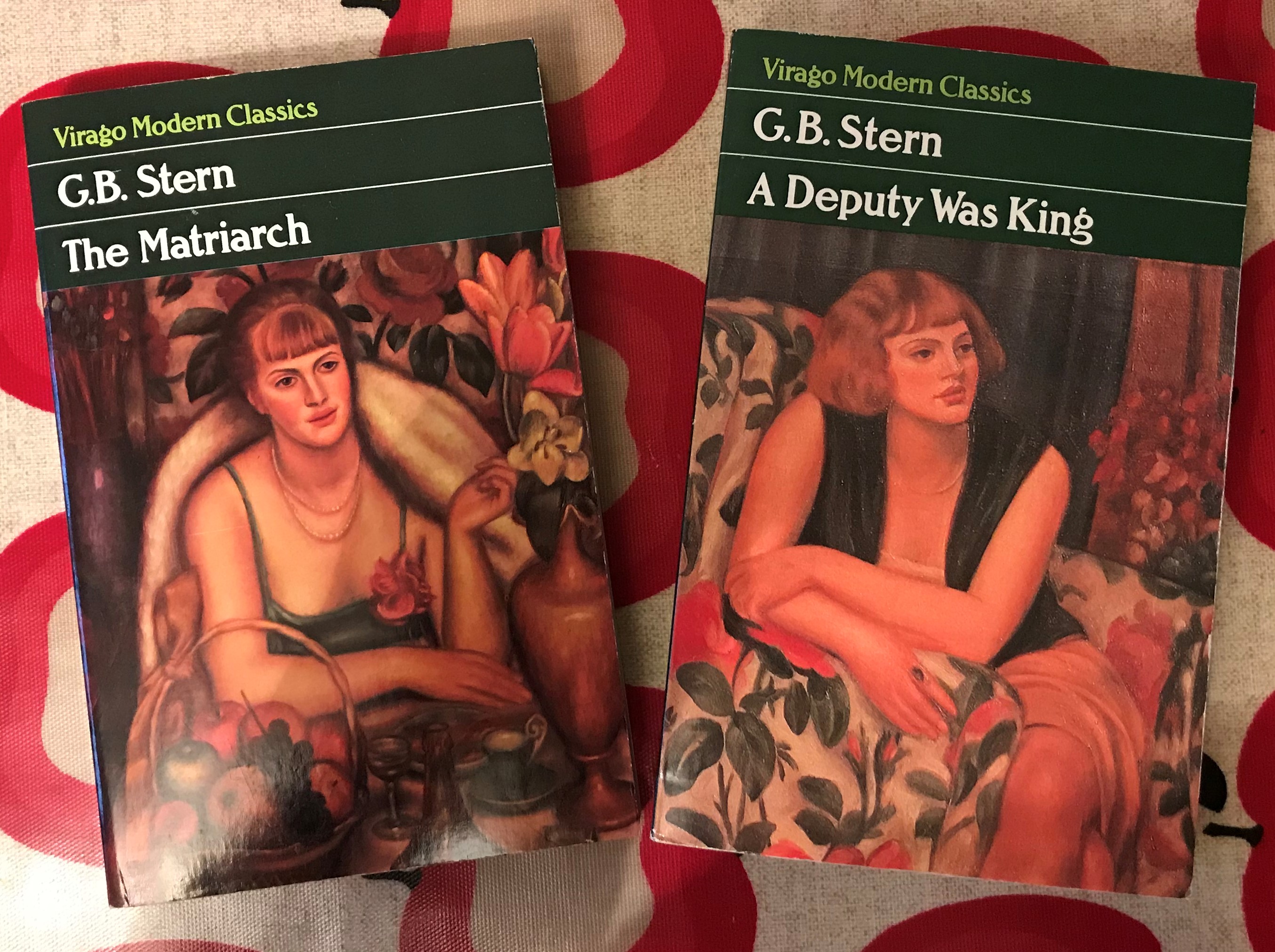
One of the many joys of charity bookshops is hunting down those green Viragos, and I found a lovely pair of GB Sterns in great condition. I’ve never read any GB Stern but I remembered her name from Jane at Beyond Eden Rock’s Birthday Book of Underappreciated Lady Authors. Part of my new-found restraint would generally include not buying more than one book by an author I’ve not read, but that lasted all of 5 minutes. They were green Viragos! In lovely condition! My willpower can only take so much…

These are the first two in the Rakonitz chronicles and the blurb on the back is really tempting, so I’m looking forward to these.

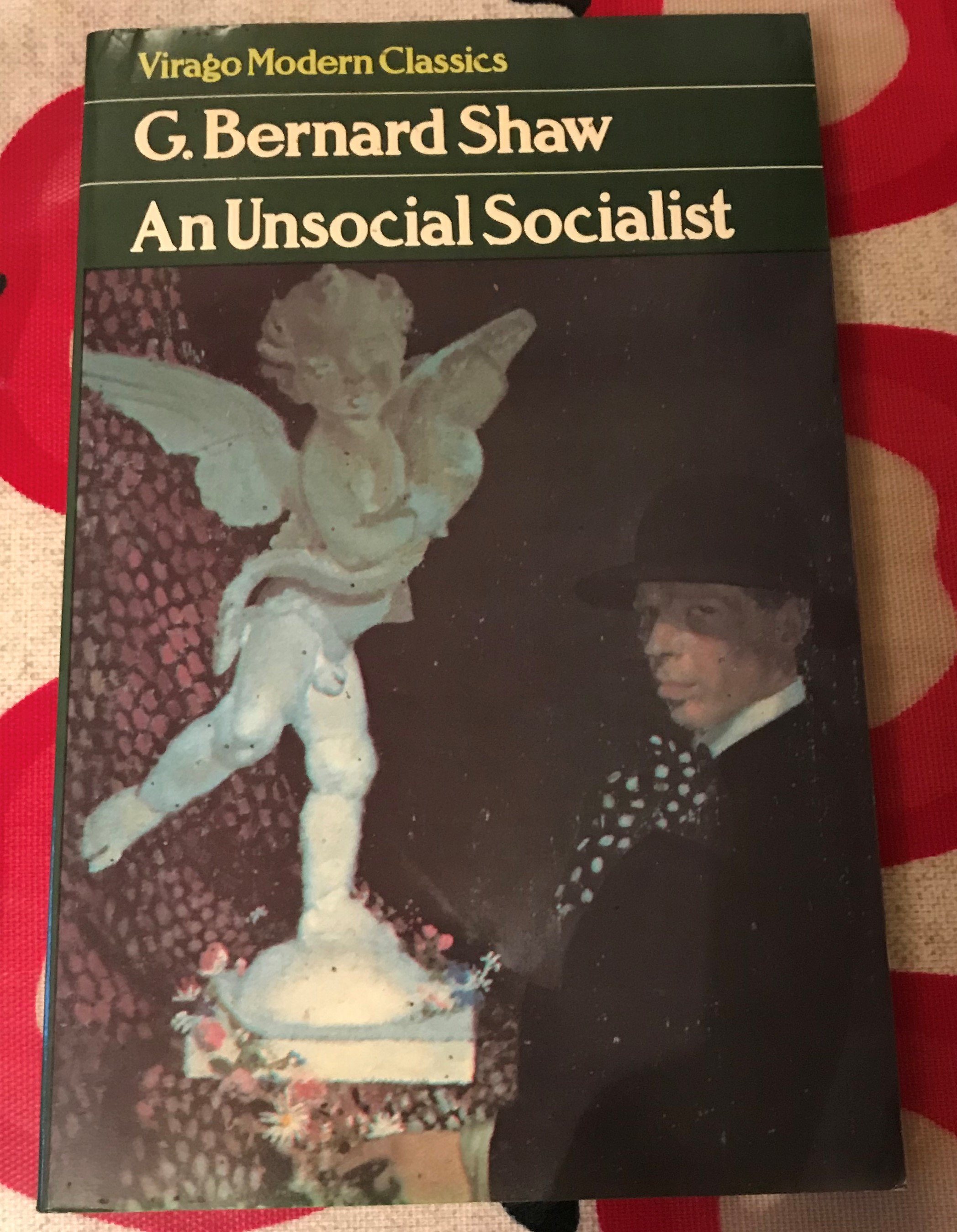
I bought one more green Virago:

I’m not a massive fan of Shaw but the blurb on the back says ‘Shaw’s view was that the false idealisation of women by men enslaved both sexes’ and he’s dismantling this in a comic way, so maybe this will be where I learn to like him.

Sticking with the theme of buying books because I trust the publishers, I picked up these by NYRB and Peirene:

The Delius is apparently a single 117-page long sentence, which frankly sounds horrific, but I trust Peirene and the translator is Jamie Bulloch who does great work so I’m still hopeful. And I do love a novella, which leads me to these:

The Auschwitz Violin, to my cynical mind, looked like an awful lot of other books with similar titles/themes which publishers love, but its novella length means I’ll give it a go, and it does look promising. The Vesaas I’ve never heard of but the reviews quoted on the back cover are rapturous and I enjoy Scandinavian literature so I’m looking forward to this.

Finally, I was pleased to come across Jill by Philip Larkin because Ali’s review last month reminded me that I wanted to read some of Larkin’s prose. Infuriatingly, that mark on the cover was caused by me trying to peel a label off, which I did carefully but it still damaged the cover:

When I’m in charge of the world, stickers will be banned from book covers, that’s a promise. Then I’ll try and sort out world peace and stuff, it’s all about priorities 😀

And there was no way I was going to let Black Narcissus pass me by, having enjoyed two Rumer Godden novels so much last month, and being a big fan of the film.

So, that’s my first book haul of the year! Looking back on the 2018 ban I would say I’ve learnt these things:

  • At the ripe old age of 41 I can still surprise myself
  • I might actually have some willpower after all
  • Its satisfying to see the TBR diminishing
  • I’m never going to not have piles of books
  • Which means I need to move somewhere with really cheap property prices to house them all
  • I still can’t be trusted in a charity bookshop

How about you, dear reader? Any bookish resolutions for 2019? Have you read any of my haul? Where would recommend I start?

Here’s to a wonderful year ahead with many great reads for all of us 😊 Apropos of absolutely nothing, but just because I’ve been listening to her a lot since 2019 started, here is Kate Bush doing a reggae cover of an Elton John song whilst playing a ukulele*. Because she can, because she’s awesome:

*Thank you Fiction Fan (see comments below)

“Nothing makes me more nervous than people who say, ‘It can’t happen here.’ Anything can happen anywhere, given the right circumstances.” (Margaret Atwood)

This is my contribution to Margaret Atwood Reading Month, hosted by Naomi at Consumed by Ink and Marcie at Buried in Print. Do join in with #MARM!

As a teenager I fell in love with Atwood and read all her novels and short stories, most of her poetry and a collection of interviews. Then I’m not sure what happened, the MaddAddam trilogy didn’t appeal to me as much and I probably hadn’t read any Atwood since The Blind Assassin in 2000. In this year of my book-buying ban, I found I had two Atwoods in the TBR, so here they are.

(image from Wikimedia Commons)

Firstly, The Heart Goes Last (2015), my first Atwood in about 18 years, and from the first page I realised I needed her back in my life. She is such an accomplished writer that you know you’re in safe hands. She knows what she’s doing: the characters will be believable, the plot will carry you through, she has something important to say. What more could you want? This being Atwood, the story is terrifying, funny, and horribly believable.

Charmaine and Stan are living in their car. Time and place are unspecified, but there’s every reason to assume it’s now, in the United States. The recession has bitten and they have lost their jobs and their homes, along with many others. Poverty and deprivation have led to rising crime and they are at risk of violent attack. Unsurprisingly, their marriage is under strain:

“Charmaine says why don’t they go jogging? They used to do that when they had their house: get up early, jog before breakfast, then a shower. It made you feel so full of energy, so clean. But Stan looks at her like she’s out of her mind, and she sees that yes, it would be silly, leaving the car unattended with everything in it…and putting themselves at risk because who knows what might be hiding in the bushes? Anyway where would they jog? Along the streets with the boarded-up houses?”

Then one day, when Charmaine is working in a bar, she sees aa television advert for Positron. Positron offers a place to live and full employment.

“She can feel the griminess of her body, she can smell the stale odour coming from her clothes, from her hair, from the rancid fat smell of the chicken-wings place next door. All of that can be shed, it can peel off her like an onion skin, and she can step out of that skin and be a different person.”

Living in Positron means alternating one month in the town, one month in the prison called Consilience. Stan is from a tough background and his brother Con is a criminal. This means Stan is far from naïve, but he is also desperate:

“They’re like the early pioneers, blazing a trail, clearing a way to the future: a future that will be more secure, more prosperous, and just all-round better because of them! Posterity will revere them. That’s the spiel. Stan has never heard so much bullshit in his life. On the other hand, he sort of wants to believe it.”

Charmaine and Stan sign away their lives to the project – there’s no leaving once you’re in – and settle into their new lives. The aesthetic is an idealised 1950s Doris Day film, with surveillance. Gradually they both, in very different ways, begin to understand the dark side of the Positron project, and of each other.

“He hadn’t recognised it when they’d been living together – he’d underestimated her shadow side, which was mistake number one, because everyone has a shadow side, even fluffpots like her.”

The plot that develops is darkly comic, and deeply sinister. Needless to say, the uses of technology in Positron are not ethical, and the question is, where do you draw the line? The answers to this question become more and more murky as the novel progresses.

Charmaine and Stan are not always sympathetic but they are believable, including why they would sign their lives away. The rise of the far right in today’s politics can seem bewildering at best and terrifying most of time, but Atwood has Stan address the reason people support their freewill being circumscribed, in no uncertain terms:

“Not that he gives much of a flying fuck about freedom and democracy, since they haven’t performed that well for him personally.”

There’s also a great deal about gender politics in The Heart Goes Last. I can’t say too much about it for fear of plot spoilers, but I greatly enjoyed this pithy observation by Charmaine when she’s taken out for dinner by a powerful man who wants to seduce her:

“She blots the corner of her eye, folding the trace of black mascara up in the serviette. Men don’t like to think about makeup, they like to think everything about you is genuine. Unless of course they want to think you’re a slut and everything about you is fake.”

The ending is perfect: a twist that shows in miniature the broader themes of the novel, ending with an unresolved question for a character and the reader. It doesn’t allow a comfortable feeling of being in a better, wiser position than the characters but instead asks: when faced with a moral dilemma, do you really know what you would do?

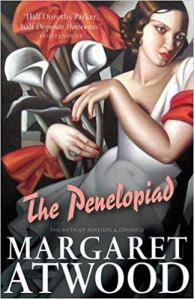
Secondly, The Penelopiad (2005), a novella (hooray!) in which Atwood retells the story of Penelope, faithful wife of Odysseus (part of Canongate’s Myth Series). Penelope narrates the story from Hades. She was the faithful wife of Homer’s myth, but also had her eyes wide open with regard to her warrior husband:

“Of course I had inklings, about his slipperiness, his wiliness, his foxiness, his – how can I put this? – his unscrupulousness, but I turned a blind eye. I kept my mouth shut; or, if I opened it, I sang his praises. I didn’t contradict, I didn’t ask awkward questions, I didn’t dig deep. I wanted happy endings in those days, and happy endings are best achieved by keeping the right doors locked and going to sleep during the rampages.”

This captures much of the themes of The Penelopiad, that is, that Penelope’s feelings for her warrior husband are not straightforward, and also, that the story of events depends on who is doing the telling, what they leave in and what they miss out. The Odyssey is a cornerstone of Western civilisation, but it is not the only version. Penelope’s Odysseus is a wily cheat, far from heroic. Helen is a vain bitch:

“Of course, she was very beautiful. It was claimed she’d come out of an egg, being the daughter of Zeus who’d raped her mother in the form of a swan. She was quite stuck up about it, was Helen.”

When Odysseus is away fighting the Trojan War, Penelope runs his estates extremely well and keeps her suitors at bay. Her son Telemachus is a brat and Penelope feels more kinship with her 12 maids, many of whom she has known since they were babies. The maids form a Greek chorus throughout the story, speaking in verse between chapters. We know that Telemachus will kill them all on his father’s return, and Atwood is intrigued as to why these powerless (poor, female) people are treated so brutally:

“Let them dangle, let them strangle –

Blame it on the slaves!”

Penelope is shown as having to carefully navigate a position that sees her wealthy but powerless, having to pick her way through a minefield of social constraints that could see her branded a whore in her husband’s absence. Her faithfulness is not out of loyalty to Odysseus but self-preservation in a patriarchal society.

There are massive themes in this novella and they are as relevant as ever when the most powerful man in the world has a constant refrain of ‘fake news!’. By the end of The Penelopiad Penelope is shown to possibly not be a reliable narrator, but then, is anyone? Don’t we all have our own versions? Atwood reminds us that for each story told, it is worth considering what gain is to be made. And she does so with irreverent glee:

“Who is to say that the prayers have any effect? On the other hand, who is to say they don’t? I picture the gods, diddling around on Olympus, wallowing in the nectar and ambrosia and the aroma of burning bones and fat, mischievous as a pack of ten-year-olds with a sick cat to play with and a lot of time on their hands.”

Taking part in #MARM has made me check Atwood’s bibliography to see what I’ve missed: I’ve still got her three most recent short story collections, Hag-Seed and the MaddAddam trilogy to catch up on. I’m really grateful to #MARM for reminding me just how much I love her writing and giving me my Atwood impetus back again!

To end, when Margaret Atwood appeared on Desert Island Discs, she chose this song by a much-missed troubadour:

Novella a Day in May #31

The final post of Novella a Day in May! It’s time for dancing Brad:

No-one is more surprised than me to be here. I never thought I’d manage to post every day for a month. Massive thanks to everyone who has read, liked, commented and shared these posts, you are all fab! I never expected people to read this blog on such a regular basis.

I’ve really enjoyed my month of novellas and I hope I’ve managed to spread some novella love along the way.

I’ve never done a summary post before but then I’ve never posted every day for 31 days before, so here’s an attempt to squeeze all those novellas into a few stats before I go on to my final choice for the month.

The gender split in authors was fairly even: 15 female authors and 16 male. Pointless pie chart time:

The novellas ranged across 3 centuries, from 1860 to 2017.

The shortest novella was Journey into the Past at 84 pages and the longest was After Claude at 206, because I cheated my own criteria by 6 pages. The average number of pages of the novellas was 142. None of them were actually this long, which goes to show there’s no such thing as average 🙂

It was a good opportunity to read some of my favourite publishers: I read 9 by Virago, 5 by Pushkin Press, and 2 by Peirene, as well as novellas published by AndOtherStories, and New York Review of Books.

I visited 13 countries including France 3 times (4 times if I count Jean Rhys) and Denmark twice. Two countries were new stops on my Around the World in 80 Books Reading challenge, hosted by Hard Book Habit: Libya and Kyrgystan. Thirteen novellas were in translation and the rest were by English, Irish and American authors. The southern hemisphere was sadly neglected, but this does give me a reason to justify even more novella reading 😉

And now the bit I found hardest: trying to pick out favourites. I planned to try and pick out a top 5 but it’s proved impossible. However, special mention has to go to William Maxwell, who I wrote about yesterday. I thought They Came Like Swallows was a work of restrained beauty. He had a perfect understanding of the novella and used sparse words to convey a story at its absolute essence. Not a word was wasted and no further words were needed. It’s made me keen to hunt down the rest of his work.

And now, onto my final choice! A novella that the blogosphere told me was great last year and then I forgot about until Susan’s post reminded me of the paperback release, so off to the library I went…

Mirror, Shoulder, Signal by Dorthe Nors (2016, trans. Misha Hoekstra 2017,188 pages)

Sonja is single, in her 40s, a translator of thrillers she finds gruesome and misogynistic. She is trying to build bridges with her distant sister, manage her massage therapist’s more esoteric suggestions, and learn to drive.

Sonja’s driving instructor Jytte screams instructions at her and won’t let her change gear, so she goes to see Folke, the head of the school,

“Sonja’s on the verge of tears. It happens unexpectedly; the sob sits in her throat and wants to come out. Folke’s hands move efficiently from side to side across the desk, and she longs to grasp one of them. Squeeze it, say ‘Thank you,’ from the heart. It doesn’t escape Sonja’s notice that she gets red in the face, because this sort of thing rarely happens. It almost never happens anymore – that someone wishes Sonja the best. She’s used to dealing with everything herself, and she’s reasonably good at it too.”

This captures much about Mirror, Shoulder, Signal: Sonja is muddling through life and doing it more or less competently, but she feels awkward and displaced. She’s from Jutland (Folke observes “All the Jutlander’s I’ve met are a bit quirky” and a Danish friend tells me this is a common stereotype ) but has lived in Copenhagen for years, long enough to not feel at home in either the countryside or the city. She’s doing OK but she could be doing better, struggling with “the things she cannot find the language to say and the people she most wants to say them to.”

Sonja’s a strong character and immensely likeable with all her idiosyncrasies. She goes her own way and always has, but reflects that this may cause more harm than good:

“Mom did me a disservice believing I could just be myself. If I hadn’t been allowed to, then I’d be sitting right now with the whole package, but that train’s left the station. And if anyone does, Mom should know that you have to adapt if you’re going to entangle yourself in an intimate relationship. Kate knows that too. And Dad.”

There’s plenty of humour in Mirror, Shoulder, Signal. Not only at Sonja’s slightly blundering way through life, but also at the madness of Jytte screaming out her driving lessons; the awkwardness between Sonja and Folke; the flaky assertions of Ellen, the masseuse. But it’s not a whimsical novel and much of the humour is pretty sharp:

 “while Sonja does miss her sister, at the same time it ignites in her a yearning for fire”

I really enjoyed the short time I spent with Sonja. Nothing much happens, as in much of life, but there is a believable character arc for Sonja whereby things remain unresolved but improving – a happyish, unsentimental ending which made me smile.

To end, normal service will now be resumed on this blog: intermittent, unnecessarily verbose posts on two books linked by a theme, most likely with a cheesy late 20th century pop song shoehorned in. Here’s one such video to ease us in, chosen in honour of the fact that while Novella a Day in May is now over, I’ve enjoyed it so much I’m wondering if I’ve got it in me to do it again next year… what better way to express this than through song, while dressed in a flared satin and spangles jumpsuit twinset? Take it away, Gloria…