Novella a Day in May #18

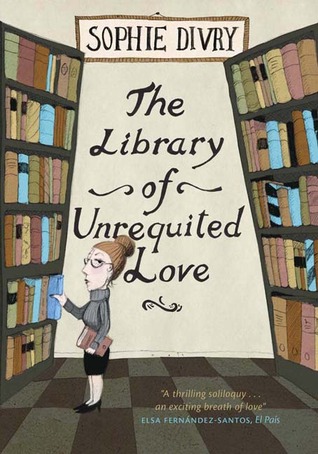
The Library of Unrequited Love – Sophie Divry (2010, trans. Sian Reynolds 2013) 92 pages

The Library of Unrequited Love by Sophie Divry is a monologue delivered by a librarian to a reader who she discovers has been locked in the library overnight, when she opens up in the morning. The librarian is middle-aged and frustrated about a plethora of things, including her job:

“Being a librarian isn’t an especially high-level job I can tell you. Pretty close to being in a factory. I’m a cultural assembly line worker.”

She is committed to librarianship however, and throughout the novella her love of books emerges, as does her appreciation of the Dewey decimal system:

“they didn’t just classify by author, they sometimes put books on the shelf by size, or date of acquisition. Now I think of it, the confusion it must have caused. Glad I didn’t live then, I couldn’t have put up with that kind of anarchy.”

The reader remains a silent interlocutor as the librarian spills out all her feelings. Although she claims she has given up on love, you get the sense this isn’t quite true:

 “One of my favourite authors, you’ve already gathered that, is Guy de Maupassant. Now there’s a man for you. Just imagine, he wrote two hundred and ninety short stories and seven novels in ten years. And then on Sundays, he went rowing on the Seine. A real force of nature, eh? He must have had terrific biceps and been fantastically intelligent.”

There are also her unrequited feelings for a regular library reader:

“With that lovely neck of his. It would disappoint me if a man as clever as Martin were to be in love. But you have to be prepared for anything.”

The librarian is a funny and acerbic narrator:

“That’s another reason I don’t go travelling. Napoleon’s always been there first. I can’t stand it.”

She is slightly self-deceiving but she is also wise, sad, honest and above all, entertaining. I enjoyed my short time in her company, mostly because The Library of Unrequited Love is actually about a love that is always fulfilled, over and over: the love of books.

“Book and reader, if they meet up at the right moment in a person’s life, it can make sparks fly, set you alight, change your life.”

Novella a Day in May #14

The Panda Theory – Pascal Garnier (2008, trans. Gallic Books 2012, 143 pages)

This is the first Pascal Garnier I’ve read, and while I’ve heard he can be a bit read-one-read-them-all, I enjoyed this quick, noir read.

Gabriel arrives in a Breton town and begins to get to know the locals, without revealing very much about himself or why he is there.

“a completely nondescript town…the sea was far away, its presence unimaginable. There was nothing picturesque here.”

Jose owns the local bar and is struggling while his wife Marie is in hospital. Gabriel can cook and so takes on this domestic duty while Jose flounders.

“With his elbows on the table, Jose hoovered up his meal. The tomato sauce ran from the corners of his mouth, to his chin and down his neck. Like an ogre.”

Gabriel wins the titular stuffed toy on the shooting range at the fair, and gives it to Jose for his children, but it stays in the bar, its impassive gaze surveying the customers, arms outstretched.

Gabriel attracts the interest of lonely, cat-obsessed Madeleine, and befriends lonely drug-addict Rita.

“ ‘I love you, Gabriel. It’s stupid but it’s true.’

The blind man turned a corner. The sound of his stick gradually faded away before disappearing completely. The town lay still, bathing in dreams in which everybody was a hero. He had to sleep. Sleep.

‘I’m going back to the hotel, Madeleine. It’s late.’

She’d never been as beautiful as she was then. Much more beautiful than her geranium.”

Gradually we learn about Gabriel’s family and why his wife and children are no longer with him. It also emerges why he is in the town and what his purpose is. The Panda Theory doesn’t hold any great surprises but it’s a well-paced, atmospheric tale that builds effectively to its conclusion. I would happily read more by Garnier, even if it is more of the same.

Novella a Day in May #13

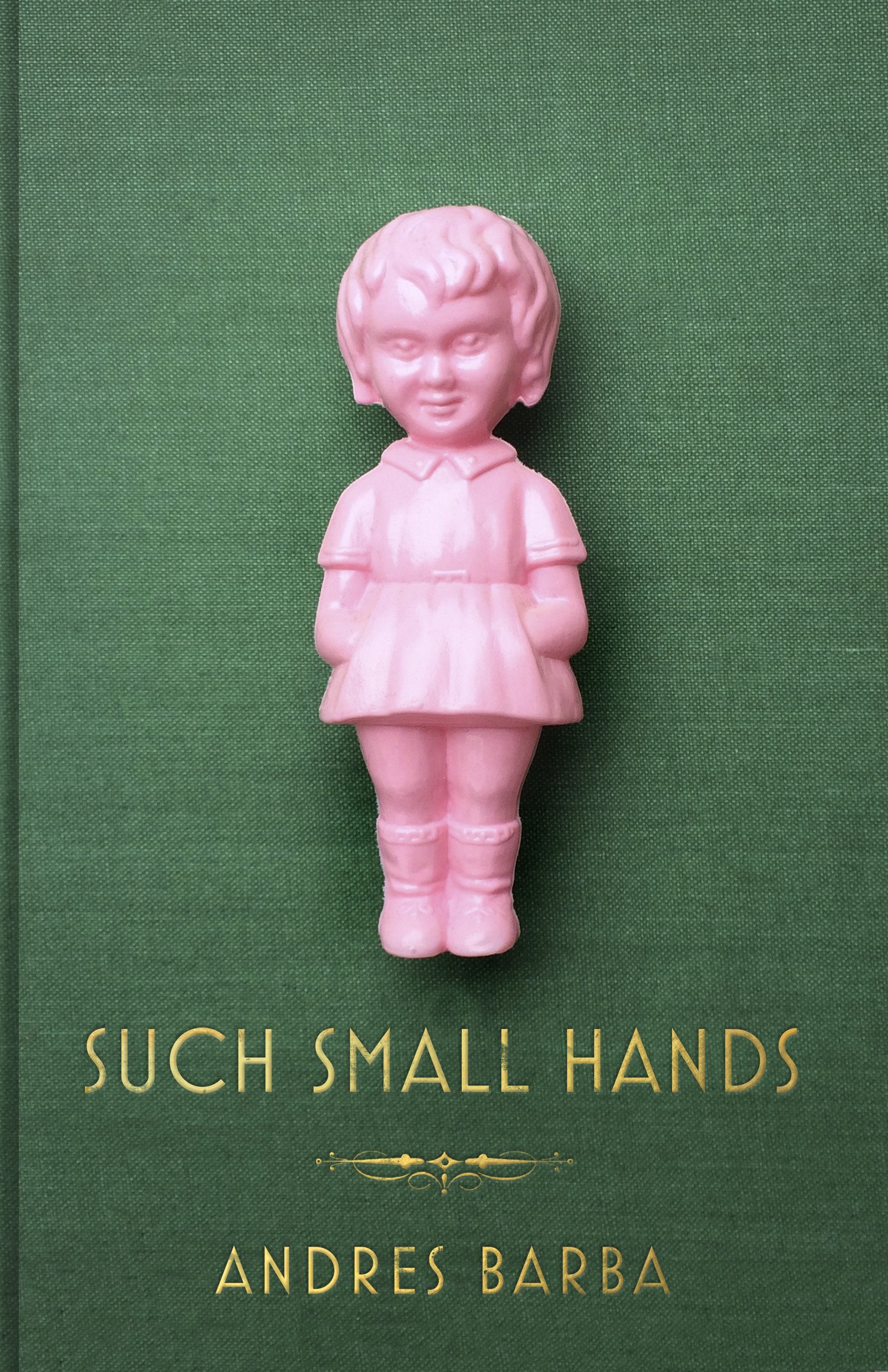
Such Small Hands – Andres Barba (trans. Lisa Dillman 2017) 101 pages

Well, this was super creepy. Institutionalised children *shudder*

Seven year old Marina is in a car accident.

“’Your father died instantly, your mother is in a coma.’ Lips pronounce them without stopping. Quick, dry words. They come in thousands of different, unpredictable ways, sometimes unbidden. Suddenly they just fall, as if onto a field. Marina’s learned to say them without sadness, like a name recited for strangers, like my name is Marina and I’m seven years old. ‘My father died instantly, my mother is in the hospital.’”

After her mother dies, Marina is sent to an orphanage, taking a doll given to her by the psychologist, which she has also called Marina. The other girls are both mesmerised and wary of Marina.

“Marina shrank and we grew. She stood alone, with her doll, by the statue of Saint Anne, watching us. Or was it the doll who was watching? We didn’t know who the doll really was. Because sometimes she looked like Marina, and she, too, seemed to have a hungry heart, and clenched fists close to her body, and she, too, was silent even when invited to join in; and she nodded her head back and forth, something we’d never seen a doll do before.  And she seemed persecuted and excluded, too.”

Neither Marina or the girls understand the relationships they forge. There is fear and eroticism mixed in with tentative gestures towards friendship. Marina’s scar from the accident is a source of wonder.

“‘You can’t feel it?’

‘No. Well, only a little.’

Desire passed through the girl, too. Like stagnant water that suddenly begins to drain, imperceptibly.

And devotion mixed in with the desire.

‘Do you want to touch it?’

‘Yes.’

But the girl didn’t react right away.”

Barba gradually builds the tension and develops the girls’ games into something deeply disturbing and sinister, but wholly believable (there is an afterword which explains the real-life inspiration for the story). This tale will haunt me for a long time.

Novella a Day in May #11

Journey into the Past – Stefan Zweig (1976 German publication; trans. Anthea Bell, 2009) 84 pages

Although I’ve since read and blogged about The Post Office Girl, this was the first Stefan Zweig I’d read and at first I wondered why everyone rated him so highly as a writer. Then I realised what he was doing in Journey into the Past was immensely clever.

It tells the story of a love affair between a student, Ludwig, and the wife of his employer, who is not named. The story begins with them on a train in the 1920s, and with Ludwig’s thoughts travelling back into the past to remember how they first met before the First World War separated them.

At first, I thought the description of the affair overblown and naïve.

“From that first meeting he had loved this woman, but passionately as his feeling surged over him, following him even into his dreams, the crucial factor that would shake him to the core was still lacking – his conscious realisation that what, denying his true feelings, he still called admiration, respect and devotion was in fact love  – a burning, unbounded, absolute and passionate love.”

At this point I was thinking Zweig perhaps wasn’t for me 😉

But as the story developed – they admit their love but it remains unconsummated, he goes abroad and then war breaks out, separating them for longer than they ever anticipated – it dawned on me that this style choice was entirely deliberate and conscious.  What Zweig shows us is a world before modern technological warfare, a world that was brutally torn apart. These naïve young lovers are part of a society, a life, that was utterly destroyed.

So although we know they are reunited, it is not with the same youthful self-obsession or indulgent love that they had previously.

“‘Everything is just as it used to be, don’t you think?’ she began, determined to say something innocent and casual, although her voice was husky and shook a little.  However he did not echo her friendly, conversational tone, but gritted his teeth.

‘Oh yes, everything.’ Sudden inner rage forced the words abruptly and bitterly out of his mouth. ‘Everything is as it used to be except for us, except for us!’”

Journey into the Past is not a depressing book despite portraying losses that are glimpsed and barely articulated. It is about the impact of international conflict on the lives of individuals in the smallest, most profound ways. Zweig questions whether those loses can be overcome, and I still don’t know what I think.

I feel foolish for my initial impression of this novella: I hadn’t realised I was in the hands of a master.

Novella a Day in May #9

First Love – Ivan Turgenev (1860, trans. Isiah Berlin, 1950) 106 pages

This short tale of thwarted first love, told by a man, Vladimir Petrovich, looking back on the summer of 1833 when he was 16, manages to be both moving and funny. I felt for the pain of the young boy, whilst simultaneously rolling my eyes at the self-importance of teenagers (a bit how I feel watching Romeo and Juliet these days – kids!)

A young man is on the brink of adulthood, having just said goodbye to is tutor, when Princess Zasyekin moves in next door. The princess is uncouth and her house shabby:

“She took snuff as noisily as ever, and fidgeted and turned about on her chair as much as before. It never seemed to have entered her head that she was a princess.”

However, her daughter Zinaida is beautiful and poised, and has suitors in abundance. She teases them all, keeping them in a state of anticipation whilst remaining just out of reach. The young Petrovich is no different:

“But through the tears and the melancholy, inspired by the music of the verse or the beauty of the evening, there always rose upwards, like the grasses of early spring, shoots of happy feeling, of young and surging life.”

Yet there is always the sense that things are happening with Zinaida that our protagonist is too green to recognise. She seems genuinely fond of him and at one point even tells him so after he nearly breaks his neck jumping from a high wall (told you – kids!) yet there is something worldly and slightly damaged about her which Petrovich cannot begin to understand.

 “My arms were smarting from the nettles, my back ached, my head swam, but at that moment I experienced a sense of bliss such as I never again felt in the whole of my life. It flowed like a delicious pain through all my limbs and finally resolved itself in rapturous leaps and cries. Yes, indeed, I was still a child.”

First Love reminded me of The Go-Between and Great Expectations whilst being resolutely its own tale. In a short space it conveys a detailed, effective portrait of the awakening of a young person to both the love and corruption that the adult world has to offer.

Novella a Day in May #8

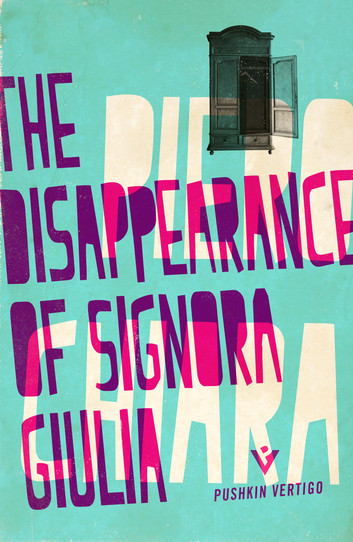
The Disappearance of Signora Giulia – Piero Chiara (1970, trans. Jill Foulston 2015) 122 pages

The Disappearance of Signora Giulia was initially published in an Italian newspaper as a serial and is now available in English translation thanks to Pushkin, as part of their Vertigo imprint. It is a quick, snappy crime thriller that does not aim for trite resolution but rather an exploration beneath the surface of a life to the murky depths.

Corrado Sciancalelpre is “blessed with a special form of intuition, that peculiar mental agility that enables great policemen to delve into the minds of criminals.”

Thankfully, he is also happy married and liked in the town in northern Lombardy where he works – no tortured alcoholic with a secret past here.

A powerful lawyer, Esengrini, asks Sciancalelpre to investigate the titular vanishing of his wife. Every Thursday, Guilia has been going to Milan to visit their daughter at boarding school, but now she has failed to return and two bags of her things are missing too. Sciancalelpre agrees and what follows is essentially a police procedural, but the short length of the story ensures the pacing remains tight.

Sciancalelpre is resolutely unsentimental but not without sympathy. The more he investigates, the more he feels for the missing woman:

“He didn’t say ‘Poor Signora Giulia to Esengrini when he visited him in his office every few days towards evening. With Esengrini, he spoke only of the undeniably disappointing results of a search conducted throughout the whole of Italy with Signora Giulia’s photo.”

It’s impossible to say much more about a crime novella without including spoilers. Suffice to say there are plenty of red herrings, people and relationships who are not what they seem. The Disappearance of Signora Giulia is a diverting read, when you’re in the mood for a crime novel you’ll finish quickly. It is not a simple tale though, and the resolution is a complex one that leaves questions unanswered. This wasn’t a source of frustration but rather felt realistic.

I really enjoyed this, Chiara’s first novel to be translated into English despite his huge popularity in Italy, and I hope there will be many more translations to follow.

Novella a Day in May #5

Cliffs – Olivier Adam (2005, trans. Sue Rose, 2009) 147 pages

Set over the course of a single night, Cliffs shows the enduring damage caused to the child – now a grown man – of a parent who dies by suicide.

The narrator is sitting on a balcony on the Normandy coast in the middle of the night, gazing at the cliffs where his mother died, while his partner and child lie sleeping in the room behind him. As he sits and smokes, he reflects on his life with his abusive father and his traumatised brother:

“We weren’t supposed to breathe move speak feel. We weren’t supposed to need anything, pocket money or comfort or affection or smiles or advice, we weren’t supposed to expect anything except the slaps, smacks or wallops he dealt out”

Later he meets other damaged souls, drawn together by a mutual recognition:

 “We’ve grown up in fear of our fathers, the troubled silence of our mothers, the empty space formed by abstract, imaginary places, without edge or centre.”

Cliffs isn’t a depressing book; it is a story of survival, of endurance even when we are irrevocably damaged by experience.

 “This way of life didn’t cure me of anything, it was merely possible when I couldn’t cope with any other kind of life, particularly the one I’d just left behind. It was a life of silence, space and absence, of maintaining an acute presence within objects, the shifting play of light, the still motion of water, the perfumes, the texture of the air. It was a life in which I finally found a niche, quiet but peaceful, a body filled with air and fog, a mind completely given over to the noise of the sea and the wind, the company of birds.”

Cliffs is beautifully written, but the beauty in no way detracts from the raw hurt experienced by narrator. It is an intense read, haunting and memorable.

Novella a Day in May #3

Jamilia – Chingiz Aitmatov 96 pages (1957, tr. 2007 James Riordan although the publishers don’t say if this was from Kyrgyz or Russian – Aitmatov wrote in both)

This novella, less than 100 pages in my edition, is a simple tale, perfectly told. It’s also one more stop on my Around the World in 80 Books Reading challenge, hosted by Hard Book Habit.

Narrated by Seit, the brother-in-law of the beautiful titular protagonist, Jamilia is reminiscent of The Go-Between, in that it is told from the point of view of the young observer of an older person’s love affair, from a time in his life when he is looking back on his past.

Set during the war, Jamilia’s husband is away fighting. An injured soldier, Daniyar, returns to the village where he was born:

“ ‘We are content and so are the spirits of our ancestors. And now, God willing, we’ll finish off the Germans and live in peace and Daniyar will raise a family like the rest of us, his own smoke will rise from the hearth.’

By invoking Daniyar’s ancestors they were saying he was one of us. And that is how a new kinsman appeared in our village.”

Daniyar, Seit and Jamilia travel regularly by cart to take the grain from the harvest to the train station. Aitmatov writes with economy yet is able to evoke a vivid scene with few words. He captures the land of Kyrgyzstan with true sensitivity and the land is an integral part of the story:

“Eager to reach home, the horses trotted briskly, the stones scraping beneath their feet. The cool wind brought with it the bitter pollen of flowering wormwood, and the faint aroma of ripening wheat. Mingling with the smell of tar and horse sweat, it all made us faintly dizzy.”

During the journeys back and forth, the quiet, unassuming Daniyar is teased by the vivacious Jamilia and Seit. Then Daniyar starts to sing, and everything changes:

“If only I could recreate his song. It contained few words, yet even without words it revealed a great human soul. I have never heard such singing before or since. The tune was like Kirgiz or Kazakh, yet in it was something of both. His music combined the very best melodies of the two related peoples and had woven them into a single, unrepeatable song. It was a song of the mountains and the steppe, first soaring into the sky like the Kirgiz mountains, then rolling freely like the Kazakh steppe.”

What lifts this tale above the ordinary is Aitmatov’s beautiful writing, but also how the story expands a simple, almost fable-like, narrative into something broader. Jamilia is about romantic love, but told at a step removed by a man who grew up to become a painter; it also becomes about art, and the transcendental nature of love and art. Jamilia falls for Daniyar because of his voice. Seit becomes seized with a desire to create, and takes his first tentative steps towards his life’s vocation. Jamilia is about how love, in all its variety of forms and circumstance, unites us all:

“I felt it was not simply a love for another person, it was somehow an uncommon, expansive love for life and earth.”

Novella a Day in May #1

For a while now I’ve been enamoured of the novella. I enjoy sparse writing styles (not so good at this myself 😉) and at its best a novella gives us a narrative distilled to its essence for maximum impact. To spread novella love I’ve decided to post about a novella each day for the whole month. There’s no fixed definition of a novella so for my purposes I’ve decided its longer than 70 pages and shorter than 200. This will definitely work! It won’t peter out and die in a heap by 5 May at all! Onwards…

The Game of Cards – Adolf Schroder (trans. Andrew Brown, 2008) 143 pages

The Game of Cards  is not ostensibly gothic or a thriller, and yet it is both these things. The story of how student Markus Hauser is employed by Selma Bruhns for a week to put several trunks worth of letters into chronological order is truly creepy and suspense-filled.

Selma is a terse, uncommunicative employer, who lives in an old house with a vast number of cats at varying stages of disease. Markus is constantly at the point of leaving, unable to stomach the “stench” of the house, the feral occupants, his awkward employer and the seemingly pointless nature of his repetitive task:

“He squatted down between the piles of letters lying on the floor, but when her resumed his work…looking for the pile in which he was putting the letters from 1943, laying the pages of the letter on it and reaching out for the next one, he paused, as if he’d only just realised that he had absolutely no idea what he was doing”

Gradually however, Markus is drawn into the letters, all written to a woman named Almut.  Very little is given away, but Markus finds himself compelled to continue, without really understanding why.

 “Words from the letters that he had read came alive. He found himself in streets where he had never been, heard the shrieking and whistling of creatures that he could not see but whose presence he surmised, felt on his skin the burning sun whose strength he had never yet felt, saw a woman coming up to him who spoke in a language that he did not understand.”

This chronology is interspersed with the investigation being conducted by Superintendent Berger, who suspects Markus of having strangled Selma with her own scarf on his last day of work. Thus we are drawn into not only the mystery of who Almut is and why Selma is obsessively writing to her, but also who killed Selma and why. Schroder jumps between the two timelines without preamble and so the reader is drawn into the disorienting, imperfectly understood situation of the all the characters.

 “With a sudden move that took Markus by surprise, she threw the animal towards him, it crashed into his chest, and only because Markus reacted quickly and caught the animal could he prevent I from falling onto the ground.

‘You are working slowly and without much concentration,’ said Selma Bruhns, turning round and stepping into the house.”

There is also the question of what happened – and what the stake was – in the titular match between Markus and Selma…

The Game of Cards is a deeply disturbing read, and a powerful portrait of enduring psychological trauma. It will stay with me for a long time.

“My roommate got a pet elephant. Then it got lost. It’s in the apartment somewhere.” (Steven Wright)

This week’s theme stems from a very boring reason. But I try to pick themes that relate to my life or what’s happening in the world in some way, and my life is very boring. In fact, the most remarkable thing about it is just how dull it is. So brace yourself reader, and try & stay awake while I tell you that I am a leasehold flat owner.

I’ve always hated this because my managing agents are inept slimebags truly reprehensible human beings, but I spent an evening last week consoling a friend who is a share-of-freeholder and is engaged in a long dispute with her one of her neighbours/fellow freehold sharers, which has now turned vaguely medieval and who she refers to by a most unsavoury nickname.

If you’re still with me, you deserve a little treat. Here’s a trailer for one of my favourite ever films which is rather apt:

So as I spent a long time thinking about flats recently, the theme is novels set in apartment blocks. Firstly, Paradises by Iosi Havilio (2012, trans. Beth Fowler 2013). Apparently this is a sequel to the author’s previous novel Open Door, which I haven’t read, but it didn’t seem to restrict my understanding of Paradises, which I found compelling. Following the death of her partner, an unnamed woman leaves her country home with her small child, Simon, and moves to Buenos Aires. She gets a job at the local zoo:

“Something about the gloomy light, the small of the enclosure, the watchfulness of the snakes in captivity produces a hole in my stomach, an anguish that forces me to increase my pace. I skirt the large tank of water turtles, ignore the lizards walk past the door saying nursery and go outside.”

The janitor, Canetti, takes a shine to her. He used to be a bank treasurer before losing his job through fraud and is filled with bitterness. He shows the woman the el Buti squat, presided over by the obese, immobile, morphine-addicted Tosca.  She moves in:

“And yet despite the filth, the heat, those intestinal noises, and the smell of shit that rises in waves, at some point in the early hours Canetti’s words from the first time he brought me here come to mind: We’re safe here. I even babble them to myself to confirm it. And so I relax and rest a bit, although still without sleeping. On the third day I cover the windows with black bin bags to prolong the night.”

The voice of the young woman is matter-of-fact and she presents her extreme circumstances almost indifferently (Paradises has been compared to L’Etranger). This, combined with the present-tense, captured the numbness of grief and the sense of just getting through each moment. Yet according to the introduction by Alex Clark, the narrator’s passivity and weird equanimity was present in Open Door too, so maybe it’s just her character. Either way, I found her voice distinct and engaging. We follow her through her life as she juggles motherhood, work, relationships with idiodyncratic but wholly believable characters: seemingly spiky Iris who cares for Simon; the unpredictable Eloisa who seems to have no boundaries at all and drags the narrator along with her; the various residents of el Buti.

“each of us has to devise our truth in relation to the other”

The squat is surrounded by paradise trees, whose berries are poisonous and whose bark holds the cure. This duality is repeated throughout the novel: alienation sits alongside connection, love and grief are side by side. Paradises is an unsettling novel but at no point did I feel alienated from the unusual, detached woman telling the story. A remarkable achievement.

Let’s take a Vincent Cassel break (that’s definitely a thing, isn’t it?)

Secondly, A Far Cry from Kensington by Muriel Spark (1988) is set at “14 Church End Villas, South Kensington, that rooming house, shabby but clean, that today is a smart and expensive set of flats, gutted and restructured, far beyond the means of medical students, nurses, and the likes of us as we were.”

Narrated by the young widow Mrs Hawkins, she describes her time at the rooming house in the 1950s.  She moves between jobs in publishing with little respect for her employers:

“Sir Alec was thin and grey and his voice matched his looks. It sounded like a wisp of smoke wafting from some burning leaves hidden by a clump of lavender.”

“I had a sense he was offering things abominable to me, like decaffeinated coffee or coitus interruptus

Spark’s satire of publishing and writers is a joy, but A Far Cry From Kensington is also about capturing a moment in time when society is on the cusp of change. Relationships between the sexes are changing, and Mrs Hawkins pushes against societal expectations of women in the mid-20th century. She is resentful of being characterised as a capable widow (she feels this is partly due to her size and begins determinedly losing weight).

Meanwhile, there is tension in the house as someone is sending threatening anonymous letters to Wanda, a European seamstress who rooms there. The different residents begin to suspect each other while landlady Milly is certain it’s an outsider:

“Milly was upset at the suggestion that it was someone in the house, to the point of being almost mesmerized by the idea. She also feared further letters. ‘These things happen in threes’ said Milly in her way of uttering bits of folk-wisdom; she was spooning tea into the heated teapot. She always mixed tea with maxims.”

Mrs Hawkins is a great narrator: matter-of-fact, funny, uncompromising.

“I enjoy a puritanical and moralistic nature; it is my happy element to judge between right and wrong, regardless of what I might actually do.”

The plot around the victimisation of Wanda is frankly a bit bonkers and easily the weakest point in the novel, but despite a weak plot A Far Cry From Kensington is full of Spark’s wit and razor-sharp observation. Not a word in this short novel is wasted.

To end, a video putting the brutalist architecture of the Thamesmead flats to good use: