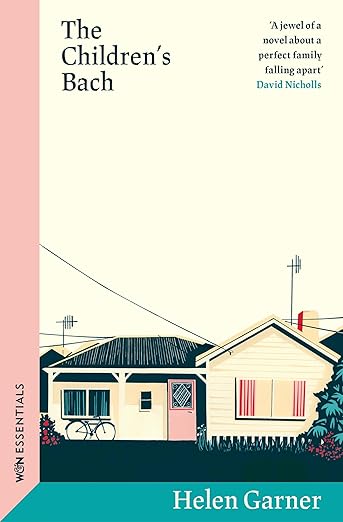
The Children’s Bach by Helen Garner (1984) was apparently hailed as one of four perfect short novels in the English language. If I was Helen Garner I would sigh with frustration at such accolades being on the jacket – how is any novel going to live up to that? But it is excellently written, and in a nice W&N Essentials edition too.
The story revolves around Dexter and Athena, a happily married couple with two children, Arthur and Billy.
“They were friends. They lived in a sparsely furnished house near the Merri Creek: its walls were cracking, its floor sloped and its doors hung loosely in their frames.”
Dexter meets an old friend Elizabeth, who has caring responsibilities she wishes she didn’t: her much younger, chaotic sister Vicki. Dexter is pleased to see her, although its unclear if it is Elizabeth herself he’s pleased to see, or what she represents:
“Dexter was mad about the past. He believed in it, it sustained him, he used it to knit meaning into the mess of everything.”
Elizabeth is living a very different life with her sort-of boyfriend Philip. It is the steadiness of what Dexter and Athena represent in contrast that draws Vicki from her sister and Philip, towards those with a more conventional set-up:
“She loved the notes they left for each other, the drawings and silly rhymes, the embarrassing singing, the vegetable garden, the fluster under which lay a generous order, the rushes of activity followed by periods of sunny calm: Vicki was in love with the house, with the family, with the whole establishment of it.”
But Athena and Dexter aren’t too good to be true. There are pressure points in any relationship and without malice, Vicki, Elizabeth and Philip start to force these open.
We follow Dexter and Athena into a more unstable world where the structures they have surrounded themselves with begin crumble. What I thought was a masterstroke was that Garner doesn’t portray this in a linear fashion. We jump forwards, there are gaps, not everything is spelled out. It stops what is in some ways a very ordinary story from becoming pedestrian, and it reflects the way the characters continue along their lives until something jolts them out of routine.
The characters are well realised without being cliches too. Athena is a loving homemaker, but she isn’t self-sacrificing. I found shocking this casual admission about her son Billy, who has an unspecified disability:
“I’m just hanging on till we can get rid of him.”
And Elizabeth, more freewheeling and self-focussed, surprises herself when Vicki moves out:
“She went home on the tram and was surprised to find a small lack in herself, a blankness where the unwelcome responsibility had been.”
Garner isn’t interested in what is easy. She is so skilled at presenting complex human beings while not seeming to take a view on them: they are as they are. I think I preferred The Spare Room of the two Garner’s I’ve read, but that is more to do with themes that I’m interested in rather than the novella itself. Either way, I’m keen to read more of the fiction and non-fiction by this skilled, clear-sighted writer.

