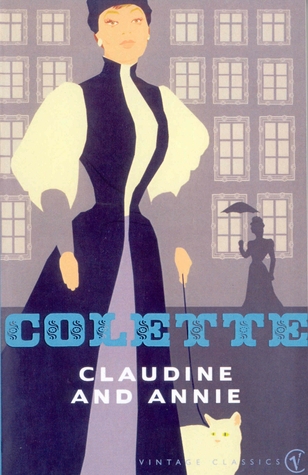
I thought it would be apt to finish Colette Week with a novel concerned with endings: The Last of Cheri (La Fin de Cheri). Here’s a reminder of my decidedly kitsch edition because it’s just so bad:
Thankfully I’m not quite so shallow as to let a hideous cover affect my enjoyment of Colette’s glorious writing (almost shallow enough, but not quite). The Last of Cheri is set 6 years later than Cheri, just after the end of World War I. He is no longer quite the callow youth he was: his affair with Lea and his experience of fighting in the trenches have left him cynical and damaged.
“he had come to scorn the truth ever since the day when, years ago, it had suddenly fallen from his mouth like a belch, to spatter and wound one whom he had loved.”
But, as the French wisely say, plus ça change, plus c’est la même chose. Cheri is still directionless, still without anything to live for beyond himself. Meanwhile his mother and wife have found purpose in war. Edmee is a nurse and consumed by her work at the hospital and extra-marital affairs, which Cheri agrees to.
“Cheri pulled out the small flat key on the end of its thin gold chain. ‘Here we go. In for another carefully measured dose of love. …’”
Cheri’s old friend Desmond is here too, still reprehensible, but like the women in Cheri’s life, having found purpose, setting up a popular nightclub where people try and forget what they and France have been through:
“They danced at Desmond’s, night and day, as people dance after war: the men, young and old, free from the burden of thinking and being frightened — empty-minded, innocent; the women, given over to a pleasure far greater than any more definite sensual delight, to the company of men: that is to say, to physical contact with them, their smell, their tonic sweat, the certain proof of which tingled in every inch of their bodies — the certainty of being the prey of a man wholly alive and vital, and of succumbing in his arms to rhythms as personal, as intimate, as those of sleep.”
If Cheri was told primarily from Lea’s perspective, The Last of Cheri is from Cheri’s perspective and Colette captures this wonderfully. Given that Cheri is so lost and directionless, the novella never appears so. The writing is insightful without being heavy-handedly psychological, and although set in town, Colette’s feel for the natural world remains:
“He noticed that the rosy tints of the sky were wonderfully reflected in the rain-filled gutters and on the blue backs of the low- skimming swallows. And now, because the evening was fresh, and because all the impressions he was bringing away with him were slipping back perfidiously into the recesses of his mind – there to assume their final shape and intensity — he came to believe that he had forgotten all about them, and he felt happy.”
This feeling of happiness is brief though, and occurs after a distressing meeting with Lea, so the reader knows Cheri is deluding himself. Like everyone else, Lea has moved on and is in a very different place, happy and fulfilled.
Poor Cheri. He is utterly lost and ricochets around without any idea as to how to remedy his emptiness. The crisis of meaning of a rich, good-looking playboy could test the reader’s patience, but Colette’s writing meant I had real sympathy for him. His life from the start meant he didn’t stand much of a chance:
“His childhood as a bastard, his long adolescence as a ward, had taught him that his world, though people thought of it as reckless, was governed by a code almost as narrow-minded as middle-class prejudice. In it, Cheri had learned that love is a question of money, infidelity, betrayals, and cowardly resignation. But now he was well on the way to forgetting the rules he had been taught, and to be repelled by acts of silent condescension.”
So, that’s the end of Colette week on the blog. I’ve really enjoyed submerging myself in her writing this week and I hope I’ve managed to convey just a tiny bit of how good she is. She has a deep understanding of people and a wonderful sympathy with the natural world. I find her evocative and capable of great artistry but with a real lightness of touch. Plus she wrote a lot of novellas, which always gets my vote 😊 She was a prolific writer so there’s plenty more to explore, which I’m really looking forward to.
I’m ending the week with Colette’s two novels about a beautiful young man, Cheri and The Last of Cheri (tomorrow). Before we go on, look at this awful book cover:
It’s the nearest I’ve come to being embarrassed to read a book in public (I still did it though 😀 )
My aesthetic qualms aside, let’s get back to Cheri. It’s a beautifully written, minutely observed novel and so the quotes are lengthy, as I inadequately attempt to give a sense of Colette’s mastery.
Fred Peloux, known to most as Cheri, is in his mid-twenties and his lover, Lea, is nearing 50.
“At the age of forty-nine, Leonie Vallon, called Lea de Lonval, was nearing the end of a successful career as a richly kept courtesan. She was a good creature, and life had spared her the more flattering catastrophes and exalted sufferings. She made a secret of the date of her birth; but willingly admitted — with a look of voluptuous condescension for Cheri’s special benefit — that she was approaching the age when she could indulge in a few creature comforts. She liked order, fine linen, wines in their prime, and carefully planned meals at home. From an idolised young blonde she had become a rich middle-aged demi-mondaine without ever attracting any outrageous publicity.”
They have been together for six years, since Cheri was 19. His mother, Charlotte, was also a courtesan and Cheri’s paternity is unknown. His beauty is astonishing but his personality is lacking.
‘Why is he so ugly when he laughs? — he who’s the very picture of beauty!’ She thought for a moment, then finished aloud: “It’s because you look so ill-natured when you’re joking. You never laugh except unkindly — at people, and that makes you ugly. You’re often ugly.”
Charlotte is determined to get Cheri married, and Lea claims she is at ease with this; she never anticipated her relationship with Cheri would be a long one. Charlotte and Lea have an antagonistic relationship but one of mutual understanding.
“They had known each other for twenty-five years. Theirs was the hostile intimacy of light women, enriched and then cast aside by one man, ruined by another: the tetchy affection of rivals stalking one another’s first wrinkle or white hair. Theirs was the friendship of two practical women of the world, both adepts at the money game; but one of them a miser, and the other a sybarite. These bonds count. Rather late in their day, a stronger bond had come to link them more closely: Cheri.”
Cheri marries a young woman named Edmée, but it is not a love match. He ends up listless and unhappy, disappearing for 3 months to live in Paris with his friend/hanger-on Desmond, denying his jealousy regarding the rumour that Lea has left the city with a new lover. It is an existence entirely empty and wholly unsatisfying to him. Cheri is worshipped for his looks and youthful energy but he is a deeply inadequate human being. His is an unexamined life, without purpose or meaning.
“For a moment he gave way to self-pity and self-contempt. How many good things had he missed by leading such a pointless life — a young man with lots of money and little heart! Then he stopped thinking for a moment, or possibly for an hour. Next, he persuaded himself there was nothing in the world he wanted, not even to go and see Lea.”
In this short novel Colette documents the evolving relationship between Lea and Cheri, and its sad conclusion. It is an insightful character study of the main protagonists, and an unblinking dissection of a relationship that is doomed to failure despite the deep love between Cheri and Lea. It will not survive societal pressures, nor the lack of humanity and compassion within Cheri.
“An undecipherable thought appeared in the depths of his eyes; their shape, their dark wallflower hue, their harsh or languorous glint, were used only to win love, never to reveal his mind. From sheets crumpled as though by a storm, rose his naked body, broad- shouldered, slim-waisted; and his whole being breathed forth the melancholy of perfect works of art.”
Cheri has been adapted quite a few times (hence my awful book cover). Here’s the trailer for the 2009 film directed by Stephen Frears:
I’ve a stinking cold Reader, please bear with me if this post is even more rambling and incoherent than usual…
Ripening Seed (original title: Le Ble en Herbe trans. Roger Senhouse 1955) has a subtitle on my old orange Penguin edition ‘An idyllic tale of a modern Daphnis and Chloe’, which I think is misleading. I didn’t find the tale idyllic; Colette is far too psychologically astute for that. So although its about a young couple discovering themselves and their love for each other over a long hot summer, its about pain as well as joys, and how the two can be hard to disentangle. It has similarities to Daphnis and Chloe, but departs from that story too.
Vinca “the Periwinkle, with eyes the colour of April showers” and Philippe who “radiated intolerance and a sort of traditional despair…for the period when body and soul are like buds ready to burst into flower” have known each other for years as their families holiday together in Brittany each year. Now Vinca is 15 and Philippe is 16, their feelings are starting to change toward one another. So far, theirs is a chaste romance, full of high adolescent feeling but without physical expression.
I’m not really in the market for teen romance – even Romeo and Juliet tries my patience – but Colette held me with this. Her evocative depictions of nature are to the fore as she captures a hot coastal summer:
“An offshore breeze wafted the scent of the new-mown after-crop, farmyard smells, and fragrance of bruised mint: little by little, along the level of the sea, a dusty pink was usurping the domain of blue unchallenged since the early morning […] the bleat of a goat and the tinkle of the cracked bell round its neck were enough to make the corners of his mouth quiver with anguish and his eyes fill with tears of pleasure. He did not let his eyes linger on the rocks where Vinca was roaming”
I also didn’t mind Vinca and Philippe’s contrariness towards one another. It seemed very believable for two young people who don’t know what to do with their feelings.
“There were still times when they could forget their love, despite the force that daily increased its tentacle hold and slowly but surely sapped their mutual trust and gentleness; and despite their very love itself, though it was changing the essence of their tender affection as coloured water changes the complexion of the rose that drinks it.”
Philippe is seduced by the older Mme Dalleray and so for the latter half of the novel the reader is waiting for the fallout from this sexual awakening away from Vinca. The title in French is from the phrase ‘manger son blé en herbe’/’to eat the wheat that has just sprouted’. In other words, people who are impatient end up denying themselves the benefit of a situation they should have let develop. As I mentioned at the start of this post, this is a story that deals with the pain of love as much as the joys…
Ripening Seed is a novella (122 pages in my edition) focused on building atmosphere and capturing a moment in time for two young protagonists. It’s beautifully written and Colette drew me into Vinca and Philippe’s world from the start.
Le Ble en Herbe has been adapted for the screen a few times (of course it has, young good-looking people in love a cinematic mainstay). Here’s a clip from the 1954 version:
In Claudine and Annie, original title Claudine s’en va (trans. Antonia White 1962), we hear someone else’s impression of the free-spirited heroine, as the novel is told from the point of view of Annie, a very different woman to Claudine.
“I don’t know anything…except how to obey. He has taught me that and I achieve obedience as the sole task of my existence…assiduously…joyfully.”
He is her husband, Alain, who she has loved since childhood and has left her for many months in order to travel to Brazil and claim a legacy. We never meet Alain but he seems fairly repulsive, including saying that she shouldn’t take his rare compliments to heart, as:
“It is my own work I’m admiring; a lovable child, fashioned little by little into and without great difficulty into an irreproachable young woman and an accomplished housewife.”
He is controlling and has left her a list of instructions, including:
“Only one call on Renaud and Claudine, too fantastically unconventional a couple”
Thankfully, for those of us who are so fond of Claudine from the previous novels, Annie ends up disregarding this advice. She and Claudine get on well, spending time together as Claudine is part of Marthe’s, Annie’s sister-in-law, social circle.
“I was animated by an indiscreet curiosity, as if, by questioning Claudine, I was about to discover the secret, the ‘recipe’ of her lucky disposition that detached her from everything, and made her indifferent to gossip, petty quarrels, even to conventions.”
Claudine is attracted to Annie, but she and Renaud have an agreement to just have two people in their marriage since the Rezi drama, so nothing romantic occurs. From Annie we learn they are a devoted and very happy couple. Annie’s marriage, by contrast, is crumbling:
“Shattered, I searched obstinately for one memory in our past as a young married couple that could give me back the husband I believed I had. Nothing, I could find nothing – only my whipped child’s submissiveness, only his cold condescending smile.”
Marthe and her social set are not a happy bunch (apart from Renaud and Claudine). There are infidelities, relentless bitching, worries about money… and yet Annie has her eyes opened to the nature of her relationship with Alain and she cannot turn back. Realistically, Annie is not ecstatic at her new life; she only knows it must happen.
“In those days which seem strangely far away I was more meek than terrified and almost happy in a timid, colourless way. Is my lot any better today, wandering hither and thither, demoralised yet more self-willed? It’s a very arduous problem for such a tired brain.”
Although I missed Claudine in this novella as the focus is very much on Annie, I still enjoyed this greatly. It was entertaining to see a character we know so well from a first-person point of view depicted through the eyes of Annie. I thought the voice of Annie was distinct from Claudine and of course I was rooting for her to leave Alain.
The story is fairly slight, but at just over 100 pages it is well-paced and suits its novella length. The final sentence was pitch perfect and such a satisfying ending to Annie’s story despite – or perhaps because of – many unanswered questions.
And so I bid farewell to Claudine and I’m so sorry to see her go. Tomorrow, a stand-alone novella – is it any wonder I love Colette so much when her novels are so blissfully short? 🙂
*This post contains spoilers for Claudine in Paris and Claudine Married*
Claudine Married, original title Claudine en menage (trans. Antonia White 1960), continues the story of Claudine after she and Renaud return from honeymoon. It begins:
“Definitely, there is something wrong with our married life. Renaud knows nothing about it yet; how should he know?”
Claudine is finding it hard to adapt to married life, much as she loves her husband. It’s hardly surprising, given that she is young and inexperienced – though not naïve – and has married a man twice her age. She is growing up, and I found her more likable in this novel than the previous two, as she acknowledges her cruelty and disregard for others’ feelings in the past, particularly poor Luce. But she still has her childlike moments:
“Without listening to him, I suddenly put the ruby in my mouth, ‘because it ought to melt and taste like a raspberry fruit drop’! Renaud, baffled by this new way of appreciating precious stones, bought me sweets the following day. Honestly, they gave me as much pleasure as the jewel.”
The start of the novel has some particularly unsavoury scenes to my twenty-first century sensibilities, when Claudine and Renaud return to her old school and sexually tease/demand kisses from the young adolescents there. It was really unpleasant, but thankfully soon over, and Renaud’s voyeuristic enjoyment of Claudine’s lesbian encounters sets the scene for later in the novel.
Claudine has to learn to adapt to a shared life, and she struggles with this. Renaud is not quite what she hoped he would be:
“I hoped so ardently that Renaud’s will would curb mine, that his tenacity would eventually overcome my fits of rebellion; in short, that his character would match the expression of his eyes, accustomed to command and fascinate. Renaud’s will, Renaud’s tenacity! He is suppler than a flame, just as burning, just as flickering; he envelopes me without dominating me, Alas! Are you to remain your own mistress forever, Claudine?”
They are also temperamentally incompatible: Renaud is urbane and sociable and enjoys travelling while Claudine likes being at home in the country.
“There is nothing nomadic about me, except my mind.”
They enjoy their sex life, but even at these moments of closeness there are distances to be traversed:
“To him [sexual] pleasure is something gay and lenient and facile, whereas it shatters me and plunges me into a mysterious despair that I seek and also fear.”
Colette is candid about sex in Claudine Married. It is not portrayed explicitly but it is dealt with directly. This includes when Claudine meets the charming Rezi:
“All her movements, the turn of her hips, the arching of her neck, the quick raising of her arm to her hair, the sway of her seated body, all described curves so nearly circular that I could see the design of interlacing rings, like the perfect spiral of seashells, that her gentle movements left traced on the air.”
They begin an affair, fully endorsed by Renaud, who provides somewhere for them to go. This is partly because he is titillated by it, and partly because his view of sex is phallocentric and so he does not take same-sex attraction between women seriously (while he is homophobic towards his gay son):
“You women can do anything. It’s charming and of no consequence whatever…”
The change from menage to menage a trois with the shallow Rezi has disaster written all over it, and Claudine knows it:
“I know that common sense, because it is my own particular brand; it allows me, precisely one minute before fatal blunders, to enjoy the lucid pleasure of telling myself: ‘This is a fatal blunder.’”
When the inevitable blow comes, Claudine returns to her beloved Montigny and Colette’s beautiful depictions of nature are once more to the fore:
“I had been able to bathe my bear hands and trembling legs in thick, deep grass, sprawl my tired limbs on the dry velvet of moss and pine-needles, rest without a thought in my head, baked by the fierce, mounting sun…I was penetrated with sunlight, rustling with breezes, echoing with crickets and birdsong, like a room open on a garden”
Claudine Married is a witty novel about the ways we blunder about in our close relationships. Claudine loves Renaud but is bored in their marriage; she admits she doesn’t love Rezi but is in sexual thrall to her. How it all plays out is believable and sad, without being tragic or overblown. The ending wasn’t to my taste but is probably more in keeping with the early-twentieth century time of writing.
The novella also has plenty to say about gender roles and how male and female sexuality is treated differently by society, but does so lightly and I really enjoyed this aspect of the novel which seemed remarkably forward-thinking.
Colette is such a beautiful writer and Claudine’s voice was as distinct as ever. I’ll be sorry to leave her behind after Claudine and Annie, of which more tomorrow 😊
As the title of Claudine in Paris (Claudine à Paris trans. Antonia White, 1958) suggests, Claudine has left Montigny for the capital. She is recovering from a severe illness which has seen her long hair chopped off due to matting, and she is finding it hard to adjust to her new looks and new home:
“I can’t conceive that people live in Paris for pleasure, of their own free will, but I do begin to understand that one can get interested in what goes on inside these huge six-surveyed boxes”
Some things haven’t changed: she and her father are still bonded by affection but talk at cross-purposes:
“No doubt he neglects Moliere as not being sufficiently concerned with slugs”
Claudine could be annoying: she’s precocious and pretty self-obsessed in the way teenagers can be, but I still liked her. She’s funny, she’s witty, and she’s aware of her own shortcomings:
“Claudine, old thing, will you never cure yourself of that itch to meddle in things that don’t concern you, that rather despicable little wish to show you’re artful and knowledgeable and understand heaps of things beyond your age? This urge to astonish people, this crave to disturb people’s peace of mind and upset too-placid lives will play you a nasty trick one of these days.”
Claudine finds her claims of broadminded libertarianism butting against her experience in Paris. Although she is fine with her cousin being gay, she is shocked to find an old school friend with very few prospects deciding to be kept by her old, overweight ‘uncle’.
“In your heart of hearts Claudine, you’re nothing but a common everyday decent girl.”
This short novel follows Claudine getting to know her extended family, gaining in confidence as she negotiates the city, and working out who she is growing into. It’s an affectionate portrait of someone on the brink of adulthood, showing how its possible to be childlike and a knowing adult at the same time, moving between the two in an instant.
Claudine falls in love in Paris, with someone who, as a reader, I thought wholly unsuitable. Was I right? Tomorrow I’ll let you know when I look at Claudine Married…
Last year I undertook to blog on a Novella a Day in May, which I really enjoyed. I’m hoping to do it again this year, but I fear I may end up delaying it until 2020. To tide me over I’m going to do a mini-version with a favourite writer who wrote short novels: Colette each day for a week, starting today as it’s her birthday.
I’ll begin obviously, with Colette’s first novel, Claudine a l’ecole which I read in English translation, Claudine at School (trans. Antonia White 1956). Claudine is fifteen and in her final year at school. She lives in Burgundy with her father, who is distant but loving, interested mainly in slugs. As a result, Claudine is left to her own devices; her voice is strong and distinctive but she can also be something of a bitch, manipulating people and freely giving out slaps and other violence to her classmates.
“My name is Claudine, I live in Montigny; I was born there in 1884; I shall probably not die there.”
There are some lovely descriptions of the countryside which Colette clearly had great feeling for:
“The charm, the delight of this countryside composed of hills and valleys so narrow that some are ravines, lies in the woods – the deep, encroaching woods that ripple and wave away into the distance as far as you can see….Green meadows make rifts in them here and there, so do little plots of cultivation.”
A new teacher arrives at the school, Aimee Lanthenay, and Claudine is immediately entranced:
“My English mistress seemed adorable to me that night under the library lamp. Her cat’s eyes shone like pure gold, at once malicious and caressing, and I admired them, not without reminding myself that they were neither kind nor frank nor trustworthy. But they sparkled so brilliantly in her fresh face and she seemed so utterly at ease in this warm, softly-lit room that I already felt ready to love her so much, so very much, with all my irrational heart. Yes, I’ve known perfectly well, for a long time, that I have an irrational heart. But knowing it doesn’t stop me in the least.”
Claudine is aware of her own attractions and confident in them, including her appeal to the school’s District Superintendent Dutertre, who she sees clear-sightedly as something of a lech. Ultimately however, she loses Aimee to her Headmistress:
“The class was well-trained now. All the girls even down to those in the Third Division knew that, during recreation, they must never enter a classroom in which the mistresses had shut themselves up… we found them so tenderly entwined, or so absorbed in their whisperings, or else Madame Sergent holding her little Aimee on her lap with such a total lack of reserve that even the stupidest were nonplussed”
The treatment of sexual attraction between women is dealt with frankly in the novel. It is never apologised for, explained away as schoolgirl crushes, or treated as anything extraordinary. Claudine is at once inexperienced but wise and somewhat cynical beyond her years:
“In a week she will possess another fiancée who will leave her at the end of three months; she is not cunning enough to hold the boys and not practical enough to get herself married. And, as she obstinately insists on remaining virtuous, this may go on for a long time.”
The plot is minimal, the novel is Claudine’s diary of her final school year and all that entails. Yet Claudine’s distinctive voice propelled me along as I wanted to see what the precocious teenager would do next.
“Papa was sending me to Paris to a rich childless aunt… How should I do without the country; with this hunger for green, growing things that never left me?”
Today is Margery Sharp’s birthday, which I know thanks to Jane from Beyond Eden Rock; I’ve joined in the celebrations with Jane the last few years and I find starting the year with Margery is a sound way to begin if ever there was one 😊
Two years ago I looked at The Eye of Love, which introduced the character of Martha, a strong-willed, self-possessed child. Sharp continues Martha’s story in two sequels, which I thought I’d look at today. These short novels work well individually but also when read together, as I did, the second giving more satisfying conclusion to the story.
Firstly, Martha in Paris (1962) which sees Martha aged 18, pursuing her art under the patronage of her childhood friend Mr Joyce, who recognises her for the genius she is and the future star she will become. He feels that to develop as an artist, she must go to Paris. Martha isn’t keen on Paris, but the prospect of staying forever with her sweet-natured Aunt Dolores means she agrees to go:
“Contrary to Mr Joyce’s prophesy, she learned to speak practically no French at all. She learnt to understand it; but […]it wasn’t as though she had anything she particularly wanted to say. The power of expressing thoughts, or emotions, was unnecessary to her; and not to be able to answer questions a positive advantage.”
Martha is still very much the stolid child we met in The Eye of Love. She is single-minded and focussed entirely on her work. She has feelings for a few people but they are deeply buried, clear-sighted and unsentimental. She is inexpressive because in the main other people are of no real consequence to her; she is indifferent to them and so has no need to seek an understanding with them.
She seems an unlikely candidate for love, but fellow Brit, bank clerk Eric Taylor falls for Martha. Or rather, he falls for who he thinks Martha is: a shy, self-effacing virgin like himself. Martha doesn’t deliberately mislead him, because she doesn’t really bother with him at all.
“Eric Taylor, in love, still wasn’t ready to make love. He felt himself he hadn’t yet quite got the hang…a parting pressure of the hand was the most he attempted; which upon Martha, who had a grip like a navvy’s, left no impression at all.”
Despite these inauspicious circumstances, their relationship develops because Martha is drawn to visit Eric and his mother at their flat, due to the prospect of nice bath. Now onto huge SPOILERS – if you don’t want to know, you’ll need to skip to the end of the post.
Inevitably, these two naïve people end up in a predictable fix: Martha gets pregnant. She carries on going to art class and doing well; she is overweight and wears baggy smocks so her pregnancy is easy to hide. She also decides that although she enjoys sex, she loves her work more, and so she is done with that side of life.
“It was time for Martha to gather her forces. No prospect had ever appalled her more, not even that of painting Christmas cards at Richmond, than this loyally-offered prospect of honourable matrimony.”
Martha is not an easily likeable character, as she disregards almost everyone she encounters. However, she never does this out of cruelty and never intends to hurt anyone. If you like Saga Noren from The Bridge (which I do), you’ll like Martha.
Some things have dated in Martha in Paris: a rather flippant treatment of the prospect of rape and a horrible racist phrase used in passing by one character. But in its treatment of sexual politics and gender roles it is remarkably progressive for its time. Martha is shown to find joy in sex without love. She is also shown to prioritise her career over all else. Sharp suggests that Martha behaves as men have done for centuries, and asks if we judge her harshly, are we doing so because she is a woman who resolutely fails to fulfil traditional gender roles?
Sharp continues to expand on the theme of gender expectations in the sequel Martha, Eric and George (1964); as a comic writer she does this explicitly but with wit so it’s never didactic.
“Young men are not accustomed to being loved and left, abandoned to bear alone the consequences of their folly, just as if they were young women.”
But this is exactly what happens to Eric Taylor. Martha leaves the baby with him and his mother to be raised, while she returns to England to focus on her painting.
“No dashing hussar abandoning a village maiden could have behaved more cavalierly. Not that Martha was in any other sense dashing, far from it; her outstanding characteristic was rather a blunt stolidity which only Eric in his innocence could have seen as virginal shyness.”
His mother, as Martha foresaw, embraces this new challenge to become a doting grandmother. She also revels in her status as rescuer of a poor abandoned baby.
“There were no such compensations for Eric. For once, it was the man who paid.”
Martha meanwhile, has become a hugely successful artist. Events conspire to send her back to Paris ten years after she left her son on the Taylors doorstep. She has no plans to see Eric or her son ever again, but of course things work out otherwise. George has grown up very much like his mother in temperament: self-possessed and single-minded. Martha has no maternal feelings whatsoever.
“She desired neither husband nor lover, nor to be admired, nor to make other women envious. All she wanted was to be unencumbered.”
What will happen to this disparate trio? I think Sharp is brilliant at endings: things work out well, without diminishing the characters or retreating into sentimentality. Martha, Eric and George was no exception to this.
To end, a sentiment with which Martha would certainly not agree:
A definite theme of the blog this year has been me being late for reading events. This will probably be my final post of 2018 so it’s apt to end on yet another belated entry, this time for Rebecca West Day in Jane at Beyond Eden Rock’s Birthday Book of Underappreciated Lady Authors, which was 21 December.
I’d hoped to do a post on two books, but the second half of this year has also seen me sluggish in both reading and blogging, so it’s just the one novel, The Fountain Overflows (1956), the first in the trilogy about the Aubrey family.
The story starts in 1900 and is narrated by Rose, one of four children of Piers and Clare. Piers is a gambling addict, and so although he and his wife are from genteel backgrounds, they survive on the brink of absolute destitution. The children grow up moving from place to place.
“We were experts in disillusion, we had learned to be cynical about fresh starts even before we ourselves made our first start”
Despite this, the children are not timid or anxious, but rather self-reliant and independent. Their mother is devoted to their father, as they all are, and the children clear-sightedly see their struggles.
“But I did not trust her. I loved her. Still I could see that she had been tripped by the snare of being grown up, she lay bound and struggling and helpless […] we children could always deceive her. Had it not been so we could not have provided for her happiness half as well as we did.”
West achieves a delicate balance in the portrayal of the Aubrey adults. It would be very easy to create to caricatures of a selfish, wastrel father and downtrodden female victim:
“ ‘Oh I am getting old and ugly, but it is not that. I cannot compete with debt and disgrace, which is what he really loves.’ “
Yet Clare never seemed especially weak to me. Her focus is music, and this takes priority over everything else. Rose and her sister Mary are gifted and practice incessantly, their brother Richard Quin is also talented but more interested in juggling and sports; their poor sister Cordelia has no talent and refuses to acknowledge it, egged on by a music teacher who is in love with her and so blind to her faults.
The Aubrey household is an intellectual one, with priorities very different to those around them in the south London suburb where they live.
“’You are allowed to read the newspapers now. I hope you will not attach too much importance to them. They give you a picture of a common-place world that does not exist. You must always believe that life is as extraordinary as music says it is.’”
West can be a colourful writer and there are elements of that here, with supernatural events and poltergeists related as matter-of-factly as trips to the House of Commons and music concerts. There isn’t a strong over-arching plot but enough to pull the reader along. The story has sadness in it, as any family with an addict in it will know, but it is not depressing because Rose’s voice is strong, unapologetic and funny in it’s unblinking assessment of those who surround her:
“Her colouring recalled a doll left out in the rain, she had the dislocated profile of a camel”
However, as a reader I found it very hard to indulge Piers as much as his wife and children did. To me he was utterly selfish and self-focussed even without his gambling, without the slightest scruple as to the risk he placed his family in.
“I had a glorious father, I had no father at all.”
The Aubrey’s practical cousin Rosamund and Aunt Constance frequently live them as they are also subject to a husband who refuses to provide, although in a very different way to Piers. There is plenty here about what led to first-wave feminism in the UK without being didactic. The men are fairly appalling but not judged harshly (except by me). Rather, West’s focus is the constraints which prevent women being able to sort things for themselves. There’s also a recurring focus on women’s clothes and how the start of the twentieth century saw female oppression made explicit through the fashions:
“ ‘Any tragic scene in those days necessarily appeared grotesque, because of the clothes worn by the women […] Today she would have the right to look like that, plain and distraught and like a hen, but she was compelled by the mode of the day to make herself as absurd as a clown by wearing a hat the size of a tea-tray, which dipped and jerked and swayed as often as she did, which was perpetually.”
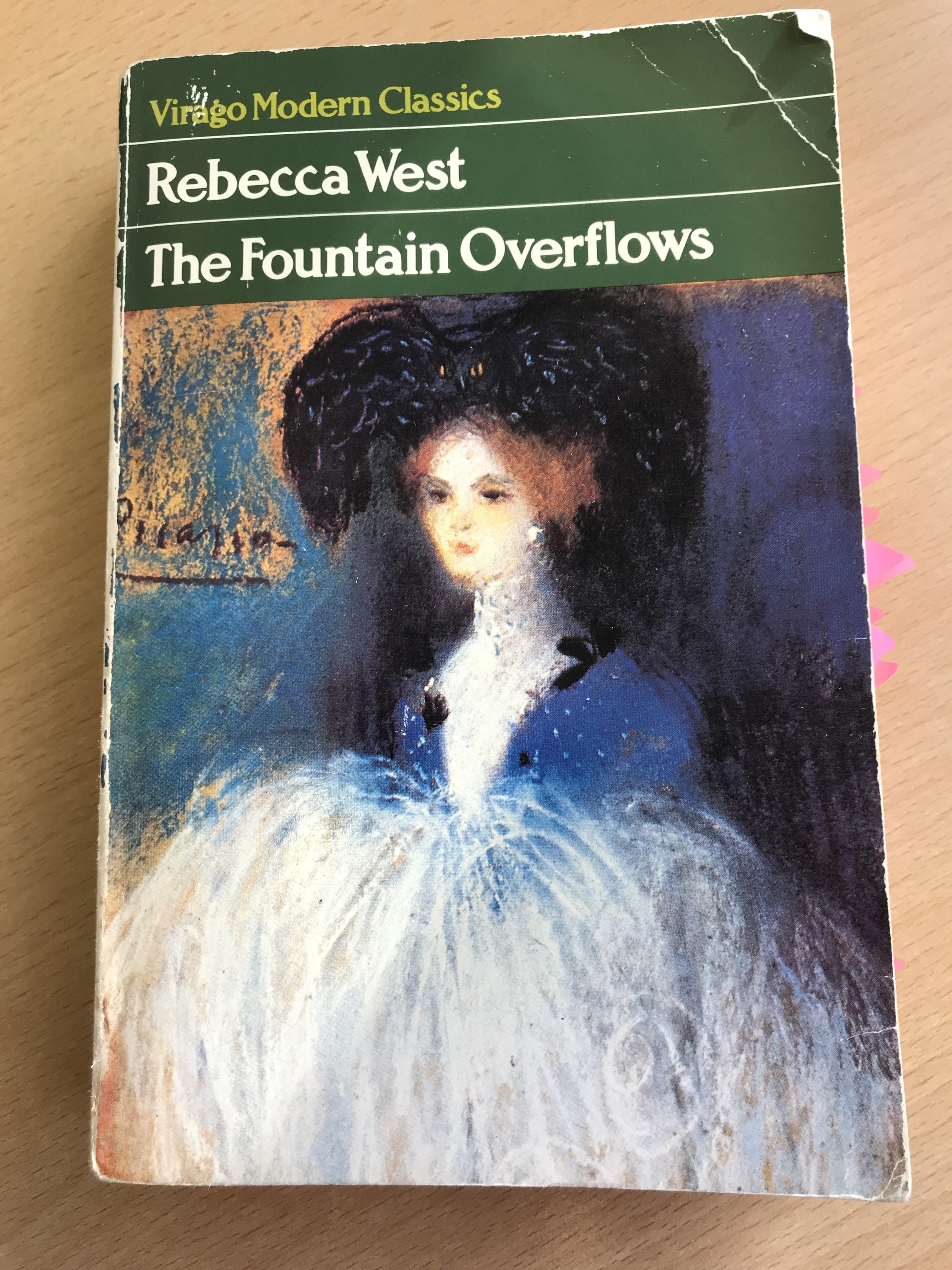
Hence the Virago cover:
All in all I greatly enjoyed meeting the idiosyncratic, independent-minded Aubrey family. The characters were wholly believable, the evocation of a lost time done without nostalgia, and West had plenty to say about wider Edwardian society. I’ll look forward to spending more time with the Aubreys through the two sequels.
“We had very often been sharply warned against sentimentality, and though we might have been able to define it only vaguely as the way one should not play Bach, we recognised it.”
And so it just remains for me to wish you all the festivities of your choosing and leave you with a non-Christmassy song (because you may well be sick of them by now) from a great Christmas film which I watched yesterday, Scrooged:
Today is Rumer Godden Day in Jane at Beyond Eden Rock’s Birthday Book of Underappreciated Lady Authors. I’m so grateful that this prompted me to read the two by Godden I had in the TBR, as she’s quickly become a new favourite. Godden is such an accomplished writer; her books are so readable and her use of language is stunning.
Firstly, Kingfishers Catch Fire (1953), which I started reading with some trepidation. I expected a novel about a 1950s English woman living in India to be filled with white entitlement and comic/exoticised portraits of the locals. Thankfully, Godden is far too sophisticated an author to do anything so crass, and the comic portrait is resolutely reserved for the clueless but well-meaning white foreigner, Sophie.
“To the Pundit, Sophie was precisely like any other European or American, only more friendly; the friendliness alarmed him. ‘These people are poor and simple…’ he began, but Sophie interrupted him.
‘We shall be poor and simple too,’ she said with shining eyes.
[…]
Sophie would not listen. Like many people there were some words about which she was sentimental; one of these was ‘peasant’. ‘Peasants are simple and honest and kindly and quiet,’ she said. ‘They don’t want what they don’t possess. They have the wisdom to stay simple. They don’t want to change.’”
This idealistic young woman crashes into Kashmir with her two children, estranged from her husband and determined to establish a life for herself. Yet the portrait of Sophie is a subtle one: she is oblivious to the needs of her children and to the cultural differences between her and her neighbours, but somehow not arrogant, just hopelessly naïve.
“Teresa could not count how many times they had moved, but each time the small ballast of hopes and plans they had collected was thrown overboard and everyone they had known was left behind.
Moo did not care. Like a little seed that is blown and can grow anywhere, on a rocky ledge, in a crack of earth, he lived a contained contented small life of his own no matter where he went. To Moo it did not matter but Teresa had roots, they were tender, soft and trailing…”
Poor Teresa. She is sensible and understands so much more than her adult parent. She also cares for Moo, who is probably on the autistic spectrum and in his own world.
In describing how Sophie and her children live in Kashmir, Godden adopts an interesting approach by having the story interjected with later reflections from Sophie and her family. So the narrative will be interrupted with comments like “‘But you were not qualified to teach Urdu,’ said Toby afterwards.” It’s not a technique I’ve seen before and it doesn’t jar as much as I would expect. The effect is to temper Sophie’s idealism and blind actions. It works to offset what sceptical readers (ie me) might be thinking: ‘but that’s just ridiculous, she’ll never make that work…’ etc. It keeps the story grounded even when the main protagonist ricochets from one ill-conceived action to the next.
Godden wrote Kingfishers Catch Fire based on her own experiences of India and her love of the land is obvious:
“There were no ceilings, only cross beams stuffed with dried furze as in most Kashmiri peasant houses. There was no glass in the windows, only hanging window shutters, no water system of course, no lighting, but it was a rarely beautiful little house. In summer it was hung with vines and honeysuckle and white-scented roses, and all around it were flowering trees….Above it all the mountain reared its head while below, lay the lake and its reflections and, far, the horizon of snow peaks.”
The plot is a deceptive one. I was enjoying what I thought was comic novel about the escapades of a fairly clueless woman; then suddenly things took a very dark turn and I found myself racing towards the end, desperate to know what happened and for things to work out well.
I loved the ending. This pithy comment on stealthy imperialism summed it up for me:
“The missionaries worked for the people but did not respect them. For all their love and zeal the wanted to bend them, bend them out of their own truth”
The message I took from Kingfishers Catch Fire was one of resolutely sticking to your own truth, whilst acknowledging and respecting other people’s. I just loved it.
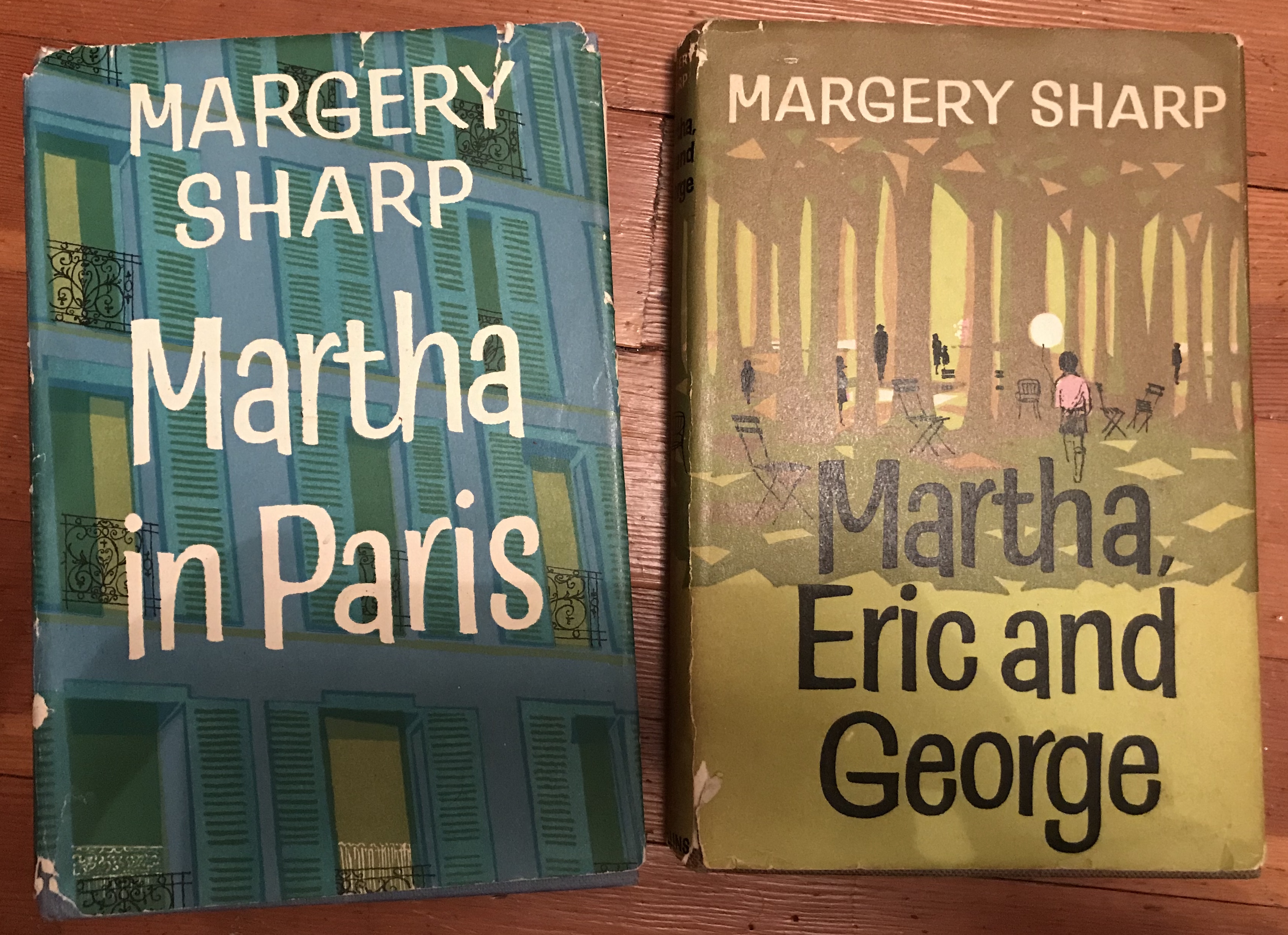
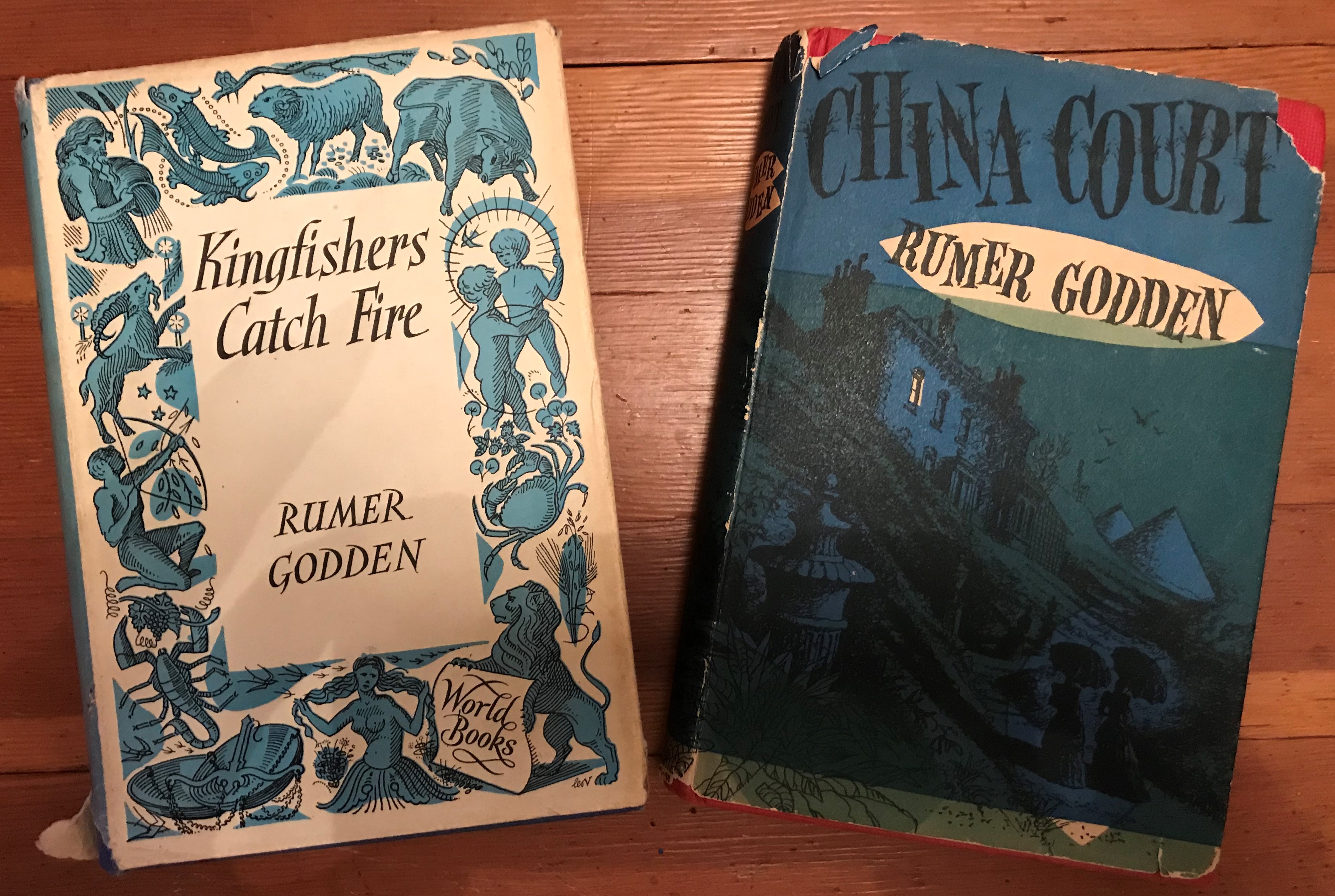
Behold my slightly battered, kitschy-covered editions:
Secondly, China Court (1961). This is another story of a dilapidated house and the woman who loves it, but otherwise very different to Kingfishers Catch Fire. The titular pile is the Victorian home of five generations of the Quin family set in the Cornish moors and built on the proceeds of china clay works.
“When one of the…rose bowls or vases is rung it gives off a sound, clear, like a chime, the ring of true porcelain, so China Court gives off the ring of a house, a true home.”
The story begins with the death of Mrs Quin, the matriarch who has resolutely stayed in China Court against all her family’s wishes (except her granddaughter) and looks at what happens after her death as her family besiege the house for the reading of the will.
The story moves back and forth across the generations. There is no indication when this will happen; scenes cut between the various family members, all in present tense. Again, this stylistic experiment doesn’t jar nearly as much as I would expect. Instead it captures a sense of the house holding all the members of the family at any one time, the echoes of their steps and their voices all layered upon one another.
“Homes must know a certain loneliness because all humans are lonely, shut away from one another, even in the act of talking, of loving. Adza cannot follow Eustace in his business deals and preoccupations as she cannot follow Mcleod the Second or Anne or Jared – no one can follow Eliza. Mr King Lee, kissing Damaris, has no inkling of the desolation he has brought her, just as Groundsel only half guesses Minna’s; Jared hides himself from Lady Patrick, and John Henry and Ripsie, in their long years together are always separated by Borowis
[…]
Loneliness can be good. Mrs Quin learns that in the long companionship of the years after Tracy goes, when she and Cecily are alone in the house; companionship of rooms and stairs, of windows and colours; in the gentle ticking away of the hours, the swinging pendulum of the grandfather clock. ‘I was happy,’ Mrs Quin could have said. Contented loneliness is rich because it takes the imprint of each thing it sees and hears and tastes”
This for me was the central theme of China Court: the value of everyday domesticity. The characters who recognise it are fulfilled and live rich lives that outwardly appear narrow but in reality connect with something fundamental that enables a wider kinship with others.
The portraits of the individuals run seamlessly and as the novel progresses they weave together for a complex depiction of family, and how histories are cyclical, building on what has gone before.
Mrs Quin is an avid gardener, and as in Kingfishers…there are beautiful descriptions of the natural world, but also of food and the various meals the family have taken together over the years.
“Now Cecily brought in saffron cake, buttered scones hot in a silver dish, brown bread and butter thin as wafers, quince jelly and strawberry jam from China Court quinces and strawberries; she had made shortbread, fruitcake and because Tracy likes them as a child, thin rolled ginger-snaps filled with cream.”
Gradually the family histories build towards a brilliant denouement in the present day of the novel. It’s dramatic but believable and once again I found myself racing towards the end. And the end is where I encountered my first reservation about Godden’s writing. To discuss it I’ll have to include a SPOILER so skip to the end of this paragraph if you don’t want to know. Here it is: an act of domestic violence takes place, an act which is quickly forgiven and leads to sex. I think it’s a dramatic device to shock a couple who aren’t communicating well (a recurring theme in the novel) towards honesty and resolution, but reading this almost 60 years after it was written was just horrible. I know from films of the time that slaps and spankings were freely given, but I’d be very surprised if this worked for modern readers.
This one incident aside, China Court is a wonderful portrait of a house and a family, beautifully evoked and fully realised with fondness but without sentimentality.
“ ‘We were truly kin,’ says Mrs Quin, and it is true that Tracy is like her grandmother in many ways; for instance, both, from the moment they first see it, are enslaved by China Court.”
To end, regular readers will know there are no depths to which I won’t sink in order to shoehorn in an 80s pop video. So please pardon the pun that has enabled my childhood hair icons to be this week’s choice: