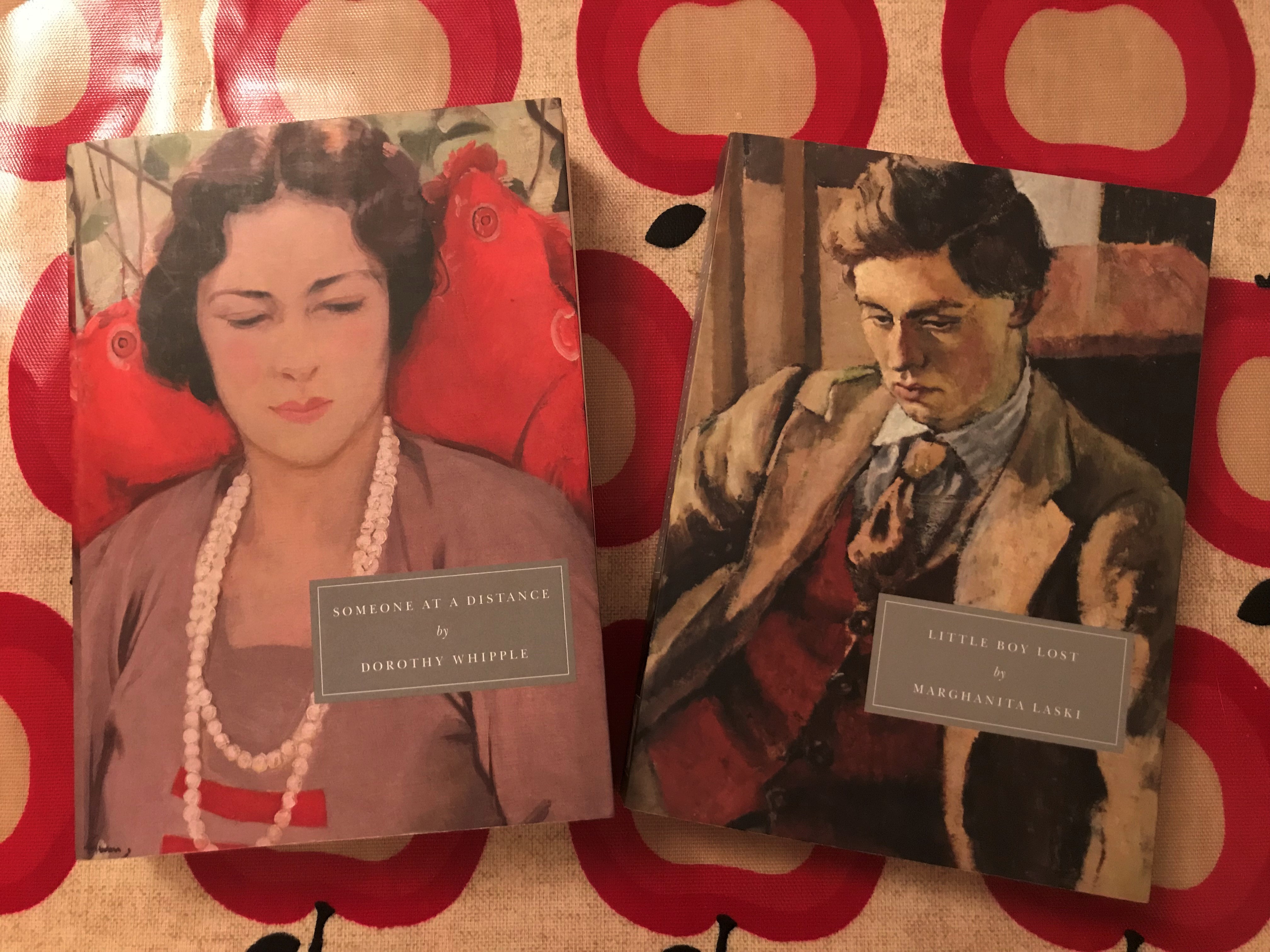
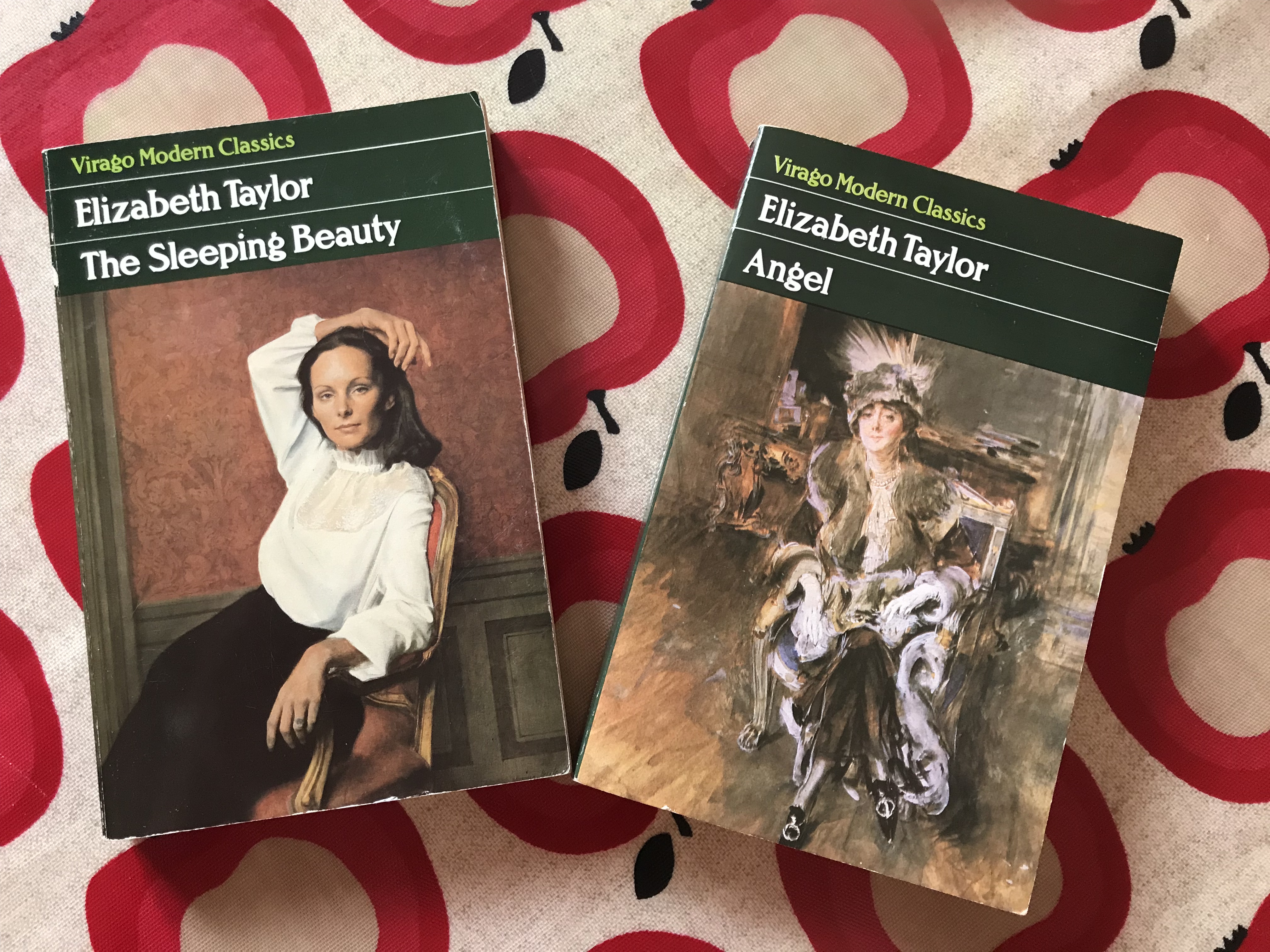
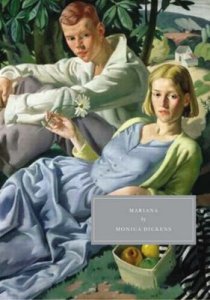
“A Persephone cover is a guarantee of good reading.” (Nicola Beauman, founder of Persephone Books)

After a month of daily posting about novellas I was planning at least a week’s break from blogging, but I couldn’t resist joining in with Jessie at Dwell in Possibility’s Persephone Readathon. Here are two short Persephones that just missed out on being part of Novella in Day in May as they were over 200 pages (but not by much).

Firstly, Lady Rose and Mrs Memmary by Ruby Ferguson (1937) which is Persephone No.53.

This is the story of a young Scottish heiress from childhood to young adulthood, framed by the visit of three tourists to the estate of Keepsfield.

“This transition to the atmosphere of another world is bewildering to modern personalities. The three strangers were conscious of a nakedness of spirit that made them uneasy spectators of a grandeur which was more than material. The old caretaker had slipped into the background, as caretakers do.”

The caretaker, Mrs Memmary, has been on the estate since she was a girl, and she tells one of the Tourists, Mrs Dacre, the story of Lady Rose. Rose is a child filled with joy, and a passionate attachment to her homeland, so far so that she names her kitten after a mighty clansman:

“Rose went out onto the sun-drenched west terrace, cuddling Rob Roy, who by now wore a small pink silk handkerchief round his head to protect him from the sun.”

She is a debutante and presented to the Queen, who takes a shine to her. It is at this moment, stepping into society for the first time, that she realises what her wealth and position truly mean:

“She was important? She, Rose Targenet aged eighteen, who had done so little but rejoice in the beauty and happiness of life. Of course her importance was not her own quality; it was because of her Papa.”

However, while she is important, she has no power. This is Victorian Scotland, and she must make a good match, securing the future of her lands and providing a male heir. We know that she managed this, as Mrs Memmary tells the tourists early on that all the splendour they see in the home is entailed to the heir, and Lady Rose is seeking a rich tenant to help pay for the upkeep of the estate.

The Victorian marriage market is poked gentle fun at during this overheard conversation between Rose’s mother and a family friend, regarding the Poet Laureate:

“If poor Alfred must write about what he calls love, he might at least explain that it is an emotion to be openly enjoyed by the middle classes.”

Although Lady Rose and Mrs Memmary could be seen as a light novel, it actually has serious points to make about the role and rights of women in the period. (It was written in in the 1930s and was apparently a great favourite of the Queen Mother, which I find fascinating. Makes me see her in a whole new light.)

Rose ends up in a loveless marriage to someone who is not horrible, but just completely cold and repressed:

“She had cried on her bed all the afternoon, realizing bitterly that in 1874 married women had no rights, even if they were countesses. She didn’t cry now, for she had the children, and in any case crying did no good after 10 years.”

Meanwhile, her friend Susan is in no better position having avoided marriage altogether:

“But what have I got? Just a piece of needlework and two disappointed elderly minded parents, and all the time in the world on my hands. If I had my way women would be free to do the same things as men; come and go as they wished, and read and talk, and be doctors and lawyers and financiers, and Members of Parliament, and newspaper writers, Wouldn’t that be wonderful?”

So what happens? We know Lady Rose is a strong character who at times is willing to defy authority, and we know she has been abroad for a long time. Mrs Dacre isn’t at all happy with what Mrs Memmary tells her:

 “ ‘You mean – that was the end of Lady Rose’s story? It seems a vague, disappointing ending.’

‘Vague?’ The old woman thought for a moment and said, ‘But in real life things go like that. Our stories have no ending. We come into the light for a little while, and then we move away into the shadows and nobody sees us anymore. It is better that way.’”

A good point, but Mrs Memmary has held something back. I don’t think I’m a great genius in guessing what it was in Chapter 2, but this didn’t spoil my enjoyment of the novel at all. I promise you it’s not a vague, disappointing ending.

Lady Rose and Mrs Memmary is in some ways a romantic novel: the country house and Scotland are both described with ravishing beauty, and it is a novel about being true to yourself and following your heart. But Ferguson also doesn’t shy away from portraying the price that is paid for these things, suggesting the price may be worth it but it can also be a high one.

Secondly, Daddy’s Gone A-Hunting by Penelope Mortimer (1958) which is Persephone No.77. Ruth Whiting lives in a commuter town with her husband Rex. Their two sons are away at boarding school and their daughter – whose conception necessitated their marriage – is studying at Oxford. Ruth is not happy:

“In all the years of her marriage, a long war in which attack, if not happening, was always imminent, she had learned an expert cunning. The way to avoid being hurt, to dodge unhappiness, was to run away. Feelings of guilt and cowardice presented no problems that couldn’t be overcome by dreams, by games, by the gentle sound of her own voice advising and rebuking her as she went about the house.”

Rex and Ruth aren’t together very much – he has a flat in London during the week and comes home at weekends.

“For Rex and herself there was no longer any hope or possibility of change; there was no longer any choice to be made. They lay, fully grown, capable of every crime and every greatness, paralysed by triviality.”

Mortimer’s unflinching eye and scathing attitude is cast wider than the intricacies of marriage; it also takes in the other couples in the area:

“The relationships between the men are based on an understanding of success. Admiration is general, affection not uncommon. Even pity is known. The women have no such understanding. Like little icebergs, each keeps a bright and shining face above water; below the surface, submerged in fathoms of leisure, each keeps her own isolated personality. Some are happy, some poisoned with boredom; some drink too much and below the demarcation line are slightly crazy; some love their husbands and some are dying from a lack of love; a few have talent, useless to them as a paralysed limb.”

Ruth seems on the verge, if not in the midst of, a breakdown. She is struggling to get out of bed and Rex engages a housekeeper/nurse.  However, what begins as a dissection of suburban 1950s marriage develops into something more political when Ruth’s daughter Angela tells her she is pregnant. The father, fellow student Tony, is selfish and callow:

“It was obviously not going to be necessary to impress on him the seriousness of the situation. He looked like a curate settling down to discuss dry rot in the organ loft.”

So Angela, unlike her mother, does not want to tie herself into marriage to an unsuitable man for the sake of an unwanted baby. The rest of the novel follows the hoops both Ruth and Angela have to jump through in order to secure an abortion. (This  particularly resonated at the time I read it given the recent vote in Ireland). What Mortimer demonstrates is the ways in which women’s lives are circumscribed and the huge fallout this can have: on mental health, physical health, participation in society, participation in our own lives.  Although she is acerbic, and undoubtedly it is a resounding cry for women’s rights to be acknowledged and given their due importance, I think above all, Daddy’s Gone A-Hunting is a plea for kindness.

“He would probably go through his entire life imagining that he was real; but not one person would owe him gratitude, remember his comfort.”

To end, I said when Novella a Day in May was over I’d go back to shoehorning late 20th century pop tunes into posts at every opportunity. So here we go, a 1980s celebration of those beautiful Persephone covers:

Novella a Day in May #24

The Pursuit of Love – Nancy Mitford (1945, 192 pages)

The Pursuit of Love was Nancy Mitford’s first novel in a trilogy about the Radletts, a bonkers upper class family.

“My Uncle Matthew had four magnificent bloodhounds, with which he used to hunt his children. Two of us would go off with a good start to lay the trail, and Uncle Matthew and the rest would follow the hounds on horseback. It was great fun. Once he came to my home and hunted Linda and me all over Shenley Common. This caused the most tremendous stir locally, the Kentish weekenders on their way to church were appalled by the sight of four great hounds in full cry after two little girls.”

The narrator is Fanny, cousin to the Radletts and rather different in temperament. Her mother leads a peripatetic life according to which man she is with, earning her the nickname The Bolter. Fanny is therefore raised by her lovely Aunt Emily, and the two have a placid, ordered existence, but it is the chaotic holidays Fanny spends with the Radletts which occupy the story.

“The Radletts were always either on a peak of happiness or drowning in black waves of despair; their emotions were on no ordinary plane, they loved or they loathed, they laughed or they cried, they lived in a world of superlatives.”

It’s thinly disguised biograpy of course. The Radletts are home educated along similar lines to Nancy and her famous sisters: in French and horsewomanship, and not much else.

“They picked up a great deal of heterogeneous information, and gilded it with their own originality, while they bridged gulfs of ignorance with their charm and high spirits, they never acquired any habit of concentration, they were incapable of solid hard work. One result, in later life, was that they could not stand boredom, Storms and difficulties left them unmoved, but day after day of ordinary existence produced an unbearable torture of ennui, because they completely lacked any form of mental discipline.”

Fanny focuses the story on that of Linda, her cousin and best friend. Linda is more like The Bolter than Fanny ever is, and has a disastrous marriage to a Tory followed by a disastrous affair with a communist, before finding a true love. The Pursuit of Love is not romantic though, Mitford’s comic eye is far too sharp for that. If it wasn’t for this, my inverted snobbery may have come to the fore and left me thinking ‘So what? Who wants to read about a bunch of ill-educated, over-privileged idiots?’ Well, as it turns out, I do. I find Mitford truly funny and accomplished in her writing. No-one escapes her wit, least of all the upper-classes and their mores:

“The behaviour of civilised man really has nothing to do with nature … all is artificiality and art more or less perfected.”

She’s not above the downright silly either, such as describing a baby as “the usual horrid sight of a howling orange in a fine black wig”.

The Pursuit of Love does provide some intriguing insights into the mid-twentieth century landowning classes though, such as their attitude to travel in the post-war period:

“it would never have occurred to the Alconleighs to visit the continent for any other purpose than that of fighting”

The Pursuit of Love is very funny but there is a brittleness there; a sense that things easily splinter and true sadness and tragedy are only ever just below the surface. The ending emphasises this element and is truly moving, all the more so as it is something of a jolt given what has gone before.

Novella a Day in May #15

The Bookshop – Penelope Fitzgerald (1978) 123 pages

The Bookshop was Penelope Fitzgerald’s second novel (I reviewed her first here) and her first to be nominated for the Booker, which she later won with Offshore. It’s set in 1959 in the small Suffolk coastal town of Hardborough. This is not a picturesque seaside resort but a damp, isolated place:

“The town itself was an island between sea and river, muttering and drawing into itself as soon as it felt the cold.”

Florence Green decides to open a bookshop in Hardborough and buys The Old House, a 500 year old derelict property:

“The Old House was not haunted in a touching manner. It was infested with a poltergeist which, together with the damp and an unsolved question about the drains, partly accounted for the difficulty in selling the property. The house agent was in no way legally bound to mention the poltergeist, though perhaps he alluded to it in the phrase unusual period atmosphere.”

Florence is a lonely widow, but she is not a pushover. As the forces of the town (mainly Mrs Gamart who wants The Old House for an arts centre for no other reason it seems than she is bored and used to getting what she wants) conspire against her, she doesn’t give up. Astutely, she acquires several copies of a book she has never read by an author she has never heard of, Lolita by Vladimir Nabokov, and it causes quite the stir, raising much-needed profits for the shop.

She also has her allies. The reclusive Mr Brundish, proudly from an old Suffolk family, is on her side. Christine Gipping, an eleven year old with 2 broken front teeth, proves a tenacious keeper of Florence’s lending library and not easily put off by supernatural elements:

“Florence did not expect her assistant to return; but she came back the next afternoon, with the suggestion that if they had any more trouble they could both of them kneel down and say the Lord’s prayer. Her mother had advised that it would be a waste of time consulting the Vicar.”

The Bookshop is an absolute gem. The portraits of the inhabitants of Hardborough fully realised and idiosyncratic yet believable. The plot is simple but taut, the writing witty. Fitzgerald achieves a perfect balance of compassion without sentimentality.

“She had a kind heart, though that is not of much use when it comes to matters of self-preservation.”

“Writing is a cop-out.” (Monica Dickens)

Today is Monica Dickens Day in Jane at Beyond Eden Rock’s Birthday Book of Underappreciated Lady Authors. I’d planned for May to be only novellas over here, but I couldn’t resist the chance to dig out 2 Persephone editions from the TBR and join in with Jane’s celebration. I’m glad I did, because I really enjoyed my first encounter with Monica Dickens.

Image from here

Firstly Mariana (1940) which is part of the Persephone Classics range. On the Persephone website they say:

 “We chose this book because we wanted to publish a novel like Dusty AnswerI Capture the Castle or The Pursuit of Love, about a girl encountering life and love, which is also funny, readable and perceptive; it is a ‘hot-water bottle’ novel, one to curl up with on the sofa on a wet Sunday afternoon. But it is more than this.”

That just about sums it up. On the one hand Mariana is a very simple novel, about a young girl called Mary growing up and reaching adulthood just as World War II breaks out. She has various infatuations and gets her heart bruised, if not quite broken, before she meets the love of her life. What raises it above this very ordinary premise is the fond characterisation and Dickens’ wit.

Mary herself is a determinedly independent soul:

“People were kind and friendly and amusing, but they thought that companionship and conversation were synonymous and some of them had voices that jarred in your head. There was a lot to be said for dogs.”

She has been this way her whole life, as her school report testifies:

“Mary is a dear little girl…but we find a tendency in her to resent authority to the point of resistance. Although she is popular with her fellow pupils, I am afraid she is a bad mixer, being at the same time intolerant and unconfident of others and disinclined to enter into the heart of the community.”

She lives with her mother who works in a dress shop, as her father died in the previous war. There is also her reprehensible, indulgent Uncle Geoffrey who leaves her aged 8 to catch the Tube home by herself. He subsequently goes off to Hollywood to make his name in the movies. What stops this being entirely whimsical is the first chapter: we know the adult Mary is waiting for news of her husband whose ship has been sunk in the conflict. So alongside the fun characters and the wit is the background of potential tragedy; things do not seem to bode well for Mary, given the titular reference to Tennyson’s poem.

But in the meantime there is gentle fun to be poked at the trials and tribulations of young love:

“She told herself that she had been through a searing experience which had left her as a woman set apart from love – a tragic figure. This sustaining vision had tided her over the misery of the end of last summer, until the excitement and newness of Dramatic College had given her something else to think about.”

Dickens is a wise writer though, and so while she presents her characters with a slightly askance view, she shows how their feelings make them who they are, and who they will be:

“She had thought that [he]was the answer to everything, and when she had found out that he wasn’t she had been left alone with no one on whom to pin her burden of romantic devotion.”

I really enjoyed Mariana, which I wouldn’t have assumed would be the case given the subject matter. Dickens is very readable and I whizzed through the novel. I enjoyed spending time with all the characters (apart from an awful arrogant Bullingdon club type who seemed to have future-Prime-Minister written all over him) and I enjoyed Dickens unpretentious, thoughtful style.

“A corner of the jigsaw of Mary’s life had been made into the right pattern, by unknown means. It seemed that one had little control over one’s own destiny. All one could do was to get on with the one job nobody else could do, the job of being oneself.”


Secondly, The Winds of Heaven (1955), which had far fewer likeable characters and was almost bleak at times, but just saved from being so by the gentle endurance of the main character, Louise, who is widowed and destitute.

“She reached for the ashtray, for she wanted to tap off the ash frequently, as she had seen highly-strung, busy people do. Louise was neither highly-strung, nor busy, but when she was in London, among people who all seemed to be doing something important in a hurry, she liked to try and keep pace.”

The reason Louise is destitute is because her husband, Dudley, who seems to have had absolutely no redeeming qualities, died and left her with all his worldly debts.

“Everyone said Louise was ‘wonderful’ about Dudley’s death, but she could not be anything else, because, shocking though it was to her, she hardly cared.”

“there was nothing for it but that Louise should stay with her daughters in turn to pass the summer months. It was all arranged at an embarrassing family conclave, where no-one could say what they were thinking, and each tried to outdo the other in unselfishness.”

And so The Winds of Heaven follows Louise as she moves from one daughter to another. Miriam lives in a suburb in the Home Counties and is an absolute snob; Anne is the laziest person on earth who has somehow managed to marry a lovely man who runs a smallholding and genuinely cares for Louise; Eva is an actor in London and having an affair with a married man. They clearly all take after their father as they are selfish and self-absorbed.  They are also, in different ways, all quite unhappy, and Louise has no idea how to help.

“she had wanted the futile thing she had made of her marriage with Dudley to be justified at least by the emergence of three happy lives.”

The novel is episodic in nature and through it we learn about Louise and her daughters. It’s a very mid-20th century English family, full of unspoken truths, supressed conflicts, and love. The somewhat depressing state of Louise’s familial relations is lightened by two beacons of light in her life: a friend, and her granddaughter. Gordon Disher is a bed salesman and pulp-fiction author who becomes: “The oddest, but most comforting friend she had ever made”. Ellen is Miriam’s daughter who like Louise, is a misfit in the family (a good thing, seeing as how appalling they all are) and who provides genuine kinship.

“how delightful to be a grandmother with a responsive grandchild, who opened her heart to you without embarrassment, because she had no-one to talk to at home”

The Winds of Heaven captures a particular moment in time, where women had only just begun to stop being exclusively homemakers and enter the workplace. Louise feels she can’t support herself, because she doesn’t believe she has any skills. This leaves her in genteel middle-class poverty, dependent on her daughters. She is part of a vanished world, and is not treated kindly by those who are finding their way in a new one. Dickens handles this social commentary with an incredibly light touch though, and so The Winds of Heaven often reads more like a series of acerbic character studies than a commentary on mid-twentieth century gender roles. It’s always highly readable, quietly building to a dramatic, tragic denouement, where hope survives.

To end, Monica had a rather famous great-grandfather. To tell you all about him, here are the incomparable Horrible Histories, channelling The Smiths:

“Would you like a little cheesy-pineapple one?” (Beverly, Abigail’s Party, 1977)

Trigger warning: This post mentions rape

Here’s my contribution to the 1977 Club, hosted by Kaggsy at Kaggsy’s Bookish Ramblings and Simon at Stuck in a Book. It’s running all week, do join in!

Firstly, Penelope Fitzgerald’s first novel, The Golden Child, which she published aged 60 (it’s never too late, budding writers!) This is a typically slim Fitzgerald novel, just 189 pages, and while I didn’t love it as much as the others by her which I’ve read (The Bookshop; At Freddies) there’s still a lot to enjoy.

The title refers to an exhibit that is on loan to a London museum. It is hugely popular with people queueing for hours on end to see the tiny dead Garamatian king covered in gold, and his ball of gold twine. The story concentrates on behind the scenes: the relationships and internal politics of the museum.

“At the sight of his tiresomely energetic subordinate, Hawthorne-Mannering felt his thin blood rise, like faint green sap, with distaste. He closed his eyes, so as not to see Waring Smith.”

It is from the energetic Waring Smith’s viewpoint that the story unfolds. He realises that certain deals have been done, certain backs have been scratched, in order for the museum to gain the exhibit.

“He had a glimpse for the first time of the murky origins of the great golden attraction: hostilities in the Middle East, North African politics, the ill-coordinated activities of the Hopeforth-Best tobacco company. Perhaps similar forces and similar shoddy undertakings controlled every area of his life. Was it his duty to think about the report more deeply and, in that case, do something about it?”

Things take a sinister turn when someone tries to strangle him with the golden twine, and two of his colleagues end up dead in highly suspicious circumstances. Waring Smith is sent on a farcical trip to the USSR (as it then was) to consult with an expert regarding the exhibit. On his return, he becomes embroiled with Special Branch, and has to decipher a code on a clay tablet which might hold a clue as to what on earth is going on.

“The Museum, slumberous by day, sleepless by night, began to seem to him a place of dread. Apart from the two recent deaths, how many violent ways there were in the myriad of rooms of getting rid of a human being! The dizzy stairs, the plaster-grinders in the cast room, the poisons of conservation, the vast incinerators underground!”

There’s a great deal to enjoy in The Golden Child but it doesn’t quite work as a mystery – some of the solving takes place ‘off-screen’ and Waring Smith is then told about it, so it doesn’t quite match what it sets itself up to be. Its strengths are Fitzgerald’s wit and her satire of politics big (The Cold War) and small (workplace); it’s a quick, fun read.

Image from here

Disclaimer, and a note for those of you who, like me, were born around the time of this Club: I’m aware that part of my enjoyment of this novel came about because of a very specific reason, which may have coloured my view somewhat. As a child one of my favourite TV programmes was The Baker Street Boys, which showed what the Baker Street Irregulars got up to when they weren’t helping out a certain world-famous detective. My favourite episode was The Adventure of the Winged Scarab, involving mystery, museums and mummies. Anyone else who remembers this series fondly can indulge in a nostalgia-fest because I’ve just discovered some kind soul has uploaded the whole lot to YouTube.

Image from here

Secondly, Injury Time by Beryl Bainbridge, which is set over the course of one evening. Edward has agreed that his mistress Binny can give a dinner party and he will invite his colleague Simpson and Simpson’s wife Muriel along.

“He gave her so little, he denied her the simple pleasures a wife took for granted – that business of cooking his meals, remembering his sister’s birthday, putting intricate little bundles of socks into his drawer.”

I loved that line which comes early in the novel and so I settled into what I fully expected to be full of the joys of Bainbridge: acerbic wit, idiosyncratic characters, acute social observation. For much of the novel, this is exactly what Injury Time provided. None of the characters seem to know exactly what they want and the changes taking place in 1970s Britain leave them all slightly baffled.

“It was astonishing how fashionable it was to be unfaithful. He often wondered if it had anything to do with going without a hat. No sooner had the homburgs and the bowlers disappeared from the City than everyone grew their hair longer, and after that nothing was sacred.”

The dinner party never really takes place. Binny is an appalling housekeeper and her home is filthy (Bainbridge based Binny on herself and Edward on a lawyer she had an affair with). Before anyone arrives she’s thrown the hoover into the backyard and stuffed the pudding behind the fridge.

“Though most of her life she had rushed headlong into danger and excitement, she had travelled first-class, so to speak, with a carriage attendant within call. The world was less predictable now…in her day dreams, usually accompanied by a panic-stricken Edward, she was always being blown up in aeroplanes or going down in ships.”

The less predictable world erupts violently into the evening of Binny, Edward, Simpson, Muriel and Binny’s inebriated friend Alma. It’s here that I have a bit of trouble with Injury Time. A character is raped. For me, this jarred uncomfortably in what until that point had been a funny, sharp novel puncturing 1970s social mores and pretensions. The rape itself is dealt with oddly: it’s part of a section that verges on surreal and is filled with non-sequiturs; the character it happens to is weirdly detached, which may be shock but this is never made clear. Looking at reviews online, I was really surprised that so few reviewers even mentioned this event. For many Injury Time remains an unproblematic comic novel. So I wouldn’t want to put anyone off reading it; I adore Bainbridge and still do, but for me how the rape was portrayed and contextualised was a problem.

I don’t want to end on a downer when so much of Injury Time is funny, so I’ll end with this quote which is pure Bainbridge. I wonder how far Binny was based on her and whether she actually did this?

“There had been too that incident when he couldn’t see Binny because he wanted to prune his roses, and she’d threatened to come round in the night and set fire to his garden, Later, a small corner of the lawn had been found mysteriously singed, but nothing had been proved.”

To end, the UK number one from this week in 1977. AHA!

“We’ll have to put a stop to this bookworming. No future in that.” (Molly Keane, Good Behaviour)

This is my final contribution to Reading Ireland Month 2018, hosted by Cathy at 746 Books and Raging Fluff. Do check out the posts from the month, it’s been great 😊

I had 2 Molly Keane novels in my substantial TBR, so this seemed a perfect opportunity to get to know an author so many seem to enjoy. I began with her first novel, the wonderfully titled The Knight of Cheerful Countenance (1926). Unbelievably, she wrote this at the age of 17 to supplement her dress allowance (!) and chose the pseudonym MJ Farrell to hide what she was doing from her friends, who were all huntin’ shootin’ fishin’ types. Molly Keane wrote the introduction to my Virago edition and it’s well worth a read, to hear tales of friends with uncles called Major Hyacinth Devereaux and the butler shrouding the parrot before morning prayers. I’d love to know if she ever met the Mitfords.

mw74333

Image from here

The plot of The Knight of Cheerful Countenance is slight: Allan comes to visit his Irish cousins, falls in love with one who loves another, while his other cousin falls in love with him. It’s full of horses and slightly less full of bloodsports, thankfully. There were about 2 passages I skipped because I just really don’t want to read about such things. And yet despite these unpromising qualities, I thoroughly enjoyed the novel.

In her introduction Keane fully acknowledges that the incredibly privileged, oblivious existence of her childhood and young adulthood is gone forever. The novel makes passing reference to the political situation of the time, but Allan and his cousins Ann and Sybil are walled up on an estate away from it all:

“Deeds of unbelievable foulness and treachery were still – judging by the newspapers – of almost daily occurrence in the land, but they seemed to leave untouched the district of Bungarvin. Yet wrecked police barracks and courthouses, country houses standing empty, and the charred walls of what had once been country houses, all went to show how little of a myth was the state of civil war in Ireland.”

As the title suggests, the novel is a romance and there is most certainly an escapist quality to it (the first publishers were Mills & Boon, although I think they published a wider range then than they do now).

“Dennys St Lawrence presented as good a picture of young manhood as one could wish to see on any glorious summer morning. With his bare dark head and his grey eyes, his handsome horse, and his easy seat in the saddle, he belonged to this Irish morning with complete entirety.”

This isn’t straight romance though. Keane views the events and the people with a fond, humorous eye:

“Silence, however, never reigned for long when Allan was anywhere about.

‘Jolly little successful what-not, what?’ he observed affably, by way of starting the conversation.”

The Knight of Cheerful Countenance is a short novel (272 pages) and so it doesn’t flag, and I would never have guessed it was written by a 17 year old. It’s not the most accomplished piece, but it’s not juvenilia either. I don’t really feel I’ve done it justice here. It’s very readable and good fun, and it certainly made me want to read more by Molly Keane.

Which is exactly what I did. Loving Without Tears (1951) was Keane’s tenth novel and she was also a successful dramatist by this time, so it is a much more sophisticated novel than her first. It is much darker than The Knight of Cheerful Countenance, centring around a wholly manipulative matriarch, the inappropriately monikered Angel, who bends her children, niece and faithful retainers to her will.

“Each worshipped her and each lamp should have its due portion of oil to feed that flame of worship, and from each she would obtain the maximum of that slave labour which is the expression of such a love.”

She is an absolute tyrant, all the more despicable because her tyranny is couched in expressions of maternal love and concern. But things are about to change. Her son Julian has returned from the war with a fiancée who is (shock!) American, and a woman of the world. She sees through Angel and will not be manipulated, unlike Angel’s daughter Slaney, who is oblivious to her mother trying to split her up from the man she loves:

“As a gardener tends nectarines, so did Angel minister anxiously to skin and hair and health of body. As well, she disciplined the beautiful body towards an excellence in the sports best calculated for its exhibition – a garlanded, shampooed young heifer, her looks a miracle, her thoughts unknown, Angel led her daughter by a ribbon towards the supreme sacrifice and glory of the right marriage.”

There’s also a niece, Tiddley, who Angel abuses despicably, bribing her to help with her plans to disrupt her children’s lives. The nanny Birdie, sees things as they are:

 “the love she’s pinching out from each of us, same as I’d disbud a rose”

Yet the brilliance of Keane’s writing means that while I desperately wanted everyone to wake-up to what Angel was up to, and for her to get her comeuppance, I didn’t want her punished too badly. Loving Without Tears is an astute psychological study of a woman who behaves appallingly, but it is done without heavy judgement and you are left to fill in some gaps as to why Angel behaves as she does. To some extent it is a comedy of manners; if only everyone can cast aside convention and have an honest conversation, everything will work out. So it is funny, but with a cynical undertone running through it which stops it being fluffy. I enjoyed watching it all play out pretty much as I expected (not a criticism, I enjoy Austen for the same reason) and the ending was entirely satisfying.

To end, a song about another famous Irish Molly:

“There is nothing so intractable as a calendar.” (Margery Sharp)

I thought the title quote rather apt, as I’m late to Margery Sharp Day this year, but I couldn’t let it pass after falling for the author since reading two of her novels for Margery Sharp day 2017. She’s so witty, she writes with such brio, and also with such humanity and warmth that I’m a confirmed fan.

13Enthusiast--articleLarge-v2

Image from here

And yet, when reading The Faithful Servants (1975), these wonders of Sharp’s writing were not quite so evident. Jane from Beyond Eden Rock, who organises Margery Sharp Day and is a great champion of her writing, had said that her later novels were not quite as good, and how right she was. The Faithful Servants is absolutely still worth reading, but Sharp’s penultimate novel is not as sparkling as her earlier work.

It’s a great idea: a trust is established at the end of the nineteenth century by dissolute Jacob Arbuthnot for aged servants down on their luck. In portraying the requests to the trust, Sharp is able to track the huge societal changes that took place between the start of the trust and well into the twentieth century, by which time the welfare state has been established and the servant class almost entirely disappeared. The various visitors to the trust’s offices are colourful and the staff only slightly less so. But…. it doesn’t quite work. The characters are all well-observed as I would expect from Sharp, and there are are some lovely touches, such as the gentle relationship established between two beneficiaries, Miss Xavier and Miss Quartermaine, of whom “neither had the least idea that they were Lesbians.”  Sharp’s wit is also in evidence:

“ ‘Lady P. simply meant that the children should drop whatever they were doing to make up the rosettes for a Tory party candidate, or sew bean bags for a Tory fete. As you know by now dear, I’ve always been a convinced Liberal; but I can assure you I didn’t object from party politics. What I objected to was the assumption that absolutely any activity took precedence over Moliere.’ ”

But it just doesn’t have the verve of her other novels. It reads more like a series of sketches, which in a sense is exactly what it is. Of course, this is a series of sketches by Margery Sharp, and so they are entertaining, sly and funny, with strong women in evidence:

“Mr Blackburn thought of her as a field flower plucked from its native heath; Mr McIntyre, as some shy little creature of the woods. Of course neither mentioned the fancy.

Then in 1874 she was arrested on a charge of murder, To be explicit, of having introduced arsenic into her employer’s night cap of tea.”

The Faithful Servants did not diminish my love for this author, but if Margery Sharp is new to you, this would not be the best place to start. A clever idea, not entirely fulfilled, but with moments of witty brilliance which act as a reminder that Sharp off her game is still better than many at their peak.

Secondly, back to 1965 and The Sun in Scorpio, which sees Sharp very much on form. The Pennon family live on a small outpost of the fading British empire, “The Next-Door Island” to Malta.

“They weren’t Army, and they weren’t Navy, they were irretrievably civilian; it was a measure of Mrs Pennon’s social insecurity that she always felt nervous before giving a dinner-party in case no-one came. At least they weren’t Trade however, and she always made a point of explaining her husband’s chest was weak.”

Sharp writes about the warm climate wonderfully and casts a similarly acute eye towards the familial relationships. The children Muriel, Cathy and Alan don’t particularly get on, and neither do their parents. Cathy especially loves the island and its warmth, and she has a formative moment with the governor, a bachelor the ex-pat ladies flutter around. However, the start of the Second World War sees Cathy wrenched away as the Pennons return to England, where their shortcomings are made even more apparent.

“Indeed, their new, heavier clothing swamped them all, diminishing individuality, and as it were underlining the fact that whereas on the Island (among some few hundred of the Ruling Race), they’d been at least petty someones, at Home (amongst some fifty millions) they were nobodies.”

Cathy in particular struggles under the grey skies of Britain. Muriel thrives as a hockey-playing school leader and Alan finds girls to fall in love with, but Cathy doesn’t excel at anything.

“In general they were a sulky lot, and Cathy was amongst the sulkiest. It was very hard on Mrs Pennon, but she had developed such a technique of losing herself in a novel, a daughter’s obvious misery disturbed her no more than a husband’s equally obvious lack of any will to live.”

Sharp follows them through the years, and while Alan is able to move away for work and Muriel turns into a unbearably smug married suburban mother, Cathy remains somewhat adrift. Once her parents are dead, she is financially bereft and has to live with Muriel. This situation depresses all involved, and when the opportunity arrives for Cathy to become a nanny to the daughter of landed gentry she gratefully escapes to Devon.

The mother of her charge is very beautiful, and very much younger than her husband.

“ ‘Alas!’ sighed Lady Jean (probably the only woman of her generation who could sigh alas and get away with it.)”

She is also manipulative and unfaithful, and her charm in referring to Cathy as her “attendant sprite” is not entirely successful. Cathy has no great affection for her small charge, but she also has no real choices in life. Sharp’s depiction of Cathy’s domestic situation is highly entertaining as she is wholly unsuited to being a nanny and has little in common with the media and image-obsessed small girl she is nannying:

“ ‘Poor gwandpa!’ lisped Elspet – out of flannel and into frills again. ‘Mummy says he’s tewwibly pwessed for money.’

‘Nonsense, he must be worth a million,’ said Cathy bracingly.

‘But all in land,’ pointed out Elspet. (It occurred to Cathy to wonder whether besides reading Vogue and Tatler her charge ever dipped into the Financial Times…..)

‘You don’t own entailed land, it owns you,’ explained Elspet. ‘Poor grandpa! I can’t go to sleep for worrying about him. You must read to me out of Peter Pan.’ “

The years pass and we see what happens to Muriel and Alan, and also Jacko, an islander who was friends with Cathy and taught her poker, who similarly finds himself in London. The main focus remains mainly on Cathy however, and Sharp doesn’t trouble to make her likable. Cathy has nothing particularly to recommend her and she isn’t very nice, but she is also unhappy, and as a woman in the early part of the twentieth-century she doesn’t have enough control over her life to try and remedy the situation.  It doesn’t matter one bit that Cathy is so unlike a heroine though. It’s actually refreshing, and realistic, and told with Sharp’s wit, economy, and verve it’s a hugely enjoyable journey towards a perfectly realised ending. The Sun in Scorpio is an absolute joy.

To end, the wonderful Harry Belafonte singing a song Cathy would appreciate:

“I think Isambard Kingdom Brunel would be a good chap to have supper with. Anyone who builds a railway and then builds a steamship when he gets to Bristol and can’t go any further must be a good chap.” (Fergus Henderson)

This week I’ll be briefly visiting the beautiful city of Bristol for work, so in preparation I’ve read 2 books by EH Young, who fictionalised Bristol as Radstowe throughout her novels.


bristol-2312860_960_720

EH Young’s world is one of genteel middle-class, and at first I wasn’t sure The Misses Mallett (1922) was for me. The descriptions of the beauty of Radstowe were somewhat overblown, and I wondered if it was going to be clumsy Austen-lite. I’m pleased to say I was completely wrong. The Misses Mallet is acutely observed and Young’s characterisation is excellent. Those who people her world are complex, not always likable but always so believable.

Caroline and Sophia are elderly unmarried Mallet sisters who spend their days reliving past glories, which may not be exactly as Caroline remembers:

“ ‘And men like what they fear,’ Caroline added.

‘Yes dear,’ Sophia said, A natural flush appeared round the delicate dabs of rouge. She hoped she might be forgiven for her tender deceits. Those young men in white waistcoats had often laughed at Caroline rather than her wit; she was, as Sophia had shrinkingly divined, as often as not their butt, and dear Caroline had never known it; she must never know it, never know it.”

The elderly Miss Malletts are comically but fondly drawn, with their frills and lace, their make-up which doesn’t hide their age, Caroline’s mistaken belief that she is wordly, and their constant self-mythologising. Rose, their younger step-sister, is different:

“restraint and a love of danger lived together in her nature and these two qualities were fed by the position in which she found herself, nor would she have had the position changed. It supplied her with the emotion she had wanted. She had the privilege of feeling deeply and dangerously yet of preserving her pride.”

She is in love with Francis Sales, but realised it too late and he married another. As Young details above, this arrested love affair quite suits her. Sales’ wife is housebound in constant pain since a fall from a horse that she believes Rose engineered. They are locked in a co-dependent, vindictive relationship bound up in what has not been said, in blame and in guilt.

Yet overall the lives of the Misses Malletts are calm and routine.

“the Mallets did not criticise their actions or analyse their minds”

This all changes with the arrival of Henrietta, their young orphaned niece.

“the Mallets don’t marry, Henrietta. Look at us, as happy as the day is long, with all the fun and none of the trouble. We’re terrible flirts, Sophia and I. Rose is different, but at least she isn’t married. The three Miss Malletts of Nelson Lodge! Now there are four of us, and you must keep up our reputation.”

But Henrietta may not be quite so ready to adopt the Miss Mallett way of life. She also falls for Francis Sales, whilst being courted by the socially awkward Charles Batty:

“He was plain; he was getting bald; his trousers bagged; his socks wrinkled like concertinas; his comparative self-assurance was quite unjustified.”

What follows is a novel written with great lightness of touch, but it is the excellent characterisation that stops it being cosy or sentimental. It is a world that has passed, but it is a world that is fully realised and Young shows that it, and the people in it, can still be recognised and understood. The Misses Mallett, and those who surround them, will stay with me a long time.


Secondly, William which came 3 years after The Misses Mallett. I found the descriptive writing in this a lot more restrained and so I wonder if either 3 years saw the maturing of EH Young’s writing style, or if she was actually having a sly dig at purple prose romances in The Misses Mallett and I missed the pastiche. Either way, William is brilliantly written and was her most successful novel. It is primarily a character study of the titular man, a self-made shipping magnate.

“William Nesbitt had no yearnings for the sea: he had had enough of it in his youth, but the thought of it was always with him and would have been with him even if his business had not compelled him to constant communication with it; and the fact that it lay down there beyond the river and out of sight, was like the presence of a woman, still beautiful, whom he loved no longer with desire, but with knowledge, understanding and satisfaction.”

William is someone who life has treated well, and he has an affection for it:

“Life was interesting, a great adventure, enlivened by countless minor episodes. It was difficult to believe anybody could find it dull. Every personality was more or less of an excitement to him – Kate, Janet, Lydia, the captains of his ships, the clerks in his office, the ships themselves, the very gulls swooping for garbage in the river, cutting the air with wings like swords.”

However, although he has worked hard and continues to do so, he has never really been tested. This is about to change. One of his five children, his daughter Lydia, leaves her husband to live with her lover. The post-war times are a-changing, and William finds himself in opposition to his wife as they cope with the fallout. William finds he is able to love his children unconditionally. His affection for life is undiminished and expanded.

“ ‘I’ve told you Kate, we can’t have them as we want them. We’re lucky to have them as they are.’”

His wife on the other hand, is outraged at Lydia’s unconventional choice and becomes embittered as she realises she holds absolutely no power to change the situation.

“He had lived with her for nearly forty years, not deceiving himself into the belief of perfect union, but in accord, with humour, with much happiness, and now, in the face of first trouble, he had lost touch with her, as though his consort were only for smooth waters.”

William is a rich novel despite not being overly long (a good thing to my way of thinking). Once again, EH Young displays excellent characterisation and psychological insight, not only towards her main protagonist but also the characters of his wife and their children. There is sadness in the novel, with Kate’s moral rigidity causing her deep pain and William’s realisation that although his marriage is basically happy “He had missed ecstasy”. However, it is not a sad novel. Rather it captures the human impact of societal change and it does so without preaching, showing how both human beings and love endure. EH Young challenges the institution of marriage (she lived in a ménage a trois for many years) whilst also showing its advantages:

“‘There’s a great deal of humbug about marriage… and a forced loyalty is the devil. And if Oliver couldn’t hold Lydia by love, why should he hold her by law?’”

It is a testament to EH Young’s writing that while society has moved on to an extent that the central dilemma no longer exists, William remains a deeply moving and compelling novel.

These were my first two novels by EH Young and I’m already a huge fan. In this year of my book buying ban, I’m pleased to find I have 4 more of her novels in the TBR mountain (it’s this kind of excess which has led to the aforementioned ban); I’ll definitely be reading them soon.

To end, a band that named themselves after their home town near Bristol:

“Cauliflower is nothing but cabbage with a college education.” (Mark Twain)

Hey freshers! If you’re reading this, it means only one thing: you survived Fresher’s Week! Congratulations! Now get yourself dosed up on alka seltzer and down to the GUM clinic, pronto.

If there’s one thing I’m expert on, other than TV detectives and cheese, its being a student. I’m ridiculously overqualified and not studying anything for the past 2 years is the longest I’ve ever gone without sitting a course of some kind, probably ever. I’m feeling decidedly twitchy and trying to decide what I want to educate myself in next (current contenders: whisky tasting/dry stone walling (not a huge demand in London, admittedly)/ French language) but until that time I’ve gone back to college via 2 wonderful novels. And for all those students out there, pay attention to your older, wiser Madame B, and remember:

Image from here

Firstly, Stoner by John Williams (1963), which is something of a rediscovered classic in recent years, with effusive praise heaped on it from all quarters. In this instance I thought the hype was absolutely deserved. Stoner is a beautifully written, acutely observed portrait of an ordinary life which is deeply moving.

William Stoner grows up on a farm without books, until his father takes the remarkable decision that Stoner should study agriculture at the University of Missouri, which he joins in 1910. What no-one foresees, least of all Stoner himself, is that he will fall in love, with literature:

“As his mind engaged itself with its subject, as it grappled with the power of the literature he studied and tried to understand its nature, he was aware of a constant change within himself”

And so we follow Stoner as he becomes a student of literature, then a teacher, and never leaves the university.

“Sometimes he stood in the centre of the quad, looking at the five huge columns in front of Jesse Hall that thrust upward into the night out of the cool grass… Grayish in the moonlight, bare and pure, they seemed to him to represent the way of life he had embraced, as a temple represents a god.”

The life Stoner leads is very ordinary: he makes a disastrous marriage but they stick it out, he becomes an OK teacher, he makes friends and enemies, he has a loving but complex relationship with his daughter… nothing happens and everything happens. The writing is so good that you are pulled along through this everyday story just as much as you would be through a heavily plot-driven thriller.

Stoner is undeniably a sad novel. Stoner has a lot of loneliness in his life and he is victim to circumstances which he cannot control and which are grossly unfair, engineered by people who vent their pain on him. Yet it is not depressing, because he endures and he finds joy. For the bibliophile, there are some beautifully realised passages describing why we love literature:

“the epiphany of knowing something through words that could not be put into words”

More generally, there is peace to be found in accepting the things we cannot change, and there is plenty Stoner cannot change:

“As he walked slowly through the evening, breathing the fragrance and tasting upon his tongue the sharp night-time air, it seemed to him that the moment he walked in was enough and he might not need a great deal more.”

I highly recommend this quietly heart-breaking novel.


Secondly, The Art of Fielding by Chad Harbach (2012), which I never would have picked up, thinking it was a sports novel, if it wasn’t for Kate at Books are My Favourite and Best reassuring me that it definitely was about more than baseball (she’s right); you can read her review here.

The Art of Fielding follows Henry Skrimshader’s career at Westish College, where he is accepted due to his prowess on the baseball field. He is recruited there by Mike Schwartz, an ambitious jock whose knees are giving out; he rooms with Owen Dunne, a beautiful clean-freak who is also a highly talented player and who begins a problematic affair; and President Affenlight discovers a new love of baseball alongside other more surprising things, just as his troubled daughter Pella returns home.

“If Affenlight were to list the things he loved, he wouldn’t include Westish – that would seem silly, like saying you loved yourself. He spent half his time frustrated with, ambivalent about, annoyed at the place. But anything that happened to alter the fortunes of Westish College, Affenlight took more seriously than if it were happening to himself.”

Henry’s career at Westish does not go smoothly and his crisis affects all those around him. There is quite a lot about baseball in the novel and it all went over my head seeing as how I’ve never watched a game in my life and don’t really plan to change this, but it didn’t affect my enjoyment of the novel in the slightest. Harbach’s writing reminded me a bit of Richard Russo, in that it captures a slightly old-fashioned, all-American life, but is involving and affecting because of this, rather than nostalgic and distancing. The focus is very much on well-drawn, idiosyncratic characters and their relationships, so that you feel absolutely drawn into their lives.

I may not know much about baseball, but what Harbach taught me is what I’ve always suspected, that for people who get it, sports and life are one and the same:

“What would he say to her, if he was going to speak truly? He didn’t know. Talking was like throwing a baseball. You couldn’t plan it out beforehand. You just had to let go and see what happened.  You had to throw out words without knowing anyone would catch them – you had to throw out words you knew no one would catch. You had to send your words out where they weren’t yours anymore.”

Really, The Art of Fielding is about love. Love between friends, parents and children, siblings, lovers, team mates, teacher and student, platonic, romantic, familial… in all its guises. And in that it is deeply moving. The ending isn’t sad but it still made me cry on the bus, dammit.

To end, a song I heard last week for the first time in years, and which took me straight back to my first foray into further education:

“The pollen count, now that’s a difficult job. Especially if you’ve got hay fever.” (Milton Jones)

Normally I celebrate the end of June thusly:

Unfortunately due to the weird summer we’re having (unseasonably hot/unseasonably cold on repeat) the scourge of my life, the devil’s seed, aka grass pollen, is still in abundance and I am refusing to go anywhere that isn’t made of concrete/steel/brick, or some combination thereof.

Well, I’ll tell you, Leo. You live through books of course, same as always. So this week I’m visiting my favourite London park, Regent’s, via two wonderful novels.

Firstly, The Heat of the Day by Elizabeth Bowen (1948), where protagonist Stella lives near Regent’s Park and where the opening scene sees counterspy Harrison flirting with Louie, an ordinary young woman who is open to affairs while her husband is away fighting the war.

“The very soil of the city at this time seemed to generate more strength: in parks outsize dahlias, velvet and wine, and the trees on which each vein in each yellow leaf stretched out perfect against the sun blazoned out the idea of the finest hour. Parks suddenly closed because of time-bombs – drifts of leaves in the empty deckchairs, birds afloat on the dazzlingly silent lakes – presented, between the railings which still girt them, mirages of repose.”

This eerie quality pervades the whole novel. While there is a plot – Harrison wants Stella to spy on her lover Robert, who is spying for the Germans – I felt this was not the driving force of what Bowen is writing about. Instead I think what she is considering is a very specific generation of people at an extraordinary moment in time.

 “Younger by a year or two than the century, [Stella] had grown up just after the First World War with the generation which, as a generation, was come to be made to feel it had muffed the catch. The times, she had in her youth been told on all sides, were without precedent – but then so was her own experience: she had not lived before.”

There is a sense throughout the book of things left unsaid, sentences unfinished, and yet a deep understanding that exists between everyone living through the war.

“So among the crowds still eating, drinking, working, travelling, halting, there began to be an instinctive movement to break down indifference while there was still time. The wall between the living and the living became as solid as the wall between the living and the dead thinned. In that September transparency people became transparent, only to be located by the just dark flicker of their hearts.”

People behave in ways that they wouldn’t normally, but they can barely remember what normal is, or why they would behave that way in the first place. Bowen tends to overwrite, but as with the other novels of hers that I’ve read, this quality didn’t bother me as much as it does usually, and I felt it particularly apt here. I just let the writing and the atmosphere wash over me. Thankfully, I’ve not lived through that type of war, but to me Bowen seemed to have done an incredible job at capturing the heightened yet oddly detached experiences that would have occurred:

“But they were not alone, nor had they been from the start, from the start of love. Their time sat in the third place at their table. They were the creatures of history, whose coming together was of a nature possible in no other day”

The Heat of the Day is about the tragedy of war in the widest sense, where no guns go off and people carry on whilst feeling torn apart. Sad, desperate, quiet, and beautifully evoked.

Regent's_Park_bandstand

Next, Mrs Dalloway by Virginia Woolf (1925) and my shortest review ever. Here it is: Virginia Woolf is a genius and Mrs Dalloway is pretty much a perfect novel. That is all.

I really don’t think I can review Mrs Dalloway. I find Woolf’s writing so rich, multi-layered and complex I feel I can’t possibly do it any kind of justice. Woolf’s treatment of a day in the life of society hostess Clarissa Dalloway and shell-shocked Septimus Smith is so sensitive and sophisticated, I feel like a gibbering idiot.  Instead here are some passages:

Clarissa: “She could see what she lacked. It was not beauty; it was not mind. It was something central which permeated; something warm which broke up surfaces and rippled the cold contact of man and woman, or of women together.”

Septimus in the park with his wife: “Happily Rezia put her hand with a tremendous weight on his knee so that he was weighted down, transfixed, or the excitement of the elm trees rising and falling, rising and falling with all their leaves alight and the colour thinning and thickening from blue to the green of a hollow wave, like plumes on horses’ heads, feathers on ladies’, so proudly they rose and fell, so superbly, would have sent him mad. But he would not go mad. He would shut his eyes; he would see no more.”

The recurring motif of the chiming of Big Ben: “The leaden circles dissolved in the air.”

Finally: “It was a splendid morning too. Like the pulse of a perfect heart, life struck straight through the streets.”

*Sigh* Even if you’ve already done so, please read Mrs Dalloway. And then read it again.

To end, the most wonderful cinematic ending: Withnail and I, and the wolves of London Zoo viewed from Regent’s Park.