This is a further (mini) contribution (not my usual two-work blog post) to Jean Rhys Reading Week, hosted by Jacqui at JacquiWine’s Journal and Eric at Lonesome Reader. Do check out their blogs and join in!
This time I’m looking at Sleep It Off Lady (1976) which is Rhys’ final collection of stories, published 3 years before she died. The stories are presented in a chronological order of the age of the protagonist, so it almost feels like a dipping into and out of someone’s life at various points; from the two young sisters living in Dominica in the first story Pioneers, Oh Pioneers to the young woman in Paris in Night Out 1925, to the elderly woman living alone in the titular penultimate story.
This approach is not dissimilar to her longer fiction, such as Good Morning Midnight, which used stream of consciousness to build up a picture of a life from fractured parts. All the things I enjoy in Rhys’ longer fiction are evident in her short stories. For example…
Her humour used to highlight a serious issue – such as mental illness encountered by repressed Edwardian Brits in the colonies:
“‘If,’ said Mr Eliot ‘the man had apologized to my wife, if he’d shown the slightest consciousness of the fact that he was stark naked, I would have overlooked the whole thing. God knows one learns to be tolerant in this wretched place. But not a bit of it. He stared hard at her and came out with: ‘What an uncomfortable dress – and how ugly!’ My wife got very red. Then she said: ‘Mr Ramage, the kettle is just boiling. Will you have some tea?’” (Pioneers Oh Pioneers)
Her unblinking look at sexual politics which degrade women and empower men. This takes an even darker turn when she documents the sexual assault of a twelve year old (this is written very sensitively and not at all gratuitously, but neither does it let the reader off the hook – we can’t ignore what has happened):
“He talked of usual things in a usual voice and she made up her mind that she would tell nobody of what had happened. Nobody. It was not a thing you could possibly talk about. Also, no one would be believe exactly how it had happened, and whether they believed her or not she would be blamed.” (Good-bye Marcus, Good-bye Rose)
And her startling observations that disconcert yet articulate something fundamental:
“But it was always the most ordinary things that suddenly turned round and showed you another face, a terrifying face. That was the hidden horror, the horror everyone pretended did not exist, the horror that was responsible for all the other horrors.” (The Insect World)
I’m so glad I took part in Jean Rhys Reading week as it encouraged me to explore this writer much sooner than I otherwise might have done. I’ve no idea why, having rated Wide Sargasso Sea so highly when I first read it in my teens, I allowed Rhys to slip off my radar. Her writing seems drawn directly from her life yet she is able to explore themes that you don’t need to be an ex-colonial, chorus girl, artist’s model, thrice-married Parisian who is friends with Ford Madox Ford to find meaning in (at least I assume so, since that’s basically my life in a nutshell).
“Very widespread now – heart condition.” (Sleep It Off Lady)
I’m really looking forward to reading the rest of her work, I only wish there was more of it.
This is my contribution to Jean Rhys Reading Week, hosted by Jacqui at JacquiWine’s Journal and Eric at Lonesome Reader. Do check out their blogs and join in!
Firstly, After Leaving Mr Mackenzie (1930). I feel I should have found this novel much more depressing I did. Julia is a woman whose looks are fading, an impending disaster for her, as she has no money and lives off the handouts of lovers who will find her easier to discard the older she gets. At the moment she has an ambiguous quality:
“Her career of ups and downs had rubbed most of the hallmarks off her, so that it was not easy to guess at her age, her nationality, or the social background to which she properly belonged.”
People tend to judge her harshly rather than kindly, particularly because she is a woman and at a time of more rigid social rules, they can read her lifestyle in her clothes, hair and makeup. The men who use her escape more lightly, such as the titular lover with whom her relationship is breaking down:
“He was of the type which proprietors of restaurants and waiters respect. He had enough nose to look important, enough stomach to look benevolent. His tips were not always in proportion with the benevolence of his stomach, but this mattered less than one might think.”
After her cheques from Mr Mackenzie stop, Julia returns to England from France. Not quite estranged from her family but not on fond terms with them either, she lives in seedy Bloomsbury boarding houses:
“But really she hated the picture. It shared, with the colour of the plush sofa, a certain depressing quality. The picture and the sofa were linked in her mind. The picture was the more alarming in its perversion and the sofa the more dismal. The picture stood for the idea, the spirit, and the sofa stood for the act.”
I find that an astonishing piece of writing. To take a description of a dilapidated room and show how that reflects the mood of the person in it is one thing, but to extend it in such a way, so original and startling, really demonstrates why Rhys deserves to be lauded.
Julia ricochets around London, trying to find a man to take care of her. Rhys does not judge her protagonist which must have been quite shocking for 1930. Julia is sexually active, unmarried, childless, and is not punished by Rhys for such deviation from the feminine ideal. While she is a sad figure, even tragic, Rhys shows how we share a commonality with Julia rather than marking her out as Other.
“She was crying now because she remembered that her life had been a long succession of humiliations and mistakes and pains and ridiculous efforts. Everybody’s life was like that. At the same time, in a miraculous manner, some essence of her was shooting upwards like a flame. She was great. She was a defiant flame shooting upwards not to plead but to threaten. Then the flame sank down again, useless, having reached nothing.”
After Leaving Mr Mackenzie is a sad novel, but what keeps it from being depressing, for me, are the gentle touches of Rhys’ humour, such as in the description of Mr Mackenzie, and the fact that Julia holds on to her resilience. She is not a victim, despite being treated appallingly, but rather a realist, who knows that her options as a woman in her circumstances are limited. Rhys has a great deal to say but does so in a non-didactic way, leaving the reader to reach their own conclusions.
Secondly, Good Morning Midnight (1939). Superficially, this sounds very similar to After Leaving Mr Mackenzie: Sasha Jansen returns to Paris alone and broke. She is losing her looks and feels lonely and desperate… but it is quite different.
Sasha does not flail around trying to extract money from everyone. Rather, Rhys writes this novel in the first person, using a degree of stream of consciousness to explore how a single woman at this point in history comes to terms with her life and the future that awaits her. Sasha is fragile:
“On the contrary, it’s when I am quite sane like this, when I have had a couple of extra drinks and am quite sane, that I realise how lucky I am. Saved, rescued, fished-up, half-drowned, out of the deep, dark river, dry clothes, hair shampooed and set. Nobody would know I had ever been in it. Except, of course, that there always remains something. Yes, there always remains something…”
She is self-destructive and lonely:
“I’ve had enough of these streets that sweat a cold, yellow slime, of hostile people, of crying myself to sleep every night. I’ve had enough of thinking, enough of remembering. Now whisky, rum, gin, sherry, vermouth, wine with the bottles labelled ‘Dum vivimus, vimamus….’ Drink, drink drink…As soon as I sober up I start again. I have to force it down sometimes…Nothing. I must be solid as an oak.”
And yet, amidst the sadness, there is resilience. We learn of Sasha’s past in Paris as she walks the streets, meets new people and is drawn back into her memories. The stream of consciousness and flitting between past and present is a highly effective. Rather than feeling like a contrived literary style, Rhys is able to create a real sense of being inside Sasha’s head and how someone would think: not in straight lines but (to steal an analogy from Jeanette Winterson) in spirals, back and forth.
Based on these two novels, I would say Rhys is brilliant at creating flawed, vulnerable women who are somehow survivors – they have a strength which is not immediately obvious, that perhaps they don’t even recognise themselves.
“I am trying so hard to be like you. I know I don’t succeed, but look how hard I try. Three hours to choose a hat; every morning an hour and a half trying to make myself look like everybody else. Every word I say has chains around its ankles”
A single woman with a sexual history who is no longer young does not have the most rosy prospects in interwar society and Rhys does not shy away from this. However, there is a sense that Sasha (and Julia) is not alone in her struggles. The search for meaning in a society that can degrade through disregard affects many and there is fellowship and sympathy to be found.
“I look thin – too thin – and dirty and haggard, with that expression that you get in your eyes when you are very tired and everything is like a dream and you are starting to know what things are like underneath what people say they are.”
Wiki tells me that when first published, (male?) critics found this novel well written but too depressing. I thought it was beautifully written and sad, but not depressing. I think for me depressing comes with a certain bleakness, and I didn’t find either novel bleak: neither Julia or Sasha ever quite lose hope.
To end, if anyone can capture the vicissitudes of a life well-lived in Paris:
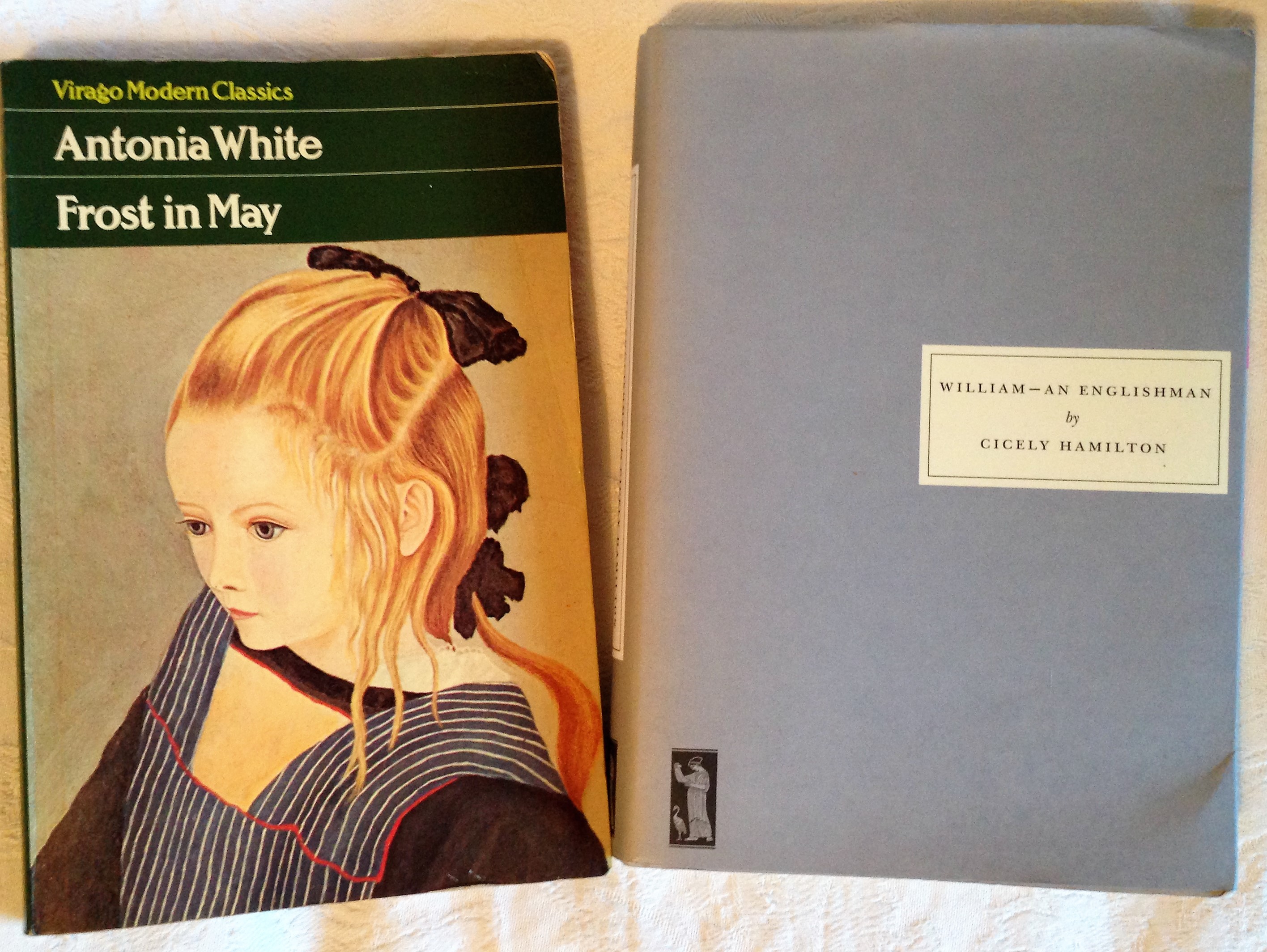
Last week I looked at The Enchanted April, so this week for May Day I thought I’d look at another Virago that helpfully has the current month in the title, Frost in May by Antonia White (1933). Virago was founded in 1973, with the Modern Classics imprint starting in 1978 “dedicated to the rediscovery and celebration of women writers, challenging the narrow definition of Classic”. Frost in May was the first Modern Classic title, so for this post I’ve paired it with the first Persephone title, as Persephone, founded in 1998, have a similar remit to publish lost or out of print books which are mainly written by women.
Frost in May is Antonia White’s autobiographical first novel, telling the story of Nanda Gray and her schooling at the Convent of the Five Wounds from the ages of 9 to 14. Nanda begins school as a devout child, finding her way in Catholicism:
“St Aloysius Gonzaga had fainted when he heard an impure word. What could the word have been? Perhaps it was ‘belly’, a word so dreadful that she only whispered it in her very worst, most defiant moments. She blushed and passionately begged Our Lady’s pardon for even having thought of such a word in her presence.”
White charts Nanda’s development throughout her school career. She is from an ordinary middle-class family, her father a recent convert, and the other girls from aristocratic European Catholic families are glamorous and much more worldly:
“Leonie and Rosario were seasoned retreatants. They went into this solitary confinement with as little fuss as old soldiers going into camp. Rosario supplied herself with a great deal of delicate needlework if a vaguely devotional nature, while Leonie announced frankly that she was going to use her notebook to compose a blank verse tragedy on the death of Socrates.”
As Nanda becomes older, she begins to struggle with her faith, although there is never a sense that she will abandon it all together. Rather it is the story of a young person trying to find a true sense of meaning within her faith, rather than without it.
“She had often been rewarded by a real sense of pleasure in the spiritual company of Our Lord and Our Lady and the saints. But over and over again she encountered those arid patches where the whole of religious life seemed a monstrous and meaningless complication.”
If this sounds like it has no place in today’s secular world, I’ve not done Frost in May justice. The novel is about a young person’s growing realisation of self, explored with sensitivity. As a heathen book lover, I related to Nanda’s discovery of poetry:
“She read on and on, enraptured. She could not understand half, but it excited her oddly, like words in a foreign language sung to a beautiful air. She followed the poem vaguely as she followed the Latin in her missal, guessing, inventing meanings for herself, intoxicated by the mere rush of words. And yet she felt she did understand, not with her eyes or her brain, but with some faculty she did not even know she possessed.”
Frost in May is a short novel and a quick read, and I can see both why it was marginalised and why Virago chose it to launch its Modern Classics imprint. It is easy to overlook: a school story in which little happens, five years in a young girl’s life and no intrusive authorial voice to proclaim any wider profundity beyond the immediate story. Yet it has plenty to say about what is profound for the individual, the influences and experiences that shape us and leave an indelible mark. White’s light touch should not be mistaken for a lack of something to say.
“Do you know that no character is any good in this world unless that will has been broken completely? Broken and reset in God’s own way. I don’t think your will has quite been broken, my dear child, do you?”
Secondly, William – An Englishman by Cicely Hamilton (1919) who was a suffragette and wrote this novel during the last year of World War I. The eponymous Mr Tully is a young man who prior to the war is a socialist, fired less by idealism and more by the need for something with which to occupy himself.
“The gentlest of creatures by nature and in private life, he grew to delight in denunciation, and under its ceaseless influence the world divided itself into two well-marked camps; the good and enlightened who agreed with him, and the fool and miscreants who did not…in short, he became a politician.”
William meets and marries a similarly dim suffragette, Griselda, and Hamilton’s satire of their unthinking politicking is relentless. They are shown as well-meaning but avoiding any challenge to their ideals and any opportunity for genuine original thought. When a certain archduke is assassinated in Sarajevo, they pay it little mind as it does directly affect their parochial politics, and they head off on honeymoon to Ardennes. When they emerge from the Forest of Arden three weeks later, they are captured by soldiers and face a traumatic awakening as to the state of the world:
“So they trotted down the valley, humiliated, dishevelled, indignant, but still incredulous – while their world crumbled about them and Europe thundered and bled.”
Hamilton does not baulk from the realities of war – of which she had first-hand experience – and it is shown as bloody and brutal. The satire falls away as William becomes the everyman caught up in circumstances far beyond his control.
“It had not seemed to him possible that a man could disagree with him honestly and out of the core of his heart; it had not seemed to him possible that the righteous could be righteous and yet err. He knew now, as by lightening flash, that he, Faraday, a thousand others, throwing scorn from a thousand platforms on the idea of a European War, had been madly, wildly, ridiculously wrong – and the knowledge stunned and blinded him.”
Hamilton’s master stroke is that the things she satirised – William and Griselda’s lack of understanding, ignorance and youthful certainties – become the very things that drive home the human tragedy of the war. They are ordinary people who just wanted to live the life they imagined for themselves, and their powerlessness and profound losses are what makes this so very sad. The devastation of World War I is left in no doubt.
After all this talk of devastation, let’s pick ourselves up with some love poetry: the wonderful Harriet Walter reading the sonnet from which this post takes its title:
Despite being woefully slow in my blogging, I’ve managed a second post for Reading Ireland Month hosted by Cathy at 746 books and Niall at Raging Fluff. Sláinte!
I’ve picked two novels linked by undergraduate protagonists – one a classic of Irish literature which is on Cathy’s 100 Irish Novels list, the other a little-known first novel by an author who has gone on to huge success.
Firstly, the classic At Swim-Two-Birds by Flann O’Brien (1939). The unnamed narrator is in many ways a typical student:
“Whether in or out, I always kept the door of my bedroom locked. This made my movements a matter of some secrecy and enabled me to spend an inclement day in bed without disturbing my uncle’s assumption that I had gone to the College to attend to my studies. A contemplative life has always been suitable to my disposition.”
His dissolution is perhaps a bit more extreme than most students however:
“It was in the New Year, in February, I think, that I discovered my person was verminous.”
Yuck. Gradually clues emerge that this student may be more literate than he first appears, such as how he describes his friend offering to buy him a drink:
“I rejoined that if his finances warranted such generosity, I would raise no objection, but that I (for my part) was no Rockefeller, thus utilising a figure of speech to convey the poverty of my circumstances.
Name of figure of speech: Synedoche (or Autonomasia)
The three of us walked slowly down to Grogan’s…”
The splintering of the narrative with the definition also hints at what is to come, as soon the story begins to be invaded by other stories the student is writing: about a devil Pooka and a fairy in his pocket; about Furriskey, born a fully grown man; a Western; versions of Irish folklore. All the narratives start to reflect and echo each other, eventually they overlap and boundaries break down. In other words, this is classic modernist brilliance, layering up myth and meta-narratives to create something astonishing. If you want to read Ulysses but you’re not sure you’re up to the task, At Swim-Two-Birds could be a good gateway novel 🙂 As Dylan Thomas said:
“This is just the book to give your sister if she’s a loud, dirty, boozy girl.”
In other words, if she’s a student.
Secondly, Stir Fry by Emma Donoghue (1994), who would go on to have enormous success with Roomsixteen years later. This is the sort of first novel that doesn’t seem to be published as much now – perfectly decent efforts of thinly disguised biography whereby an author gets to grip with their craft. I’ve no actual facts to back up my theory, but it seems that while more and more books are published, first novels now have to have a huge wow factor – not necessarily a bad thing, but there’s an awful lot of truly dreadful writing being published because it will make money, while these better written but modest efforts flounder. I hope potentially good novelists are not being put off: hang in there budding writers!
Anyway, back to Stir Fry. Maria is seventeen and leaves her rural home to start university in Dublin.
“Dirty blue clouds were scudding over slate roofs. A good cold smell in the air and the whiff of turf smoke as she turned the corner made her think of home. The dusk lasted much longer in the country; nothing to get in the way she supposed. In Dublin there was only half an hour of grey, then the street lamps blinked on and all the shoppers hustled home in the dark.”
She is remarkably naïve, even given her young age, and takes forever to realise that her two flatmates are in a same-sex relationship:
“Now suddenly here were two friends of hers kissing on the table she ate at every night. Rapt faces and library books and garlic, how bizarre.”
She considers moving out, which may seem ridiculous, but Maria’s world sees discussions like this occur in all earnestness:
“‘Look, they’re both very nice. And they wear skirts sometimes too.’
‘Oh, I know,’ said Yvonne wisely, ‘but they’d have to, wouldn’t they, as cover?’”
What follows is a sweet story of Maria coming to realise who she is and what she wants. The characters are all very believable and they and Dublin are drawn with real affection. Stir Fry is a quick read, a bildungsroman in which nothing and everything happens. It doesn’t contain the brilliance Donoghue displayed with Room, but it still made me think it’s a pity we don’t see these types of first novels much anymore.
To end, an Irish band that first came to prominence when I was student – this song was played at many a sticky-floored student club back in my day:
You’re not wrong, JD. Mine is in definite box-of-frogs territory. It’s the thing I like most about her. I’ve been extraordinarily lucky, but a relationship such as ours will never be immortalised in literature given that we get on well and it would be inexorably dull. So for mother’s day (which it is today in the UK) I’m looking at two portrayals of mothers that are nothing like my own but which make for great reads. This post is dedicated not only to my own mother, but also to my sister-in-law, for whom today is her first mother’s day as a mother 🙂
My first literary mother is Mrs Ramsay from To the Lighthouse by Virginia Woolf. I chose this because Virginia Woolf is one of my mother’s favourite writers, and like the homebrew peach schnapps I once allowed past my lips, I deeply regret this now. How on earth do you write about anything by Virginia Woolf? Her writing is so rich, so multi-layered, so dense and yet so subtle that I don’t feel adequate to the task – which I’m sure the following discussion will prove beyond a doubt 😉
In To the Lighthouse, the Ramsay family descend on their holiday home in the Isle of Skye. Woolf’s stream-of-consciousness technique is perfect at capturing everything that occurs beneath the surface of an ordinary day, the deep significance below the seemingly insignificant:
“the monotonous fall of the waves on the beach, which for the most part beat a measured and soothing tattoo on her thoughts and seemed consolingly to repeat over and over again as she sat with the children the words of some old cradle song, murmured by nature, ‘I am guarding you – I am your support’, but at other times suddenly and unexpectedly, especially when her mind raised itself slightly from the task in hand, had no such kindly meaning, but like a ghostly roll of drums remorselessly beat the measure of life, made one think of the destruction of the island and its engulfment in the sea and warned her whose day had slipped past in one quick doing after another that it was all as ephemeral as a rainbow – this sound which had been obscured and concealed under the other sounds suddenly thundered hollow in her ears and made her look up with an impulse of terror.”
Mrs Ramsay is a nurturing and dedicated mother but here Woolf exposes the fractures that threaten a seemingly harmonious exterior. I think this passage is just brilliant – the setting up of the monotonous background noise that lulls yet twists in a moment, the mind rebelling against the self, the pure terror that we can be overwhelmed by our own feelings – all while domesticity continues undisturbed.
The family are surrounded by Mrs Ramsay’s nuturing love and the sea, and as the passage above shows, these are bound together in their constancy being mistaken for predictability. To the Lighthouse uses water imagery to great effect, the sustaining essence that can imperil and kill:
“how life, from being made up of little separate incidents which one lived one by one, became curled and whole like a wave which bore one up with it and threw one down with it, there, with a dash on the beach”
This is my experience of reading Woolf: small incidents, layered up into writing of such power that you surface from her novels feeling dashed by a powerful force.
If you’d like to read some proper reviews of this wonderful novel, there have been insightful and interesting posts written lately by bloggers including Lady Fancifull and Simon at Stuck in a Book. If you’d like to know more about the man Mrs Ramsay married, a man given to views such as: “He wondered if she understood what she was reading. Probably not, he thought. She was astonishingly beautiful.” Sarah has written a typically witty and entertaining post over at Hard Book Habit.
Secondly, The Blue Room by Norwegian author Hanne Orstavik (trans. Deborah Dawkin) one more stop on my Around the World in 80 Books Reading Challenge, hosted by Hard Book Habit. I can’t remember which blogger made me aware of this so if it was you please leave a comment! Peirene Press publish contemporary European novellas, and group them in sets of three, linked by theme. The Blue Room is part of the Coming-of-Age series, and concerns Johanne’s intense relationship with her mother; they live together while Johanne trains to be a psychologist. Her career choice is deeply ironic, given that she has no insight into the manipulative, controlling behaviour her mother directs towards her, or her own victimhood.
“She’s right, I thought, we belong together like two clasped hands.”
Well, two clasped hands can be affectionate, reassuring, but also restraining and restrictive. The novel takes place over the course of a day, when Johanne was due to leave to spend six weeks in the States with her boyfriend, yet wakes to find herself locked in the titular space and unable to leave. As she thinks back over recent events, relationships with her mother, boyfriend and God emerge and the reader is left to piece together what is going on beyond what Johanne doesn’t say. She is an unreliable narrator of her own life as we all are, because her perspective is limited by what she cannot see.
Her mother is deeply controlling and Johanne has the victim’s hypersensitivity to her abuser’s every need and whim. At no point does she articulate that it is her mother who has locked her in, unwilling to let her leave.
“Perhaps I’m locked in here as part of an experiment. Perhaps somebody’s pumping gases in and changing my consciousness.”
Johanne’s sexual fantasies abruptly break into the narrative, filled with violence, with herself as the dominated party in BDSM scenarios. Again, despite her training, she cannot see how this is bound up in her relationship with her mother:
“And what exactly, I asked, is the meaning of this pain? Don’t we grow when we’re happy? Mum looked at me: she seemed angry and said nothing.”
Johanne is young and naïve, lacking insight, both sweet and shocking. The Blue Room is a powerful novella about our closest relationships and how they influence us in ways we barely comprehend.
To end, a little treat for my mother and any other LDP fans out there – enjoy!
David Bowie died on 11 January (and then Alan Rickman 3 days later – 2016 is rubbish so far). Although I have never been personally moved by a celebrity death, shocking and sad as they are, on Monday I found myself weeping in the middle of King’s Road (lesson: don’t look at the BBC News app in public). In common with his worldwide legions of fans, Bowie had a special place in my heart and it’s a horrible shock that our hero has gone.
Consoling myself through the internet, I discovered he had listed his 100 Must Read books, so I thought I would look at two in this post. Sarah over at Hard Book Habitalso wrote about this list, do pop over and read her lovely post. One of my choices is also my first stop on Hard Book Habit’s Around the World in 80 Books Reading Challenge, which you can read all about here.
Firstly, The Prime of Miss Jean Brodie by Muriel Spark (1961), probably her most famous novel. Miss Brodie is a romantic teacher in a conservative girl’s school in Edinburgh in the 1930s. Eschewing the curriculum, she educates her girls in the ways of art, love… and fascism. Boasting “Give me a girl at an impressionable age and she is mine for life.” Miss Brodie has a group of girls who form the ‘Brodie set’, and the novel, slipping back and forth in time, is told mainly from their points of view, despite a third person narrator.
“Miss Brodie had already selected her favourites, or rather those whom she could trust; or rather those whose parents she could trust not to lodge complaints about the more advanced and seditious aspects of her educational policy.”
Miss Brodie repeatedly insists that she is in her prime; she is silly and vain, and the school are out to get her. But Spark does not judge her harshly, suggesting she is just in the wrong place at the wrong time:
“It is not to be supposed that Miss Brodie was unique at this point of her prime…there were legions of her kind during the nineteen-thirties, women from the age of thirty and upward, who crowded their war-bereaved spinsterhood with voyages of discovery into new ideas and energetic practices in art or social welfare, education or religion.”
We learn quite early on that she is betrayed, and that it one of her set who betray her, forcing her into early retirement. Miss Brodie is a complex character: charismatic; aspirational for herself and others; entirely inappropriate towards her pupils and with truly hideous politics. She is an independent spirit who vastly underestimates her own vulnerability.
“It was then that Miss Brodie looked beautiful and fragile, just as dark heavy Edinburgh itself could suddenly be changed into a floating city when the light was a special pearly white and fell upon one of the gracefully fashioned streets. In the same way Miss Brodie’s masterful features became clear and sweet to Sandy when viewed in the curious light of the woman’s folly”
The Prime of Miss Jean Brodie is a short novel – 128 pages in my edition – which shows just how much a brilliant writer can say in a short space. Spark has created one of the legendary characters of modern fiction who truly stays with you: like her or loathe her, its almost impossible not to be drawn in, becoming one of the ‘Brodie set’.
Secondly, The Leopard by Giuseppe Tomasi di Lampedusa, set during the nineteenth century Risorgimento, whereby the different states of the Italian peninsula unified into a single state. Telling the story of the aristocratic Sicilian Salina family, particularly Fabrizio, the Prince, the novel has an elegiac quality as it documents the decline of the family and change of a way of life.
“Between the pride and intellectuality of his mother and the sensuality and irresponsibility of his father, poor Prince Fabrizio lived in perpetual discontent under his Jove-like frown, watching the ruin of his own class and his own inheritance without ever making, still less wanting to make, any move toward saving it.”
The Prince is surrounded by people, between political responsibilities and social engagements, yet he is an isolated figure, partly due to his “contempt for all his own relatives and friends, all of whom seemed to him mere driftwood in the languid meandering stream of Sicilian pragmatism”.
But the Prince cannot resist the forces of all that surrounds him, and while the military action of the Risorgimento takes place only by report, he and his family are dragged towards modernisation, such as having his aristocratic gene pool diluted by the daughter of a clerical man who:
“moved through the forest of life with the confidence of an elephant which advances in a straight line, rooting up trees and trampling down lairs , without even noticing scratches of thorns and moans from the crushed”
The domestic is resolutely tied with the political and historical, even during the intimacy of seduction:
“he felt as if by those kisses he were taking possession of Sicily once more, of the lovely faithless land which now, after a vain revolt, had surrendered to him again, as always to his family, its carnal delights and golden crops.”
Yet while the people are tied to the land and its history, a recurring theme is of human insignificance, of the transitory nature of humans and their constructs, of all around us falling away. This isn’t depressing, and indeed there is a subtle humour in The Leopard, but it is sad and there is a sense of existential crisis. This wider theme is distilled into the Prince’s relationship with his beloved stars:
“As always, seeing them revived him; they were distant, they were omnipotent and at the same time they were docile to his calculations; just the contrary to humans, always so near, so weak and yet so quarellsome”
The Leopard is a short novel but it took me a while to read it as it so densely written, not a word is wasted. Lampedusa’s use of imagery is strikingly beautiful and he is not afraid to tackle huge ideas.
“the real problem is how to go on living this life of the spirit in its most sublimated moments, those moments that are most like death”
To end, a memory from last summer. I accompanied my friend’s children – aged 4 and 7 – to an open-air showing of Labyrinth. There are contradictory reports about Bowie’s feelings towards this film, but for me it has a special place in my heart because it was the point at which, aged nine, I first fell in love with him.
Prior to the showing, there were many jokes about indoctrination and my brainwashing of children, but on arrival I found my flash cards on The Life and Times of David Bowie were not needed. There were a number of avid Labyrinth-watchers dressed up in oversized mullet wigs and inappropriately large codpieces, a la Jareth the Goblin King. The kids squealed with delight and ran around to greet them all, crying “David Bowie! David Bowie!” When my friend’s son arrived back where we were sitting, he flopped down, breathless with joy, and simply said “David Bowie.”
Happy 2016! How are your New Year’s resolutions going? I excelled myself this time around, by abandoning mine before I’d even begun. My internal monologue went thusly:
“I’m going to not buy any more books until I’ve read all those I already own.
… except playtexts (they’re so small they barely count).
…and Persephones.
…and green Viragos.
…and anything else that I really, really want.”
*Sigh* Useless. Even Paul Newman has lost all faith in me.
OK, so that was just an excuse to put a picture of Paul Newman in the post and if we’ve learnt one thing, it’s that I am incapable of exercising any sort of self-control, especially regarding books and gifs, and cheese, and single malts, and watching inane detective shows, and…..
So if you are a fellow willpower-free zone, I have an answer for you. Surround yourself with people who are worse than you in some way, and you’ll realise you’re not so bad after all. Now is not the time for aspirations, it is a time for resignation and another fistful of chocolates 🙂 This week I thought I’d look at anti-heroes, and two characters who will make you feel like the most virtuous person alive.
Firstly, Tom Ripley in The Talented Mr Ripley by Patricia Highsmith (1955).
Tom Ripley is approached by the father of an acquaintance in a bar, who has mistaken him for a decent human being:
“Judging [Tom] from that night, Charley could have told Mr Greenleaf that he was intelligent, level-headed, scrupulously honest, and very willing to do a favour. It was a slight error.”
An understatement to say the least. Tom agrees to go to Europe to try and persuade the prodigal son, Dickie Greenleaf, to return home and join the family business, not for any altruistic reason but because he’s worried a petty scam he’s been running is catching up with him. Dickie is a golden boy, rich, idle and good-looking :
“Tom could not help feeling that Richard was not very intelligent, or else he loved to be photographed and he thought he looked best with his mouth spread from ear to ear, which was not very intelligent of him, either.”
Tom becomes obsessed with Dickie, wanting to be all that he is and have all he has:
“Possessions reminded him that he existed, and made him enjoy his existence. It was as simple as that. And wasn’t that worth something? He existed.”
Tom’s slippery notion of himself, identity and existence is the driving force of the novel as he dissolves the boundaries between him and Dickie, eventually *SPOILER* killing him and stealing his identity. The remainder of the novel sees him dodging authorities and Dickie’s friends, spinning lies and manipulating everyone in his path: “He was himself and yet not himself. He felt blameless and free, despite the fact that he consciously controlled every move he made.”
Tom is a sociopath of course, and the real strength of the novel lies in the study of his character rather than the thriller elements, well done as they are. It is Tom’s character that spawned four sequels and really gets under your skin; as a reader I felt drawn in by him, creating a weird ambivalence through empathy and disgust. Tom is a powerful but sad character – he knows something is missing in him, something that makes him entirely alone:
“It struck Tom like a horrible truth, true for all time, true for the people he had known in the past and for those he would know in the future: each had stood and would stand before him, and he would know time and time again that he would never know them and the worst was that there would always be the illusion, for a time, that he did know them, that he and they were in complete harmony and were alike.”
The Anthony Minghella film adaptation of The Talented Mr Ripley is widely known, but I also recommend a French adaptation from 1960, Plein Soleil starring an unnervingly beautiful Alain Delon as Ripley:
Secondly, Joe Lampton in Room at the Top by John Braine (1957).
I expected this story of social climbing to have dated but surprisingly, it wasn’t so. The references to northern mill towns being a hive of industry is sadly past and the rigid social classes, worry over a relationship’s ten year age gap and Joe’s lover’s concern that she is ancient at the ripe old age of 34, seem less relevant. However, as a portrayal of greed for material acquisition and the mistaking of such as being a purposeful life, Room at the Top is as incisive as ever.
Joe leaves the poverty of his home town of Dufton to move to the more prosperous Warley:
“I was going to the Top, into a world that even from my first glimpses filled me with excitement: big houses with drives and orchards and manicured hedges, a prepatory school to which the boys would soon return from adventures in Brittany and Brazil and India or at the very least an old castle in Cornwall, expensive cars – Bentleys, Lagondas, Daimlers, Jaguars –parked everywhere as a kind of ostentatious litter as if the district had dropped them at random as evidences of its wealth”
Joe rooms at the top of one of the large houses, takes a job at the local town hall, but has ambitions far beyond his current circumstances:
“I saw myself, compared with him, as the Town Hall Clerk, the subordinate pen-pusher…I wanted an Aston-Martin, I wanted a three-guinea linen shirt, I wanted a girl with a Riviera suntan – these were my rights, I felt, a signed and sealed legacy.”
Joe joins the local am-dram society and is drawn to young, rich Susan: “I’ll marry her if I have to put her in the family way to do it. I’ll make her daddy give me a damned good job. I’ll never count pennies again.” Thus begins a double life, one where he is with Susan, determinedly climbing the slippery pole, “I was manoeuvring for position all the time, noting the effect of each word; and it seemed to devalue everything I said” and one where he is with Alice, his older lover, able to be authentically himself.
Joe is an intriguing character, utterly reprehensible in his machinations but painfully self-aware and never self-justifying: he wants what he wants and he sets out to get it. There is no sense that he is any better or any worse than those who surround him, and so Room at the Top, while an intimate portrait of one man, is also a damning portrait of post-war society. I didn’t wholly dislike Joe, but Braine doesn’t shy away from the emotional fall-out of using people in this way and we are not expected to excuse Joe’s behaviour.
“I felt choked with my own selfishness as nasty as catarrh; there was nothing in my heart to match the lovely sweep of the moor and the sense of infinite space behind it and a million extra stars above.”
Joe’s punishment is a terrible one: he gets everything he wants.
Room at the Top was a huge success and quickly adapted into a similarly successful film with Simone Signoret winning an Oscar for her portrayal of Alice:
So take it from me, Tom Ripley and Joe Lampton: even if you’ve failed in all your New Year resolutions, you’re doing OK 🙂
This is a loooong post – strap in people, and bring Kendal mint cake.
These days I don’t generally socialise as part of a group (unless it’s a work do, an experience that Dante forgot to include in his descriptions of the circles of hell) but in the last week I’ve been out with two sets of friends, which was a lovely change. For this reason, in this post I thought I’d look at writers who have famously been part of a group.
Firstly, A Moveable Feast by Ernest Hemingway, which was published after his death and recalls his time as a young man in Paris during the interwar period, part of une generation perdue, or lost generation:
“’’That’s what you are. That’s what you all are,’ Miss Stein said. ‘All of you young people who served in the war. You are a lost generation.’
‘Really?’ I said.
‘You are,’ she insisted. ‘You have no respect for anything. You drink yourselves to death…’”
Miss Stein is of course Gertrude Stein, and her literary salon attracts some of the greatest writers of the generation: F Scott Fitzgerald, Ezra Pound, Ford Maddox Ford (a less than flattering portrait), Hilaire Belloc, James Joyce… it really is astonishing that these minds were all in the same place at the same time.
I can’t tell you how much I want to dislike Hemingway. He was macho, into bloodsports, treated women appallingly… but his writing just takes my breath away. A Moveable Feast gives some insight into his craft; his drive to write what is true and to distil his writing into the sparse style he became so famous for:
“Since I had started to break down all my writing and get rid of all facility and try to make instead of describe, writing had been wonderful to do. But it was very difficult, and I did not know how I would ever write anything as long as a novel. It often took me a full morning of work to write a paragraph.”
He is filled with the arrogance and uncertainty of youth, completely committed to his craft:
“I’ve seen you beauty, and you belong to me now, whoever you are waiting for and if I never see you again I thought. You belong to me and all Paris belongs to me and I belong to this notebook and pencil.”
“I would stand and look out over the roofs of Paris and think, ‘Do not worry. You have always written before and you will write now. All you have to do is write one true sentence. Write the truest sentence you know.’”
While he is sitting in cafes trying to write one true sentence, the young Hemingway comes into contact with various writers also trying to perfect their craft, including one of my favourite poets, Ezra Pound:
“Ezra was kinder and more Christian about people than I was. His own writing, when he would hit it right, was so perfect, and he was so sincere in his mistakes and so enamoured of his errors, and so kind to people, that I always thought of him as a sort of saint. He was also irascible, but so perhaps have been many saints.”
I just don’t understand how a person unfailingly described by all who knew him as being so generous, supportive and kind could also be such a massive fascist. It does make me feel a bit better about liking his poetry though. He also provides many of the episodes of comic relief in A Moveable Feast:
“I had heard complaining all my life. I found I could go on writing and that it was no worse than other noises, certainly better than Ezra learning to play the bassoon.”
Hemingway and his first wife were poverty-stricken in this period, and one of the places that offers succour is the now-famous English language bookshop Shakespeare and Company under the auspices of Sylvia Beach.
“On a cold windswept street, this was a warm, cheerful place with a big stove in winter , tables and shelves of books, new books in the window, and photographs on the wall of famous writers both dead and living.”
From within this perfect bookshop, Sylvia lends Hemingway and Hadley money and books, and helps create the man who would write this about F Scott Fitzgerald
“His talent was as natural as the pattern that was made by the dust on a butterfly’s wings. At one time he understood it no more than the butterfly did and he did not know when it was brushed or marred. Later he became conscious of his damaged wings and of their construction and he learned to think and he could not fly any more because the love of flight was gone and he could only remember when it had been effortless.”
If that passage doesn’t want to make you weep at the tragic beauty of it all, then I don’t know if we can be friends. Damn you Hemingway, you’ve made me love you just like all those other women who should have kept well away.
Woody Allen explored the attraction of this group of writers in Midnight in Paris. I liked the film, but even a friend who loathed it admitted Corey Stoll did a great job as Hemingway:
“But Paris was a very old city and we were young and nothing was simple there, not even poverty, nor sudden money, not the moonlight, nor right and wrong, nor the breathing of someone who lay beside you in the moonlight.”
Secondly, The Wise Virgins by Leonard Woolf, who was part of the Bloomsbury group, and in his second (final) novel portrays his wife, Virginia. He is also in the privileged position of being one of the few male authors published by Persephone Books, and their lovely edition of this novel includes an endpaper print by Vanessa Bell, Virginia’s sister.
Harry Davis moves with his family into the stultifying suburban society of Richstead (Richmond/Hampstead) where he is introduced to the Garlands and their four daughters, who do nothing all day because that is all they are expected to do:
“Harry felt the dull sense of depression creeping over him again. ‘It’s so bad,’ he said, ‘to be comfortable. That’s why you want to go on forever in the same place.’
‘But I like being comfortable,’ said Ethel decisively. ‘I don’t think it’s bad at all.’
Harry remained silent; he couldn’t think of anything more to say. Gwen watched his rather heavy face. She could not make him out; she was not sure whether she liked him or hated him at first sight. He seemed to be exceedingly ill-mannered, she thought.”
Harry is an artist, and wants so much more. He meets the intellectual, free-thinking Camilla (seen as representing Virginia) and falls in love. While I think reading the novel for biographical ‘clues’ misses the point and would prevent enjoying the novel fully, it’s not difficult to imagine Virginia agreeing with some of Camilla’s sentiments:
“’There’s so much from marriage from which I recoil. It seems to shut women up and out. I won’t be tied by the pettiness and the conventionalities of life. There must be some way out. One must live one’s own life’”
The difficulty is, most of the characters are too vacuous, lazy and pretentious to tread their own path. They’re not terrible people, but the Bloomsbury set seem to sit around all day trying to be clever, while the suburban set obsess over flowers. Apparently some found Camilla-as-Virginia offensive, but if that was what Woolf was doing, Leonard-as-Harry fares little better, too weak to ever seize the life he imagines, lacking the courage of his own convictions:
“He turned over, and lay flat, burying his face in the grass. Harry felt as if he himself were turning into stone. He just managed to say:
‘You think her absolutely cold?’
‘She’s a woman and a virgin: isn’t that enough?…What they want is to be desired – that’s all. And when they get that from some poor devil with a straight back and a clean face, they think they are in love with him, and he marries, to be disappointed.”
If all this sounds terribly tedious, it isn’t. Woolf satirises early twentieth-century society and shows how it denies sexuality and oppresses men and women, but especially women. It could be a bleak novel – none of the characters really know what they want or how to break free – but I think we’re not meant to take them as seriously as they take themselves. While it’s not a broad comedic novel, The Wise Virgins has plenty of humour in it:
“This gentleman was undoubtedly a clergyman; his red nose and the causes of it had made it difficult for him to be a minister of Christ for any long time in one place…his life had its advantages, he used to affirm in his more secular moments, because he never had to write a new sermon; one congregation after another listened to the same four which had escaped the wear and tear of wandering with their author up and down England.”
The Wise Virgins is about a denial of desires both individual and collective, and how damaging it can be. The Bloomsbury group in real-life were much more sexually liberated, and while I’m not sure the result was damage-limitation, it did result in some beautiful art.
You made it to the end of this post! Thanks for reading, and here is your reward:
This is part of a series of occasional posts where I look at works from Le Monde’s 100 Books of the Century. Please see the separate page (link at the top) for the full list of books and an explanation of why I would do such a thing.
Now that I have some of my life back after a period where I was deranged enough to both work and study full-time (what was I thinking???? etc etc ad infinitum) I’ve decided I need to get back on track with my reading challenge, and I’m easing myself in with the slim novel The Big Sleep by Raymond Chandler.
The Big Sleep is the first of Chandler’s novels, and the first I’ve read. It’s a mark of how far his style and the hardboiled detectives he created have become assimilated into modern culture that I could hear Humphrey Bogart’s voice in my head reading every word:
Having finished the novel it’s a source of constant disappointment to me that I don’t have Bogie’s voice in my head narrating my daily life, although admittedly if he did turn up he’d probably leave out of utter boredom:
“I walked to the kitchen. A cat appeared from nowhere, making his disgust at the lack of crunchies in his bowl known. I poured a cup of tea. The kettle needed descaling but I couldn’t be bothered. I was out of milk. I debated whether to drink it black or go to the shop. The tea in the cup was as dark as the night outside. As dark as my soul. I put on my coat, knowing the wind outside would be colder than the welcome awaiting my return if the cat bowl remained empty.”
Hmm, it’s not really working, is it? Let’s see it done properly, with tales of blackmail, murder, riches and glamour in Los Angeles, rather than domestic banalities in south London. Private eye Philip Marlowe is summoned by the affluent and moribund General Sternwood:
“His long narrow body was wrapped – in that heat – in a travelling rug and a faded red bathrobe. His thin clawlike hands were folded loosely on the rug, purple-nailed. A few locks of dry white hair clung to his scalp like wild flowers fighting for life on a bare rock […] The General spoke again, slowly, using his strength as carefully as an out-of-work showgirl uses her last pair of good stockings.”
This is the real joy of Chandler, his much-parodied use of simile, inventive and atmospheric. The images he uses accentuate the world-weary knowingness of Marlowe: “Dead men are heavier than broken hearts.” but I must confess that my sheltered existence meant I didn’t always understand all of them: “Her face fell apart like a bride’s pie crust”. Whaaat? Anyone?
As Marlowe investigates the blackmail case the General has employed him to uncover, he is drawn into the seedy underbelly (I think the phrase ‘seedy underbelly’ was probably coined to describe Chandler’s oeuvre) of Los Angeles – “It seemed like a nice neighbourhood to have bad habits in”– pornography, drugs, murder, and of course, sexy ladies at every turn:
“She got up slowly and swayed towards me in a tight black dress that didn’t reflect any light. She had long thighs and she walked with a certain something I hadn’t often seen in bookstores.”
The plot is convoluted, with everyone double-crossing everyone else and Marlowe at the centre of it all, trying to hang on to some sort moral compass:
“I got up feeling sluggish and tired and stood looking out of the windows, with a dark harsh taste of Sternwoods still in my mouth. I was as empty of life as a scarecrow’s pockets.”
He is compelling narrator, wise, brave and so much cooler than probably any of his readers (definitely me.)
This is a novel to accept on its own terms – one where atmosphere and style top anything else. Famously, director Howard Hawks queried a plot-hole with Chandler when he was filming The Big Sleep. Chandler confirmed he had no idea as to the answer. But for escapist entertainment, a quick read with a confident narrative voice (Humphrey Bogart’s to be precise), The Big Sleep is a great example of the hard-boiled genre.
“The coffee shop smell from next door came in at the windows with the soot but failed to make me hungry. So I got out my office bottle and took the drink and let my self-respect ride its own race.”
I’m clearly not alone in a love of autumn: the interwebs are awash with the beauty of it all, stunning scenes of colour change and mists of mellow fruitfulness (or something). I was overwhelmed with images and so of course I abandoned pictures and opted for this montage of autumn scenes (because a family of beavers having a bath is quite the most brilliant thing to ever grace my viewing):
Back to books. Firstly, the obvious choice of Quartet in Autumn by Barbara Pym. Nominated by Philip Larkin in 1977 as the most underrated novelist of the twentieth century, it turned out to be a good year for Pym as this novel was also nominated for the Booker. Her popularity has grown steadily since this time, eradicating the problem faced by Letty, one of the titular quartet:
“She had always been an unashamed reader of novels, but if she hoped to find one which reflected her own sort of life she had come to realise that the position of an unmarried, unattached, ageing woman is of no interest whatever to the writer of modern fiction.”
Despite the title, this novel isn’t about a seasonal change but about a time in life. The quartet of Letty, Marcia, Norman and Edwin work together in an office and are heading towards retirement, all of them facing the prospect of an abundance of spare time spent alone. They are all single and slightly baffled by the world around them.
“How had it come about that she, an English woman born in Malvern in 1914 of middle-class English parents, should find herself in this room in London surrounded by enthusiastic shouting, hymn-singing Nigerians? It must surely be because she had not married. No man had taken her away and immured her in some comfortable suburb where hymn-singing was confined to Sundays and nobody was fired with enthusiasm.”
The world has changed a lot since 1914, and in the late seventies these four are looking for meaning at a time when the world is ready to place them in a home and suggest they while away their days stultifying inactivity. Pym is interested in those thought to be terminally uninteresting; she observes lives lived on a small scale and pinpoints the quirks, the pain, the tragedy and the humour. Quartet in Autumn could be a bleak read, and it does deal with a great deal of sadness. The four are lonely and misunderstood and not sure what to do about any of it.
“Norman went back to work. He had a few days leave still in hand. ‘You never know when they might come in useful,’ he said, but he felt that those extra days would never be needed, but would accumulate like a pile of dead leaves drifting on to the pavement in autumn.”
But Pym is one of the best writers at evoking a gentle but incisive humour into things, and she holds her story right on the precipice between tragedy and comedy. She encourages us to laugh at life, but with kindness. This is perfectly realised through the character of Marcia:
“Ageing, slightly mad and on the threshold of retirement, it was an uneasy combination and it was no wonder that people shied away from her or made only the most perfunctory remarks”
Yet Marcia is not a victim. She is not well, but she is determined and she goes her own away, like her unique use of libraries:
“The library was also a good place to dispose of unwanted objects which could not in her opinion be classified as rubbish suitable for the dustbin…one of the library assistants (a woman) had her eye on Marcia, but she was unconscious of this as she deposited a small, battered tartan-patterned cardboard box, which contained ‘Killikrankie oatcakes’ at the back of a convenient space on one of the fiction shelves.”
Quartet in Autumn is a little gem, beautifully observed and in its own quiet way, utterly scathing of the disregard shown to members of society who are inconvenient to the majority.
Secondly, autumn often evokes the return to school after the summer holidays, so I thought I’d look at A Good School by Richard Yates, which was published the year after Quartet in Autumn. I braced myself for this one, as Yates can be soooo depressing, but this wasn’t too bad… despite being brutal in places. Dorset Academy is a prep school funded by the eccentric, elderly and rich Abigail Church Hooper; a small, isolated “funny school” where the sons of well-meaning parents who can’t afford somewhere more prestigious are bullied/ignored educated.
“And I can see my father starting to turn away then, concluding the pleasantries, looking tired. He wasn’t old that summer – he was fifty-five – but within eighteen months he would be dead. ‘Well,’ he would say, ‘as a matter of fact I’d never heard of it either but it’s – you know – it’s supposed to be a good school.’”
We follow William Grove, a shy nervous boy desperately trying to fit in and survive at Dorset.
“He still hadn’t cried, except in the privacy of his room late at night (and even there you couldn’t be sure of remaining alone; the doors were locked only by sliding wooden bolts, easily picked open with a knife or a screwdriver; nobody was safe)but he’d come to adopt a chronic posture of humiliation. If a wretch was what they wanted, he would be a wretch.”
But rather than a relentless tale of bullying, what emerges is a claustrophobic atmosphere where everyone is damaged to a greater or lesser extent. Grove does survive, and even finds some pleasure editing the school paper. The bullies are insecure victims themselves. The teachers are lonely and without vocation:
“Mr Gold despised all Dorset boys on principal – rich, spoiled little snot-noses – but he had to admit this Haskell, was kind of an interesting kid…But when Mr Gold tried to tell his wife about it that night, in the kitchen of their home in Unionville, she didn’t want to listen. “’Interesting’?” she repeated. “You’re telling me ‘interesting’ and ‘sophisticated’ about some fifteen-year-old prep school kid? Come on. I think you’re going soft in the head Sidney.” And he guessed she was right”
What Yates shows is that sometimes there are circumstances that just have to be borne, survived and then left as soon as possible. It’s not always a great tragedy, just something you made it through. The novel is set around the time of Pearl Harbour, a bleak reminder that there can be many worse things to try and survive beyond your school days.
To end, something more cheerful: a clip from a documentary filmed at my school. This is how we began every school year: