The 1970 Club is running all week hosted by Karen at Kaggsy’s Bookish Ramblings and Simon at Stuck in a Book. The Club weeks are always great fun, so do check out the posts!
Whenever the club weeks are announced I always go straight to the TBR to see what I’ve got available. 1970 didn’t yield as many fruits as 1937 Club back in April, but it did offer four choices. Unfortunately I don’t think 1970 is my year as far as my TBR pile goes…two DNFs and a third I wish I had DNF’d rather than ploughed through. Thankfully the fourth I found to be excellent!
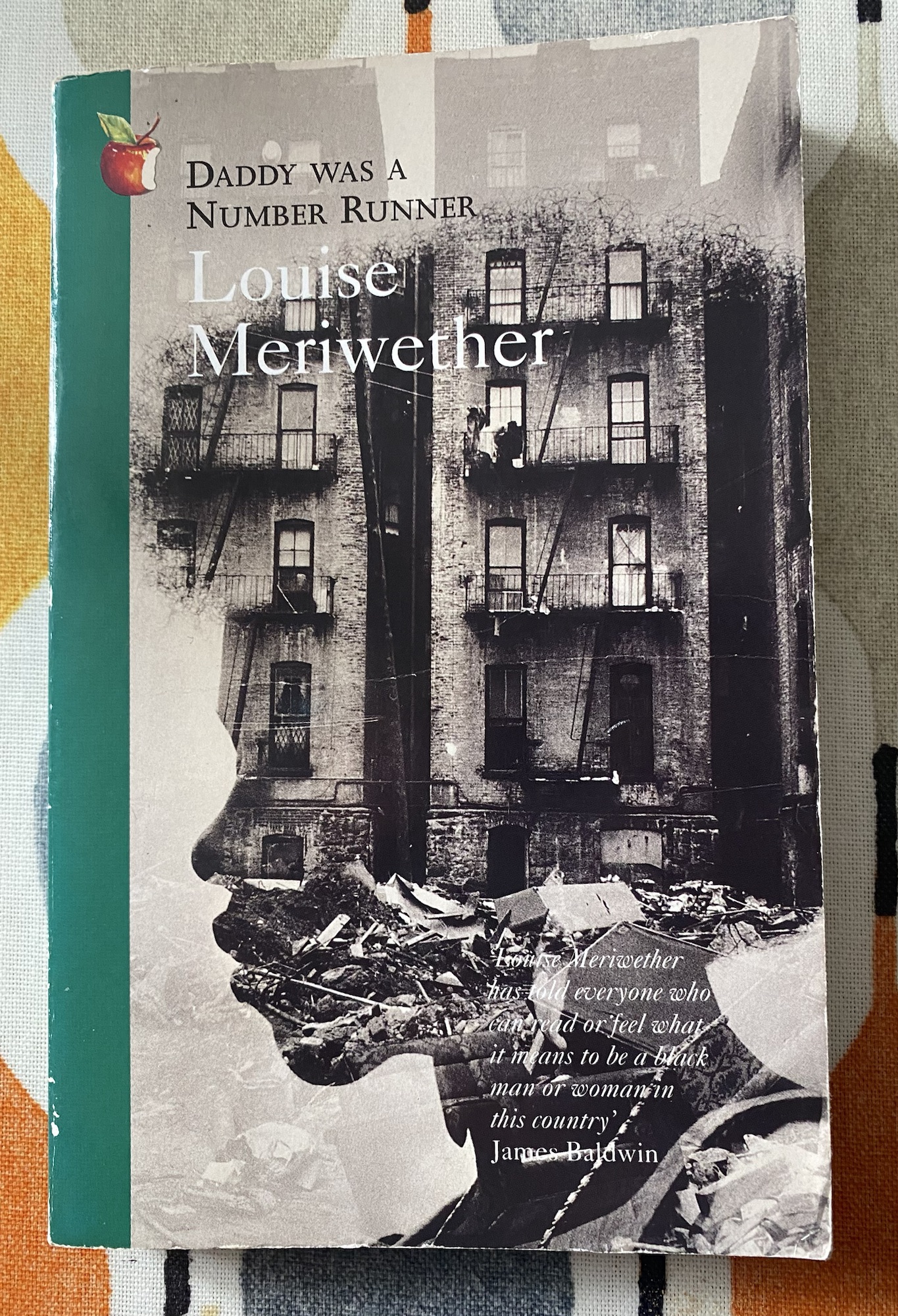
Daddy Was a Number Runner was the first novel by Louise Meriwether and widely acknowledged to be bona fide classic in its evocation of 1930s Harlem, through the eyes of a twelve-year-old girl, Francie Coffin. In the Foreword, James Baldwin writes:
“she has so truthfully conveyed what the world looks like from a black girl’s point of view, she has told everyone who can read or feel what it means to be a black man or woman in this country. She has achieved an assessment, in a deliberately minor key, of a major tragedy.”
From the opening lines as Francie helps her father with his titular illegal lottery, her voice is so direct and distinctive. As she runs home to try and get to school on time, we are thrust into a hot summer’s day in Harlem.
“The air outside wasn’t much better. It was a hot, stifling day, June 2, 1934. The curbs were lined with garbage cans overflowing into the gutters, and a droopy horse pulling a vegetable wagon down the avenue had just deposited a steaming pile of manure in the middle of the street.
The sudden heat had emptied the tenements. Kids too young for school played on the sidewalks while their mamas leaned out of their windows searching for a cool breeze or sat for a moment on the fire escapes.”
Francie’s family are incredibly poor, and running the numbers brings some money in. If lotteries are a tax on hope, Harlem is full of hope. It’s also full of bed bugs, rats and roaches. Poor Francie is eaten alive every night and has to go armed into her favourite pastime:
“I was sitting at the dining room table reading a library book, armed with my usual supply of weapons. Tonight I had a hammer, a screwdriver, and two hairbrushes. When I heard a noise I threw the hammer toward the kitchen and the rats scurried back into their holes. When I got down to my last piece of ammunition I would give the dining room up to the rats and go on to bed.”
Reading and schooling are seen as a way out of the ghetto. Francie’s older brother Sterling is bright and just about staying in school. Her other brother, James Junior, found school hard and, much to the worry of his loving parents, he is running with the local gang:
“He wasn’t mean enough to be an Ebony Earl nohow. How could he ever mug anybody, good-natured and nice as he was. Why, when he smiled his whole face laughed. He wasn’t like old Sterling who didn’t like anybody and whose narrow, old man’s face was full of dark, secret shadows.”
Francie’s parents are loving and kind, and how they hold onto those traits against the relentless grind of poverty is a miracle.
“[Mother] was always either soaking clothes or scrubbing them or hanging them out on the line. With all of that activity we should have been super clean but somehow we weren’t.”
“Daddy played by ear and could swing any piece after he heard it only once.”
Francie’s father is proud and doesn’t want to accept state relief or for his wife to work. But eventually he has to give in on both counts:
“They don’t give you enough money to live on so you have to bootleg some kind of work, then they deduct that from your relief check, too. I wonder how they expect you to live. Didn’t I tell you I didn’t want to mess with those people?” But for once he didn’t shout, seeming to be more tired than angry.”
The structural racism faced by Francie, her family, and everyone she knows is brilliantly evoked. Meriwether displays it through various characters, and there is an enormous tragedy looming for several families. The fallout on children is vivid, through Francie but also her peers. Her best friend Sukie is always filled with fury, which young Francie fails to see is due – at least in part – to Sukie’s father seeking release in alcohol and her sweet sister China Doll working for a violent pimp who beats her in front of onlookers.
Meriwether also articulates issues directly to the reader in her portrayals of, or references to, real life characters who Francie encounters, such as Reverend Adam Clayton Powell, Father Divine, Marcus Garvey, and the Scottsboro case.
There is so much hardship in Daddy Was a Number Runner, and outside of the home Francie has to navigate violence and sexual attention from many that grows into assaults. There’s also a horrible scene with a cat. What stops the novel being unremittingly bleak is her loving parents; her love of books; and Francie’s resilient, honest, humorous, indignant voice.
“I walked to 110th St and looked across Central Park at the lights twinkling in the skyscrapers. That was another world, too, all those lights way over there and this spooky park standing between us. But what good would those lights do me anyway?”
I’ve really enjoyed the three EH Young novels I’ve read but it’s been ages since I picked her up. I’m thankful to the 1937 Club, running all week and hosted by Kaggsy at Kaggsy’s Bookish Ramblings and Simon at Stuck in a Book for prompting me to get back to her!
Gerald is an architect who designs unimaginative houses that Celia despises: “here was the same puzzle of gain and loss, more money for the family and a little less beauty in the world.”
Young portrays with frankness that Celia and Gerald have a sexless marriage, because Celia cannot bear the thought of physical intimacy with her husband:
“by neglecting some of the duties of a good housewife, she stored the energy necessary for avoiding friction; by avoiding as much as possible, Gerald’s demonstrations of affection, and she had almost perfected her technique, she could give him the friendship and the kindness which vanished when more was asked of her.”
But in all honesty, she also neglects those other housewife duties too because they hold no real interest for her. She is an indifferent housekeeper (I can definitely relate) and cook, and spends a lot of her time at step removed from her surroundings. She dreams of a lost love – Richard, the brother of schoolfriend Pauline – and talks to herself.
“She had always a secret pride in its intangible persistence, its difference from a love nourished by the senses, and a more secret fear that what gave it life was its dreamlike quality.”
Those around her are used to vagueness and detachment. Living nearby is her “very stupid” sister May, her solicitor husband Stephen and their daughters including Susan. Celia’s brother John inherited the family drapery business and also lives close by, with his wife Julia and their various offspring. Another sister Hester is living a scandalously single life in London.
May and Julia form a pair, keeping each other company with their distracting daily small rivalries.
“She was congratulating herself on a superior wit because these two had supplied her with so much unintentional amusement, but she knew she had supplied them with something they valued more than laughter, an opportunity for criticism and disapproval.”
As the above quote shows, Celia can be judgemental of others. There are times when she is really quite cruel to her relatives, telling them what to do and not being entirely kind about it. But she is also fond, loving, intelligent, silly and funny. She’s a wonderful, fully-rounded, very believable creation.
The least likable character is her brother John: “John’s sense of duty towards his family was chiefly confined to criticism.” Even loving wife Julia loses patience with him at one point:
“She was enraged by John’s masculine belief in the sufficiency of his lasting passion for her, his primitive conviction that she was honoured by it and for its sake must gladly endure his faults of character and his intolerance of her own. In this rarely candid moment, she searched her mind for any other reason why she should like him and could not find one, but he was a habit and she would have been lost without him.”
We follow the extended family through various dramas, some larger than others. Stephen takes himself off for a few days, leaving May wondering if she’s been abandoned. John has to face his eldest son not wanting to follow him into the business. Celia’s son Jimmy has a crush on May’s daughter Susan (first cousins – eek). Celia has to wrestle with her mother-in-law, and there various intrigues which amount to very little. As Celia observes:
“I live in a teacup and forget it isn’t the whole world.”
However, Celia isn’t a comfort read. It is concerned with the realities of married life at a time when divorce was very rare and opportunities for women generally were very limited. Young portrays the frustrations, sadnesses, tedium, and even fear her characters experience alongside the small joys, affection and love in their lives. It feels very real, and while it is not depressing it also doesn’t offer any false hope or sentiment either.
“The art of living, the only one Celia tried to practise, was as exacting as any other.”
By end of the novel the characters know themselves and each other slightly better, and have gained some wisdom and insight through small incremental steps. There are no major epiphanies and no huge outward changes. It is a finely written and closely observed tale of interwar middle-class lives that above everything else, carry on.
While it was an involving and affecting novel, I didn’t feel Celia was the strongest of Young’s work that I’ve read – there were too many superfluous characters and the light plotting couldn’t quite sustain the length. For me, it would have benefitted from cutting one branch of the family and around 100 pages. But EH Young not at her tip-top best is still so very good and there is a great deal to enjoy in Celia.
“She had a calm indifference to what anyone might think of her, not because she herself was indifferent people, but because while she was interested in herself, as any intelligent person must be, she did not expect or wish to arouse interest in others, she had no apologies to make for what she was not, or explanations of what she was.”
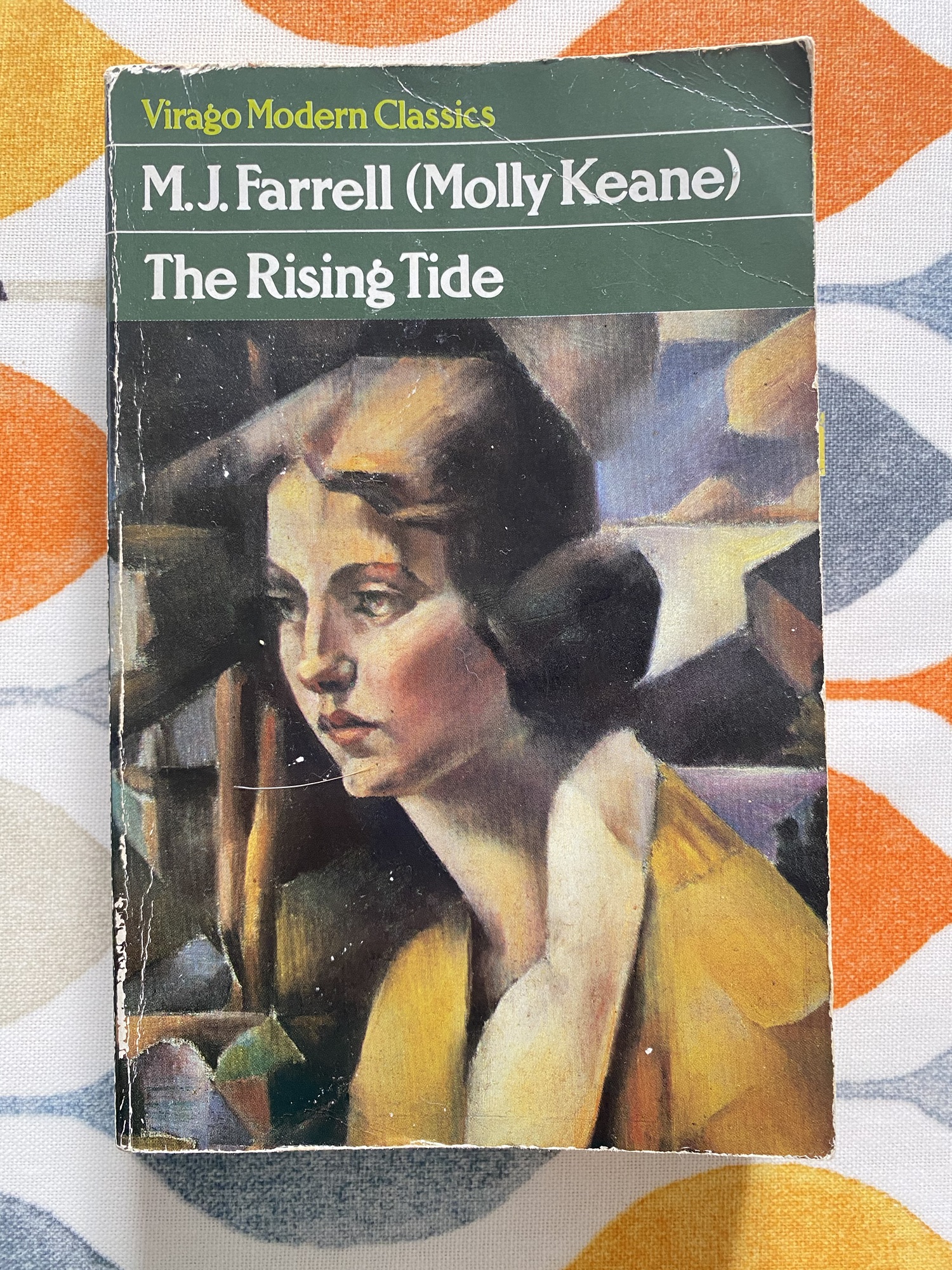
I’ve really enjoyed the Molly Keane novels I’ve read, but I think The Rising Tide might be my favourite of them all. There’s lots here that is familiar to readers of Keane’s work: Irish upper classes, Gothic Big Houses, controlling matriarchs, a stomach-churning obsession with bloodsports… but the edges were softened a bit here. The matriarchs were horribly believable yet not skirting quite as close to Gothic caricature as some of her creations; the bloodsports were referenced frequently but from the point of view of two people who hated them; snobbery was less to the fore. Keane’s astute characterisation and observational skills were as sharp as ever and the descriptive writing – especially regarding clothes and gardens – absolutely sumptuous.
The Rising Tide opens at the start of the last century. The big house is Garonlea, and Lady Charlotte French-McGrath rules over it in a constant display of her mean spirit. Her style has all the fuss and overdecoration of the Victorian period, but without any generosity:
“No lighting or heating. Tepid bathwater at best. All the wallpaper dark green or dark red. Festoons of red velvet curtains, tassels, fringes. In this room seventeen ‘occasional’ tables beside big ones and a vase of flowers on each one.”
Charlotte’s devoted husband Ambrose really just wants to be left to walk in his woods. They have four young daughters out in society: Muriel, Enid, Violet and Diana, as well as an heir in their son Desmond.
“Really, there was nothing else to be done except the things that Lady Charlotte did and she did them with wrath and speed and efficiency and throughout showed an unflinching social front.”
Things change when Desmond brings his glittering, selfish fiancée Cynthia to Garonlea:
“‘Muriel, my dear, you may take Cynthia up to her room.’
‘Yes, I’m rather a dirty girl, I think,’ said Cynthia, blinking like a cat, gold cat in the warm light room where white chrysanthemums smelt antiseptically and a majestic silver tea service glittered on an elaborately clothed table.”
Cynthia charms everyone, especially youngest daughter Diana. Cynthia likes to be charming and she likes to be adored by all. Hence, her and Lady Charlotte’s relationship is doomed from the start, and as awful as Lady Charlotte is, Cynthia is no better. She is only concerned with making people worship her and has no interest in them beyond that:
“She was always thrilled by it [the worship] and it called out at moments a dramatic feeling of goodness and humanity in her, rather an imitation sensation perhaps and one that never lasted long enough to cause her any serious personal inconvenience.”
Diana, the youngest and most rebellious of the sisters, dislikes men, enjoys it when the fashion changes so she can cut her hair, wears trousers and she adores Cynthia. But Keane is never condescending or stereotyping towards Diana and the portrait is subtle. I read Diana’s attachment as romantic, but it isn’t possessive and in fact this could easily be my twenty-first century reading of an intense chaste attachment. (There’s another character who is definitely gay, and again he is not judged for this.) Later, Keane points out that Diana, in being left to tend her gardens and live a useful life, becomes the happiest of all the sisters, rather than pitiable or bitter for remaining unmarried.
One reservation Diana has regarding her beloved Cynthia is the treatment of her children. Simon and Susan are very different to their mother and she is cruel to them, forcing them into pursuits they find terrifying and otherwise utterly unconcerned with their lives:
“Cynthia was rather impersonal about the children. If they had not had decorative value and if they had not excited Desmond so much, she would have had very little to do with them. Perhaps when they were older and started riding they would be more interesting.”
“Why could they not love hunting and dogs and ratting and badger digging and their ponies, as all right-minded children should, instead of having to be compelled and encouraged to take their parts in these sports and pleasures?”
Yet Keane demonstrates sympathy for Cynthia too. It’s a small SPOILER to say that Desmond dies in World War I, and Cynthia did truly love him. This isn’t apparent to the rest of her family in her behaviour, as she manages her grief by throwing herself into the role of society hostess. She is made for this, as are the 1920s. As she parties, drinks to excess and has affairs, very few recognise the deep pain she is running from:
“If she could fill the present moment so that she need not look before or behind it, she found that she had some ease and quietness of mind. Hunting she thought was best, but what really made her nearest to forgetting was her perpetual and indefeatable success with the men.”
“All the rest of her life was a dangerous shell of pretence, a thin shell against her ear full of screaming whispers.”
This makes Cynthia understandable, but not any more likable. She is entirely selfish and there is no kindness in her. After the death of Lady Charlotte, she is mistress of Garonlea and Diana lives with her. Cynthia knows the trauma experienced by Diana within the walls of the house but does not make any allowances for her, as this would not be convenient.
“It was a pity that all these changes at Garonlea altered it so little for Diana. To her Garonlea was more itself than it had been before Cynthia had tore down its red wallpapers and hurled the unwanted ancestors into attics with their faces to the wall […] The spirit and power of Garonlea still lived with a tenfold strength. It was as if it stored and reserved its power for a future day. Quite literally the breath of such places, the strong camphor-filled breath, on the still laden air of an outdoor place thick with old childish memories filled Diana with hatred and a tremendous consciousness of things as they had been at Garonlea all her life till now.”
As the above paragraph shows, Keane makes Garonlea its own character too. It is a looming, energy-sapping, Gothic presence: “The ruthless benignancy of Garonlea and all that Garonlea stood for. It would always be the same, it always had been.”
This is such a long post and there’s loads I haven’t mentioned! Not least the descriptive writing. Details of clothes are used to emphasise the differences between the generations: the multi-layered, highly scaffolded dresses of the sisters, in contrast to the looser styles of the Bright Young Things who follow them. Keane’s love of gardening is apparent too, in detailed descriptions of the grounds:
“Near the house sunlight poured on flat grass and on groups of blue hydrangeas and thickets of red-hot pokers. It lay the length of the opened bank of the valley as hotly as in July. Black cattle standing close together in a ring of chestnut trees looked as if they were all carved from the same block and not yet unjoined from it. There was a shaken air of blue where the half turned bracken and the woods sloped down and up.”
The Rising Tide is such a rich novel and there’s so much to enjoy. Keane’s characterisation is sharp but never cruel, and her understanding of the societal changes that occurred in the first third of the twentieth century is acute. To those of you who have made it this far, thank you for sticking with me 😀
To end, a 1930s-style party tune on a Gothic theme, hopefully Cynthia would approve:
Somehow I’ve accumulated several Janette Turner Hospital books in the TBR, without ever managing to get round to reading any of them. So thank goodness for AusReading Month 2023 hosted by Brona at This Reading Life which finally got me to pick one up!
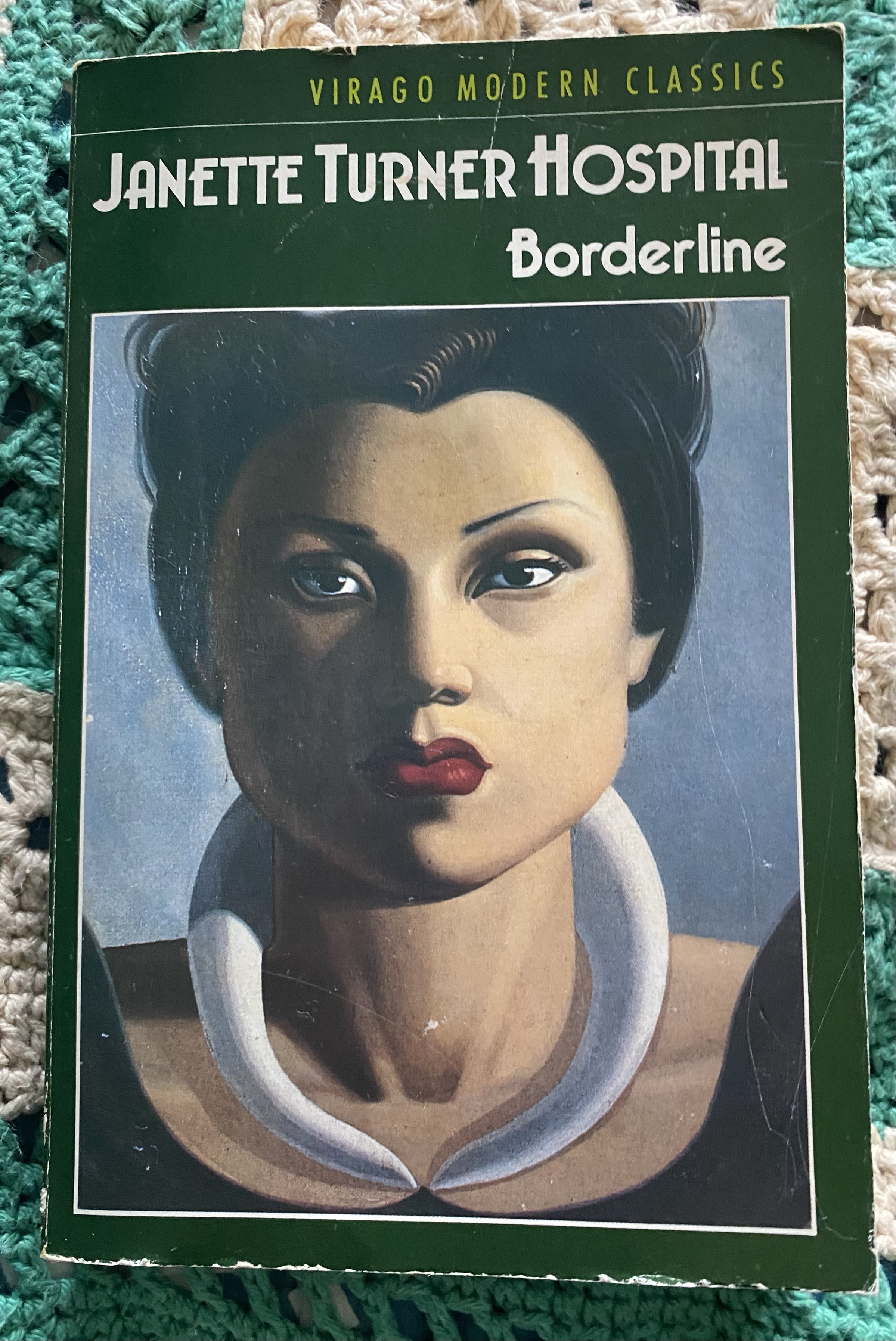
Borderline is JTH’s third novel, published in 1985. The blurb on the back describes it as a metaphysical thriller, but I don’t think that’s a helpful description. There are thriller elements but what JTH is more concerned with is the unreliable narratives we tell ourselves and others; how we can love those who remain so unknown to us; and the unpredictability of all our lives that can change in an instant. These themes don’t lend themselves to definite resolutions, so those seeking a thriller will be disappointed.
However, if you’re happy to go along with an exploration of these ideas that ends without any neat answers, there’s a lot to enjoy in Borderline.
The narrator is Jean-Marc, a man who has always had a slightly Oedipal relationship with his father’s girlfriend, Felicity. Seymour aka Old Volcano, was an artist much older than Felicity, who was nearer in age to her stepson.
“When I was five, my father was already famous and my mother was mostly distraught. Later she escaped. She made a quantum leap into banality. Which is the true secret of happiness – a second marriage, a very ordinary life, other children. Naturally she does not care to see me, a revenant from that earlier bad time, and I do not blame her at all.”
Felicity and Seymour’s relationship inevitably ends, and Felicity becomes a successful art dealer. She is returning from a trip when, at a border crossing between the United States and Canada, she makes the impulsive decision to smuggle Dolores Marquez, a refugee from El Salvador, with the help of a man called Gus.
Gus’ full name is Augustine, he’s a salesman who is routinely unfaithful to his wife. Felicity calls Dolores La Magdalena after a painting. People in this novel have different names, different roles, splintered lives. They disappear and no-one knows where to begin looking for them.
Gus’ daughter Kathleen turns up at Jean-Marc’s house, and their relationship seems to almost transgress boundaries, but not quite. As they try and locate their loved ones, Jean-Marc acknowledges that he is filling in a lot of gaps with very little to go on:
“Her stories bombard me, they seem to have become my own memories, they writhe and change and regroup in the way true memories do. They are like photographs in her grandfather’s dresser, a deluge of the ever-present past.”
The plot of Borderline is enough to pull the reader along, but this is not the novel to read if you want a plot-driven story. Jean-Marc tracks Felicity as best he can, but she remains out of reach. The stories in Borderline are unclear in origin: what Jean-Marc has experienced, what he has been told, what he is making up.
“Her days are baroque, they curl into each other like acanthus leaves, she lives somewhere between now and then. She moves in and out of her life.”
“Still, I have to admit, there has always been a quality of absence about her; which is why her disappearance itself seems insubstantial, merely a figure of speech, or a trick of the light, a momentary thing.”
I would completely understand if someone experienced this novel as a frustrating and disappointing read. However, I felt Borderline was an effective exploration of how human beings try and make sense of themselves, each other and the world when so much remains unknown and chaotic. It has some truly breathtaking passages and JTH is absolutely a writer I’d like to explore further.
To end, let it never be said that I shy away from the obvious in my 80s song choices 😀
The 1962 Club, hosted by Simon and Kaggsy, starts today and is running all week which I am very excited about 😊 The Club weeks are always great and I’m really looking forward to seeing the posts. This is the first of what I hope will be three contributions, but as I never blog as much as I mean to, failure is almost inevitable!
The Golden Spur was Dawn Powell’s last novel, and it’s a humorous look at the bohemian arts scene of late 1950s New York, specifically Greenwich Village. This was a world Powell was very much a part of and my edition features an effusive introduction from Gore Vidal who was one of her close friends.
We are introduced to the artists and writers – both up and coming, and those very much faded and failing – their hangers-on and their varied associates through the outsider view of Jonathan Jaimison. He is in his late twenties and recently discovered that his father isn’t the domineering tyrant he grew up with, but someone from this scene, back when his mother was hanging out with Prohibition-era flappers.
So Jonathan leaves his Ohio home and soon makes his way to the titular bar, at the start of his quest to find his biological father:
“Through a gap in the plum velvet cafe curtains he could see the bar … He breathed deep of the heady New York air, that delirious narcotic of ancient sewer dust, gasoline fumes, roasting coffee beans, and the harsh smell of the sea that intoxicates inland nostrils. Then he pushed open the door.”
He’s quickly adopted by Lize and Darcy, two frenemies who sleep with the same male artists, although it’s not entirely clear why, as they seem to have no great fondness for men or for art:
“The girls never asked questions about a man’s private interests or listened when he tried to tell them. For them it was enough that he was a man and that he was there. Who needs a talking man?”
“That his newest canvas was gone should have told her something, but she wasn’t sure which was the new one because all his pictures looked alike to Lize. Great lozenges of red and white (‘I love blood,’ he always said), black and grey squares (‘I love chess,’ he’d say), long green spikes (‘I love asparagus’). All Lize had learned about art from her life with painters was that the big pictures were for museums and the little ones for art.”
As Jonathan makes his way in New York, he moves between two generations: the young artists and the fading interwar generation. There is a nostalgia for the Prohibition period and what New York was then which is beautifully evoked, alongside a recognition that New York is a city that continually makes itself and its inhabitants anew:
“Jonathan recognised New York as home. His whole appearance changed overnight, shoulders broadened, apologetic skulk became swagger; he looked strangers in the eye and found friendship wherever he turned. With the blight of Jaimison heritage removed, his future became marvellously incalculable, the city seemed born fresh for his delight. He took for granted that his mother’s little world, into which he had dropped, was the city’s very heart.”
Although The Golden Spur is described as a comic novel, I didn’t find it laugh-out-loud funny. Rather I’d describe it as affectionately satirical. It ribs the 1950s arts scene and the vacuous people drawn to it, but it never has a bitter or nasty tone:
“Anybody with a tube of paint and a board was an artist. But writers were not writers unless decently unpublished or forever muffled by a Foundation placebo.”
“‘I just want to be overestimated,’ Earl shouted, ‘like everybody else, goddammit.’”
Despite the overarching plot being Jonathan’s search, this really isn’t a plot-driven novel. Rather, the question of his paternity is a device to introduce the various characters and their world. It’s a novel to read for the evocation of the city, of a particular society found within it, and for the characterisation and the wit. In the way that Tales of the City was serialised in the San Franciso Chronicle, I felt The Golden Spur could have worked similarly in The Village Voice. It’s almost a series of sketches, albeit well realised ones.
I can’t say I loved this quite as much as Gore Vidal clearly did, but then he probably recognised a lot of the characters and situations within the novel. I still found a great deal to enjoy, and Powell certainly has a way with words:
“She was making more and more passes at the wrong men, then trying to recoup with stately cultural pronouncements in her refined Carolina accent, which she kept polished up like her grandfather’s shotgun, ready to bring recalcitrant suitors into line.”
To end, I was going to go with the song Little Lize because that’s the only other time I’ve come across the name. I thought it would be easy to get a good quality version as the massively successful Fisherman’s Friends have recorded it. But I couldn’t find a decent one so here they are instead singing about never leaving home. New York isn’t for everyone…
I had such a book hangover after Bleak House. I couldn’t settle to anything. A friend of mine who loves a certain 80s singer has a phrase when she hears other warblers: “He’s alright, but he’s not George Michael.” Well, I kept picking up books that were alright, but they weren’t Bleak House. So few books are, I find…
Then I remembered that when Simon did his books of the year round up last year, I’d recognised two were on my TBR pile. Surely books good enough to make the final cut would see me right? Of course they did 😊 Hooray for bloggers and their brilliant recommendations!
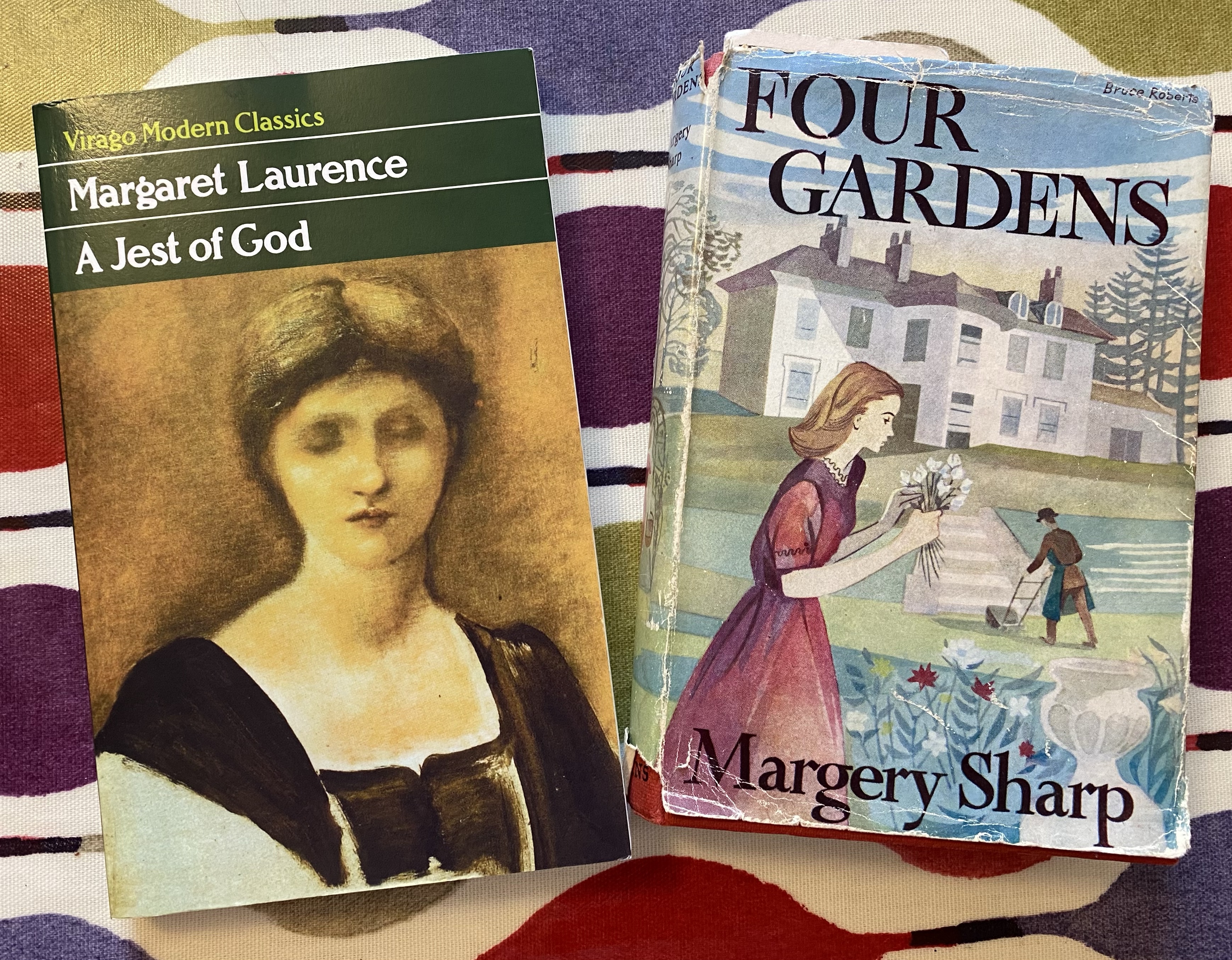
Firstly, the novella which made the top of Simon’s list, A Jest of God by Margaret Laurence (1966). This was the second in Laurence’s Manawaka sequence, but thankfully they can all be read as standalones as I’d not read anything by her before. On the strength of this, I’ll definitely be seeking out her writing again.
A Jest of God is an intimate character study of Rachel Cameron, a thirty-four-year-old teacher who lives with her emotionally manipulative mother above the Manitoba funeral business her father ran until he died.
The novel is narrated in the first-person, and Rachel’s mind is an oppressive and tense place to be. She is highly anxious and self-censoring:
“There. I’m doing it again. This must stop. It isn’t good for me. Whenever I find myself thinking in a brooding way, I must simply turn it off and think of something else. God forbid that I should turn into an eccentric. This isn’t just imagination. I’ve seen it happen. Not only teachers, of course, and not only women who haven’t married. Widows can become extremely odd as well, but at least they have the excuse of grief.”
This anxiety and second-guessing is not helped by her mother’s behaviour, which is self-pitying, judgemental and highly manipulative. Rachel recognises this, but is at a loss as to how to extricate herself:
“Her weapons are invisible, and she would never admit even to carrying them, much less putting them to use.”
“All such words cling to the mind like burrs to hair, and I can never seem to brush them away, as I know I should do.”
Rachel’s mother is not an out-and-out baddie though, and Laurence expertly demonstrates the vulnerability and fear that underlies her machinations. Similarly, Rachel does not always behave well. In one particular scene early in the book, she actually behaves despicably and doesn’t make amends despite her instant remorse. She is a complex, contradictory character, wholly believable. Laurence treats her tenderly but unflinchingly; without judgement but also without sentiment.
Rachel could so easily be a stereotype: a lonely single woman, living with her mother. But Laurence side-steps clumsy characterisation, or easy dismissal of Rachel, by delicately exploring the true meaning of the adjective so often attached to unmarried women approaching middle-age: she is desperate. She is absolutely desperate and despairing. She is lonely, and feels trapped in the life she has always known, with no way out. She wants things to be different, but she doesn’t know how. She is deeply, existentially sad.
1966 is a time of societal change, when women like Rachel could feel stifled by convention and also have some sexual freedom. So when Nick, and old schoolfriend appears, there are brief moments of physical connection. But in only seeing things from Rachel’s point view, the reader is able to realise how little intimacy there is. And that is what Rachel needs, more than the sex which Nick offers. Yet she doesn’t know how to achieve this:
“I talk to him, when he is not here, and tell him everything I can think of, everything that has ever happened, and how I feel and for a while it seems to me that I am completely known to him, and then I remember I’ve only talked to him like that when I’m alone. He hasn’t heard and doesn’t know.”
In some of Nick’s reported speech, the reader picks up on things Rachel ignores. She is so bound in her own intense feelings, she can’t really hear the cues Nick gives, over her relentless inner voice.
“He’s thirty-five, not fifteen. His past such gauche public performances. What he worried about Rachel? I’m not worried. I’m perfectly alright. Well, relax, then. I am relaxed. Oh? Shut up. Just shut up.”
A Jest of God is such an accomplished novel that is also so approachable. I found Rachel’s voice got under my skin very quickly and distinctly, and I had to read on. I think it works very well as short novel, longer would have been too oppressive and difficult to sustain I suspect. But at the length it is it remains powerful and impactful, and not as depressing as I’ve made it sound!
Ultimately there is resilience and change for Rachel, even some defiance. And there are brief moments of humour, such as Rachel trying to duck her colleague Calla’s constant invitation to attend Tabernacle with her:
“At least I have postponed it, and perhaps by that time some reasonable excuse will come along, or I’ll be dead.”
A stunning novel: a precise and compassionate character study, clever and humane. I’m so glad to have discovered Margaret Laurence at long last.
“Something must be the matter with my way of viewing things. I have no middle view. Either I fixed on a detail and see it as though it were magnified – a leaf with all its veins perceived, the fine hairs on the back of a man’s hands – or else the world recedes and becomes blurred, artificial, indefinite, an abstract painting of a world.”
Secondly, after being in Rachel’s head, I looked forward to some comic relief from an author I always enjoy: Margery Sharp. Four Gardens (1935) was number ten in Simon’s list. But this wasn’t as comic as some of her other novels; it had a slightly elegiac tone and the relationships included a certain sadness. But it wasn’t a sad novel overall, and I sunk into Four Gardens with pleasure.
Four Gardens follows the life of Caroline Chase from late teens to middle-age and the titular spaces she finds herself in. The device with gardens isn’t remotely heavy-handed and for a significant section of the novel they barely feature. But Caroline is a gardener, given half a chance, and it is instinctive and natural to her:
“Her step, as she now redescended to the rose garden, was therefore a proper gardeners tread – slow, considerate, with long abstracted pauses for survey and meditation. She also, without thinking, removed her hat and gloves.”
This is her first garden, one she trespasses into, and as she meets her first love there, it has a dreamlike quality. Perhaps this is why her love of gardening is so easily disregarded when she leaves behind youthful folly to marry the determinedly sensible Henry:
“For all these things in themselves – love at first sight, undying devotion, and general aloofness – were very exciting indeed; it was only in connection with Henry that they became so curiously prosaic.”
And so for many years Caroline doesn’t garden at all. She runs a house and she raises her son and daughter in the town where she has always lived. She is the creator of a safe space for her children and an unwavering routine for her staid but affectionate husband.
Despite the love she feels for her family and the tranquillity of her home life, I did find an element of melancholy to Caroline’s domestic arrangements. Her family are near and dear, but there seemed to be very little intimacy: she and Henry rarely communicate about anything beyond practical considerations, and she doesn’t really understand her children at all. She also despises her closest friend in the village, Ellen Watts – a monstrous and wholly believable creation. Caroline reflects very little though, and so any concerns are quickly subsumed in the relentless demands of domesticity:
“Thinking – the deliberate exercise of the brain – did not come naturally to her.”
But I wouldn’t want to give the impression that Four Gardens is ponderous or heavy-going in any way. It felt quite a realistic presentation of Edwardian contentment, though not without Sharp’s gentle jibes, such as this discussion of wallpaper where Caroline evokes her husband’s approval to counteract her mother’s reservations:
“Mrs Chase was at once silenced. […] It would have seemed perfectly reasonable to her that Caroline, who was in the house all day, should have suited her surroundings to the taste of a man who was out of it.”
I did want Caroline to exert herself in some way, to stake a claim beyond her roles meeting everyone else’s needs. Finally she does it, when she starts growing runner beans during World War I, and realises how much she is nurtured by time with her plants:
“there was usually a quiet space, between twelve and half-past, when the first work of the house was finished and before the children’s dinner became a pressing consideration; and these thirty minutes Caroline began to guard and cherish as a precious treasure.”
The war years are beautifully evoked by Sharp, with all their worry alongside self-serving censorious behaviour of some in the village. After the war, everything changes. Caroline finds herself mistress of a large house, with a garden she can’t touch unless she wants to incur the wrath of a succession of gardeners:
“The garden was looking well. But it always did look well, and gave her no special pleasure […] It was perfectly designed and perfectly kept, and to Caroline completely uninteresting.”
Meanwhile, her children are vaguely affectionate, patronising strangers. They change the names she loves, Lily becoming Lall and Leonard, Leon. They are academically accomplished and having had money their whole lives, utterly contemptuous of it. These Bright Young Things live by a morality that is absolutely baffling to Caroline, and there is a lovely echo of an earlier scene between Caroline and her mother in a later conversation between Caroline and Lall. The reader can see they are so much more alike than either realises, dramatic irony at its lightest.
I’m not one for biographical readings of novels but something of the tone of Four Gardens – affectionate, gentle, slightly sad – did make me consider the dates. In Caroline, Sharp is writing about her parents’ generation, so maybe that explains it… or maybe it has nothing to do with it at all, who knows?
Caroline’s fourth garden finally sees her able to do as she pleases. I couldn’t help feeling she might really surprise her children, and herself 😊 A warm, engaging story of a woman’s outwardly ordinary adult life during great societal change.
To end, Paul Newman adapted A Jest of God as Rachel, Rachel for his directorial debut. This very odd trailer doesn’t make it seem overly appealing:
The White Bird Passes – Jessie Kesson (1958) 159 pages
Last year I read a short story by Jessie Kesson and I was so impressed I really wanted to try more of her work. Luckily I saw her novella The White Bird Passes in my local charity shop and swooped in. I wasn’t disappointed.
Eight year-old Janie lives with her mother in Our Lady’s Lane, aptly named because this side street is full of matriarchs, including Poll Pyke, Battleaxe and The Duchess. They live in absolute poverty, hand to mouth, and yet the story isn’t depressing because Janie isn’t depressed. She loves living where she lives.
The novella is based on Jessie Kesson’s early life and it is beautifully balanced portrayal. It doesn’t shy away from the realities (suicide, sex work, disease and infestations) but these sit alongside love, humour, enjoyment.
“The Green was as much part of the Lane as the communal pump in the causeway. If you weren’t in the Lane you were ‘down at the Green’. There is no third alternative. Even if there had been, you would have been out of your mind to have chosen it in preference to the Green.
The summer through, the Greens chair-o-planes, whirling high, blistered with colour and blared with music. The Devil’s Own Din was how the sedate residents of Hill Terrace described it in protest to the Lord Provost and the Town Council, but to the Laners who were the true lovers of the Green it was music.”
It authentically captures characters and dialogue, without ever descending into caricature. At no point is there any authorial judgement on the way the characters are living, it is simply as it is.
“Janie never had to beg for her own needs. There were better ways of satisfying them. The surest way to get a penny was to scour the football grounds for empty beer bottles and sell them back to the beer shops at half rate. A fair bargain, since the bottles hadn’t belonged to you in the first place. More remunerating but less infallible, was to stand outside The Hole in the Wall on Saturday night, bump into the first drunk man you saw, weep loudly, pretending he had bumped into you. That was usually a sure threepence forced into your palm. Sometimes it was sixpence if the man was drunk enough. For her other needs, Janie confined herself to the dustbins in High Street.”
Janie’s mother Liza comes from a reasonably well-off family who view her as a disgrace. When Liza takes her for a visit, we get a glimpse of a life away from urban poverty.
“Janie wondered at her mother’s easy intimacy with this country; her quick recognition of the flowers in the woodworkers’ gardens, with names unheard of in the Lane; Snow in Summer, Dead Man’s Bells, Love in a Mist, Thyme, yellow St. John’s wort, pink star bramble-blossom. ‘There’s going to be a good crop of brambles the year.’ Liza cast an experienced eye over them. ‘We’ll need to come for a day in autumn for the bramble picking.’ They wouldn’t of course. But Janie had learned to enjoy the prospect more than the reality.”
Eventually the Cruelty Man catches up with Janie and enacts the local opinion that “the bairn would be better in a home.”
This part of the story is not given the same consideration by Kesson. Again, there is no judgement. You can see why Janie was taken away and how it can be both the right and wrong decision. But the state orphanage is not Kesson’s consideration in The White Bird Passes. The story belongs to the Lane and the women of the Lane, especially to Janie and Liza.
“But Liza had been beautiful, Janie remembered. Almost like Shelley said. Her beauty made the bright world dim. Not quite the same though. All the other women of the Lane had been grey. Prisoners clamped firmly into the dour pattern of its walls and cobblestones. But Liza had always leapt burnished, out of her surroundings. And in the leaping had made the dim world bright.”
The Life and Death of Harriett Frean – May Sinclair (1922) 184 pages
I am very fond of Victorian novels. Those huge, sprawling tales of domestic realism suit me very well in the right mood. However, the heroines do have a tendency towards pious self-sacrificing virgins, whose superhuman goodness is rewarded in the end by a rich husband and/or massive legacy. So even while they profess a dedication to heavenly rewards, they can do so from the comfort of being hugely loaded in the earthly realm, alongside a hottie in a big white shirt (which admittedly does sound pretty appealing).
It is this premise that May Sinclair takes issue with in The Life and Death of Harriett Frean.
Early in the novel there is an example of how the child Harriett behaves in the way expected of little Victorian girls, and as a result does not get her needs met. The only reward is a sense of self-satisfaction:
“Being naughty was just that. Doing ugly things. Being good was being beautiful like Mamma. She wanted to be like her mother. Sitting up there and being good felt delicious.”
Sinclair shows how this conditioning is reinforced through insidious guilt-trips:
“Understand, Hatty, nothing is forbidden. We don’t forbid, because we trust you to do what we wish. To behave beautifully…”
And so Harriett grows up idolising her parents and never questioning whether this mode of behaviour is more about convenience for others than actually what is right.
Harriett’s biggest sacrifice is refusing to enter a relationship with the man engaged to her friend. It is this she consistently returns to, through a life that never truly sees or allows for others. Sinclair shows the vanity and self-centredness wrapped up in supposed self-effacement:
“When she thought of Robin and how she had given him up, she felt a thrill of pleasure in her beautiful behaviour, and a thrill of pride in remembering that he had loved her more than Priscilla.”
The Life and Death of Harriet Frean explores how this type of behaviour – inauthentic, fundamentally dishonest – can lead to unhappiness in big and small ways, from never having cutlets served how you prefer to destitution for some. But Harriett never really learns, sticking stubbornly to her frame of reference even as life repeatedly demonstrates the inadequacy of doing so and the damage that can be done.
For me the novella remained just the right side of didactic, but I think had it been longer it may have drifted into preachiness. As it was, it remained an interesting counterpoint to all those fictional Victorian heroines who may not have found things quite so clear-cut in real life.
Well, we’ve reached the end of November and contrary to my plans but entirely in keeping with my expectations, I’ve barely managed to blog at all despite all the wonderful reading events that take place. Still, I’m delighted that I am at least managing to join in with AusReading Month 2022 hosted by Brona at This Reading Life. (Even if it is at the eleventh hour and I’m conveniently ignoring the fact it’s already 1 December in Australia right now – I really must do better.)
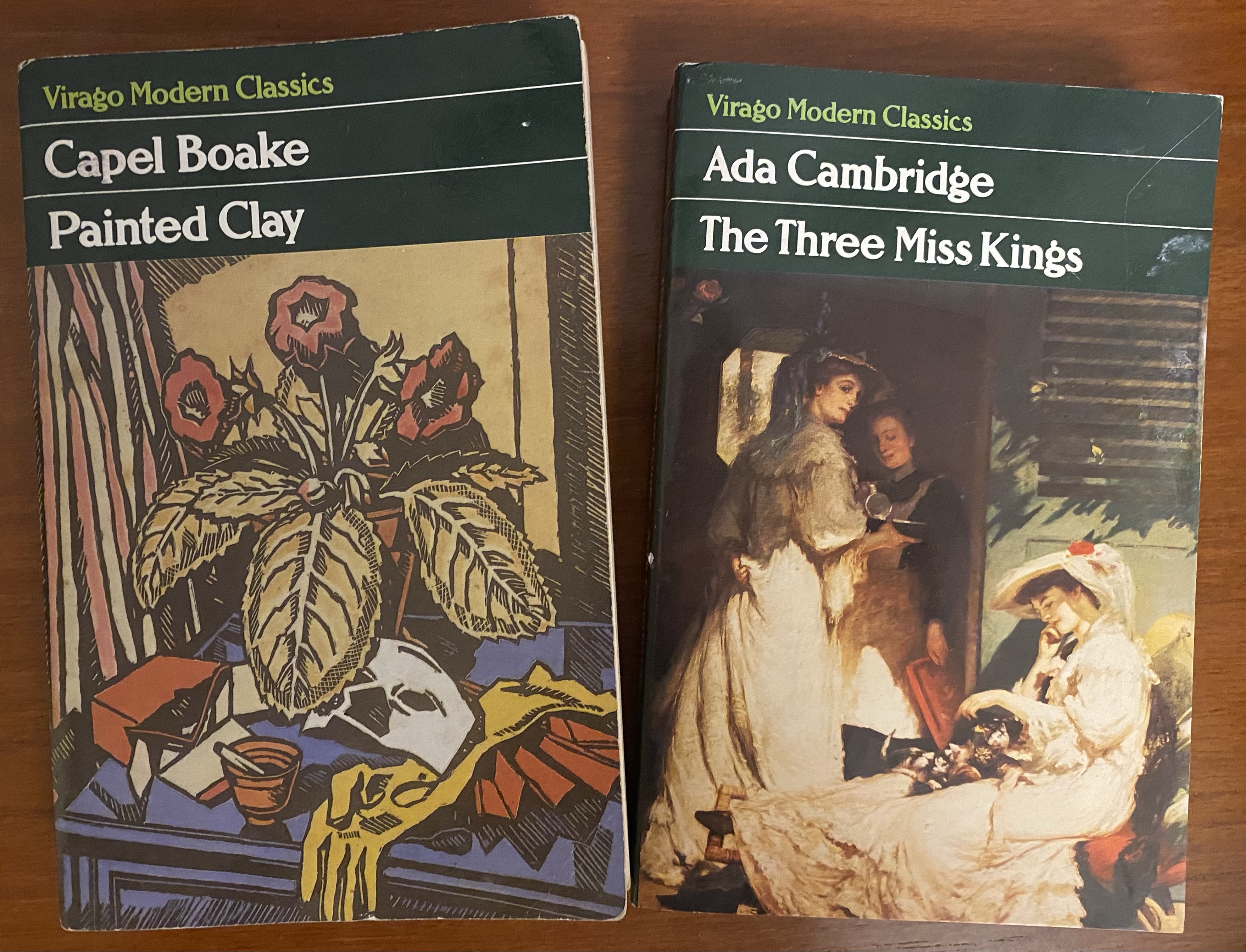
I chose two novels out of the humungous VMC pile and they both turned out to be entertaining considerations of the roles of women in late nineteenth and early twentieth century Melbourne.
In reverse chronological order, Painted Clay by Capel Boake (1917). Set in 1913-14, this coming-of-age story follows Helen Somerset as she tries to forge her own way in a society that places considerable strictures on women.
At the start of the novel, lonely and isolated Helen is only a few years older than the century, as she living in a suburb with her distant father:
“Several women had watched carefully and had made sure their curtains had not been down for months. They always took their curtains down, washed them, and put them up again, every four weeks. The end house did not do this. Therefore there must be something very wrong with the occupants of the end house.”
Determined for change, she makes overtures to the young women who live next door, and finds herself invited in. She is shy and awkward, but the family is warm and welcoming.
“She knew that if she were alone she could have carried on the most brilliant conversation with everybody, but now she seemed to have nothing to say.”
Belle is engaged to sleazy Bert, while her sister Irene moons over the picture of a matinee idol. They are full of life and show Helen another way to live. She joins Irene in working in a shop, suffering under the deliberately unpleasant work given to her by the jealous supervisor. We follow Helen from shop to office work, as she learns to wrestle with the bullying of women and the unwanted attentions of men, struggling to work out what she wants when it seems to be so different from other women her age:
“She fled from the thought of sex; it horrified her – but it came back and back. She tried to close her mind against it, but it came insistent and whispering, distorting her view of life full in despair she went to her books again.”
Helen is not a wet blanket though, or a naïve and priggish beauty which can sometimes make heroines of this era hard to warm to. She’s quite determined to live her own life, away from the life paths everyone seems to expect of her.
“Helen had a soft, but unyielding obstinacy against which all argument beat in vain.”
Things begin to change for her when she is taken into a bohemian artistic set. She falls in lust with Alick Russell, and one thing leads predictably to another … what is less predictable is Helen’s reaction to sleeping with a man outside marriage:
“She wondered why she did not grieve over it, why she was not overcome with sorrow and repentance. She puzzled over it with frowning brows, but could reach no satisfactory conclusion.”
[…]
“I can’t see the difference between being married and not. It doesn’t seem to me to matter very much, and yet it does. I wish I were either a very bad woman or a very good one. If I were a bad woman nothing would bother me, and if I were a very good woman I wouldn’t think about it. I would just be married, and that would be the end of it.”
Painted Clay is a carefully non-didactic exploration of women’s roles and choices at this moment in time. Female characters are not judged for choosing unsatisfactory marriages, when the alternative may be worse for them. Older unmarried women are not shown as leading happy lives due to how limited their choices are, yet Helen is consistent in her belief that marriage is not for her.
Although not explicit, female desire is dealt with frankly, as is the fallout from its expression – fallout which lands disproportionately on women rather than men, despite their equal involvement.
What struck me most though, was not the attitude towards female sexuality or marriage, but towards sex work. It is referred to more than once in the novel and Boake is determinedly non-judgemental of those who undertake it. There is this interview Helen undergoes with a recruiting Madam:
“Helen shook her head, ‘No’ she said. ‘I can’t.’ Her tone was final, and the woman recognised it, though she made a last effort to persuade her. ‘Why not?’ she asked.
‘I don’t know why not,’ answered Helen. ‘It’s not my way, that’s all.’”
Then later in the novel she takes a woman from the street for a hot meal:
“Helen looked round with a frown. She found that everyone in the room was staring at them. She looked at them with bitter scorn. She hated them for their smug complacency. She felt neither love, liking, or even pity for the girl she was with, but she preferred her to the smug suburban women with their intolerable air of conscious virtue.”
I expected a much more judgemental attitude for the time, and it was refreshing to have this assumption undermined. (Also on the subject of the streets – the urban setting and changing seasons are wonderfully evoked. Sadly I don’t know Melbourne but I’m sure those who do would find much to enjoy in this evocation of it in the early decades of the last century).
Painted Clay was Capel Boake’s first novel and on the strength of this I would definitely be interested in reading more. It’s not the most sophisticated novel but it’s concise, well-paced and very readable. Boake died in her 40s having published three novels (one further was published posthumously) and some poetry.
Secondly, The Three Miss Kings by Ada Cambridge (1891) which I was encouraged to take off the shelf by Emma’s escapism list. Although depicting a far more conventional life of middle-class mores and marriage than Painted Clay, The Three Miss Kings still manages to cast an askance, humorous view at late Victorian life.
At the beginning of the novel the titular heroines – Elizabeth, Patty and Eleanor – find themselves all alone in the world after their father dies.
“It was a curious position altogether. As far as they knew, they had no relations, and they had never had a friend. Not one of them had left their home for a night since Eleanor was born, and not one invited guest had slept there during the whole of that period. They had never been to school, or had any governess but their mother, or any experience of life and the ways of the world save what they gained in their association with her, and from the books that she and their father selected for them.”
Cambridge is at pains to stress the young women’s refinement and ‘breeding’ to an extremely tedious degree. However, later in the novel she stops banging on about this quite so much, which was certainly a relief, and gets on with telling an oft-told tale in a very readable way (excepting a couple of clunky passages with characters voicing long opinions on topical issues such as the role of the church).
The women travel from their rural home to Melbourne to be shocked and then embraced by city life, under the guiding light of their self-appointed guardian Mrs Duff-Scott:
“The only drawback to her enjoyment in them was the consciousness that, though they were nobody else’s, they were not altogether hers. She would have given half her fortune to be able to buy them, as she would buy three bits of precious crockery, for her absolute possession, body and soul—to dress, to manage, to marry as she liked.”
Three comely young ladies, refined of manner and naïve of just about everything – what will possibly happen? Mrs Duff-Scott has an idea, and lines up potential suitors for all of them with alarming ineptitude. I particularly enjoyed her assessment of Mr Westmoreland:
“He was the richest of them all, and the most stupid, and therefore he seemed to be cut out for Patty, who, being so intellectual and so enterprising, would not only make a good use of his money, but would make the best that was to be made of him.”
Cambridge does undermine some of the conventions she is focussing on, or at least mocks them lightly. For example, how to describe her heroines:
“like a tall lily, I feel I ought (and for a moment was tempted) to add, only that I know no girl ever did look like a lily since the world was made, nor ever will, no matter what the processes of evolution may come to.”
She’s also very pragmatic alongside the romance, such as the consideration of marrying for money:
“If these motives seem poor and inadequate, in comparison with the great motive of all (as no doubt they are), we must remember that they are at the bottom of a considerable proportion of the marriages of real life, and not perhaps the least successful ones. It goes against me to admit so much, but one must take things as one finds them.”
She even allows some feminist commentary regarding commanding male heroes:
“’Who would marry a chicken-hearted milksop if she could get a splendid tyrant like that?’ exclaimed Patty, fervently, for the moment forgetting there were such things as woman’s rights in the world.”
So although a romance in many ways, The Three Miss Kings is not unwaveringly romantic. I’ve never read Ada Cambridge before and I really enjoyed this first encounter. She brought a different voice, humour and interesting characterisation to make a familiar story include some surprises.
The story is firmly rooted in 1880 and in Melbourne, with descriptions of the International Exhibition. Melbourne Cup, public gardens, streets and crowds which were very evocative. If I’ve not said much about the plot it’s because I don’t think it’s really needed – you get the idea!
“I don’t think it is that things are going wrong, dear. It is only that we have to manage them, and to steer our way, and to take care of ourselves, and that is so trying and perplexing.”
To end, forward a century for service as usual with a 1980s pop video, from a Melbourne band:
To describe my blogging as patchy would be to suggest a productivity that currently I can only aspire to. Thankfully Simon and Kaggsy are hosting one of their wonderful club events this week, always irresistible and especially so this time, as 1929 is bang in the middle of the interwar years, my reading sweet spot.
(Great badge 🙂 )
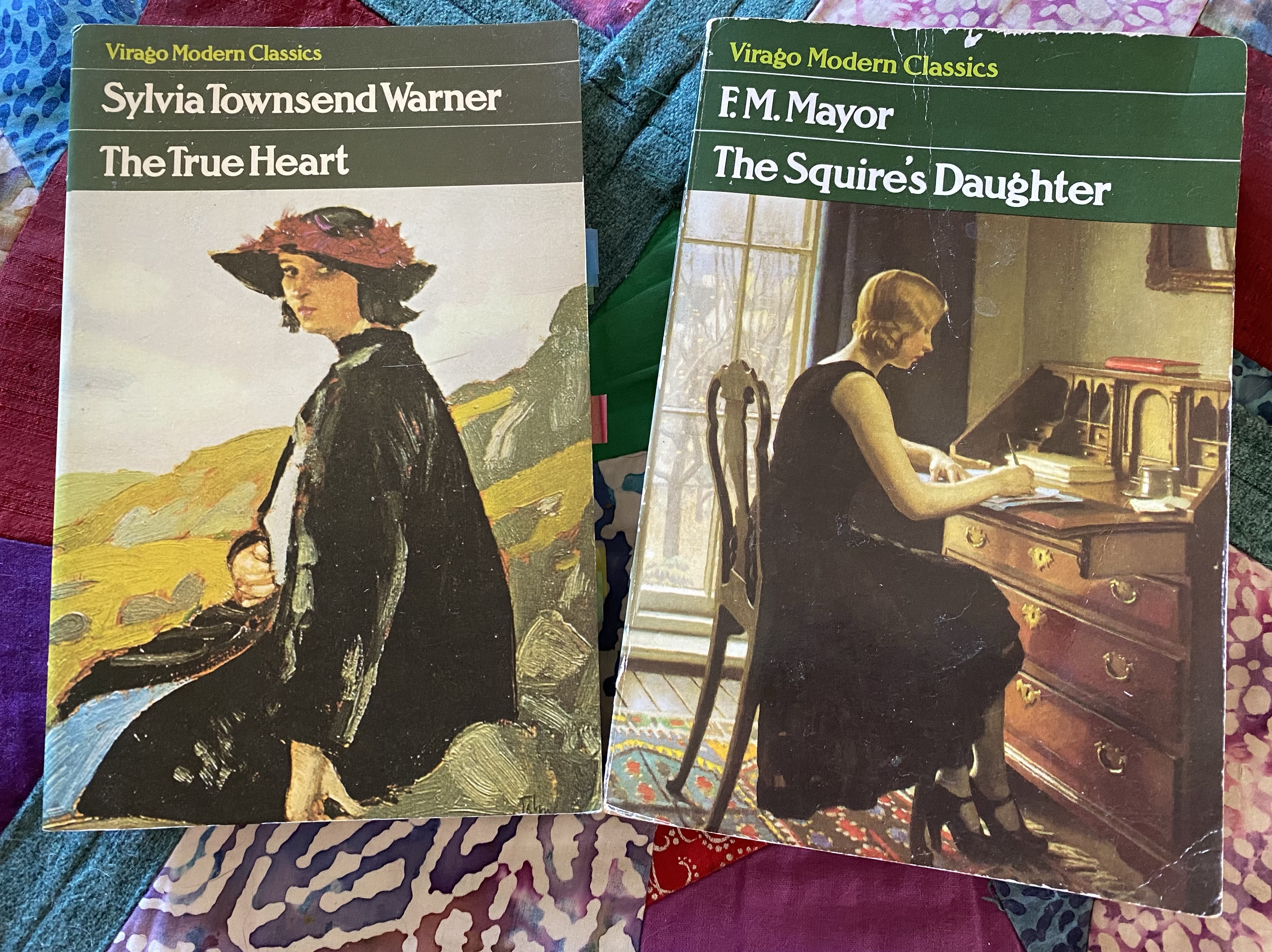
I’m hoping to post twice this week, and I thought I’d start here with two Virago Modern Classics.
I probably wouldn’t have been particularly drawn to The True Heart if it wasn’t written by Sylvia Townsend Warner, author of the wonderful Lolly Willowes. The blurb on the back says:
“This is the love story of Sukey Bond and Eric Seaborn. Sukey is an orphan, in service, the lowest of the low. It is 1873, and in her first position as a servant girl on a farm in the Essex Marshes, she meets Eric – gentle, simple […] The lovers are parted by Eric’s rich mother […] But nothing can deter Sukey. Only Queen Victoria, she feels, can help, so she sets off to see her. Extraordinary things happen on this heroic journey, but Sukey’s simple love and courage carry her to final victory- reunion with her beloved Eric and love triumphant.”
Absolutely nothing in that description appeals to me. Well, maybe the Essex Marshes. And Queen Victoria. But nothing else. However, I was quickly won over by this description on page two of Miss Pocock, the Matron of Sukey’s orphanage on prize-giving day:
“She had been up since 4 A.M. putting finishing touches to the orphans housewifery. Now she wore her new purple bodice and her face of state, where the expression never varied, as if her countenance were cased up in invisible stays.”
Having excelled on the prize day, virtuous Sukey goes to work as a maid on a farm, a position found for her by an orphanage patroness, Mrs Seaborn.
“Sukey was still persuaded that there was something very odd and exceptional about her life, though she, of course, was a very ordinary creature. In truth it was humdrum enough and the cares and pleasures that filled her days were those common to any servant-girl on a small farm. Nor were the other inmates of the farm remarkable in any way that appeared to her.”
There she meets Mrs Seaborn’s son Eric, an outsider like Sukey, living alongside the Norman family who run the farm:
“They spoke of him always as ‘Young Eric,’ and by the insistence upon his youthfulness seemed to disassociate themselves from him. He was like a pet lamb, grown too large for the house but whom the household had forgotten to put out of doors.”
Eric has been dumped at the farm by his mother who is ashamed of his ‘idiocy’ and seizures. The two fall in love, each naïve and inexperienced. Sukey soon believes she is pregnant despite knowing nothing of the facts of life and therefore not realising that there is zero chance she has conceived a child. What stops the story from being overly saccharine is STW’s humour, which is gently witty – entertaining but never slyly undermining her characters.
“A baby may grow up and make any number of people miserable. Besides justification, they also require long clothes and short clothes and little woollen socks – and how is an unmarried baby going to find these?”
As the blurb suggests, Eric’s mother separates them and Sukey begins her epic journey towards reconciliation. The story is a retelling of Cupid and Psyche, and the tale does have a mythic quality as Sukey meets various colourful characters on her journey and through some sort of miracle manages to stay safe.
The tone of The True Heart is so finely balanced. I think as a twenty-first century reader I was waiting for the knowing irony, the askance aside which never came. It made me question if this is how I’m used to seeing love presented in contemporary stories, which is a pretty bleak thought. Yet STW is not remotely sentimental either. Rather she is clear-sighted and compassionate.
“He was sorry for birds. He loved all helpless things, all wild things, all harmless and thoughtless things, for he himself was wild and harmless, thoughtless and helpless. He was sorry for the bird, he understood its distress. Her distress he could not understand. It passed by him like the wind – violent, alien, incomprehensible. Her anger was aflame that would not take upon him.”
A singular novel, thought-provoking and written with the lightest touch.
By contrast, the female protagonist in The Squire’s Daughter by FM Mayor is somewhat jaded by her worldly experiences even by the age of 21. Ron de Lacey – as the title indicates – is from a privileged background and she uses this privilege to enjoy a frivolous, vacuous London life as a flapper (aka living my dream life 😀 ).
“In Ozzy’s set they were all young; for her sex the most successful age was eighteen; the new Cabaret girl was sixteen, she and Nadine were already rather old. Aunt Laura knew spinsters by the score, they were generally political, and Ron hated politics.”
Ozzy is her brother, somewhat estranged from his family due to his refusal to fight in the War, the conflict casting a long shadow even for a generation who barely remember it.
Ron also returns to the family seat of Carne rarely, and seems indifferent to its pending sale despite the pain it causes her father. The heirs care nothing for the country seat, only the staff seem to share her father and aunt’s understanding of what it once meant:
“Carne was like a college to the old servants, and they were its Fellows.”
“The gardener combined contempt for her with a fond respect for gentry.”
However, it is not because she hugely values her London life that Ron feels alienated from Carne. There is a sense that she is entirely adrift, with no sense of purpose or of self anywhere.
“She had been an ultra-smart young woman, extracting every ounce of success from her seasons, and with Ozzy’s set she could be as vulgar and exaggerated as a chorus girl. In repose, however, her eyes were often unsatisfied, and sometimes sad.”
It is during a visit at Carne that Ron falls somewhat inexplicably in love with the most English-monikered man, Bob Manners. I really enjoyed this conversation between them over dinner, whereby Ron attempts to engage Bob in discussion about a literary great:
“‘Do you like Tchekov?’
‘I don’t know what it is? Is it a drink?’
‘No it’s a Russian, who writes plays.’
[…]
‘I think there’s nobody like Tchekov. I know just where I am with him. He’s like all of us. His people drift about, and want something terribly for five minutes, and then want something else, and all the time they don’t know what they want after all.’
‘I’ve never met any Englishmen like that.’ said he, ‘nor do I want to, nor do I believe they exist.’
‘Yes, but I expect my Englishmen aren’t your Englishmen.’”
They begin a tentative courtship, he unused to romance, she overused to its rituals:
“She was neither shy nor nervous. She could not imagine life without frequently going to tea with men who had fallen, we’re falling, or might fall in love with her.”
The novel follows their relationship and those of her family, alongside the disintegration of Carne. Although the tone is restrained, I found The Squire’s Daughter to be really a very sad novel. It was about the long-term damage of war; the pain of failed communication with those you love; the desperate search for meaning to live your life by, across the generations.
“I suppose one had a surfeit of feeling in the war and used it all up.”
To end, a clip of Greta Garbo still managing to be stunning in the world’s worst fitting dress, in 1929 film Wild Orchids (flogging scene at beginning, skip to 1:00 to avoid):