“Rough winds do shake the darling buds of May” (William Shakespeare)

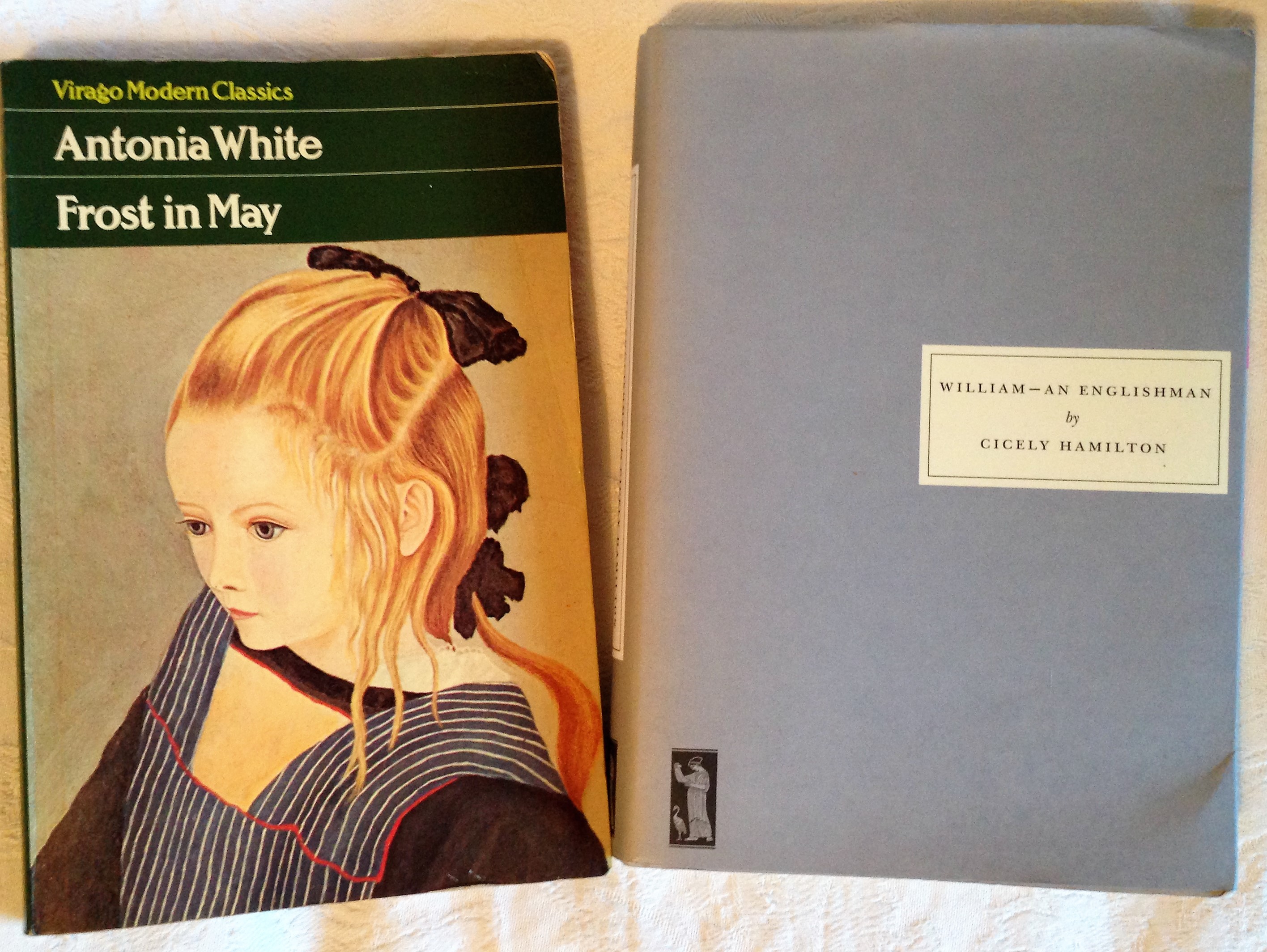
Last week I looked at The Enchanted April, so this week for May Day I thought I’d look at another Virago that helpfully has the current month in the title, Frost in May by Antonia White (1933). Virago was founded in 1973, with the Modern Classics imprint starting in 1978 “dedicated to the rediscovery and celebration of women writers, challenging the narrow definition of Classic”. Frost in May was the first Modern Classic title, so for this post I’ve paired it with the first Persephone title, as Persephone, founded in 1998, have a similar remit to publish lost or out of print books which are mainly written by women.

200 (2)

Frost in May is Antonia White’s autobiographical first novel, telling the story of Nanda Gray and her schooling at the Convent of the Five Wounds from the ages of 9 to 14. Nanda begins school as a devout child, finding her way in Catholicism:

“St Aloysius Gonzaga had fainted when he heard an impure word. What could the word have been? Perhaps it was ‘belly’, a word so dreadful that she only whispered it in her very worst, most defiant moments. She blushed and passionately begged Our Lady’s pardon for even having thought of such a word in her presence.”

White charts Nanda’s development throughout her school career.  She is from an ordinary middle-class family, her father a recent convert, and the other girls from aristocratic European Catholic families are glamorous and much more worldly:

“Leonie and Rosario were seasoned retreatants. They went into this solitary confinement with as little fuss as old soldiers going into camp. Rosario supplied herself with a great deal of delicate needlework if a vaguely devotional nature, while Leonie announced frankly that she was going to use her notebook to compose a blank verse tragedy on the death of Socrates.”

As Nanda becomes older, she begins to struggle with her faith, although there is never a sense that she will abandon it all together. Rather it is the story of a young person trying to find a true sense of meaning within her faith, rather than without it.

“She had often been rewarded by a real sense of pleasure in the spiritual company of Our Lord and Our Lady and the saints. But over and over again she encountered those arid patches where the whole of religious life seemed a monstrous and meaningless complication.”

If this sounds like it has no place in today’s secular world, I’ve not done Frost in May justice. The novel is about a young person’s growing realisation of self, explored with sensitivity. As a heathen book lover, I related to Nanda’s discovery of poetry:

“She read on and on, enraptured. She could not understand half, but it excited her oddly, like words in a foreign language sung to a beautiful air. She followed the poem vaguely as she followed the Latin in her missal, guessing, inventing meanings for herself, intoxicated by the mere rush of words. And yet she felt she did understand, not with her eyes or her brain, but with some faculty she did not even know she possessed.”

Frost in May is a short novel and a quick read, and I can see both why it was marginalised and why Virago chose it to launch its Modern Classics imprint. It is easy to overlook: a school story in which little happens, five years in a young girl’s life and no intrusive authorial voice to proclaim any wider profundity beyond the immediate story. Yet it has plenty to say about what is profound for the individual, the influences and experiences that shape us and leave an indelible mark. White’s light touch should not be mistaken for a lack of something to say.

“Do you know that no character is any good in this world unless that will has been broken completely? Broken and reset in God’s own way. I don’t think your will has quite been broken, my dear child, do you?”

IMG_0699

Secondly, William – An Englishman by Cicely Hamilton (1919) who was a suffragette and wrote this novel during the last year of World War I. The eponymous Mr Tully is a young man who prior to the war is a socialist, fired less by idealism and more by the need for something with which to occupy himself.

“The gentlest of creatures by nature and in private life, he grew to delight in denunciation, and under its ceaseless influence the world divided itself into two well-marked camps; the good and enlightened who agreed with him, and the fool and miscreants who did not…in short, he became a politician.”

William meets and marries a similarly dim suffragette, Griselda, and Hamilton’s satire of their unthinking politicking is relentless.  They are shown as well-meaning but avoiding any challenge to their ideals and any opportunity for genuine original thought. When a certain archduke is assassinated in Sarajevo, they pay it little mind as it does directly affect their parochial politics, and they head off on honeymoon to Ardennes. When they emerge from the Forest of Arden three weeks later, they are captured by soldiers and face a traumatic awakening as to the state of the world:

“So they trotted down the valley, humiliated, dishevelled, indignant, but still incredulous – while their world crumbled about them and Europe thundered and bled.”

Hamilton does not baulk from the realities of war – of which she had first-hand experience – and it is shown as bloody and brutal. The satire falls away as William becomes the everyman caught up in circumstances far beyond his control.

“It had not seemed to him possible that a man could disagree with him honestly and out of the core of his heart; it had not seemed to him possible that the righteous could be righteous and yet err. He knew now, as by lightening flash, that he, Faraday, a thousand others, throwing scorn from a thousand platforms on the idea of a European War, had been madly, wildly, ridiculously wrong – and the knowledge stunned and blinded him.”

Hamilton’s master stroke is that the things she satirised – William and Griselda’s lack of understanding, ignorance and youthful certainties – become the very things that drive home the human tragedy of the war. They are ordinary people who just wanted to live the life they imagined for themselves, and their powerlessness and profound losses are what makes this so very sad. The devastation of World War I is left in no doubt.

After all this talk of devastation, let’s pick ourselves up with some love poetry: the wonderful Harriet Walter reading the sonnet from which this post takes its title:

“In springtime, the only pretty ring time,/When birds do sing, hey ding a ding, ding” (William Shakespeare)

Things are not going well, reader. I won’t bore you with details, but as I survey the Beckettian wasteland that is my life (never piss off a bibliophile, we can exaggerate and self-pity in such literary terms) two things bring me solace: one, that the forty minute commute to my circumlocution-office job gives me fixed time to read (apart from one particularly bad day where I spent the journey staring out of the window into the abyss of my existential crisis gardens of south London); and two, that my favourite season is finally here. Hooray for Spring!

giphy (7)

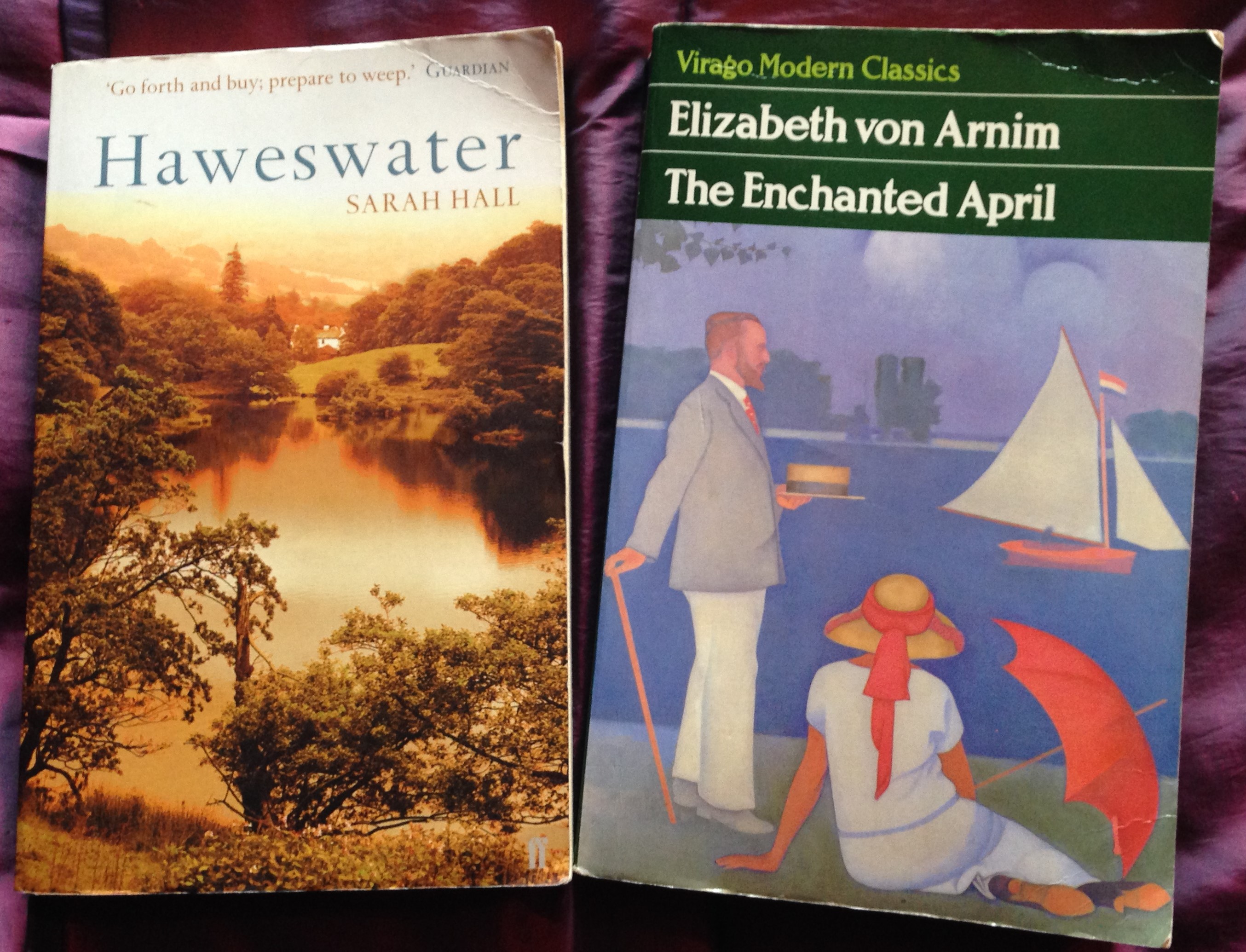
So this week I thought I’d look at novels that are linked with Spring in some way.  Firstly Haweswater by Sarah Hall (2002). The connection to Spring is tenuous at best – I chose it because it’s set in the Lake District, which thanks to Wordsworth is irrevocably linked with this time of year. Hall’s highly accomplished first novel centres around the true story of the valley of Mardale being flooded in 1935 to create a reservoir to supply water to Manchester.

“This valley, with its own natural shape, created as the earth’s muscles cramped and pulled with ferocious sloth millennia earlier, was perfect.  Six miles down, at the bottom of the dale, where the fells curved towards the ground and flattened inwards, hard volcanic rock came to the surface, and it would be possible to lay down a flat arm of cement and brick.”

Images from here and here

The Lightburn family work the land, raising sheep and living lives deeply connected to their environment. Janet, their daughter, works as hard as anyone, refusing to let her gender limit her. She is formed by her strong independent nature and the land that surrounds her:

“There are deaths that have made more sense than lives here. But nothing hangs in the balance. She has been pressed between two vast mountain ranges without claustrophobia or repression; each year she is re-forged. She accepts the weather and the ability of the rain to overwhelm all else. It’s inconsequential. This is a sacred place.”

The charismatic and glamourous Jack Liggett arrives from Manchester to tell the villagers that their entire lives are about to be literally swept away, and Janet’s pious mother has a horrible sense of what is to come:

“There was a vast black bird in her heart, she said to him, foreboding. It warned her of sickness and ill change, lifting its morbid wings. And with the dark man in their midst there was danger, she knew it. But Samuel could not understand. And how could he see fear taking shape or feel its feathery wingtips along her ribcage?”

Haweswater is a beautifully written account of ordinary lives caught up in extraordinary circumstances. Hall has a deep understanding of landscape and a sensitive approach to her characters. It is a sad, poignant novel, but not depressing: people, like the land, mostly endure.

“He was here, within reach. The landscape had him enfolded, safe, like bark holding back the spreading rings of a tree. She put her face in the grass and her tears swept down concave blades and soaked into the dry earth, into the fossils and claws and muscles of rock from thousands of years ago.”

If that all sounds a bit depressing, my second choice may be more to your liking: The Enchanted April by Elizabeth von Arnim (1922), which I was inspired to rescue from the depths of my TBR by reading Shoshi’s wonderful review.

IMG_0698

This novel is an absolute joy: a heartwarming, silly, acerbic, funny, insightful joy.  Mrs Wilkins and Mrs Arbuthnot are drawn to an advertisement in The Times which promises “wisteria and sunshine” at an Italian medieval castle for the duration of the titular month.  Mrs Wilkins is in need of a change:

“She was the kind of person who is not noticed at parties.  Her clothes, infested by thrift, made her practically invisible; her face was non-arresting; her conversation reluctant; she was shy. And if one’s clothes and face and conversation are all negligible, thought Mrs Wilkins, who recognised her disabilities, what, at parties, is there left of one?”

While Mrs Arbuthnot needs space to work out what on earth to do with her marriage:

“And Frederick, from her passionately loved bridegroom, from her worshipped young husband, had become second only to God in her list of duties and forebearances. There he hung, second in importance, a bloodless thing bled white by her prayers.”

They decide to take the plunge, and advertise for two more women to join them, ending up with young and feckless Lady Caroline and older and self-absorbed Mrs Fisher. The women take a while to adjust to one another, but the magic of Italian Riviera is impossible to resist (as is von Arnim’s writing, permit me a lovely long quote):

 “All the radiance of April in Italy lay gathered together at her feet. The sun poured in on her. The sea lay asleep in it, hardly stirring. Across the bay the lovely mountains, exquisitely different in colour, were asleep too in the light; and underneath her window, at the bottom of the flower-starred grass slope from which the wall of the castle rose up, was a great cypress, cutting through the delicate blues and violets and rose-colours of the mountains and the sea like a great black sword. She stared. Such beauty; and she was there to see it. Such beauty; and she was alive to feel it. Her face was bathed in light.”

Surrounded by this picturesque scene, all the women, wanting to escape their lives for a variety of reasons, undergo a healing process, a regeneration. If this makes the novel sound worthy and heavy-handed, it really isn’t.  It’s a wonderful study of group dynamics and how what we need can be brought to us by the most unlikely people. Even Mrs Fisher is powerless to resist:

“She knew the feeling, because she had sometimes had it in childhood in specially swift springs when the lilacs and syringas seemed to rush out into blossom in a single night, but it was strange to have it again after over fifty years. She would have liked to remark on the sensation to some one, but she was ashamed. It was such an absurd sensation at her age. Yet oftener and oftener, and every day more and more, did Mrs Fisher have a ridiculous feeling  as if she were presently going to burgeon.”

Von Armin doesn’t shy away from the difficulties of life: “She felt small and dreadfully alone. She felt uncovered and defenceless. Instinctively she pulled her wrap closer. With this thing of chiffon she tried to protect herself from the eternities” but what she suggests is that if we open ourselves to possibilities, the insurmountable becomes surmountable, our fears conquerable. If you need a lift; a fun, escapist read that still has something to say but does so with the lightest of touches, then The Enchanted April is for you. Enchanting indeed!

To end, there has been Shakespeare galore this weekend as it is 400 years since his death, and I opened this post with some of the weakest lines he ever wrote 😀 To redress the balance, here are some of the greatest lines he ever wrote: