“The pain coloured her writing.” (Daniela Krien, Love in Five Acts)

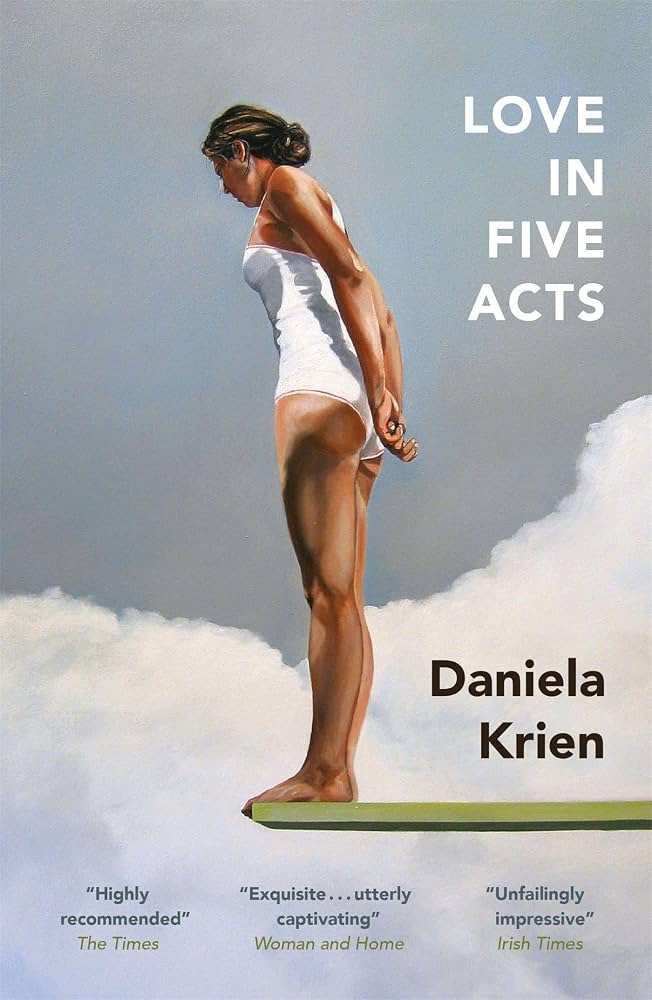
I really enjoyed The Fire by Daniela Krien when I read it back in May, so I was keen to pick up Love in Five Acts (2019, transl. Jamie Bulloch 2021) for  German Literature Month hosted b by Caroline and Tony.
This short novel follows five women in sequence: Paula, Judith, Brida, Malika and Jorinde. They are all living in Leipzig and are interconnected in a variety of ways, some they are aware of, others not.

Krien has not chosen to try and represent a wide swathe of society; probably wisely. The women are all 30s-40s, romantically interested in men, leading reasonably privileged lives. However, in each section they are fully realised individuals, and their explorations of love with its inherent pains alongside joys is subtly evoked.
It begins with Paula, initially married to Ludger. We see their marriage disintegrate after the tragedy of their baby dying.

“Paula fell away from normal life. Her baby’s death distanced her from the average person. Her pain remained unshared. It was like a cake that grew, and she ate and ate without it ever getting smaller.”

Judith is Paula’s long-term friend, and in her section we learn the strain that Paula’s overwhelming grief put on their friendship:

“Paula is like an abyss, a deep, black hole into which you cast reason, patience and love. All of it sinks to the depths without ever producing even the slightest echo. Johanna’s death changed everything.”

Judith is resolutely single, more enamoured of horses than men. She is on the apps though, and there are glimpses of her desire for love and intimacy behind her spiky exterior.

“The most difficult thing about meeting up with men you don’t know is the effort of having to explain yourself, always having to start from scratch, there being no existing reference points. It’s a real feat, on top of which there’s the queasiness for the hour beforehand and the stale taste of futility afterwards.”

Brida captures the struggle to ‘have it all’ – the strain of trying to balance a career she is passionate about with childcare:

“Undine had come at the wrong time. Her arrival was like a large, heavy paw forcing Brida’s head back under a dark body of water just as she’d briefly come up for air.”

Married to Götz, he is the main breadwinner and so unsympathetic when Brida wants to prioritise her writing. Later they are divorced, but it is messy…

When Brida and Götz met, he was with Malika. We see the lies and obfuscations he undertook as his relationship with Brida began. Malika has never got over the betrayal, and grieves deeply for the children she never had:

“The further her imagination drifted into the future, the more children she was surrounded by. At the point where the corresponding husband appeared, Malika would usually fall asleep.”

Jorinde is Malika’s sister and their relationship is tense, coloured by their parents favouritism and ambition for their children, which Malika failed to fulfil, despite being a hugely successful teacher.

One of the aspects I really liked in The Fire was what it means to live in twenty-first century Germany having grown up in the GDR. Here the change is evoked through Malika and Jorinde’s parents for whom “East and West were more than just geographical markers.”

Malika’s story was the one I found most moving, she was so deeply damaged. Yet she and Jorinde move towards a sort-of reconciliation and there is even a path that begins to open up whereby Malika may not get exactly the life she wants, but one that will be more fulfilling than the one mired in grief which she currently has.

Love in Five Acts portrays ordinary lives at particular moments in time for these women. The generational difference is given an extra dimension as they try and find their way in reunified Germany. It is a clear-sighted portrayal, without sentimentality and not shying away from pain, but not despairing either.

This doesn’t quite fit in with #NovNov unfortunately, at 249 pages. But it is a quick read (I can vouch for it being readable on a London to Manchester train) which doesn’t outstay its welcome.

To end, I never shy away from a tenuous shoehorning of a tune… this is me, like some of Krien’s protagonists, embracing a reinvention of my love 😀 Patti Smith is definitive, but I actually like how Brett Anderson’s voice works here:
“I know my story sounds weird.” (Margaret Atwood, Fourteen Days)

I don’t have a lot of time this month, which is a shame because as every blogger knows, November is the month of all the blogging events, and I do really like taking part. This is all a preamble to explain why I’ve just read a short story for Margaret Atwood Reading Month hosted by Buried in Print rather than finally getting to the MaddAddam trilogy!

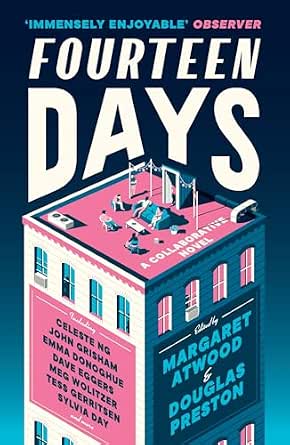
Fourteen Days (2024) is a collaborative novel by thirty-six Canadian and American authors, edited by Atwood and Douglas Preston. Its subtitle is A Literary Project of the Authors Guild of America, and the preface from the Guild explains that part of the advance for this work supported writers during the covid pandemic. It is set during that time, the premise being that the residents of a Lower East Side tenement building gather on the roof for a fortnight to tell each other stories.

If I had more time I would have read the whole book and tried to guess which story was Atwood’s, but instead I looked at the back to see which she wrote and just read that. So if you want to read Fourteen Days and don’t want to know, look away now!

Atwood’s story takes place on Day 10, and displays her usual mix of commentary, humour, learning and irreverence. A woman who none of the residents have seen before joins them on the roof and explains she works as an exterminator of bed bugs and attends free classes at NYU. Recently she learned about Arachne:

“This was supposed to be a terrible punishment, which made me laugh when I heard about it, because I myself used to be a spider. Given the choice between a girl and a spider, who wouldn’t opt for the spider? A female spider, needless to say. Girls are always being predated by male humans, but with spiders it’s the other way round.”

She wants to learn about humankind and so is focusing on philosophy and mythology classes. This has resulted in her reflecting on the difference between humans and spiders and she takes exception to the negativity often associated with spiders.

Atwood has a lot of fun with wordplay in this story, and the spider-woman’s voice is distinct and engaging. I’m sure it’s inevitable that each reader will enjoy some of the stories in Fourteen Days more than others, but this part of Day 10 has definitely encouraged me to get to the rest when time allows!

“From my philosophy classes I’ve learned that humans can fret a lot about things that can never be known, such as the ultimate meaning of life. I personally feel that the ultimate meaning of life is eggs, but I may be very old fashioned.”

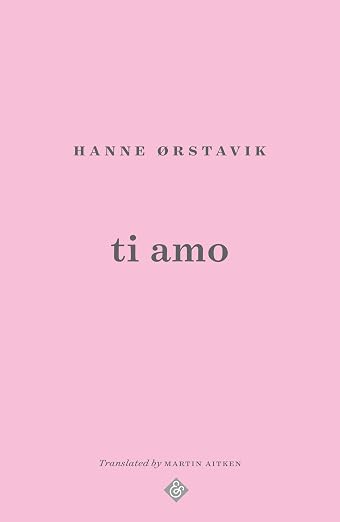
“We say it instead of saying something else.” (Hanne Ørstavik, ti amo)

This post discusses end-stage cancer.

I’ve read two previous novellas by Norwegian author Hanne Ørstavik, Love (1997), and The Blue Room (1999). Both are incredibly tough reads about abusive parent/child relationships, but brilliantly written. Her portrayal of the pain in familial relationships is just as unflinching in ti amo (2020, transl. Martin Aitken 2022, 93 pages), but here she considers a loving romantic partnership, and what happens when one of the couple is facing end-stage cancer. It’s my first read for Novellas in November, hosted by Cathy at 746 Books and Bookish Beck and it’s given me a very strong start.

We are plunged immediately into the altered existence that the narrator and her partner are living (it is a novella, but autofiction) as they try to manage the last part of his life. There is both intimacy and distance:

“Once, I would reach out in the night to touch your skin, to place my hand on your back, your stomach, your thigh, anywhere at all, and there’d be connection, contact. […] But you are no longer in your body, I don’t know where you are. Awash in morphine, you drift in and out of sleep or languor, and we do not talk about death.”

The narrator writes about how she values truth so highly, and as a reader I thought this was visible in Ørstavik’s unflinching gaze across her work. In ti amo, she doesn’t shy away from portraying the physical indignities the person diagnosed suffers; these are very hard passages to read. Nor does she portray the narrator as a perfect, self-sacrificing angel. It felt incredibly, almost brutally honest, including acknowledgement of how what is written isn’t always entirely the truth.

The narrator’s striving for truth means she struggles with the obfuscation around prognosis. Her partner doesn’t want to know, which she respects, but she is also furious with the situation and the silence from the medical team:

“Why can’t we speak the truth? Why can’t we say things the way they are? Why do they have to hide your death from you? Do you really not want to know, not to be in contact with, not to feel, the truth of yourself?”

She also captures the constant anticipatory grief that she carries:

“I feel as if I’ve come home when I look into your eyes. The way I look into your eyes and at the same time, always, know that you’re going to die. It’s been you and me and death for so long now.“

It is an incredibly sad book, as you would expect, not least because the narrator explains how much she had to overcome in life to get to where she could enter a loving relationship. Having reached that point, she meets her Italian partner, and after just a few years, their time together will be over.

“I’ve always thought there was something contrived about it when people go on about being so sensitive to death, being afraid of death. How can they, I’ve always wondered, these living people? I’ve struggled so hard just to feel the heart beating in my chest, to feel there’s something there that’s alive inside me, and not just steel and stone.“

There are moments of ordinary, tender intimacy too, as the couple have to navigate a way to find touchpoints when one of their bodies is failing:

“We watched the birds, their comings and goings, and you know the names of all the various kinds, you tell me what they’re called in Italian. And we sit there looking out instead of at each other,”

I’ve never experienced the death of a partner. But I’ve witnessed a lot of moments in my work over 27 years, and from my outsiders view Ørstavik captured so much, writing tenderly, angrily and honestly about the experience.

“I can’t do anything to help you. I can’t do anything for myself either, apart from that, finish the novel. […] It’s my way of existing in the world, I make a space for myself”

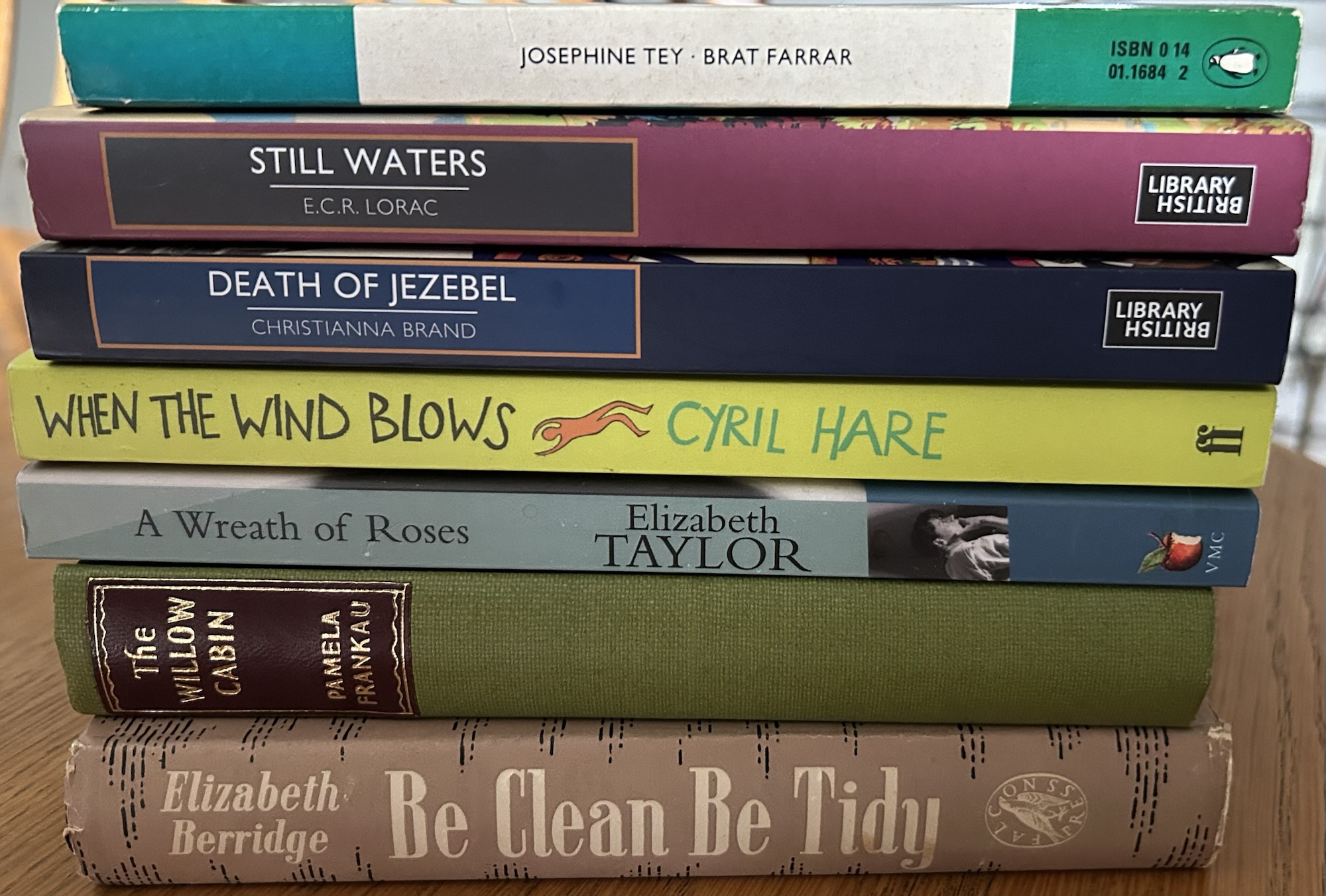
“This situation is just plain silly. It isn’t a love affair; it’s an obstacle race.” (Pamela Frankau, The Willow Cabin)

Unfortunately I didn’t have time to finish The Willow Cabin during Kaggsy and Simon’s marvellous 1949 Club, but I’m catching up now! This was my first Pamela Frankau and I’m so glad the Club prompted me to pick this up, because a basic summary would not especially appeal to me: a young woman enters into an affair with a still-married-but-separated older man, then the war starts… So far, so meh. But The Willow Cabin is a mature and interesting exploration of adult relationships, far beyond the central romance.

At the start we have a Prologue dated 1936, where young actor Caroline Seward is twenty-two years old and unhappy at home. She is unconventionally attractive, and pretty sweary (although her language seems mild to a twenty-first century reader.) At an afterparty she meets Michael Knowle, a married surgeon in his late thirties…

In Time Stolen we are in 1939 and the affair between the two is well-established. Caroline has matured, having had to face the realities of loving a man who will not divorce his wife, despite their living apart.

“Slowly, she had learned to rage in secret and to weep alone. She had learned to hide from him the small worries that he begged to be allowed to share. She had discovered early that she could make him laugh, and it became an obligation always to make him laugh, to save the funny things for him and hand them over, as toys to a child, at the day’s end. She had cured herself of questioning him, rebuking him and sulking at him.”

Their circle of friends is accepting, and Frankau demonstrates brilliantly how there is always the shadow of a third person in their relationship, Mercedes Knowle. Mercedes remains unknowable, as Michael will not discuss her, and people have widely differing opinions of her. Michael’s loyal sister Dorothy believes:

“Mercedes was a woman, and Mercedes was therefore to be blamed…. Michael’s sins she saw always in proportion. They were male, with his virtues.”

Huh! While Jay, Caroline’s professional collaborator, warns her:

“You know, of course, that Michael could get his divorce anytime that he wanted it; that his martyred attitude is a superb piece of bluff. That, being Michael, he is completely devoted to his career and completely set in the pattern that he has made. He has, at the moment, just enough freedom to suit him. You protect him from Mercedes and Mercedes protects him from you. A nice balance. Neither can encroach too far.”

I have to say this chimed with my sceptical twenty-first century reading of the situation. But really the focus isn’t on the relationship. Michael remains a somewhat unformed character, and I think this is entirely deliberate. Frankau’s interest in The Willow Cabin lies with the women (the title quote is from a love speech in Twelfth Night, but it is spoken by one woman (Viola in disguise) to another woman, Olivia, as part of a love triangle with Lord Orsino.) Frankau considers the effect of the relationship on Caroline, rather than evoking the relationship itself. And a huge part of that is her idea of Mercedes.

My favourite sections were the last two: The Calendar of Long Hours which covers 1943 to 1944, followed by Time Harvested, 1948.

During the war, Caroline works for the ATS, separated from Michael who is an army surgeon. A standout scene for me was a group of friends waiting for Caroline in a London bar, with the Blitz raging outside.

“He could see nothing ahead for any of them, the tight little circle of temporarily-favoured persons to whom all this was important. ‘It is the last spring; the guillotine is coming down. And after that it won’t matter who loves and who is unloved; … How foolish not to be able to be happy now, when there was so little time left.’”

It is a sad scene, made all the more poignant by the overlay of social ease. The war has made them all cynical. Dennis observes:

“’Need we have D-Day? I’ve had several of those. All I want is to do is to stay here and drink this reasonable gin and watch the top of the steps for Caroline.’”

Then later on, Caroline remarks on the terror of flying bombs:

“’I still don’t know why these things appear to have shattered my morale. I never minded the quaint, old fashioned Blitz.’”

The callowness of some of the characters which made them not entirely likable in the earlier sections now seems a marker of youth, gone forever although they are still so young. It is one of so many losses which Frankau evokes without sensationalism or sentimentality.

After the war, Caroline is touring a successful play in the USA, where Mercedes now lives, having nearly died in France and still struggling with the aftermath the conflict on her health.

“Where was she, the tough crusader responsible for this wrecked body? Absent tonight. There was only the image of the younger person who had failed.”

And so the two women eventually meet, and it as a subtle, complex and affecting as the rest of The Willow Cabin had led me to expect.

“‘Your Michael isn’t mine, nor mine yours. And there was, I imagine, a Michael whom we neither of us knew.’”

To end, the source of the title quote: