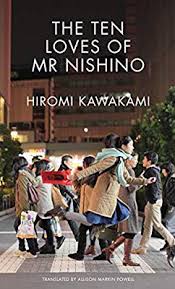
The Ten Loves of Mr Nishino – Hiromi Kawakami (1995, trans. Allison Markin Powell 2019) 195 pages
I really enjoyed the previous novels by Hiromi Kawakami that I’ve read, Strange Weather in Tokyo and The Nakano Thrift Shop, so I approached The Ten Loves of Mr Nishino with high expectations. Although this was still highly readable and full of well-realised, idiosyncratic characters, I didn’t find it quite as satisfying as the others. I think this is because I misunderstood the title. I thought Nishino was the subject and the Loves were the object. But, in having the Ten Loves tell their stories in individual chapters, it turns out they are the subject, Nishino the object – an enigmatic object who remains mysterious to the end.
This is not a novella about the romance of love, though it is about the impact of romantic encounters. Kawakami is interested in how people relate to each other and the effect that we have on people’s lives that we can’t recognise or fully comprehend. She’s not interested – at least not here – on rose-tinted explorations of romantic love. The first chapter is from the point of view of a married woman who has an affair with Nishino:
“What is love, really? People have the right to fall in love, but not the right to be loved. I fell in love with Nishino, but that’s not to say he was required to fall in love with me. I knew this, but what was so painful was that my feelings for Nishino had no effect on his feelings for me. Despite this pain, I longed for him more and more.”
We then go back in time to when Nishino was at school, and learn something of his painful past:
“A strange air drifted around Nishino. An air that none of the other kids in class had. I had the impression that, if I were to try and push that air around, there would be no end to it. The more I tried to push it, the deeper I would get caught up in it. And no matter how hard I pushed, I would never reach Nishino on the other side.”
Nishino is someone who is never without a partner, and sometimes these women overlap. The women’s perspectives on each other add to the narrative; one of his loves is stunningly beautiful, but we only learn this from his subsequent girlfriend, as the woman herself would never describe herself that way.
Despite his womanising, it is Nishino who comes across as vulnerable, much more so than the women, even when he causes them pain.
“I wanted to flee from Nishino as quickly as possible. This desire welled up from the bottom of my heart. I still couldn’t put my finger on what the sense of discomfort was – all I knew for sure was that it was present. And no matter how hard I tried, I simply couldn’t make it go away – that cold and awful uneasiness.
I wanted to flee. This simple thought flooded my mind. The same way that I had wished I could love him.”
Through ten very different women, we catch glimpses of Nishino but we never see him fully. This captures the central question of the novella: how much do we ever know another person? It’s not a bitter question though, or a desolate one. Rather it is one of compassion. I came away from Ten Loves… with a sense not of the importance of romantic love, but of kindness. Because at the point you touch another person’s life, you have no idea of what has gone before and what they carry with them.
 madame bibi lophile recommends
I’m looking forward to this one having enjoyed both Strange Weather in Tokyo and The Nakano Thrift Shop but will bear you first paragraph in mind when I get to it. Spot-on final sentence!
LikeLiked by 1 person
I hope you enjoy it Susan! As I say, I preferred the other two, but there’s still a lot to enjoy here. I really like Kawakami’s writing.
LikeLiked by 1 person
What a beautifully written post. I agree with Susan about your final sentence.
LikeLiked by 1 person
Thanks Liz! Kindness is so important isn’t it? It make a huge difference to someone, we may not even realise how much.
LikeLiked by 1 person
This is such an interesting review, not least because I’d also assumed from the title that Mr N would be front and centre in the narrative – the subject not the object as you so succinctly put it. There’s often something elusive about Japanese fiction, an unknowable quality that remains tantalisingly out of reach. That certainly seems to be the case here…
It’s probably not top of my list, but I’ll definitely keep it in mind. And if I do decide to read it, at least I’ll be going in with the appropriate expectations! Many thanks.
LikeLiked by 1 person
Yes, he certainly remains an enigma, despite having a big impact on the women’s lives, it’s a really interesting approach. I hope you enjoy it if you get to it Jacqui!
LikeLike
Yes, spot on – kindness is the thing…
LikeLiked by 1 person
Its so important and yet so easily disregarded.
LikeLiked by 1 person
Yes about kindness!
I haven’t read this but a few of her other books, also those you mention. It’s a bit hard to say though as I’ve read her in German. She and Yoko Ogawa were translated to German long before being translated to English but, I think from the French not the Japanese. I think in France are many very good translators from Japanese.
I think I would still like this one even if it might not be her best.
LikeLiked by 1 person
That’s really interesting, I didn’t know the German translation would be from the French. I’m sure if you enjoy Kawakami you’ll enjoy this Caroline. I did like it, but I prefer the other two I’ve read.
LikeLiked by 1 person
They often do that. Just a week ago I saw an article praising that for the first time a new Murakami was translated directly from the Japanese. They are not always translated from French. Also seem to remember seeing one from English. If I can, I try to read the French.
LikeLiked by 1 person
It does sound like an interesting way to explore the central character even if he does remain shadowy at the end. I’m intrigued to know what made the lover feel that sense of unease…
LikeLiked by 1 person
He definitely remains unknown although you get glimpses of him. It is an interesting characterisation. There are some odd things that make people uneasy, but nothing too horrible, I promise!
LikeLiked by 1 person
How curious! And with a writer who clearly chooses her words very carefully, I can’t help but think that the title is deliberately up-setting, so that we are intended to think one way about it and then realize that there’s quite another way to think. Which is kind of like relationships, wherein we are often so thoroughly preoccupied with our own perspective, and we forget that there’s a whole other, separate, distinct (possibly barely known or little understood) person right in there with us. I’d not added any of her book to my TBR previously, but there are several on there now: thank you!
LikeLiked by 1 person
Yes, that may well be it, she’s a really clever and subtle writer. I hope you enjoy her! Nankano Gift Shop is my favourite 🙂
LikeLiked by 1 person
GTK, I’ve added that to my GR note. It seems to be the most readily available via our public library system too, so that’s convenient.
LikeLiked by 1 person