November is the month of sooooo many reading events, and I’m hoping to take part in Margaret Atwood Reading Month and Novellas in November, but I thought I’d start with German Literature Month XIV, hosted by Caroline at Beauty is a Sleeping Cat and Lizzy Siddal at Lizzy’s Literary Life.

Grand Hotel by Vicki Baum (1929, transl. Basil Creighton 1930-1 revised by Margot Bettauer Dembo 2016) is a novel I’ve been meaning to get to for some time, republished by the wonderful New York Review of Books Classics.
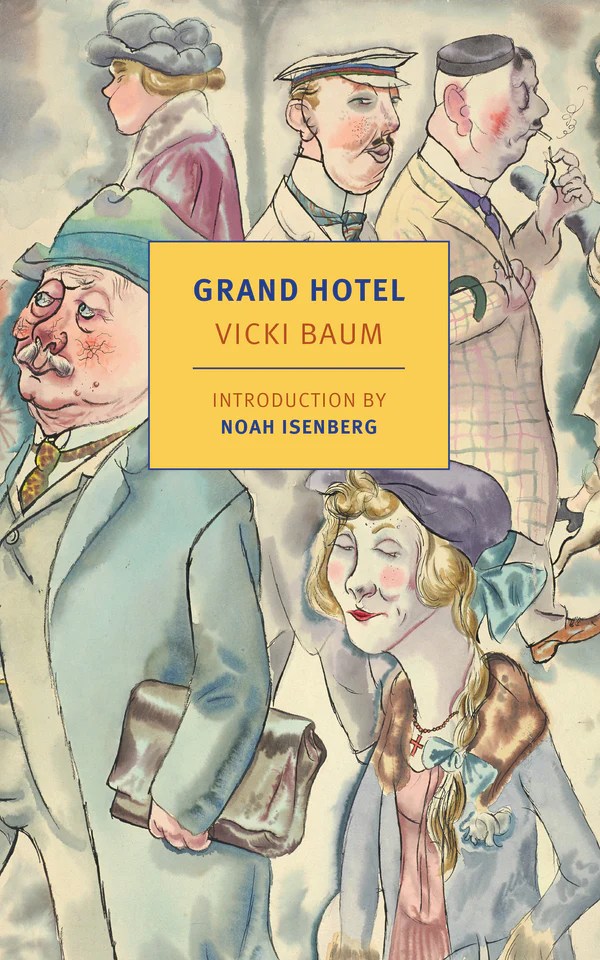
I find a Weimar Republic setting always so enticing, and this novel was a bestseller in it’s day, originally serialised in a magazine. Sometimes with serials you can really see the joins when they are placed in novel form, but the episodic nature of hotel stays by various guests works well and Grand Hotel felt entirely coherent.
The titular building is opulent and glamorous:
“The music of the jazz band from the Tearoom encountered that of the violins from the Winter Garden, and mingled with the thin murmur of the illuminated fountain as it fell into its imitation Venetian basin, the ring of glasses on tables, the creaking of wicker chairs and, lastly, the soft rustle of the furs and silks in which women were moving to and fro.”
As readers we know that momentum for World War Two is building, but for the guests at this time it is the shadow of World War I which still looms large. Doctor Otternschlag’s face has been severely damaged by a shell. Every day he asks if a letter has arrived for him which it never has. We don’t know what this quiet, traumatised man is waiting for.
“Doctor Otternschlag lived in the utmost loneliness – although the earth is full of people like him…”
Glamour is brought by Grusinskaya, a prima ballerina desperately trying to hang on to physical vigour against the forces of aging. She is somewhat ambivalent, feeling driven to be as she has always been, and exhausted by it all:
“Perhaps the world would have loved her as she really was, as she looked now, for example, sitting in her dressing room – a poor, delicate, tired old woman with worn out eyes, and a small careworn human face.”
The most pathos occurs in the guest who doesn’t fit in: Kringelein, a clerk from Fredersdorf, given a terminal prognosis and determined to squeeze the pips from life before it’s too late. He chooses the Grand Hotel as his boss, Herr Preysing, stays there when in Berlin.
“He felt again, here in the bar of Berlin’s most expensive hotel, the same intoxication, a sense of exuberant plenty as well as of anxiety and alarm, the faint threat haunting the wicked joy of wrongdoing, the excitement of an escapade.”
Kringlein’s difficulty is, he is unsure of how to achieve his somewhat nebulous aim. Doctor Otternschlag tries to help but fails, unsurprising given his jaded, damaged view of the world. More successful is gentleman thief Gaigern, a dashing young nobleman who charms everyone:
“I am quite without character an unspeakably inquisitive. I can’t live an orderly life and I’m good for nothing. At home I learned to ride and play the gentleman. At school, to say my prayers and lie. In the war, to shoot and take cover. And beyond that I can do nothing. I am a gypsy, an outsider, an adventurer.”
He kits out Kringelein in fine clothes and takes him for fast drives in cars and up in a plane, but what are his motives? As Kringelein throws his hard-earned but limited money around, what will Gaigern do?
“Human kindness and warmth was so much a part of his nature that his victims always received their due share of them.”
Baum weaves together these disparate lives expertly, as they bump against each other within the Grand Hotel to a greater or lesser extent. There are overarching plots that draw characters together but Baum demonstrates that while hotels are places where change may occur, they do not lend themselves to resolution so easily. Hotels are by nature transitory and lives must be continued, consequences dealt with, once the guests pass through the revolving doors and back into the world.
“Perhaps there is no such thing as a whole, completed destiny in the world, but only approximations, beginnings that come to no conclusion or conclusions that have no beginnings.“
The tone is so well-balanced, with moments of light humour, almost slapstick, alongside darker elements. I did feel a constant undercurrent of sadness, but this highlighted the resilience of the characters who keep on keeping on during this interwar period, rather than being depressing.
Grand Hotel provides a compelling evocation of the Weimar era too, with glamour, seediness, riches and poverty all bound together in a vibrant, intoxicating, overwhelming Berlin. I’m so pleased to have finally read this novel.
“The room had taken on that utterly strange and enchanted appearance often encountered in hotel bedrooms.”
Grand Hotel was adapted by Hollywood in 1932, which despite my love of Garbo I’ve never seen. Time to remedy the situation!
 madame bibi lophile recommends
Thanks for solving my German lit month book problem! Like you, I have been meaning to try to read this for ages, and you have reminded me of it at what seems to be a very good time; I’ve found my library has a 1930 edition tucked away in the stacks so I will seek to give it a dusting!
Once again, your review is a delightful read in itself; you serve very tasty appetisers for a book 😊
LikeLiked by 1 person
Oh great! I’m so glad your library has a copy. I really hope you enjoy it.
LikeLike
This sounds fascinating. Just recently I listened to a BBC podcast about the Weimar Republic and it was a window onto a Germany that I knew very little about. It tends to be viewed nostalgically, (with good reason because of what came after) but it was a much more complex situation politically and socially than I had thought.
So this one goes onto the wishlist, thanks for an enticing review.
LikeLiked by 1 person
I’ll look for that podcast, thank you for alerting me to it.
Yes, the nostalgia is so understandable but of course it’s so complex. I find it fascinating.
I hope you enjoy this one when you get to it Lisa!
LikeLiked by 1 person
I read this when too young to grasp the nuances. I’m sure a rereading would pay off handsomely.
LikeLiked by 1 person
Yes, I think I would have enjoyed it when I was younger but I’m glad I read it now. The characters are suited to older readers I think. I hope you enjoy it if you do go for a re-read!
LikeLiked by 1 person
I hadn’t heard of this and it sounds brilliant, thanks – to be squeezing the pips out of life is my ambition too, what a great review! I see Grand Hotel is on Amazon so I must give that a watch!
LikeLiked by 1 person
So glad you like the sound of this Jane! I’ll be watching Grand Hotel too – such a great cast.
LikeLiked by 1 person
Lovely review, Madame B. I adored this too when I read it – so brilliantly done I thought! And I still haven’t managed to catch up with the film, must do so!!
LikeLiked by 1 person
Great to hear how much you enjoyed this Kaggsy! I hope the film is a good one, I’m hoping to watch it soon.
LikeLiked by 1 person
One of those books I’ve known of for years without actually knowing much about it, so thanks for enlightening me! It sounds great – I assume it may have been the inspiration for the plethora of hotel based films and TV series over the years. Always a great vehicle for having lots of disparate characters gathered together without the need for contrived connections.
LikeLiked by 1 person
Yes, I really enjoy a hotel/guest house setting for that reason!
LikeLiked by 1 person
A lovely review of a wonderful book, so thank you for bringing it back to me in such a delightfully vivid way. As you say, Baum balances the tones so expertly which gives the novel moments of lightness and gaiety amid the darkness and melancholy.
The film is good and well worth catching up with – enjoy!
LikeLiked by 1 person
Thanks Jacqui! Great to hear the film is a good one – I’m hoping to watch it this weekend.
LikeLike
I watched a couple of series when I was younger (on BBC, but I can’t remember the titles just now) and fell in love with the idea of comings-and-goings in hotels (and the whole upstairs/downstairs conceit too) and it’s never really left me. This sounds really good!
LikeLiked by 1 person
It’s such a great setting isn’t it? So glad you like the sound of this one!
LikeLike
Pingback: German Literature Month XIV Author Index – Lizzy’s Literary Life (Volume 2)