Novella a Day in May 2026 – No.12

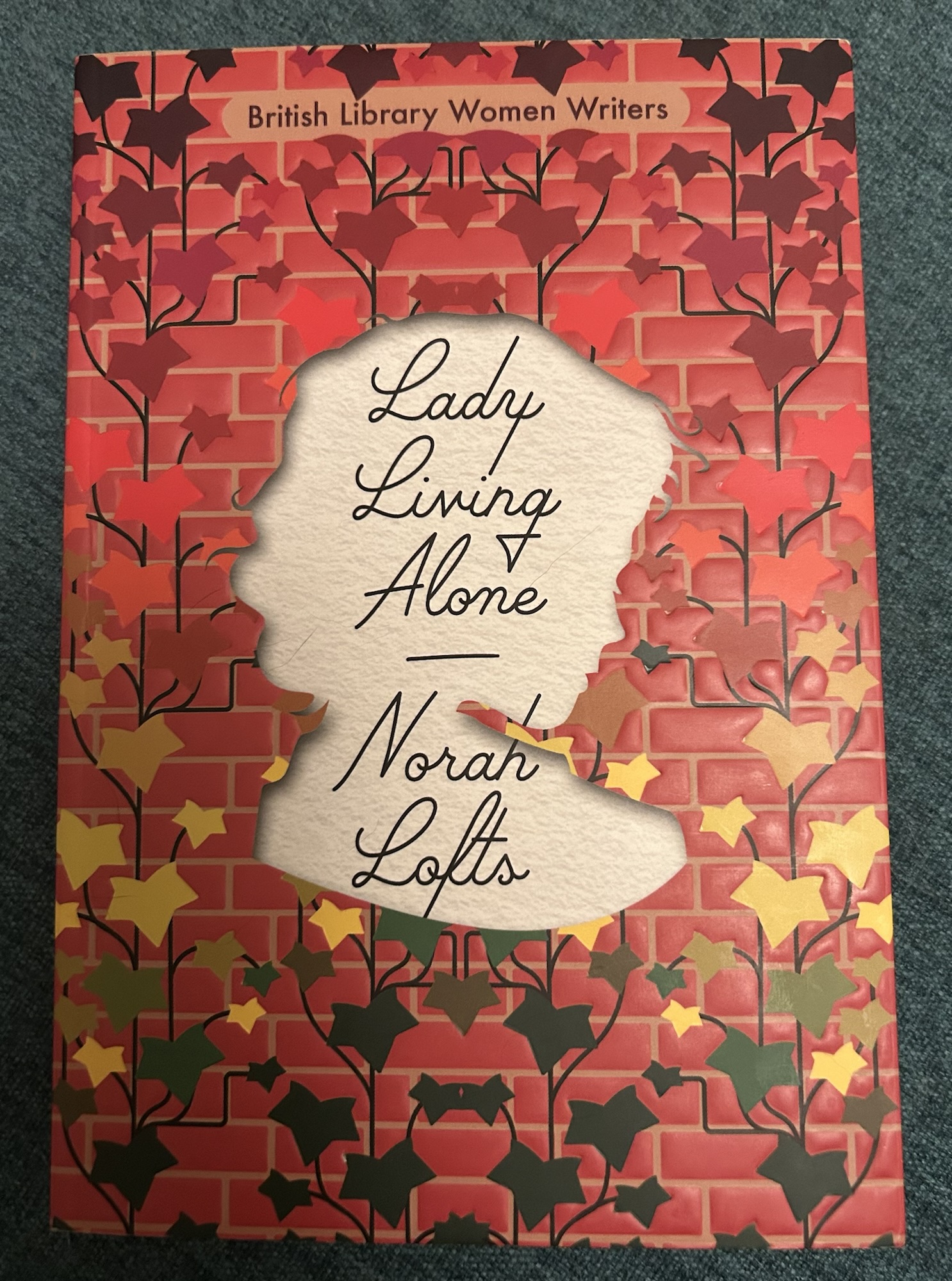
The British Women Writer’s Series is doing such a wonderful job rediscovering lost gems, and Lady Living Alone by Norah Lofts (1945) is no exception. I really enjoyed this witty, tense novel from a new-to-me writer, and it was in a typically lovely series cover too:

Set in the 1930s, the wonderfully-named Penelope Shadow is three years older than the century and living with her widowed sister-in-law, her nephew and niece. She fails at every job she attempts, until she hits on the idea of writing. Her historical novels featuring bold heroines are moderately successful, until one of them becomes hugely successful.

Miss Shadow herself was one of those women who is never described without the diminutive: the sweet little thing, a funny little thing, poor little thing, and, of course, after ‘Mexican Flower’, a clever little thing.”

Penelope’s inability to manage day-to-day routines means she is consistently under-estimated. But when her sister-in-law plans to remarry and emigrate, Penelope realises she needs help. I wondered if this wry observation was a piece of self-satire by Lofts:

“For behind Penelope Shadow stretched a long, long line of scribes and daubers, adults in their own peculiar world, but children in this one, vague, feckless, thoughtless creatures always sheltering, consciously or unconsciously, behind some sensible, practical person.”

Penelope has a phobia of being in a house alone after dark, and so she wants a live-in housekeeper. After a series of failures in this regard and following a Gothic interlude in a guesthouse, she leaves with a young, good-looking waiter:

“For Penelope had secured a treasure. There was no other word for it. She had won not only a housekeeper who could cook, and a cook who could housekeep, she had, all in one person, a nurse, a mentor, a chauffeur, a chambermaid, butler and steward.”

But there is an underlying sense that all is not as it seems with Terry Munce. This is compounded when she is visited by her more worldly, pragmatic writer friend, who genuinely sees Penelope as she is, and yet has not taken to Terry at all:

“Miss Fletcher was enchanted, not with the pretty young prodigy whom she had at first taken Penelope to be, but with the odd, contradictory, unpredictable person that she really was.”

As the story progresses, Lofts shifts Lady Living Alone from a domestic comedy of manners with an endearingly eccentric heroine, into a tense domestic noir, with an eccentrically vulnerable heroine.

She also uses Penelope’s situation to make some pointed observations about the legal position of women at this time.

“She knew, even as she settled down to her own job, in her own house, that she was not her own woman in the same way that she had been”

(The supporting material in the BLWW series is always helpful and the timeline; Preface from Alison Bailey as Lead Curator; and Afterword from Simon Thomas, Series Consultant, provide useful context on this issue.)

Such is Lofts skill that the shift in tone and wider political points never jar. I found Lady Living Alone immediately engaging, and then absolutely compulsive as I whizzed through it without any sense of how events might play out. I’m trying to avoid spoilers so that anyone who hasn’t read it might have the same experience, and so I’ll end the post here!

Novella a Day in May 2022 No.24

The Love Child – Edith Olivier (1927) 138 pages

The Love Child has been reissued as part of the British Library Women Writers series, a wonderful endeavour which has my fellow Novella a Day in May-er Simon Thomas as series consultant 😊

From the opening of The Love Child, I knew I was in for a treat:

“Agatha Bodenham had unconsciously moved a pace or two from the others, and she stood, isolated, near the head of her mother’s grave while the clergyman finished the service. She was wearing a dress of the shape and the tone of black which her dressmaker thought suitable for morning orders, and her hat was quite without character.”

Such a clever opening, and such detailed characterisation in so few words. This continues with clear-sightedness, yet with compassion too.

“She and her mother were women of peculiarly reserved natures, finding it hard to make friends, and holding their country neighbours at a distance. So reserved, too, that they had been barely intimate with each other, living through their days side by side without real mingling of experiences or sharing of confidences. Indeed, they had neither experiences nor confidences to share.”

Now her mother has died, Agatha is deeply, despairingly lonely. It has always been a lonely life in many ways, and she has never had many friends. Then she remembers a childhood imaginary companion, Clarissa. She wills Clarissa back to her, and the scamp – fleet of foot, irrepressible of nature – reappears. It’s not unheard of to retreat into fantasy at times of stress, but what lifts this from the psychological to the fantastical is that other people can see Clarissa too.

“She hardly believed it herself when she thought about it. She just didn’t think about it at all – she lived, and for the first time in her life.”

This presents a particular problem for Agatha as to how to explain Clarissa’s presence, the solution of which is the title.

“There was a special flavour about this scandal, because nobody believed it, however often it was repeated. The thing was unthinkable. To look at Agatha was to know that the policeman’s story was an impossible one, and yet its very impossibility made it the more amusing.”

Clarissa grows up with Agatha and the two are very much bound together. Clarissa encompasses all the behaviours that were supressed in Agatha long ago: appetites for food, for books, for life. However, as a person with those traits grows older, they are naturally going to want to experience more and varied things. Agatha feels Clarissa moving away from the insular world they have created together to beyond Agatha’s limits.

“Now Clarissa would be the guiding spirit, and it appeared she would at once step out of the artificial world which Agatha had created for them to live in, and go to the everyday world which had always been so comfortably and remotely outside, a world which seemed to Agatha at once more commonplace and more disconcerting than their own.”

In many ways The Love Child is a very sad novel. Agatha is so lonely and the solution to that loneliness is one that will cause her further pain. It’s not made clear in the novel whether Agatha is experiencing mental ill health or a truly wondrous manifestation. In a sense it doesn’t really matter because what is being portrayed, in a compelling and involving way, is the quiet desperation that could exist within an ordinary woman’s life in this period.

Agatha has no troubles or ostensible difficulties to contend with, but what she has is an entirely unfulfilled life and no idea of how to live differently. Her solution is extreme, and in many ways is one borne out of fear. She has been equipped with almost no life skills, and a fear of the wider world. It is no wonder that her solution is one that possibly lives only in her own head, and thrives in her domestic realm.

“Agatha thought she liked picnics, and in the long winter evening she often played at going to them with Clarissa. She felt rather differently about them in the summer, preferring them at a distance, like most things.”

I found The Love Child to be a sensitive and inventive novel. It was also highly readable and made me keen to seek out more of Edith Olivier’s work.