It’s been years since I read Yuri Herrera’s Signs Preceding the End of the World but I remember being impressed by it. Published in translation by the always interesting AndOtherStories, his debut novel Kingdom Cons (2008, transl. Lisa Dillman 2017) is a fable of just over 100 pages.
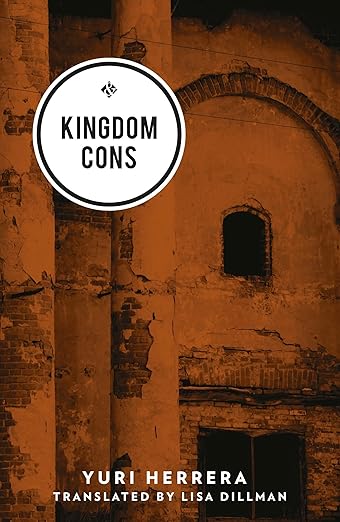
It is told from the point of view of Lobo, whose parents left him an accordion when they went to ‘the other side’ which I took to mean the USA. He makes his living singing on the streets and in cantinas, until one day he sees The King.
He decides he wants to be part of the Court, and so he goes to the King’s palace:
“The royalty of a king determined these things: the man had settled among simple folk and turned the filth to splendour. Approached from afar, the palace exploded from the edge of the desert in a vast pageantry of gardens, gates and walls. A gleaming city on the fringes of a city in squalor, a city that seemed to reproduce its misfortune on street after street.”
The King takes a shine to him, and so Lobo becomes The Artist, part of the coterie. Frequently referred to as a ‘fool’ or ‘clown’, he is the court jester, a musician placing The King in folk ballads.
“The Artist bowed again and followed the man, fit to burst into tears and blinded by bright lights and his future.”
Also in court are The Heir, The Manager, The Journalist, The Doctor, The Witch and other courtiers. The Artist falls for the daughter of The Witch, but there is much he doesn’t know about her, and how things run at Court, although he starts to piece them together.
Of course, this isn’t a medieval centre of rule, but a modern day drug cartel. We see the politics between cartels, the violence and power struggles at a step removed, but they are there. (The only violence I found difficult was the killing of a bird, which isn’t directly depicted.)
I didn’t find the fairytale/fable framing to be obfuscating or sanitising what was taking place. Instead. I thought it was a clever move by Herrera to show how embedded cartels are in society, how they draw on long-established societal structures, and how there is wider complicity. It is an inventive way of approaching a story so frequently told.
Kingdom Cons is a quick read, almost a short story. The characters are deliberately lightly sketched, presenting as long-established archetypes to emphasise how the running of the cartel is nothing new. It is powerful in its demonstration of how mythology endures, questions who should be mythologised, and the use that is made of myths.
“It’s as if there is no right to beauty, he thought, and he thought that the city ought to be set alight from its foundations, because in each and every place where life sprouted up through the cracks, it was immediately abused.”
 madame bibi lophile recommends
I was impressed by Signs Preceding…, too, but have read nothing by him since. It sounds as if this one takes a similar approach, addressing themes obliquely. Adding it to my list.
LikeLiked by 1 person
I hope you enjoy it Susan! It’s a quick read, interesting to see how he developed further with Signs Preceding…
LikeLiked by 1 person
I really loved Signs too and his one after that, The Transmigration of Bodies, referring again to crossing into the USA. The latter was quite violent if I remember. I have a copy of Kingdom Cons on my bookshelf. It sounds both similar (themes) and different (fairy tale). I want to read it for myself now.
LikeLiked by 1 person
I’ll look out for Transmigration of Bodies, although I may have to skip some of the violence, thank you for the warning!
I hope you enjoy this one when you get to it Annabel.
LikeLike
Yet another stimulating and thoughtful review Madame Bibi; they keep on coming!
This does sound as if it packs quite a thought provoking punch for such a slim book.
LikeLiked by 1 person
Thanks so much Sarah!
I did find it thought provoking – although short and limited in characterisation it made me think about the way cartels fit into society.
LikeLike
Sounds very clever, Madame B – I was expecting a historical setting until you revealed what the book was actually about!!
LikeLiked by 1 person
It is clever Kaggsy, he uses the medieval court tropes really well!
LikeLiked by 1 person
Fables are probably not my favourite form of literature, but this sounds intriguing and very well executed, especially the cartel element. Herrera seems to have built up a strong reputation over here, which is great to see!
LikeLiked by 1 person
Nor mine either Jacqui, but I found this doable as it was so short, and well done as you say.
He does seem very respected doesn’t he? He has a lot to say so it’s great he’s achieving a large audience.
LikeLike
I enjoyed Signs Preceding… this sounds quite good.
LikeLiked by 1 person
It’s slighter than Signs… but it does something interesting with a small space!
LikeLiked by 1 person
I haven’t read this one, but I read Signs… after reading his short stories (Ten Planets) which were on the Ursula K. Le Guin FIction Prize shortlist a couple years ago (hmmm, I think their next list will be out before too long). His way of seeing things, that interests me. I’m not sure I would care if it was called a fable or whatever words were on the cover… I’d be curious no matter what.
LikeLiked by 1 person
I’d be interested to read his short stories for sure. I hope you enjoy this one if you get to it, great to hear you rate his work.
LikeLike
What an intriguing premise! I think I’m too scared and squeamish to read about drug cartels in any guise, but I applaud the ingenuity.
LikeLiked by 1 person
I wouldn’t usually read about drug cartels either, but because I’d enjoyed him previously I picked this up. It’s very well done!
LikeLike