It was JacquiWine’s enthusiasm for Olivia Manning’s Balkan Trilogy which caused me to add it to the TBR, and a conversation with Marcie in the comments of Jacqui’s Levant Trilogy post which led to me finally getting the first instalment read! I’m delighted that Marcie and I are doing a buddy read for all three volumes this year, starting with The Great Fortune (1960) in June.
I’d originally planned to get this read by good time starting in April, but life took over, then novellas, and I’ve ended up finishing it on 29 June – one day spare! It says something for Manning’s writing that even my terrible memory and total inability with names kept her pretty large cast of characters straight despite a gap of about 8 weeks or so…
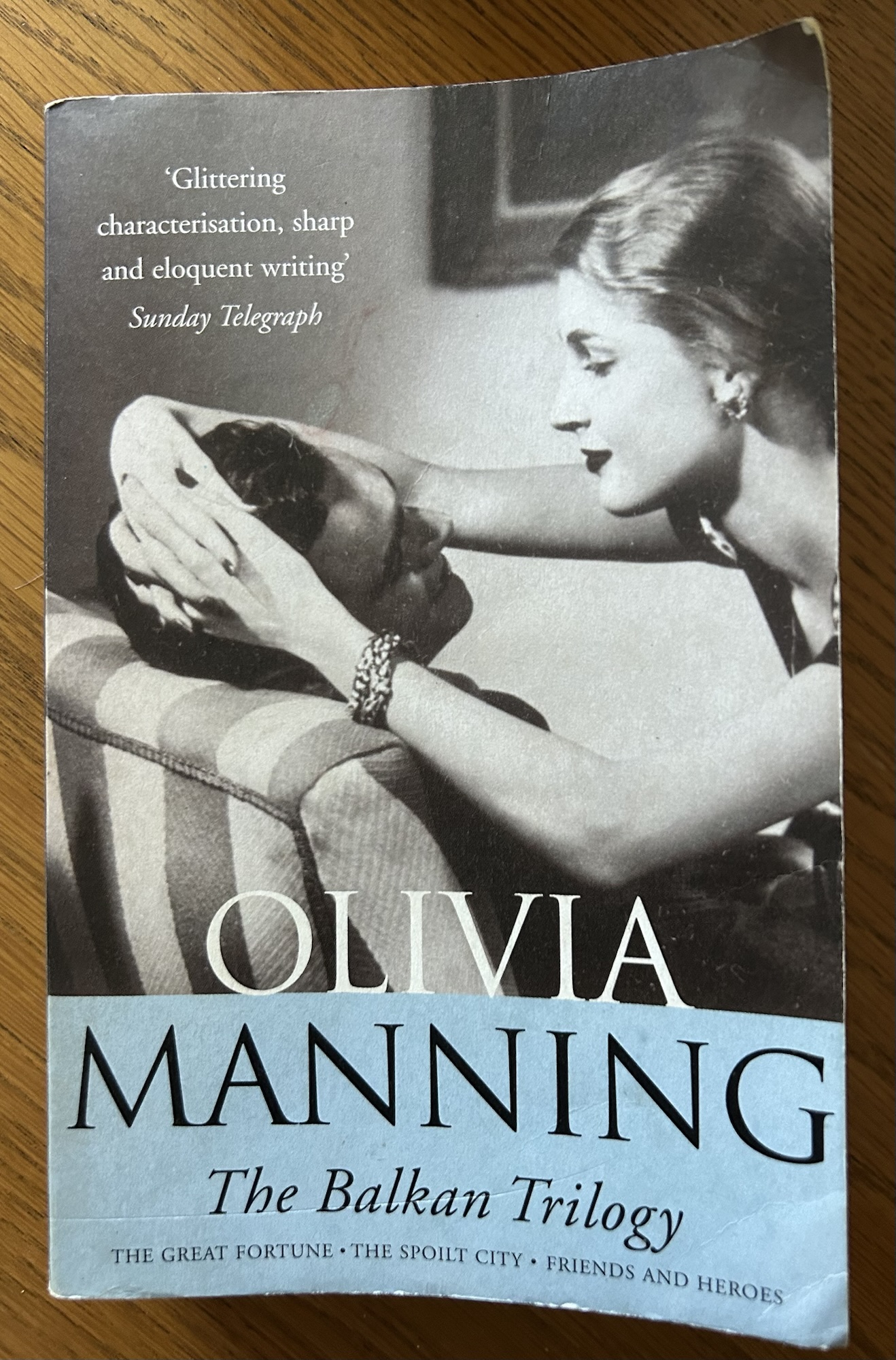
Guy and Harriet Pringle are newly married. The book opens with their arrival in Bucharest, a new experience for Harriet, but Guy has been there a year, working for the British Council at the university. It is 1939 and the new war across Europe looms large.
“‘Who is that?’ Harriet whispered. ‘Does he know us?’
‘Everyone knows us. We are the English. We are at war.’
‘But who is he?’
‘lonescu, the Minister of Information. He’s always here.’
‘How odd to live in such a small capital!’
‘There are advantages. Whatever happens here, one is in the midst of it.’”
It’s a time of adjustment to a new life and each other, against a rapidly changing, unstable background. Harriet begins to realise they are not easily compatible, with Guy’s relentless sociability at odds with her need for intimacy:
“They had slipped into marriage as though there could be no other possibly resolution of such an encounter. Yet — supposing she had known him better? Supposing she had known him for a year and during that time observed him in all his other relationships? She would have hesitated, thinking the net of his affections too widespread to hold the weighty accompaniment of marriage.”
The characterisation of these two young people is complex. Although Guy is constantly in company, this is motivated by his communist beliefs and a general generosity of spirit, rather than any particular interest or warmth regarding individuals.
“Guy said: ‘He leads his life, as we all do. What do you care what he does?’
‘Naturally I’m interested.’
‘Why be interested in people’s private lives? What they are pleased to let us know should be enough for us.’
‘Well, I just am. You’re interested in ideas; I in people. If you were more interested in people, you might not like them so much.’
Guy did not reply. Harriet supposed he was reflecting on the logic of her statement, but when he spoke she realised he had not given it a thought.”
My experience of Guy was that he was one of the most irritating, infuriating characters I’ve ever come across. His generosity paradoxically made him entirely selfish, as he seemed to have no real consideration for Harriet at all. She isn’t particularly likeable either, often xenophobic and begrudging with people. But as their relationship matures, she is more forgiving than me, recognising “a husband made unreliable only by his abysmal kindness”.
Manning makes them both so real (apparently based on her and her husband) that it became of little consequence that I didn’t like them – I wanted to hear about their lives at this time. Guy does live by his ideals, so he is not a deliberately unkind person, just utterly oblivious. He has enough redeeming qualities for Harriet’s love to be understandable:
“We must help him, not because he’s a good person but because he needs help. You understand that.”
Through Guy, we meet a range of characters who have ended up in Bucharest at this particular moment. These include but are not limited to:
Sophie, a student Guy considering marrying in order for her to have a passport – in his usual way he is unconcerned regarding her being in love with him; Sacha is another of his students, part of an immensely rich family called the Druckers; Harriet makes friends with Bella, an English woman married to a Romanian, Nikko Niculescu; we meet staff at the university, and journalists at the English Bar. Manning handles her large cast deftly, and even the less prominent characters are sketched distinctly.
There is also my favourite character – in many ways equally irritating as Guy – Prince Yakimov, an Irish/Russian prince. Yakimov is perpetually sponging off his friends, promising an always due to arrive remittance, pleading with them to pity “poor Yaki”. He is preoccupied by fine food, and starving most of the time. His English is peppered with phrases that sound almost Wodehouseian. He is utterly ill-equipped to deal with life in any way whatsoever, and yet somehow he endures on his own terms:
“Had Yakimov been content to eat modestly, he could have existed from one remittance to the next, but he was not content. When his allowance arrived, he ate himself into a stupor, then, penniless again, returned, a beggar, to the English Bar. It was not that he despised simple food. He despised no food of any kind. When he could afford nothing more, he would go to the Dâmbovița and eat the peasant’s staple food, a mess of maize. But food, rich food, was an obsessive longing. He needed it as other men need drink, tobacco or drugs.”
The progress of the war is documented, but never heavy-handed. The characters stop by a publicly displayed map of Europe which shows the fall of Poland and the invasion of Denmark, Norway, and the Low Countries. Through the journalists in the English bar, the Battle of Dunkirk is relayed.
As the risk to Harriet and Guy grows, he responds surprisingly by becoming entirely wrapped up in producing a performance of Troilus and Cressida. I found this an intriguing choice by Manning. One of Shakespeare’s less well-known plays, it is tonally deeply odd. A tragedy but filled with unpleasant characters, a comedy but in bad taste a lot of the time. Harriet observes that everyone seems to be playing themselves. Yaki is commended for his portrayal of Pandarus, but Pandarus is a pimp. The play ends with that character wishing venereal disease on the audience – yuck. I love Shakespeare but Troilus and Cressida tests that assertion more than any other of his works.
It is a play about the Trojan war, so in a way it shows again how young and naïve so many of the characters are, play-acting while a very real war grows ever-more threatening. It also adds to the general sense of uncertainty, with very little to secure your knowledge or hope upon.
“Guy came hurrying in behind them. […] His size gave her an illusion of security — for it was, she was coming to believe, no more than an illusion. He was one of those harbours that prove to be too shallow: there was no getting into it. For him, personal relationships were incidental. His fulfilment came from the outside world.”
This volume ends in June 1940, and so as readers we know that these characters still have so much conflict to live through.
I’ve only scratched the surface of The Great Fortune, but this post is already far too long! It took me a while to get back into this novel, before something clicked and I whizzed through the remainder. I’m really looking forward to carrying on the story with The Spoilt City.
In 1987, the BBC made both trilogies into a seven-part series, which seems a lot to squeeze in. I think I might give it a try, once I’ve finished reading them all…
If anyone would like to join us for this buddy read, please do! We’ll be posting in The Spoilt City in August and Friends and Heroes in October.
 madame bibi lophile recommends
I remember reading both Balkan and Levant trilogies in the late ’80s having watched the BBC adaptation and finding them enthralling. They seemed to capture the time so well. Coincidentally, my partner has been reading them again and is coming to the end of the Levant having enjoyed them very much.
LikeLiked by 1 person
Oh that’s great to hear Susan, both for you and partner enjoying the books and for the TV series. I’m looking forward to both!
LikeLiked by 1 person
I was infected by Jacqui’s enthusiasm too and managed to source all three books in both the Balkan and the Levant Trilogy shortly after her post. However, as you say, life has other plans and somehow other books seemed to leap in front of The Great Fortune in the calling to be read next queue!
Thanks for the nudge. I have reshuffled and it’s now in a more prominent pile! I might get to it before 2027 given a fair wind. I appreciate the warning about Harriet and Guy being unlikeable; sometimes that leads to my struggling to engage with a book, but it sounds as if it doesn’t matter here.
LikeLiked by 1 person
I hope you enjoy it when you get to it Sarah!
It doesn’t matter at all about them not being likeable – and I have to remind myself they are both very young, only in their 20s, so I should be more generous!
LikeLike
He really does sound irritating and infuriating, I’m glad you’re enjoying the buddy read but I don’t think I could tolerate that character. 🙂 I did enjoy reading about your experience of this book, and I look forward to hearing more about it in the future. 🙂
LikeLiked by 1 person
I’m sorry to have put you off! I’m glad you enjoyed the post though 🙂
The novel is so well written that Guy’s character didn’t stop me enjoying the book at all, but I would welcome him maturing and being less selfish in future volumes 😀 I’ll guess I’ll just have to see…
LikeLiked by 1 person
Hahaha, yes, I can see it being a satisfying read if he is recognised by the other characters as being irritating, and especially if he learns the error of his ways. 🙂 Don’t apologise, thank you for the warning, haha.
LikeLiked by 1 person
Oh yes, this sounds marvellous, and I’d love to see the BBC adaptation too!
LikeLiked by 1 person
So glad this appeals Lisa! The BBC adaptation does look good, I’m looking forward to it.
LikeLike
What a great choice for a buddy read, Madame B! I read the Balkan Trilogy some time back and absolutely loved it, though for some reason have never gone on to the Levant – I should, really… I agree that Guy is possibly the most irritating character in fiction, but Manning’s writing is so good that you have to keep reading. And I also adored poor Yaki – what a marvellous character he is!!
LikeLiked by 1 person
Great to hear you loved this Kaggsy, and are also a fan of poor Yaki – what a character!
LikeLiked by 1 person
I thought The Balkan Trilogy was more interesting than The Levant Trilogy, but they are both good. Guy is really irritating, though.
LikeLiked by 1 person
That’s good to know, I think I’d like to read both. Guy is so irritating!
LikeLiked by 1 person
It seems weird that he would think his wife is the only person who doesn’t need his attention—taking her for granted in an extreme way!
LikeLiked by 1 person
His behaviour is quite baffling!
LikeLiked by 1 person
I think it’s an extreme case of taking her for granted.
LikeLiked by 1 person
ooh yes I plan to read this too but I don’t think I can sign up for a buddy read as I’m so slow, you’ve increased my enthusiasm to get going though, I want to see just how irritating Guy is!
LikeLike
I hope you enjoy it when you get to it Jane! I’ll be interested to hear how you find Guy 😀
LikeLiked by 1 person
I’m so delighted you enjoyed The Great Fortune, and many thanks for linking to my posts, very kind of you!
It’s lovely to read your thoughts on this one as it’s been a while since I read the Balkan Trilogy, but this brings the initial instalment rushing right back! Yes, Guy is infuriating and Harriet can be tricky to sympathise with at times; but Manning’s great skill is to make these characters feel believable and truthful. That’s an astute point about the choice of Troilus and Cressida, too. Thanks for a great review!
LikeLiked by 1 person
Thank you so much for your enthusiastic posts which encouraged me to pick this up!
The characters are so believable – I’m so invested in them despite Guy making me grind my teeth at times 😀
I’m really looking forward to The Spolit City next.
LikeLike
Good heavens, Kenneth Branagh in 1987? I had quite forgotten how long he’s been around! This is a trilogy I’ve often been tempted to read. Sadly I won’t be able to fit in with your buddy read, but I’m looking forward to hearing what you think of the other two volumes.
LikeLiked by 1 person
I think this production is where he and Emma Thompson met! They both look very young in the trailer, don’t they?
I hope you enjoy this when you get to it FF, I’m looking forward to the other volumes.
LikeLiked by 1 person
Like you, I had ideas about reading this first volume in the trilogy with time-to-spare, but I didn’t finish until the last evening of June (not that we are being overly strict, it’s just nice to have a goal or, otherwise, there is always another shorter and simpler book that butts into the reading line, isn’t there).
I was surprised to find that most of the characters are unlikeable (because it’s not all that common with VMCs really) but they are all interesting (and believable) and that’s what really matters. Still, it wasn’t what I’d expected, so it took a bit of adjusting and it slowed me down until I resettled.
The choice of “T&C” made sense to me because it’s been emerging, occasionally, as a reference in NAmn media, in the context of the 47th (i.e. current) administration in the U.S. and concepts of leadership and corruption. So I appreciated the extra information about the play, without having to read it again!
The idea of scale really intrigues me, that statement about how one’s always in the midst of everything there (but must await news of the world beyond): I’ll be noodling over that perspective as we read the next volume. (I think I want to see the series afterwards too!)
LikeLiked by 1 person
I should say that I think of OM as a VMC author, but I don’t think this particular series or the follow-up was one of their pub’s? My copy is an older Penguin!
LikeLiked by 1 person
Yes, I read The Play Room in VMC, and I have The Doves of Venus and The Wind Changes in the TBR in VMC editions, but for some reason they didn’t publish the Balkan Trilogy or the Levant Trilogy. NYRB Classics have published both though, and School For Love.
LikeLike
I’m missing The Wind Changes and School for Love then. Maybe there were TV-tie-in editions that complicated the rights for this series when the VMCs were going strong. (Ohhhh, I used to love those TV-tie-ins for the English TV series we were sometimes able to see across the pond. How I absolutely loved The Flame Trees of Flika, and my little Penguin pocketbook with the actresses on the cover.)
LikeLiked by 1 person
That’s a good point, maybe that is what happened. It does seem an unusual choice not to do the trilogies otherwise.
I’ve never heard of Flame Trees, I shall explore!
LikeLike
It wasn’t a recommendation, but I’m sure there are eleventy-billion copies second-hand (probably housed in travel or biography rather than fiction); it was the sort of colonial story that was ubiquitous on TV, the sort that kept everyone in their “proper place” without instructing anyone outwardly, but I think it stood out to me because the mother and daughter had more of a role?
LikeLiked by 1 person
Absolutely – no real pressure which is great, but having agreed we’d do this I’m very grateful for the focus!
I think I expected to like Harriet more than I did, as it’s mainly from her POV and she’s somewhat adrift. But as you say, it doesn’t really matter as they are all compelling characters.
I didn’t know T&C was being used as a reference in the media – how intriguing!
They seem simultaneously in the thick of it and a bit cut off don’t they? As you say, it will be interesting to see how this plays out, particularly as I think Harriet is on the move in the next volume…
LikeLike
Pingback: “Here they were, wrecked together on the edge of Europe as on an island and she was learning to keep her thoughts to herself.” (The Spoilt City, Olivia Manning) | madame bibi lophile recommends