Just Like a River – Muhammad Kamil al-Khatib (1984, trans. Michelle Hartman and Maher Barakat, 2003) 110 pages
Just Like a River was Syrian writer Muhammad Kamil al-Khatib’s first novel, set in Damascus in the 1980s. It forms another stop on my much-neglected Around the World in 80 Books reading challenge, hosted by Hard Book Habit. The novella looks at the lives of a group of Syrians, with different chapters from different viewpoints. In this way, al-Khatib builds a picture of the individuals, Damascus, and the wider Syrian political situation.
Dallal is the young daughter of Yunis, a Chief Sergeant in the army. She struggles with the expectations placed on women where she lives and idealises life overseas:
“Young European women live alone. They rent rooms and come home at night when they like. Over there, men do not harass women in the streets but are polite like Doctor Morton White.”
Ha! Unfortunately we know she is sadly mistaken, in both this and in her assessment of her professor. He is self-centred and shallow, and exoticises Syrian women without really bothering to get to know a single one:
“He had illusions that he would discover Arab women through Dallal. He would explore this Middle East that was shrouded in secrets.”
By returning to characters over various chapters al-Khatib deepens the individual portraits. Yusuf is in love with Dallal and his friend Zuhayr at first seems a real misogynist. Then it becomes apparent that his flippancy hides a deeper hurt, and he is as cynical about men as he is women:
“What do we offer them other than a mirror image of our fathers’ backwardness? We act as if we are only thieves or guards of their hymens.”
The portrayal of women is sympathetic, so Dallal is seen as young and naïve rather than ignorant and prideful. Her friend Fawziya is hurt yet optimistic:
“Fawziya was a disappointed woman. Her tempestuous love affair with Sami caused her to have a general disrespect for men, coupled with a longing for some certain, but unknown, man… She and her mother dealt with things just as one might expect two destroyed women in solidarity with each other would. They were two women betrayed by both men and time, and who persevered, waiting for a certain something, a certain man, a certain incident. This is why they spent so much time reading coffee cups and interpreting dreams.”
As they all deal with the day-to-day concerns of family conflict and unspoken feelings, the political situation is building in the background. When he is called to the army, Yusuf is not particularly concerned. As it becomes clear that the conflict may be escalating, he meets it with grim humour:
“ ‘They don’t give us good weapons or enough of them. Look, can’t you see how the bombs fall down like paper?’
Yusuf laughed. ‘I fear that we, not the missiles, are paper,’ he said.”
Just Like a River is an evocative and memorable portrait of a group of people struggling against the forces directing their lives, and themselves. If that makes it sound heavy or depressing, it isn’t. It looks at huge themes straight on, but does so with compassion and understanding.
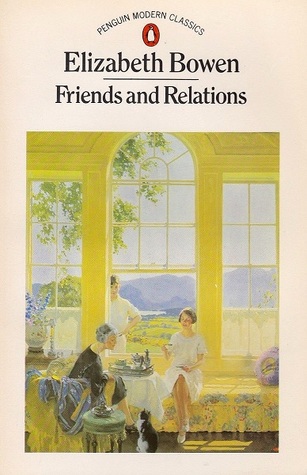
Friends and Relations – Elizabeth Bowen (1931, 159 pages)
Following on from yesterday, another Irish novella today, this time by Elizabeth Bowen, whose longer novels I’ve greatly enjoyed and two of which I wrote on for Reading Ireland 2017.
Friends and Relations opens with the wedding of Laurel Studdart to Edward Tilney. Laurel is beautiful and not particularly nervous about the wedding: she spends the morning playing cards with her father. This sets a major theme for the novel, around lack of passion in marriage and how much importance should be attached to it.
The reception is at the family home in the Malvern hills, Corunna Lodge. The only discordant note in this upper middle-class idyll is the groom’s slightly scandalous mother:
“Edward remained throughout wonderfully self-possessed; perhaps because of this he did not make an entirely good impression. Lady Elfrida, in claret-coloured georgette, also over-acted a little. Besides being a divorcee, which should but does not subdue, she was the bridegroom’s mother – and one apt to play always a little too gracefully a losing game.”
Laurel’s sister Janet sits on various committees and has roped her Wolf Cubs into helping out at the wedding. She is pragmatic and sensible, yet it is her choice of beau in Rodney Meggatt just a few months later which introduces conflict into the family. Rodney’s uncle Considine was named as co-respondent in Lady Elfrida’s divorce proceedings. Lady Elfrida fails to see what all the fuss is about:
“She did not consider the situation awkward at all. Not nowadays when everybody was different, everyone else dead.”
Lady Elfrida is a wonderfully self-centred creation. She doesn’t seek to hurt others, but barely acknowledges how her actions impact on people, such as Edward’s enduring sense of shame, or when she broke Considine’s heart.
“She had perhaps injured him, perhaps even vitally…Under her dry-eyed farewell look, her last tragic un-regret, in Paris, he had certainly desiccated.”
Similarly self-focussed is Theodora Thirdman, schoolgirl and guest at the wedding, given to prank phone calls and later a flatmate of Edward’s best man’s sister, determined to demand the love she craves.
“she had passions for women – awkward, such a tax on behaviour, like nausea at meals.”
As the years pass, Edward doesn’t want any connection between his children and Considine, but events conspire against him when his children visit their aunt and uncle, who are now living in Considine’s manor house, Batts:
“At one time his children were not to be at Batts with Considine…on any account. But since a first epidemic had swept the Tilney family, this had relaxed. He wished his children would not call Considine ‘Uncle’ and that Hermione Meggatt need not appropriate Lady Elfrida as ‘Grandmother’. Between these whirlpools of sensibility, these reefs of umbrage, the two families had, however, steered for ten years an uneventful course.”
This is a densely written novel with a focus on character rather than plot. Things do happen, particularly in one eventful week following a typically unsubtle manoeuvre by Theodora, but it is primarily people and their relationships that change and develop.
Bowen often leaves it for the reader to fill in the gaps – more than once I had to go back and check I hadn’t missed something. But no, it’s just that she doesn’t lay everything out explicitly, including her characters’ thoughts and motivations. This could be frustrating, but I thought it worked well in capturing the sense of a well-to-do family at a historical time when things are left unsaid and everything simmers below the surface.
“You must see what families are; it’s possible to be so ordinary; it’s possible not to say such a lot.”
There are comedic moments, particularly with Theodora, and in some ways it could be read as a comedy of manners, but Friends and Relations is more subtle than that, and contains a great deal of pain and sadness too. Not my favourite of the Bowens I’ve read, but definitely worth a look for her highly skilled writing and astute insights into human beings.
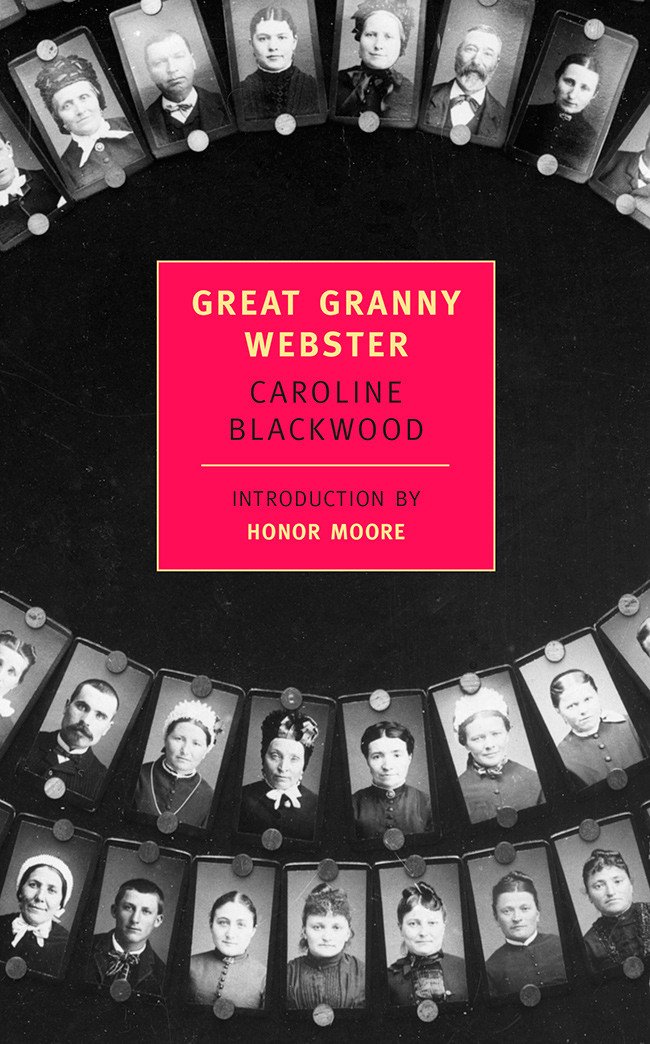
Great Granny Webster – Caroline Blackwood (1977, 96 pages)
My blogging slump meant I completely failed to take part in Cathy and Niall’s Reading Ireland 2019 (#Begorrathon) in March, and so I’m including a few Irish novellas this month. The first of these is by an author I’ve never heard of, which seems extraordinary given her quite astonishing life story.
The titular matriarch of this novel is a wonderfully Gothic creation:
“She had arranged her hair in two grey tufts that lay on her forehead like a couple of curly horns, so that what with the exaggerated narrowness of her elongated face, and her uniquely over-long upper lip, she often reminded me of a melancholy and aged ram.”
The narrator is sent to Hove to recuperate with her great-grandmother in 1947 when she is 14, as it’s thought the sea air will help her recuperate from an operation. It’s totally bizarre that her family would think this a good idea, as Great Granny Webster lives in severe austerity in a damp and gloomy house, alone except for her aged and devoted retainer, Richards.
“All she wanted from each new day that broke was the knowledge that she was still defiantly there – that against all odds she had still managed to survive in the lonely, loveless vacuum she had created for herself.”
Unsurprisingly, this is not a warm and affectionate portrait of the generations of a family. It is however, witty, astute, sad, and incisive. Great Granny Webster is entirely uncompromising:
“ ‘There really is nothing more unattractive than the sight of a young woman displaying a repulsive amount of arm. I am not going to mention this subject again.’
Great Granny Webster always told the truth. She never once referred to my sleeves or my arms again.”
We later learn that her daughter (the narrator’s grandmother) completely lost all sense of reality, trapped in the family castle at Dunmartin. The echoes of previous generations are heard down the years. As an adult, the narrator is contacted by her fragile, enchanting Aunt Lavinia who is having similar problems:
“One day Aunt Lavinia rang me up to say it was too maddening, she was in prison. When I sounded astonished she admitted that it wasn’t exactly a prison, but it was just as bad, for she was being detained in a hospital where she had been put by the police.”
What Blackwood captures brilliantly is how in families, people can be superficially polar opposites but underneath it all, so very alike, much to their own alarm:
“Aunt Lavinia’s house was very warm. She liked to have log-fires burning and her central heating turned on even in the summer. Although her bedroom was rather like a hot-house and fragrant with the smell of her lillies, I had exactly the same feeling of chill I had experienced in the bleak, cold, flowerless drawing room of Great-Granny Webster when that old lady had predicted that eventually I would be very like her.”
In such a short space, Blackwood achieves fully-rounded portraits of three generations of women in an idiosyncratic noble family. Great Granny Webster is, like its anti-heroine, bleak, funny and unique.
I read this in an old Picador edition, but I’m delighted to say the wonderful NYRB Classics have re-issued it.
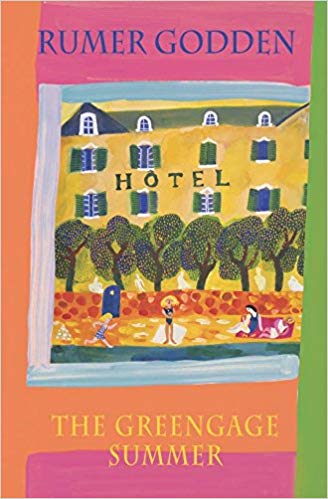
The Greengage Summer – Rumer Godden (1958, 187 pages)
I really enjoyed my first experience of Rumer Godden last year, and so it was that I picked up The Greengage Summer with high expectations, which were fully met 😊
The story is narrated by thirteen-year-old Cecil describing how she, her older sister Joss and younger sister Hester, plus ‘The Littles’ brother Willmouse and sister Vicky, are left to essentially fend for themselves at the Les Oeillets hotel in champagne country, after their mother develops septicaemia from a horsefly bite and is hospitalised.
“Perhaps it was this first sight that made me always think of the garden at Les Oeillets as green, green and gold as was the whole countryside of the Marne where, beyond the town, the champagne vineyards stretched for miles along the river, vineyards and cherry orchards, for this was cherry country too, famous for cherries in liqueur. Mother had been thinking of battlefields; she had not thought to enquire about the country itself; I am sure she had not meant to bring us to a luxury corner of France where the trees and the vines changed almost symbolically in the autumn to gold.”
It is reminiscent of Kingfishers Catch Fire, in that it is told from the perspective of someone looking back, who has been rescued from a foreign country by a man – Uncle William in this instance – with interjections from the present.
“ ‘You are the one who should write this,’ I told Joss, ‘it happened chiefly to you’; but Joss shut that out, as she always shuts things out, or shuts them in, so that no-one can guess.
‘You are the one who likes words,’ said Joss. ‘Besides…’ and she paused. ‘It happened as much to you.’
[…]
‘But you were glad enough to come back,’ said Uncle William,
‘We never came back,’ said Joss.
So what happened to cause them to leave themselves behind in Les Oeillets? I don’t want to give too much of the plot away…
The children are captivated by Eliot, a charming debonair English man who is having an affair with Mademoiselle Zizi, the hotel owner. Madame Corbert, the manager, is jealous, desiring Zizi herself. This is explained to them by Paul, the not much older but very much wiser hotel boy. These intrigues would be difficult enough, but Joss suddenly blooms, her beauty throwing things even further into disarray.
“I know now it is children who accept life; grown people cover it up and pretend it is different with drinks”
Some things around the hotel, or rather, around one of the guests, don’t add up, and it will be a rude awakening to the cruelties of the adult world for the children when they find out the truth. And it is the truth to a great extent – the author’s introduction to my edition explains the experience her family had, on which she based the story.
“For us champagne will always have a ghost; it can never be a wine for feasts but one for mourning.”
The Greengage Summer is a well-paced, atmospheric read with excellent characterisation. It’s no wonder it was quickly adapted into a film in 1961, starring Susannah York as Joss and Kenneth More as Eliot:
Breaking Away – Anna Gavalda (2009, trans. Alison Anderson 2011) 143 pages
Breaking Away is a simply plotted novella which appears deceptively straightforward in its storytelling, but builds towards a meaningful resolution.
Garance is in her late twenties and cadges a lift to a wedding with her brother Simon and annoying sister in law Carine. The characterisation of Carine starts the novella off on an enjoyably bitchy note as the chaotic Garance, who has stayed up all night playing poker and is waxing her legs on the backseat, offends beauty pharmacist Carine’s sensibilities.
“Carine is utterly perplexed. She consoles herself by stirring sugarless sugar into a coffee without caffeine.”
They stop and pick up another sibling, Lola, who likes to conspire with Garance to wind up Carine. At which point I began to feel for Carine – maybe she wouldn’t be such a nightmare if the siblings weren’t so cliquey and excluding. At this point though, the portrait of Carine does modify slightly.
“She may be a first class pain but she does like to please others. Credit where credit is due.
And she really doesn’t like to leave pores in a state of shock. It breaks her heart.”
Their fourth sibling, Vincent, isn’t at the wedding, so the three of them leave Carine and bunk off to go and collect him. Garance reflects on her various siblings’ trials and tribulations and how their upbringing has influenced who they are. She decides her parents are culpable:
“Because they’re the ones who taught us about books and music. Who talked to us about other things and forced us to see things in a different light. To aim higher and further. But they also forgot to give us confidence, because they thought that would come naturally. That we had a special gift for life, and compliments might spoil our egos.
They got it wrong.
The confidence never came.
So here we are. Sublime losers.”
But the humour in the novella stops it being self-pitying. In fact, the four of them are doing OK. They’re just enjoying taking a rare moment to spend time together.
Breaking Away captures a moment in time for the four siblings, and has an elegiac quality, for time past and relationships that must inevitably change. The tone isn’t sad however, more resolute; it’s about how love endures beyond all the external changes.
“What we were experiencing at that moment – something all four of us were aware of – was a windfall. Borrowed time, an interlude, a moment of grace. A few hours stolen from other people.”
To end, plenty of songs are name-checked in Breaking Away, including this one which “taught us more English than all our teachers put together”:
A Month in the Country is why I read novellas: beautifully written, acutely observed, exploring huge themes in a tightly constructed story that is an absolute gem.
Set just after World War I, shell-shocked soldier Tom Birkin arrives in the Yorkshire town of Oxgodby to uncover a medieval mural in the local church, much to the consternation of Reverend Keach:
“ ‘It wasn’t in the contract,’ he hedged, somehow managing to imply that neither were my stammer and face-twitch.”
[…]
“I looked like an Unsuitable Person likely to indulge in Unnatural Activities who, against his advice, had been unnecessarily hired to uncover a wall-painting he didn’t want to see, and the sooner I got it done and buzzed off to sin-stricken London the better.”
Tom hopes that a quiet summer of regular work, quiet and solitude will help him heal:
“The marvellous thing was coming into this haven of calm water and, for a season, not having to worry my head with anything but uncovering their wall-painting for them. And, afterwards, perhaps I could make a new start, forget what the War and the rows with Vinny had done to me and begin where I’d left off. This is what I need, I thought – a new start and, afterwards, maybe I won’t be a casualty anymore.
Well, we live by hope.”
He is employed due to a legacy, which has also employed another soldier, Moon, to find a grave just outside the church walls. Moon works out pretty quickly where the grave is so spins out his task to enable him to excavate remains he has identified at the site. The two recognise one another as kin due to their war experiences, without discussing what happened to either of them.
“This was a fairly typical beginning to most days – a mug of tea in Moon’s dug-out, usually not saying much, while he had a pipe… he would look speculatively at me. Now who are you? Who have you left behind in the kitchen? What befell you Over There to give you that God-awful twitch? Are you here to try to crawl back into the skin you had before they pushed you through the mincer?”
Carr writes about the technicalities of restoration so cleverly. Details are included to make Birkin’s voice authentic, but without it being overwhelming or seeming clunky. What he also captures is Birkin’s love of his work:
“But for me, the exciting thing was more than this. Here I was, face to face with a nameless painter reaching from the dark to show me what he could do, saying to me as clear as any words ‘If any part of me survives from time’s corruption, let it be this. For this is the sort of man I was.’”
Birkin makes friends with residents in Oxgodby: Mr Ellerbeck the station master, his young daughter Kathy, and Anne Keach, the reverend’s wife, who seems as lost as Tom. Written from the point of view of Birkin looking back, there is an elegiac quality to the story, particularly evoked through the descriptions of nature:
“For me that will always be the summer day of summers days – a cloudless sky, ditches and roadside deep in grass, poppies, cuckoo spit, trees heavy with leaf, orchards bulging over hedge briars. And we nimbled along through it”
Restoration, healing, judgement, the transitory nature of experience, time, life’s fragility… all these themes are explored in just 85 pages. And yet A Month in Country never seems limited or superficial. Absolutely deserving of its classic status.
A Month in the Country was adapted into a film in 1987. I watched it after reading this and it is a broadly faithful adaptation but not entirely successful in capturing the sense of the summer, or the relationships between the characters. Definitely worth a watch though, with an excellent cast (especially Patrick Malahide as Reverend Keach):
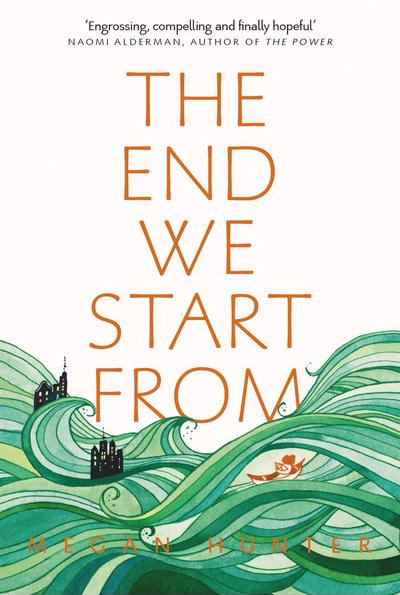
The End We Start From – Megan Hunter (2017) 127 pages
The End We Start From is poet Megan Hunter’s first novel, and she brings a poet’s precision to her longer-form writing. The words on the page are sparse and she knows how to use them to convey maximum meaning and build atmosphere.
The narrator is a young woman who has just given birth. The day her son arrives in the world is the day London disappears in floods, and so the newly-expanded family head north to her in-laws.
“R’s father N will not turn the television off. I stay in the kitchen, the only screenless room, with my smarting pulp on a cushion and the baby mushed against my breast.
R’s mother G will not stop talking. This not-stopping seems to be the first side-effect.
Everything has been unstopped, is rising to the surface.”
Referring to characters just by their initials adds to the general sense of disorientation as the woman adapts to her wholly new life. She views the horrors of what is happening to society at a step removed, aware but also wrapped up in her new baby. This means that while the novella is dystopian, it doesn’t have the relentless quality of some dystopian fiction. Instead it feels quietly unsettling and unnerving.
“It is bad, the news. Bad news as it always was, forever, but worse. More relevant. This is what you don’t want, we realise. What no-one ever wanted: for the news to be relevant.”
There is also a dark humour at moments, in the contrast between their old and new lives.
“He has not researched the best camp. He has not spent hours poring over comparative reviews of refugee camps. He wants none of them.”
The stark style of Hunter’s writing captures the fractured experience in the aftermath of a natural disaster. The reading experience is a series of startling images and arrested sentences that build to effective portrayal of new motherhood in extreme circumstances.
“Whatever I imagine, it is something else.
Where I expect desolation there is the atmosphere of a jumble sale.
Where I envisage welcomes and tea, smiles and Blitz spirit, there is grey concrete, wailing people dragging themselves across the road, photo-boards of the missing.
Our city is here, somewhere, but we are not.
We are all untied, is the thing.
Untethered, floating, drifting, all these things.
And the end. The tether, the re-leash, is not in sight.”
The Reader on the 6.27 – Jean-Paul Didierlaurent (2014, trans. Ros Schwartz 2015) 194 pages
Easily the worst part of my day is my commute. If London rush hour had existed in fourteenth century Italy, I’m sure Dante would have made it one of his circles of hell.
But if Guylain Vignolles was on my morning tube, I’m sure things would be vastly improved. This titular hero is thirty-six years old and lives alone save for a goldfish named Rouget de Lisle V. He finds people difficult and so he has become something of a loner.
“His aim was to be neither good-looking nor ugly, neither fat nor thin. Just a vague shape hovering on the edge of people’s field of vision. To blend into his surroundings until he negated himself, remaining a remote place never visited.”
However, there is one point in his day when he does not blend into his surroundings. On his morning commuter train he reads the passengers excerpts from random books. They are pages he has rescued from his job at a book-pulping plant, a job he hates. Stealing the pages away from under the surveillance cameras of his horrible boss and disturbingly enthusiastic colleague is an act of rebellion, of resistance against the disregard shown to the books and all they contain.
“When the train pulled out of the station and the passengers alighted, an outside observer would have had no trouble noticing how Guylain’s listeners stood out from the rest of the commuters. Their faces did not wear that off-putting mask of indifference. They all had the contented look of an infant that has drunk its fill of milk.”
Despite his odd manner and social reluctance, Guylain does have friends. There is the security guard who only speaks in a very particular poetic style:
“The day he discovered the alexandrine, Yvon Grimbert had fallen head over heels in love. Faithfully serving the twelve-syllable line had become his sole mission on earth.”
There is also his ex-boss, who had a terrible accident at work:
“Giuseppe Carminetti, former chief operator of the TERN treatment and recycling company, ex-alcoholic and ex-biped, was going to do his utmost to recover the books that contained what was left of his pins.”
Yes, you read that correctly. Giuseppe’s legs were pulped along with some books and subsequently turned into paper. He is now fixated on hunting down all the books that were printed on such paper, thereby reclaiming his legs.
You may have realised by now that you need a pretty high tolerance for whimsy when reading The Reader on the 6.27. I have a high threshold and so I really enjoyed this novella. The idiosyncratic characters are still believable, and their relationships touching. The power of the spoken word and of literature in all its forms is comically evoked – particularly when Guylain gets recruited to read at a retirement home – but is still a powerful message.
Guylain’s reading matter changes when he finds a memory stick in his usual seat which contains the diary of Julie. While it’s undoubtedly intrusive that he reads the diary its believable that he is trying to do so in order to return the stick to its owner.
Unlike with whimsy, my tolerance for male protagonists falling in love with objectified female fantasy figures is rock-bottom. For me, Didierlaurent got the balance for this part of the story right, and Julie has strong, authentic female voice.
There’s no sense at any time that this sweet story isn’t going to play out in a truly cockle-warming way so it’s not a surprising read, but then it’s not trying to be. A tale of outsiders who, though they would never realise it, are absolutely charming.
Portrait of the Mother as a Young Woman – Friedrich Christian Delius (2006, trans. Jamie Bulloch 2010) 125 pages
Dear Reader, I’ve been somewhat absent from the blogosphere recently and I’ve really missed it. This was because at the end of March I decided on the spur of the moment to apply for a PhD which caught my eye. I had no plans for further study and so this meant April was spent in whirlwind of desperately trying to get my reading up to date, meeting with old tutors to remind them who on earth I am and begging for a reference, and then writing my application. The deadline is this Friday but I’ve now submitted my application and I’m hoping I might regain my sanity in the meantime. I don’t think I’ll get it, but my tutors have been really supportive and its good to shake things up now and again.
Aaaaaaannnnyway, I really enjoyed blogging on a novella a day in May last year, so I’m throwing myself back into it this year. I had such plans…. NADIM this year was going to be carefully thought through, with a good spread of countries (last year I ignored the southern hemisphere completely and lovely Naomi pointed out I’d also skipped Canada) and a wonderful balance of styles and subjects… yeah, that’s not happening. Instead this month (and I really hope to make it to the end) will be hastily cobbled together posts which completely fail to do the wonderful form of the novella any justice at all. But I still hope I manage to spread some novella love along the way 😊
I thought it apt to start with one from a publishing house that has done so much to champion the form: Peirene Press, who specialise in publishing contemporary European novellas, aimed to be read in one sitting. I’m a big fan of theirs and so I swooped down on Portrait of the Mother as a Young Woman when I saw it in my favourite charity bookshop.
Portrait of the Mother as a Young Woman is set over the course of one afternoon in Rome in 1943. Margherita is 19 years old, pregnant and alone as her husband is serving in the German army in Tunisia. She feels alien in a city where she doesn’t speak the language, and she is walking to a Bach concert at the Lutheran church.
“the immense city of Rome, still seemed to her like
a sea which she had to cross, checked by the fear of all things unknown, of the yawning depths of this city, its double and triple floors and layers, of the many thousand similar columns, towers, domes, facades, ruins and street corners, of endless number of pilgrimage sites for cultured visitors, which she walked past in ignorance, and of the faces of people in the streets, which were difficult to make out, in these stormy times of a far-off war which was drawing nearer every day”
And now, bear with me as I break something to you which you may have gathered from the quote above, which sounds awful but I promise it isn’t: the entire novella is one sentence. Wait, come back! It’s ok, really. Trust me 😉
There are paragraphs which make the whole thing easier, and Delius, possibly because he is a poet, has a great ear for rhythm. This means the sentence, broken by commas, works well in capturing the sense of someone walking, their thoughts falling into the pattern of their steps. I thought it was really effective and such an impressive feat of translation by Jamie Bulloch too.
“for two months she had crossed the Tiber almost every day via the Ponte Margherita, as if that were totally normal, but nothing was totally normal, especially not in these times, each day was a gift, each of the child’s movements in her belly a gift, each verse from the Bible and each glance across the Tiber”
Throughout her journey across the city, we learn about Margherita’s life in Germany and her new marriage. She is religious – daughter of and wife to clergymen – but not given to much reflection, preferring to stay silent in political discussions. Her husband and father are somewhat sceptical of the Reich, but Hitler has been in power throughout Margherita’s childhood and adolescence, she was part of the League of German Girls and it is only now, away from home, that she finds herself beginning to feel confused.
“On her own she could not work out what you were allowed and not allowed to say, what you should think and what you ought not to think, and how to cope with her ambivalent feelings”
Even though nothing of great note happens in the course of the novel, there is still an effective and believable character arc. Cut adrift, Margherita is beginning to learn who she is. There is a sense that this naïve, unquestioning woman is potentially quite steely, and as readers we know she will need that in the months and years to come.
“She sensed something within her rebelling against the constant obligation to stifle the feeling of longing with her reason and her faith, because feelings were forbidden in wartime, you were not allowed to rejoice with happiness, you had to swallow your sadness, and like a soldier you were forced to conceal the language of the heart”
If only traditional Welsh wisdom would reach current leaders, who seem determined to build walls both literal and metaphorical rather than bridges at the moment… *sigh*
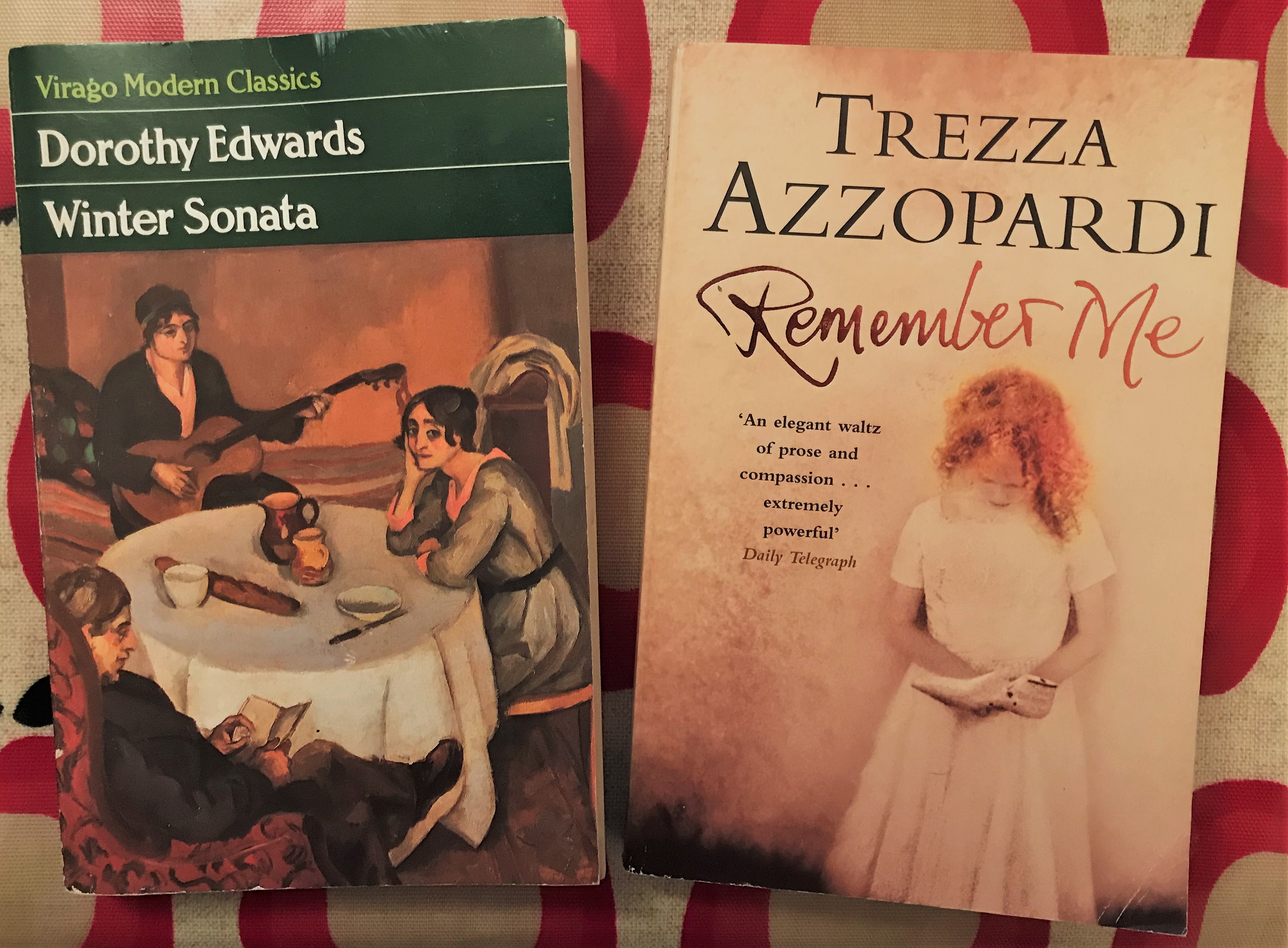
Firstly, Winter Sonata by Dorothy Edwards (1928), who was born in Glamorgan in 1903. This was her only novel after she tragically died by suicide when she was 31, six years after its publication.
Arnold Nettle is a shy man and in frail health. He moves to a village where his family own the Post Office, to work there and recuperate.
“Every evening at six o’clock Arnold Nettle used to come home from the post-office and walk slowly along to his lodgings. The sun was setting and it would disappear behind the black feathery branches of the trees, leaving streaks of red in the grey sky. He went in and had his tea, and then he usually sat reading by the fire or practising a bit on his cello. Sometimes, of course, he sat simply looking into the fire, and it seemed he was a little nervous even in his own society, because often he would blush and smile shyly to himself. At ten o’clock he would put his book and his cello back in their places and fasten the window and go to bed.”
So, a simple life conveyed in a simple style. I wasn’t sure about this style at first, whether it was deliberate to convey Arnold’s thought processes and deliberately quiet life, or whether it was the inexperience of the writer. It worked well for Arnold, and it did change slightly when the story focussed on other characters. Arnold is asked by a local family to play his cello for them; Olivia and Eleanor live with their aunt, Mrs Curle, and her son George. Arnold is very much taken with Olivia.
“Olivia smiled at him too and made him sit down, He still kept the gloves firmly in his hands, but he sat down smiling at them all and asked in a comparatively loud voice, ‘Where is your cat?’ and since this was the first quite independent remark he had ever made in that house, it almost gave the rather absurd impression that he had this evening come there especially to see the cat.”
The story follows these young people and also Mr Premiss, a self-focussed cad who is friends with George, and Pauline, Arnold’s landlady’s daughter. Very little happens so this is not the novel for you if you like a strong plot, but I thought it worked effectively in capturing people and a place at a moment in time, over the course of one winter.
Ultimately though I decided the naïve style was due to Dorothy Edwards’ inexperience as a writer. There are far too many occasions on which Olivia’s eyes are described as sad, her sister’s as blue. This description is not always out of place:
“Olivia looked about her with her large, rather childlike but sad eyes. Her happy mood had gone in some way; she did not feel so full of energy. There is something, too, rather unpleasant about winter; it is cold and frozen and nothing seems to move, and yet there is no sense of rest anywhere.”
Yet far too frequent. But what really stopped me loving this novel was a feeling of detachment from the characters. For me as a reader, I don’t need to like the characters but I do need to feel involved with them in some way. Again, this may have been a stylistic choice – Olivia seems depressed, Arnold is alienated, and so creating this feeling in the reader helps capture the feelings of the characters:
“At supper he was very careful to listen to the conversation and not to get lost in his own thoughts. But even then he listened, and even took part in it, almost as though he were dreaming it all. They sat around the table like stars, and when they spoke their voices seemed to come to him from far away”
I only write about books I would recommend, and I would recommend Winter Sonata, but with some reservations. I found it an interesting novel with some beautiful writing but also a bit unsatisfying. I’ve definitely not done it justice here and in capturing a quiet desperation within ordinary lives it is restrained and accomplished. What I am sure of is that Dorothy Edwards was a talented writer and may have just been finding her feet with this. I’d certainly like to read Rhapsody, her collection of short stories. Had she lived and carried on writing, I think she could have been really successful.
Secondly, Remember Me by Trezza Azzopardi (2004) who was born in Cardiff and based the main character of this novel, Winnie, on Nora Brindle, a woman who lived on the streets of Cardiff.
“There was a panicky sort of wind about, swirling everything up from the gutter and blowing dirt in your face. Eyes full of grit; with my case and the bin liner…I was wearing my silver coat with the plastic bag in the inside pocket, and the shoes I’d got from the Salvation Army the week before. I had my case with me. I always took my case.”
Winnie is homeless but shelters in an abandoned shop that she has some previous connection to, along with some young homeless boys. They move on and she is on her own when a young woman breaks in a steals her case. Her pursuit of her things leads Winnie to remember the past, and Azzopardi moves seamlessly back and forth across time.
Winnie has been considered odd since she was a child. Her mother seems to suffer from depression, although in the first half of the twentieth century it isn’t called that. All young Winnie knows is that her frail mother is wasting away in bed, and like Winnie, she communes with the dead.
“I avoided cracks in the pavement, I crossed my fingers and touched wood, and at night, I prayed. Despite everything, the ghosts took their fill. Each day a little more of my mother was stolen. In no time at all, her eyes went hard as jet; her hair, brittle as spun sugar.”
We follow Winnie through her life: evacuation during the war, bullying at school, falling in love. She lives with her grandfather after her mother dies and her father tries to keep Winnie’s memories of her alive:
“A handkerchief, a ribbon, a heart-shaped locket sprinkled with rust; these are objects, artefacts, proof of life. I balance his memories, all the same, storing them on top of mine, carefully leaning one against the other like a stack of playing cards. I am building a tower without bells. Later I will bring it all down, in an earthquake of my own.”
What we witness is that time and again Winnie is used by people. Azzopardi shows with a deft touch how society will judge Winnie – homeless, unloved, likely mentally ill – harshly, although she has never been vindictive or deliberately tried to hurt anyone. Meanwhile those who use her – usually male, employed, solvent – get away with it.
Remember Me isn’t remotely sentimental and Winnie never asks for pity. She is an unreliable narrator, but then everyone would be an unreliable narrator of their own life – how can it possibly be seen with any objectivity?
“Who cares about an old woman and a few bits of tat? No one, that’s who, no one on the world.”
Winnie’s life is hard, and unfair, and yet her resilience and a message of hope endures to the very end.
Following Winnie’s lead, here is a memory of my own: when I was a student in the 90s, there was the Cool Cymru music explosion, with the chart success of bands like Manic Street Preachers, Super Furry Animals, and The Stereophonics amongst many others. When Catatonia appeared on Top of the Pops to perform Mulder and Scully in 1998, I think it was the first time I’d heard an English-language pop song sung in a Welsh accent (I’m not counting Bonnie Tyler because I think she didn’t mean for her accent to slip through), much to the pleasure of my Welsh housemate at the time. Here is their lead singer Cerys Matthews performing a traditional Welsh folk song: