“Middle age is when your age starts to show around your middle.” (Bob Hope)

This post is my contribution to the 1938 Club, hosted by Kaggsy’s Bookish Ramblings and Stuck in a Book – do join in! As I rooted through my enormous TBR for books published in this year, I was astonished by the number I owned published in 1937 and 1939 – despairing, I turned to my Persephone pile and found two, hooray! So although it was scary biscuits there for a while, it all came up ticketty-boo in the end…and I promise that’s the last dubious 1930s slang you’ll hear from me 🙂

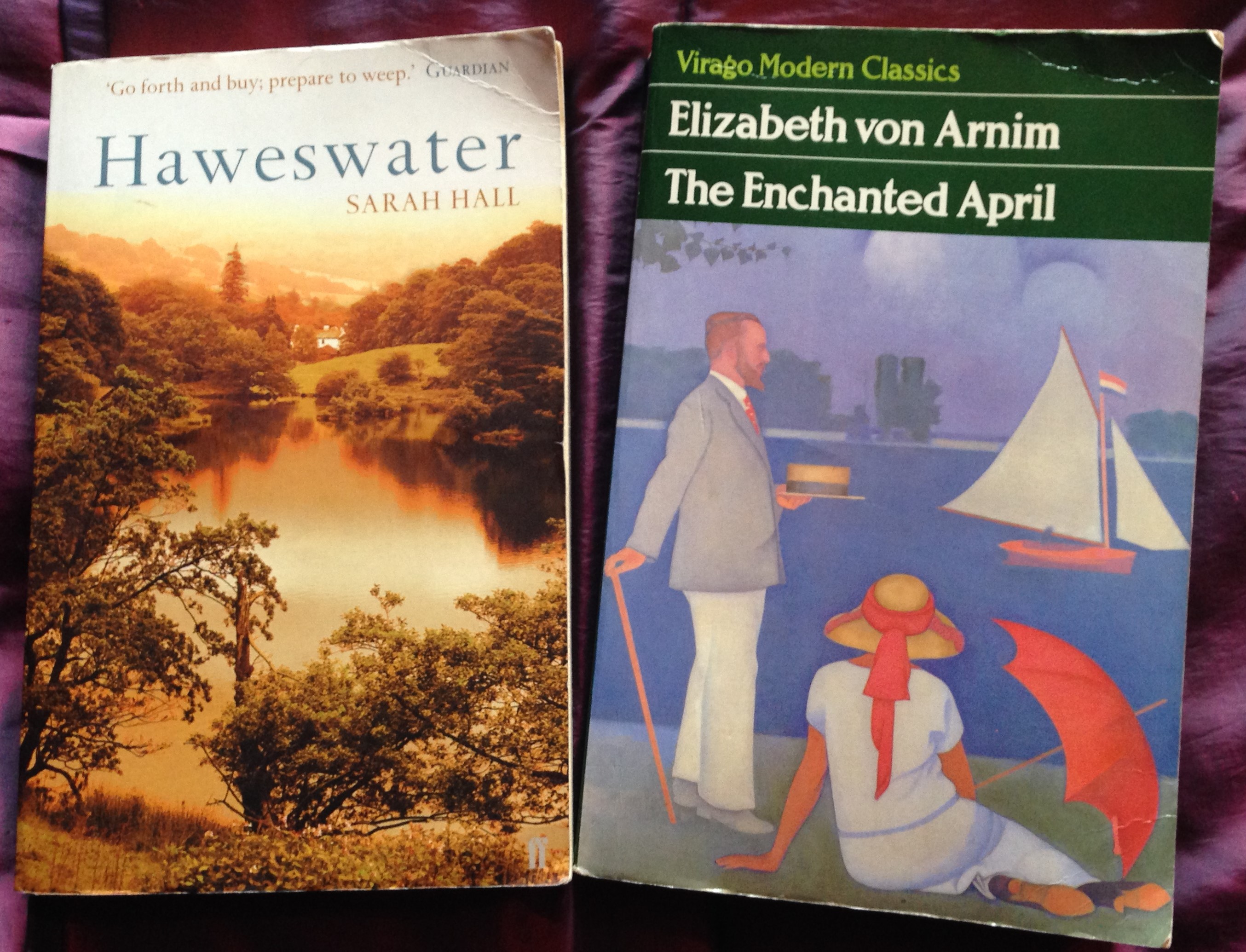
As it turned out, the two novels were linked thematically too: both are comic portraits of middle-aged women rediscovering themselves and proving that life can still hold surprises. Both were an absolute joy, so thank you Karen and Simon, for moving these to the top of the TBR and bringing them into my life that bit sooner!

the-1938-club

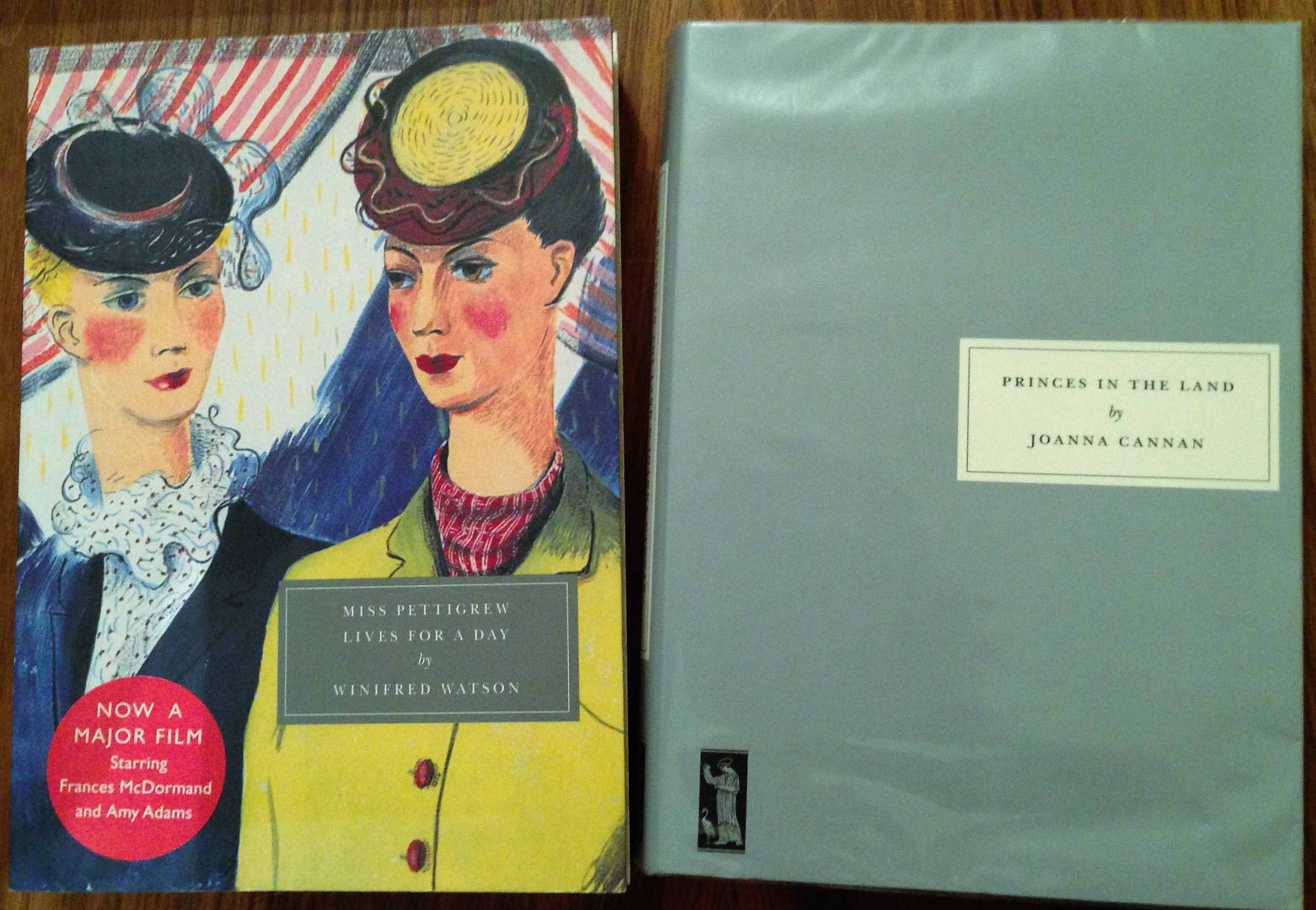
Firstly, Princes in the Land by Joanna Cannan. Patricia is a wild, horse-loving redhead, part of the landed gentry but determinedly not a debutante, not wanting to marry someone like her sister’s choice:

“Victor, a pink young man with china-blue eyes and hair as golden as Angela’s, who could and did express all life was to him and all his reactions to it in two simple sentences, ‘Hellish, eh?’ and ‘Ripping, what?’”

Patricia falls for Hugh, a middle-class scholar who offends her mother’s upper-class sensibilities:

“‘it’s the small things that jar – cruets and asparagus servers and ferns..’

‘Patricia,’ said Lord Waveney winking at his grand-daughter, ‘isn’t such a fine piece of porcelain that she can’t stand a jar. If I were a woman, I’d sooner my husband kept a cruet than a mistress. Damn it, I’d sooner he helped himself to asparagus with servers than whisky without discretion.’”

Patricia marries Hugh and as they both change over the years she ends up feeling vaguely disappointed; he is preoccupied professor, she has compromised who she was out of all existence. They have three children and as they grow older Patricia wonders what is left of her life:

“I’ve just got to grow old and feeble and ugly. And what then? She asked, passing the marmalade factory, diving under the bridge, fleeing on between lighted dolls’-houses, and answered herself: some foul disease- a paralytic stroke and your face all sideways, or cancer and your last words on earth a howl for morphia”

I realise this may sound resolutely depressing but it really isn’t. Princes in the Land is written with a light touch and is filled with witty observations. Cannan laughs at human foibles but does so with affection. Patricia soon cheers herself with the thought of her children, the fact that she is:

“Mrs Lindsay with a charming house and three nice children, one going into the Army, one not sure yet but perhaps publishing, one still too young to know but almost certain to do something with horses”

One by one, her children break the news to her that actually, they do not have the remotest inclination to follow the paths she has imagined for them. Patricia is a nice person, she is sensible and she loves her children, and so she steps back to let them make their own choices and mistakes. It means however, that she is not fulfilled through them, and so she is thrown back to thinking about what on earth she is going to do with the rest of her life:

“The kingdoms she had won for them they had rejected. August with his shiny black bag and his bowler hat, his two pounds a week and his gimcrack villa; Giles dispensing God as a remedy for discontent, boredom or sex repression; Nicola without an idea in her head beyond combustion engines – these weren’t the children for whom she’d given up fun and friendship, worked, suffered, worried, taken thought, taken care, done without, supressed, surrendered and seen her young self die.”

I hope it’s not too much of a SPOILER to say she works something out – the tone of the novel means I remained hopeful that she would, and it would have been a real shock if a depressing, bleak outcome had won. Princes in the Land is just lovely, and truly moving: I don’t think anyone on the bus noticed me having a little cry as I reached the end…

IMG_0696

Secondly, Miss Pettigrew Lives for a Day by Winifred Watson. Unlike Princes in the Land, Miss Pettigrew is all light and very little shade, but that is not a criticism. It’s a joyous novel: a day in the life of the titular poverty-stricken spinster, a woman society has written-off as having nothing to offer, whose willingness to embrace new experiences sees her reborn.

In desperate need of a job, Miss Pettigrew arrives at the apartment of the glamourous Delysia La Fosse:

“In a dull, miserable existence her one wild extravagance was her weekly orgy at the cinema, where for over two hours she lived in an enchanted world peopled by beautiful women, handsome heroes, fascinating villains, charming employers, and there were no bullying parents, no appalling offspring, to tease, torment, terrify and harry her every waking hour. In real life she had never seen any woman arrive to breakfast in a silk, satin and lace negligee. Every one did on the films. To see one of these lovely visions in the flesh was almost more than she could believe.”

Miss La Fosse has lots of experience but little common sense, Miss Pettigrew has no experience but much common sense. As she gets swept up in Miss La Fosse’s complicated love life, this virtue means she soon becomes indispensable. Rather than sitting in judgement of this Bright Young Thing, Miss Pettigrew finds herself enjoying this foray into a life hitherto unknown.

“ ‘Do you know what that is?’

‘It looks,’ said Miss Pettigrew cautiously, ‘very much like a Beecham’s Powder. Very good, I understand, for nerves, stomach and rheumatism.’

‘That’s cocaine,’ said Miss LaFosse.

‘Oh no! No!’

Terrified, aghast, thrilled, Miss Pettigrew stared at the innocent-looking powder. Drugs, the White Slave Traffic, wicked dives of iniquity, typified in Miss Pettigrew’s mind by the red plush and gilt and men with sinister black moustaches roamed in wild array through her mind. What dangerous den of vice had she discovered? She must fly before she lost her virtue. Then her common sense unhappily reminded her that no one, now, would care to deprive her of that possession.”

As the day progresses Miss Pettigrew dives headlong into events and finds herself forever changed.  This is a novel to read when you need a lift, to be carried along as Miss Pettigrew is on a wave of fun and silliness. It is also a reminder that to open yourself to the unknown is to allow space for hope, and for change, at any time in life.

“She didn’t care what happened. She was ready for it. She was intoxicated with joy again. Past questioning anything that happened on this amazing day.”

I haven’t seen the film of Miss Pettigrew but I definitely plan to – Frances McDormand, wonder of wonders:

“Students, eh? Love ’em or hate ’em, you can’t hit them with a shovel!” (Terry Pratchett, Making Money)

Despite being woefully slow in my blogging, I’ve managed a second post for Reading Ireland Month hosted by Cathy at 746 books and Niall at Raging Fluff. Sláinte!

ireland-month

I’ve picked two novels linked by undergraduate protagonists – one a classic of Irish literature which is on Cathy’s 100 Irish Novels list, the other a little-known first novel by an author who has gone on to huge success.

Firstly, the classic At Swim-Two-Birds by Flann O’Brien (1939). The unnamed narrator is in many ways a typical student:

“Whether in or out, I always kept the door of my bedroom locked. This made my movements a matter of some secrecy and enabled me to spend an inclement day in bed without disturbing my uncle’s assumption that I had gone to the College to attend to my studies.  A contemplative life has always been suitable to my disposition.”

His dissolution is perhaps a bit more extreme than most students however:

“It was in the New Year, in February, I think, that I discovered my person was verminous.”

Yuck. Gradually clues emerge that this student may be more literate than he first appears, such as how he describes his friend offering to buy him a drink:

“I rejoined that if his finances warranted such generosity, I would raise no objection, but that I (for my part) was no Rockefeller, thus utilising a figure of speech to convey the poverty of my circumstances.

Name of figure of speech: Synedoche (or Autonomasia)

The three of us walked slowly down to Grogan’s…”

The splintering of the narrative with the definition also hints at what is to come, as soon the story begins to be invaded by other stories the student is writing: about a devil Pooka and a fairy in his pocket; about Furriskey, born a fully grown man; a Western; versions of Irish folklore.  All the narratives start to reflect and echo each other, eventually they overlap and boundaries break down.  In other words, this is classic modernist brilliance, layering up myth and meta-narratives to create something astonishing. If you want to read Ulysses but you’re not sure you’re up to the task, At Swim-Two-Birds could be a good gateway novel 🙂 As Dylan Thomas said:

“This is just the book to give your sister if she’s a loud, dirty, boozy girl.”

In other words, if she’s a student.

Secondly, Stir Fry by Emma Donoghue (1994), who would go on to have enormous success with Room sixteen years later. This is the sort of first novel that doesn’t seem to be published as much now – perfectly decent efforts of thinly disguised biography whereby an author gets to grip with their craft. I’ve no actual facts to back up my theory, but it seems that while more and more books are published, first novels now have to have a huge wow factor – not necessarily a bad thing, but there’s an awful lot of truly dreadful writing being published because it will make money, while these better written but modest efforts flounder. I hope potentially good novelists are not being put off: hang in there budding writers!

Anyway, back to Stir Fry. Maria is seventeen and leaves her rural home to start university in Dublin.

“Dirty blue clouds were scudding over slate roofs. A good cold smell in the air and the whiff of turf smoke as she turned the corner made her think of home. The dusk lasted much longer in the country; nothing to get in the way she supposed. In Dublin there was only half an hour of grey, then the street lamps blinked on and all the shoppers hustled home in the dark.”

She is remarkably naïve, even given her young age, and takes forever to realise that her two flatmates are in a same-sex relationship:

“Now suddenly here were two friends of hers kissing on the table she ate at every night. Rapt faces and library books and garlic, how bizarre.”

She considers moving out, which may seem ridiculous, but Maria’s world sees discussions like this occur in all earnestness:

“‘Look, they’re both very nice. And they wear skirts sometimes too.’

‘Oh, I know,’ said Yvonne wisely, ‘but they’d have to, wouldn’t they, as cover?’”

What follows is a sweet story of Maria coming to realise who she is and what she wants. The characters are all very believable and they and Dublin are drawn with real affection. Stir Fry is a quick read, a bildungsroman in which nothing and everything happens. It doesn’t contain the brilliance Donoghue displayed with Room, but it still made me think it’s a pity we don’t see these types of first novels much anymore.

To end, an Irish band that first came to prominence when I was student – this song was played at many a sticky-floored student club back in my day:

“Being Irish, I always had this love of words.” (Kenneth Branagh)

Happy St Patrick’s Day! To celebrate this day, and to participate in Reading Ireland Month hosted by Cathy at 746 books and Niall at Raging Fluff , I’ve picked one novel from my TBR mountain which was also on Cathy’s 100 Irish Novels list and a poem by one of my favourite contemporary Irish poets . This will also be one more stop on my Around the World in 80 Books Reading Challenge, hosted by Hard Book Habit.

ireland-month

Firstly, The Sea, The Sea by Iris Murdoch which won the Booker in 1978. This was recommended to me by my sixth form English tutor, which means it’s been on my TBR for *cough* 20 years *cough*.  Oh dear. I got there eventually.  Charles Arrowby, theatre director, decides to retire to the coast:

“The sea is golden, speckled with white points of light, lapping with a sort of mechanical self-satisfaction under a pale green sky. How huge it is, how empty, this great space for which I have been longing all my life.”

Arrowby is vain, arrogant, solipsistic, self-aggrandizing… He views himself as some sort of Prospero figure:

But of course he isn’t a magician, he has no more power than anyone else.  The titular force of nature that surrounds him acts as a reminder of this, indifferent and formidable.

 “the sea was a glassy slightly heaving plain, moving slowly past me, and as if it were shrugging reflectively as it absent-mindedly supported its devotee”

It isn’t long before his self-induced exile starts to unravel. He starts to have hallucinations about sea monsters and within this unstable psychology is the constant background obsession with his teenage love, Hartley. By odd coincidence, she now lives in the same village with her husband, and all of Arrowby’s delusions become focused on her, as he is unable to conceive of anything that won’t fit in with his own needs:

 “I reviewed the evidence and I had very little doubt about what it pointed to. Hartley loved me and had long regretted losing me. How could she not?”

The Sea, The Sea is an extremely clever novel, carefully balancing Arrowby’s delusions on a precipice between comedy and terror:

“ ‘There’s an eternal bond between us, you know there is, it’s the clearest thing in the world, clearer than Jesus. I want you to be my wife at last, I want you to rest in me. I want to look out for you forever, until I drop dead.’

‘I wish I could drop dead.’

‘Oh shut up –‘ “

I was never sure which way it would go, how violently it would all unravel, or whether it would resolve in a subdued, sad way. Arrowby’s quiet, introspective (possible spy) cousin is the voice of reason, resolutely ignored:

“You’ve built a cage of needs and installed her in an empty space in the middle. The strong feelings are all around her – vanity, jealousy, revenge, your love for your youth – they aren’t focused on her, they don’t touch her. She seems to be their prisoner, but really you don’t harm her at all. You are using her image, a doll, a simulacrum, it’s an exorcism.”

The Sea, The Sea is a novel that tackles major themes: the nature of love, the meanings we attach to our lives, how we decide what is real when we can only view from our own perspective, how we recognise what really matters. Arrowby’s narcissism is contemptible, but the skill of Murdoch’s writing shows him as an everyman (despite his belief in his own extraordinariness) and places us in a position where to judge him harshly is to judge ourselves:

“Time, like the sea, unties all knots.  Judgements on people are never final, they emerge from summings up which at once suggest the need for reconsideration. Human arrangements are nothing but loose ends and hazy reckoning, whatever art may pretend in order to console us.”

Secondly, Why Brownlee Left by Paul Muldoon, the titular poem from his 1980 collection.  Muldoon’s poems can be difficult to comprehend and contain head-scratchingly obscure references, but he is also humorous and playful, and takes such clear joy in language that I think any new collection from him is cause for excitement. The poem I’ve chosen is one of his most accessible but still leaves plenty of space for the reader to decide on meaning; it contains Muldoon’s gentle humour, and it’s all tied together with expert use of rhythm and echoing half-rhyme – I hope you like it 🙂

Why Brownlee left, and where he went,

Is a mystery even now.

For if a man should have been content

It was him; two acres of barley,

One of potatoes, four bullocks,

A milker, a slated farmhouse.

He was last seen going out to plough

On a March morning, bright and early.


By noon Brownlee was famous;

They had found all abandoned, with

The last rig unbroken, his pair of black

Horses, like man and wife,

Shifting their weight from foot to

Foot, and gazing into the future.

Do join in with Reading Ireland month aka the Begorrathon, and if you’re not a Luddite like me you can also check out their Facebook page 🙂

To end, as I read a review of a new Phil Lynott biography over the weekend, here are Thin Lizzy singing their version of a traditional Irish song:

“Mothers are all slightly insane.” (JD Salinger)

You’re not wrong, JD. Mine is in definite box-of-frogs territory. It’s the thing I like most about her. I’ve been extraordinarily lucky, but a relationship such as ours will never be immortalised in literature given that we get on well and it would be inexorably dull. So for mother’s day (which it is today in the UK) I’m looking at two portrayals of mothers that are nothing like my own but which make for great reads. This post is dedicated not only to my own mother, but also to my sister-in-law, for whom today is her first mother’s day as a mother 🙂

My first literary mother is Mrs Ramsay from To the Lighthouse by Virginia Woolf. I chose this because Virginia Woolf is one of my mother’s favourite writers, and like the homebrew peach schnapps I once allowed past my lips, I deeply regret this now. How on earth do you write about anything by Virginia Woolf? Her writing is so rich, so multi-layered, so dense and yet so subtle that I don’t feel adequate to the task – which I’m sure the following discussion will prove beyond a doubt 😉

In To the Lighthouse, the Ramsay family descend on their holiday home in the Isle of Skye. Woolf’s stream-of-consciousness technique is perfect at capturing everything that occurs beneath the surface of an ordinary day, the deep significance below the seemingly insignificant:

“the monotonous fall of the waves on the beach, which for the most part beat a measured and soothing tattoo on her thoughts and seemed consolingly to repeat over and over again as she sat with the children the words of some old cradle song, murmured by nature, ‘I am guarding you – I am your support’, but at other times suddenly and unexpectedly, especially when her mind raised itself slightly from the task in hand, had no such kindly meaning, but like a ghostly roll of drums remorselessly beat the measure of life, made one think of the destruction of the island and its engulfment in the sea and warned her whose day had slipped past in one quick doing after another that it was all as ephemeral as a rainbow – this sound which had been obscured and concealed under the other sounds suddenly thundered hollow in her ears and made her look up with an impulse of terror.”

Mrs Ramsay is a nurturing and dedicated mother but here Woolf exposes the fractures that threaten a seemingly harmonious exterior.  I think this passage is just brilliant – the setting up of the monotonous background noise that lulls yet twists in a moment, the mind rebelling against the self, the pure terror that we can be overwhelmed by our own feelings – all while domesticity continues undisturbed.

The family are surrounded by Mrs Ramsay’s nuturing love and the sea, and as the passage  above shows, these are bound together in their constancy being mistaken for predictability. To the Lighthouse uses water imagery to great effect, the sustaining essence that can imperil and kill:

“how life, from being made up of little separate incidents which one lived one by one, became curled and whole like a wave which bore one up with it and threw one down with it, there, with a dash on the beach”

This is my experience of reading Woolf: small incidents, layered up into writing of such power that you surface from her novels feeling dashed by a powerful force.

If you’d like to read some proper reviews of this wonderful novel, there have been insightful and interesting posts written lately by bloggers including Lady Fancifull and Simon at Stuck in a Book. If you’d like to know more about the man Mrs Ramsay married, a man given to views such as: “He wondered if she understood what she was reading. Probably not, he thought. She was astonishingly beautiful.” Sarah has written a typically witty and entertaining post over at Hard Book Habit.

Secondly, The Blue Room by Norwegian author Hanne Orstavik (trans. Deborah Dawkin) one more stop on my Around the World in 80 Books Reading Challenge, hosted by Hard Book Habit. I can’t remember which blogger made me aware of this so if it was you please leave a comment! Peirene Press publish contemporary European novellas, and group them in sets of three, linked by theme. The Blue Room is part of the Coming-of-Age series, and concerns Johanne’s intense relationship with her mother; they live together while Johanne trains to be a psychologist. Her career choice is deeply ironic, given that she has no insight into the manipulative, controlling behaviour her mother directs towards her, or her own victimhood.

“She’s right, I thought, we belong together like two clasped hands.”

Well, two clasped hands can be affectionate, reassuring, but also restraining and restrictive. The novel takes place over the course of a day, when Johanne was due to leave to spend six weeks in the States with her boyfriend, yet wakes to find herself locked in the titular space and unable to leave. As she thinks back over recent events, relationships with her mother, boyfriend and God emerge and the reader is left to piece together what is going on beyond what Johanne doesn’t say. She is an unreliable narrator of her own life as we all are, because her perspective is limited by what she cannot see.

Her mother is deeply controlling and Johanne has the victim’s hypersensitivity to her abuser’s every need and whim. At no point does she articulate that it is her mother who has locked her in, unwilling to let her leave.

“Perhaps I’m locked in here as part of an experiment. Perhaps somebody’s pumping gases in and changing my consciousness.”

Johanne’s sexual fantasies abruptly break into the narrative, filled with violence,  with herself as the dominated party in BDSM scenarios. Again, despite her training, she cannot see how this is bound up in her relationship with her mother:

“And what exactly, I asked, is the meaning of this pain? Don’t we grow when we’re happy? Mum looked at me: she seemed angry and said nothing.”

Johanne is young and naïve, lacking insight, both sweet and shocking. The Blue Room is a powerful novella about our closest relationships and how they influence us in ways we barely comprehend.

To end, a little treat for my mother and any other LDP fans out there – enjoy!

“I have no patience with the modern neurotic girl who jazzes from morning to night, smokes like a chimney, and uses language which would make a Billingsgate fishwoman blush!” (Agatha Christie, The Murder on the Links)

You might be able to tell from my gravatar that my hair was worn in a very short pixie crop. I decided to grow it into a bob, and it’s taking approximately eleventy billion years to get there. The result of this is that despite my love of all things art deco, and indiscriminate detective show watching, I cannot watch Miss Fisher’s Murder Mysteries due to serious hair envy.

Thank goodness Poirot is bald. And I don’t mind the fact that his moustache is (marginally) better than mine. So for now my experience of a fictionalised 1920s needs to be limited to novels where I can pretend that all the women have crew cuts.

Firstly, The Paying Guests by Sarah Waters. I don’t read many thriller-type novels, and Waters wouldn’t wholly fall into this category, but she can certainly write a page-turner and I find myself reading compulsively to reach the end as soon as possible. Set in 1922, The Paying Guests is set amongst the hardships and fallout of World War I.  Frances Wray and her mother live in the mildly oppressive south London suburbs, grieving the loss of Frances’ brother in the trenches and the subsequent death of her father, which has resulted in the need for them to take in paying guests (Mrs Wray’s suburban sensibilities baulk at the term ‘lodgers’). Frances had been a suffragette and in a loving relationship with another woman before the war, but had given up both to support her mother, and live a kind of half-life:

“She was young, fit, healthy. She had – what did she have? Little pleasures like this. Little successes in the kitchen. The cigarette at the end of the day. Cinema with her mother on a Wednesday. Regular trips into Town. There were spells of restlessness now and again; but any life had those. There were longings, there were desires…”

The paying guests arrive in the form of Mr and Mrs Barber, and Frances is drawn towards the colourful and artistic Lilian:

“And that was all it took. They smiled at each other across the table, and some sort of shift occurred between them. There was a quickening, a livening – Frances could think of nothing to compare it with save some culinary process. It was like the white of an egg growing pearly in hot water, a milk sauce thickening in the pan. It was as subtle yet as tangible as that.”

Frances and Lilian begin an affair, and the brilliance of Waters’ writing means this is set within meticulous – but never overwhelming – period detail, and is simultaneously erotic and yet with a sense of foreboding that draws you onwards:

“Only when Frances’s lips began to travel to her knuckles did she draw one of her hands free – the left hand, the one with the rings on it. She set it down to steady herself against Frances’s embrace and there was the muted tap of her wedding band, a small, chill sound in the darkness.”

I won’t say much more for fear of spoilers, except that The Paying Guests is Waters at the height of her powers, achieving a compulsive plot-driven story that is also humane and moving:

“Making her way back to the yard, looking again at the rosily lighted windows of her own and her neighbours’ houses, she had the stifling sensation that she was putting herself beyond the reach of those warm, ordinary rooms, cutting herself off forever from all that was decent and calm.”

Secondly, Carter Beats the Devil by Glen David Gold. A fictional biography of Charles Carter, golden-age stage magician, Gold’s first novel follows Carter from his childhood discovery of his vocation, through his apprenticeship in seedy sideshows, to his zenith performing the titular spectacle.

“The rarest need in life is the one met suddenly and completely. This is how it was with Charles Carter and the art of magic.”

For much of the novel, Carter is in existential crisis (not as tedious at it sounds) having lost the love of his life. There’s also the small matter of being pursued by the Secret Service who suspect him of having killed President Harding and having an arch nemesis lurking in the background, waiting to strike. The 1920s setting is perfect, perched as it is on the cusp of a new world – technology is growing apace and the old theatre traditions are dying out, while the aftermath of the war adds an extra dimension to the audiences’ need for magic:

“Six nights a week, sometimes twice a night, Carter gave the illusion of cheating death. The great irony, in his eyes, was that he did not wish to cheat it. He spent the occasional hour imagining himself facedown in eternity. Since the war, he had learned how to recognise a whole class of comrades, men who had seen too much: even at parties, they had a certain hollowing around the eyes, as if a glance in the mirror would show them only a fool having a good time. The most telling trait was the attempted smile, a smile aware of being borrowed.”

As with magicians, Gold’s art is visual, he creates such vivid scenes that this was one of those novels that I could clearly see being filmed. Although a chunky novel, it doesn’t flag and, like Carter’s show, builds to a satisfying denouement.

Carter Beats the Devil is about the illusions we accept, those we refute, the role of marvel in our lives, and when to take the leap and abandon the need to know how it all works.

“Faith was a choice. So, it followed was wonder.”

To end, the most tickety-boo, spiffingest flapper of them all, the divine Josephine Baker, who truly is the cat’s meow:

“The inspector sat down on a stair, fired up a cigarette, and entered an immobility contest with a lizard.” (The Snack Thief, Andrea Camilleri)

Reader, I’ve been abandoned by a man.  He just left, with no word of when he will return and how I miss him.  He’s gorgeous, he lives in a place of outstanding beauty, he shares my food obsession and always brings the sunshine with him.

Always a sucker for the BBC4 Saturday night foreign detective dramas, I am deeply traumatised by the ending of Young Montalbano, whose Sicilian sunshine was no end of help in getting me through these grey February days.  The deli across the road sells great arancini but carb-loading on the Inspector’s favourite food is not quite compensating for my loss.

The BBC tried to make up for the series ending by screening an interview with the author of the Montalbano books, 88 year -old Andrea Camilleri. The man is charm personified so if you have a chance to watch this interview in the next few weeks I definitely recommend it.  In the opening scene Camilleri pays tribute to Spanish crime writer Manuel Vazquez Montalban, after whom he named his creation.  So off I trot to Barcelona in the company of Pepe Carvalho, Montalban’s private detective, in the hope that Spanish sunshine will help keep my vicarious vitamin D levels up. For this post I’ve paired it with another Spanish crime novel, The Invisible Guardian by Dolores Redondo (tr. Isabelle Kaufeler), which I was delighted to win in a giveaway on Elena’s lovely blog, Books and Reviews.  Do head over to B&R for Elena’s insightful review of The Invisible Guardian and interview with the author. These two books are also one more stop on my Around the World in 80 Books Reading Challenge, hosted by Hard Book Habit.

In Tattoo (tr. Nick Caistor), Pepe Carvalho “an ex-cop, an ex-Marxist and a gourmet” is hired by a local hairdresser to identify a body that has been pulled out of the sea, badly disfigured but with the legend “Born to Raise Hell in Hell” tattooed on his back.  It’s a shame Montalban has died, because a cross-over novel penned by him and Camilleri would have been something to behold; their two protagonists are so similar that they’d either become bosom buddies or detest each other on sight:

“Strolling aimlessly around the market was one of the few ways that this tall, dark-haired man in his thirties, who somehow contrived to look slightly dishevelled despite wearing expensive suits from tailors in the smartest part of town, allowed himself some spiritual relaxation whenever he left Charo’s neighbourhood and headed back to his lair on the slopes of the mountain overlooking Barcelona.”

Carvalho’s investigation takes him from Barcelona to Amsterdam where he becomes embroiled in the drugs trade, gets badly beaten, and engages sex workers as informers. He is tough and cynical and in that sense very much in the line of familiar hard-boiled detectives, but Montalban has self-referential fun with this:

 “Carvalho did not want to seem too smart, or behave like a Chandler character facing a stupid, brutal LAPD cop.” 

This is Tattoo’s main appeal for me – a European sensibility brought to a Chandler-esque tale. I wasn’t keen on the violence towards women, particularly when one of them sleeps with Carvalho straight afterwards, but Montalban redeems himself slightly by having sex worker who is strong, independent, and not punished by rape and/or being killed off, which I didn’t entirely expect for a novel written in the 1970s. The tale is told with dry humour through some remarkable images: “the man had the mental recall of a great masturbator”. Quite.

This is the second Carvalho mystery and I didn’t feel I had to have read the first. Apparently the series becomes more politically engaged as it goes along, the ‘ex-Marxist’ element of the detective satirising Spanish politics, which is an interesting turn to take – for this reason I definitely plan on spending more time in Pepe’s company.

From Barcelona to Basque country, and The Invisible Guardian by Dolores Redondo. I am not a big reader of contemporary crime fiction, but I was intrigued by Elena’s review, which described how the Basque setting of Elizondo brought its own unique atmosphere to the novel:

“The Baztan forest is enchanting, with a serene, ancient beauty that effortlessly brings out people’s most human side; a childlike part of them that believes in fairies with webbed ducks’ feet that used to live in the forest… Amaia felt the presence of such beings in that forest so tangibly that it seemed easy to believe in a druid culture, the power of trees over men, and to imagine a time when communion between magical beings and humans was a religion throughout the valley”

Amaia is Inspector Salazar, deployed from Pamplona back to her home town to investigate a series of murders: young girls, strangled and laid out ritualistically. While the details of the dead are disturbing, I didn’t feel it was overly gory, and certainly not voyeuristically gruesome. We are never allowed to forget that these are young people, on the cusp of womanhood, robbed of their lives:

 “the girl’s small, pale face with tiny drops of water still trapped in her eyelashes acted like clamorous cries to which she could not help but respond”

As Amaia investigates the murders she also has to face the ghosts of her past, and although she is deeply troubled, she’s not the stereotype of a tortured, isolated, renegade detective. She is happily married (although the relationship is under strain), she has family around her including a loving, strong aunt,  and she follows procedure.

“This was her hometown, a place in which she had lived for most of her life. It was part of her, like a genetic trace, it was where she returned to in her dreams when she wasn’t dreaming about the dead bodies, assailants, killers and suicides which mingled obscenely in her nightmares”

What I thought Redondo did exceptionally well was mixing a recogniseable contemporary reality with the old religion, mysticism and mythology of the past; the investigation progresses through a combination of procedural police work with intuition and precognition. This never jars and adds to the eerie, unnerving quality evoked by the Baztan forest without losing the tension of the investigation. It’s an extraordinary achievement. My one reservation is that the dialogue occasionally felt a bit clunky, but I suspect this may be a translation issue as I imagine trying to capture natural speech is extremely difficult. The Invisible Guardian is the first in a trilogy and I’m really looking forward to the next two installments.

To end, a glimpse of where BBC4 is taking me after Sicily. I haven’t watched last week’s episodes yet, and although it looks great, I think I’ll need to get my vicarious sunshine elsewhere:

The Tendrils of the Vine – Colette (Le Monde’s 100 Books of the Century #59)

This is part of a series of occasional posts where I look at works from Le Monde’s 100 Books of the Century.  Please see the separate page (link at the top) for the full list of books and an explanation of why I would do such a thing.

When I first started this challenge, I thought it would never be complete as I have commitment issues Wikipedia told me that Tendrils of the Vine had never been translated.  Yesterday in my favourite charity bookshop (handily located across the road from my flat, so I don’t have to stagger far with my heavy loads/nightmarishly located across the road from my flat – if you had a problem with drug addiction you wouldn’t live opposite a crack den) I picked up a huge volume of The Collected Stories of Colette for £3.50, and was very excited to see Tendrils of the Vine translated within it (by Herma Briffault – and I see Wiki no longer makes its fallacious claim).

In fact , Tendrils of the Vine, proclaimed A Fable in the title, is only 1000 words long and I may have been able to struggle through with my appalling French.  The difficulty is, being only 1000 words long, I really can’t say too much about it without spoilers, so this will be an uncharacteristically short post from me 🙂

The story begins in typical fable fashion, describing how the nightingale got his song:

“While he slept, the vine’s gimlet feelers – those imperious and clinging tendrils whose sharp taste, like that of fresh sorrel, acts a stimulant and slakes the thirst, began to grow  so thickly during the night that the bird woke up to find himself bound fast, his feet hobbled in strong withes, his wings powerless…”

The nightingale escapes, and sings relentlessly to keep himself awake through the Spring,  thereby avoiding the terrors of the vine.  I can’t say much more, except Colette then expands this into a truly creepy and oppressive tale. The fact that she does this in 1000 words within a pastoral fabulistic setting makes it like a short, sharp punch to the sternum. What a writer – I’m looking forward to reading the rest of my newly-acquired tome.

“We’ve all heard that a million monkeys banging on a million typewriters will eventually reproduce the entire works of Shakespeare. Now, thanks to the Internet, we know this is not true.” (Robert Wilensky)

Gong Hei Fat Choi! Happy New Year of the Fire Monkey! To celebrate the start of the Lunar New Year I thought I would look at writers from cultures and countries outside of China that also widely celebrate this event: a Hong-Kong born writer’s Philippines-set novel, and a Japanese writer, as the interwebs tell me Japan celebrates both the Gregorian and Lunar new years.  These will also be two more stops on my Around the World in 80 Books Reading Challenge, hosted by Hard Book Habit.

Firstly, Brownout on Breadfruit Boulevard by Timothy Mo (1995). I picked this up because it was enthusiastically recommended  in a lecture I attended on post-colonial literature. Brownout is set primarily in the Philippines, in the fictional city of Gobernador de Leon, where Victoria Init, admirer of Imelda Marcos, strives to extend her congressman husband’s power.

“Rubbish carts too dilapidated to carry the neat and frugal household wastes of Osaka had come from Japan; schoolbuses no longer fit to carry Korean children from Seoul; traffic lights , too laconic to blink longer at the soldierly traffic in Wellington would glare defeasance implacably red-eyed at the escaped lunatics behind the steering wheels of the Gobernador de Leon jeepneys. Traffic was absurdly heavy…you would stay in the same place a maximum of five minute before creeping on again…So what if it was only inches? Advance was cumulative; the achievement slow but palpable. In short, at the end of it you had made progress. Progress was Victoria Init’s idol. She would sacrifice everything and everyone at the feet of that stern shibboleth”

The second part of the novel deals with a conference of academics coming to the city, through which Mo is able to extend the portrait of corruption flourishing in the face of lazy indifference and self-interest far beyond the politicking Inits and a toothless journalist named Boyet. The visiting intellectuals have no understanding, wrapped up as they are in their own tiny worlds. Some are overtly derogatory to other cultures, others restraining themselves to sweeping racism:

“Filipinos don’t actually have a colonial chip on their shoulder…The ordinary pinoy likes America and Americans, in fact there’s nothing he’d like better than to be one. And as for the language of the oppressor issue, Holy Moses, they grow up speaking English. It’s as natural to them as…”

I think it speaks volumes that the sentence is unfinished by the speaker. As a satire Brownout doesn’t entirely work – there’s not really a character to care about, to anchor the narrative to or throw the corruption into sharp relief.  It’s a novel filled with characters, a broad portrait that for me could have done with being a little deeper.  However, Mo is a highly skilled writer and, as my lecturer suggested, Brownout is certainly interesting from a post-colonial point of view. It didn’t wholly capture me but I enjoyed it enough that it makes it onto this blog, where I only write about books I recommend.

Secondly, The Diving Pool by prolific Japanese writer Yoko Ogawa (trans. Stephen Snyder), a collection of three stories written in a beautiful, spare style. In the deeply unsettling titular story a young girl falls in love with her foster brother:

“Sometimes I wish I could describe how wonderful I feel in those few seconds from time he spreads his arms above his head, as if trying to grab hold of something, to the instant he vanishes into the water. But I never can find the right words. Perhaps it’s because he’s falling through time, to a place where words can never reach.”

The narrator lives with a large extended family where she is the only biological child.

“I can never hear the words ‘family’ and ‘home’ without feeling that they sound strange, never simply hear them and let them go. When I stop to examine them, though, the words seem hollow, seem to rattle at my feet like empty cans.”

It’s quite a feat that for a precise, beautifully eloquent writer such as Ogawa, she makes what is left unsaid and unacknowledged the dominant theme of the collection. The girl in The Diving Pool carries out horrible acts of cruelty without really knowing why; in Pregnancy Diary, a young woman is mesmerised and yet alienated by her sister’s pregnancy:

“I wonder how she broke the news to her husband. I don’t really know what they talk about when I’m not around. In fact, I don’t really understand couples at all. They seem like some sort inexplicable gaseous body to me – a shapeless, colourless, unintelligible thing trapped in a laboratory beaker.”

Again, the narrator does not behave well, indeed, behaves in a shocking way, with quiet malice. The inarticulate nature of the narrators makes their behaviour all the more unsettling, as it is presented through simple statements of fact, unadorned and unjustified.

In the final story, Dormitory, a young woman returns to the dorm building she stayed in as a student:

“I would hear it for the briefest moment whenever my thoughts returned to the dormitory. The world in my head would become white, like a wide, snow-covered plain, and from somewhere high up in the sky, the faint vibration began…I never knew how to describe it. Still, from time to time I attempted analogies: the icy murmur of a fountain in winter when a coin sinks to the bottom; the quaking of the fluid in the inner ear as you get off a merry-go-round; the sound of night passing through the palm of your hand still gripping the phone after your lover hangs up…”

Ogawa is a stunning writer, and in this final story, rather than a psychologically disturbed protagonist, she unsettles the reader by leading them down a well-worn narrative route, before abruptly destabilising it with a surreal and astonishing final image. Highly recommended.

“The weather is like the government, always in the wrong.” (Jerome K. Jerome)

What, in the name of Tomasz Schafernaker, is going on with the weather? (For those of you in countries where this legend doesn’t broadcast, he became my favourite –and I didn’t even know I needed one – when he ended a forecast with: “So, in summary…” then blew a raspberry and gave the thumbs-down. Succinct and accurate, Tomasz.)

Here in the UK we’ve had a weirdly mild winter, with the exception of 3 days this week which were the seasonal norm, and now we’re back to disconcertingly warm.  Meanwhile the east coast of the US has had the worst snow storm in 100 years. This has now passed and apparently skies have brightened, but please stay safe if you are there, reader. To give myself the sense of winter which is lacking here, I thought I would look at 2 snowbound novels. Inevitably, these will not be set in Britain, and so they also represent two more stops on the Around the World in 80 books reading challenge – hoorah! Coincidentally, they are also both collected short stories which do form a sort of narrative, so don’t be put off, short-story-phobes.

Firstly, A Winter Book by Tove Jansson, who I’ve written about before, a Finnish writer who wrote in Swedish, best known for the Moomins but a wonderful writer for adults too.  If you’re a fan of Jansson and have read her semi-autobiographical The Sculptor’s Daughter, then you might find this repetitive as the vast number of stories are taken from there. However, if you want to dip a toe into Jansson to see how you get on with her, this is as good a place to start as any.

Much is written from a child’s perspective and Jansson’s independent, stubborn and wonderfully inventive nature shines through. In the story Snow (I’m being resolutely obvious in my choices) she finds herself snowbound with her mother in an unfamiliar house.

“But I said nothing because I didn’t like this strange house. I stood in the window and watched snow falling, and it was all wrong. It wasn’t the same as in town. There it blows black and white over the roof or falls gently as if from heaven, and forms beautiful arches over the sitting-room window. The landscape looked dangerous too. It was bare and open and swallowed up the snow, and the trees stood in black rows that ended in nothing. At the edge of the world there was a narrow fringe of forest. Everything was wrong.”

Jansson’s world is small, yet enormous.  Much is set on her beloved island of Klovharu, and in Snow this is narrowed down to a single house, yet with her child’s imagination, it becomes a fairytale, in the Grimm sense, with a feeling of unreality and menace.

“Next morning the daylight was green, underwater lighting throughout the room. Mummy was asleep. I got up and opened the door and saw that the lamps were on in all the rooms although it was morning and the green light came through the snow which covered the windows all the way up. Now it had happened. The house was single enormous snowdrift, and the surface of the ground was somewhere high up above the roof.”

Jansson’s style is simple and pared back, which I think makes it all the more wonderful. It captures a child’s voice without artifice and is dramatic in its directness.

There is a similar sense of surreal wonder in The Iceberg, a delightful story where the young girl spots an iceberg floating nearby with a grotto hollowed out of it:

“My hands and my tummy began to feel icy-cold and I sat up. The grotto was the same size as me, but I didn’t dare to jump. And if one doesn’t dare to do something immediately, then one never does it.

I switched on the torch and threw it into the grotto. It fell on its side and lit up the whole grotto, making it just as beautiful as I had imagined it would be. …it was so unbearably beautiful that I had to get away from the whole thing as quickly as possible, send it away, do something! So I sat down firmly and placed both feet on the iceberg and pushed it as hard as I could It didn’t move.

‘Go away!’ I shouted. ‘Clear off!’”

This magical, humorous tale is pure Jansson: a truly memorable delight.

Secondly, A Country Doctor’s Notebook by Mikhail Bulgakov, a collection of his stories about being a newly-qualified doctor in an isolated practice, serving poverty-stricken rural Russian workers.

“The nearest street lamps are thirty-two miles away in the district town. Life there is sweet: it has a cinema, shops. While the snow is whirling and howling out here in the open country, there on the screen no doubt, the cane-brake is bending to the breeze and palm trees sway as a tropical island comes into view….”

He is the only doctor in the practice and finds himself woefully underprepared, his distinction in exams teaching him nothing about how to do his job.

“I tried to talk evenly and gravely, and to repress impulsive movements as far as possible, to walk and not run as twenty-four-year-olds do who have just left university. Looking back, I now realise that the attempt did not come off at all…I had been shown round the hospital and was left in no doubt whatever that it was generously equipped. With equal certainty I was forced to admit (inwardly of course) that I had no idea what many of these shiny, unsullied instruments were for.”

Living in fear of a patient presenting with a strangulated hernia, Bulgakov somehow manages to muddle through, and actually seems to make a fairly decent doctor despite his own fear and misgivings: “I thought to myself: ‘What am I doing? I shall only kill the child.’ But I said: ‘Come on, come on – you’ve got to agree! You must! Look, her nails are already turning blue.”

Bulgakov’s writing throughout these stories might surprise fans of his surrealist masterpiece The Master and Margarita, as it is a determinedly realistic and linear narrative. However, it is bleak, funny, highly readable, and there are a few hints of what was to come once Bulgkov gave up his medical practice and turned all his attention to writing…

“Outside was a sight I had never seen before. There was no sky and no earth – only twisting, swirling whiteness, sideways and aslant, up and down, as though the devil had gone mad with a packet of tooth powder.”

To end, unapologetically cute footage of Japanese snow monkeys warming up in hot springs:

“I don’t know where I’m going from here but I promise it won’t be boring.” (David Bowie)

David Bowie died on 11 January (and then Alan Rickman 3 days later – 2016 is rubbish so far).  Although I have never been personally moved by a celebrity death, shocking and sad as they are, on Monday I found myself weeping in the middle of King’s Road (lesson: don’t look at the BBC News app in public).  In common with his worldwide legions of fans, Bowie had a special place in my heart and it’s a horrible shock that our hero has gone.

Consoling myself through the internet, I discovered he had listed his 100 Must Read books, so I thought I would look at two in this post. Sarah over at Hard Book Habit also wrote about this list, do pop over and read her lovely post. One of my choices is also my first stop on Hard Book Habit’s Around the World in 80 Books Reading Challenge, which you can read all about here.

Firstly, The Prime of Miss Jean Brodie by Muriel Spark (1961), probably her most famous novel.  Miss Brodie is a romantic teacher in a conservative girl’s school in Edinburgh in the 1930s. Eschewing the curriculum, she educates her girls in the ways of art, love… and fascism. Boasting “Give me a girl at an impressionable age and she is mine for life.” Miss Brodie has a group of girls who form the ‘Brodie set’, and the novel, slipping back and forth in time, is told mainly from their points of view, despite a third person narrator.

“Miss Brodie had already selected her favourites, or rather those whom she could trust; or rather those whose parents she could trust not to lodge complaints about the more advanced and seditious aspects of her educational policy.”

Miss Brodie repeatedly insists that she is in her prime; she is silly and vain, and the school are out to get her. But Spark does not judge her harshly, suggesting she is just in the wrong place at the wrong time:

 “It is not to be supposed that Miss Brodie was unique at this point of her prime…there were legions of her kind during the nineteen-thirties, women from the age of thirty and upward, who crowded their war-bereaved spinsterhood with voyages of discovery into new ideas and energetic practices in art or social welfare, education or religion.”

We learn quite early on that she is betrayed, and that it one of her set who betray her, forcing her into early retirement.  Miss Brodie is a complex character: charismatic; aspirational for herself and others; entirely inappropriate towards her pupils and with truly hideous politics.  She is an independent spirit who vastly underestimates her own vulnerability.

“It was then that Miss Brodie looked beautiful and fragile, just as dark heavy Edinburgh itself could suddenly be changed into a floating city when the light was a special pearly white and fell upon one of the gracefully fashioned streets. In the same way Miss Brodie’s masterful features became clear and sweet to Sandy when viewed in the curious light of the woman’s folly”

The Prime of Miss Jean Brodie is a short novel – 128 pages in my edition – which shows just how much a brilliant writer can say in a short space. Spark has created one of the legendary characters of modern fiction who truly stays with you: like her or loathe her, its almost impossible not to be drawn in, becoming one of the ‘Brodie set’.

Secondly, The Leopard by Giuseppe Tomasi di Lampedusa, set during the nineteenth century Risorgimento, whereby the different states of the Italian peninsula unified into a single state. Telling the story of the aristocratic Sicilian Salina family, particularly Fabrizio, the Prince, the novel has an elegiac quality as it documents the decline of the family and change of a way of life.

“Between the pride and intellectuality of his mother and the sensuality and irresponsibility of his father, poor Prince Fabrizio lived in perpetual discontent under his Jove-like frown, watching the ruin of his own class and his own inheritance without ever making, still less wanting to make, any move toward saving it.”

The Prince is surrounded by people, between political responsibilities and social engagements, yet he is an isolated figure, partly due to his “contempt for all his own relatives and friends, all of whom seemed to him mere driftwood in the languid meandering stream of Sicilian pragmatism”.

But the Prince cannot resist the forces of all that surrounds him, and while the military action of the Risorgimento takes place only by report, he and his family are dragged towards modernisation, such as having his aristocratic gene pool diluted by the daughter of a clerical man who:

 “moved through the forest of life with the confidence of an elephant which advances in a straight line, rooting up trees and trampling down lairs , without even noticing scratches of thorns and moans from the crushed”

The domestic is resolutely tied with the political and historical, even during the intimacy of seduction:

“he felt as if by those kisses he were taking possession of Sicily once more, of the lovely faithless land which now, after a vain revolt, had surrendered to him again, as always to his family, its carnal delights and golden crops.”

Yet while the people are tied to the land and its history, a recurring theme is of human insignificance, of the transitory nature of humans and their constructs, of all around us falling away. This isn’t depressing, and indeed there is a subtle humour in The Leopard, but it is sad and there is a sense of existential crisis. This wider theme is distilled into the Prince’s relationship with his beloved stars:

“As always, seeing them revived him; they were distant, they were omnipotent and at the same time they were docile to his calculations; just the contrary to humans, always so near, so weak and yet so quarellsome”

The Leopard is a short novel but it took me a while to read it as it so densely written, not a word is wasted. Lampedusa’s use of imagery is strikingly beautiful and he is not afraid to tackle huge ideas.

“the real problem is how to go on living this life of the spirit in its most sublimated moments, those moments that are most like death”

To end, a memory from last summer.  I accompanied my friend’s children – aged 4 and 7 – to an open-air showing of Labyrinth.  There are contradictory reports about Bowie’s feelings towards this film, but for me it has a special place in my heart because it was the point at which, aged nine, I first fell in love with him.

Prior to the showing, there were many jokes about indoctrination and my brainwashing of children, but on arrival I found my flash cards on The Life and Times of David Bowie were not needed.  There were a number of avid Labyrinth-watchers dressed up in oversized mullet wigs and inappropriately large codpieces, a la Jareth the Goblin King.  The kids squealed with delight and ran around to greet them all, crying “David Bowie! David Bowie!” When my friend’s son arrived back where we were sitting, he flopped down, breathless with joy, and simply said “David Bowie.”

“I know just how you feel.” I told him.