“My brother Bob doesn’t want to be in government – he promised Dad he’d go straight.” (John F. Kennedy)

Have sympathy for me reader, for it’s started and it won’t stop until 7 May. We are having a national election, which means turning on the news is to hear about how the various parties interpret the same statistics entirely differently, each claiming a victory for themselves; incessant party political broadcasts with production values only slightly above a year seven video project; smug campaigning by politicians desperately trying to disguise their smugness in a series of cringey set pieces to convince us they are in touch with something called ‘the ordinary man’…it goes on, and on, and on…

Resistance is futile, so I’m embracing it this week by looking at writing about politics. Drama seemed to be the way to go, as there is much discussion at the moment about political theatre. James Graham’s play The Vote, is being broadcast live on election night, a real time drama about a polling station, making the link between theatre and politics explicit. It also means there’ll be something to watch other than endless exit poll speculation, for which I am truly grateful (I will be voting by the way, I just hate all the politicking).

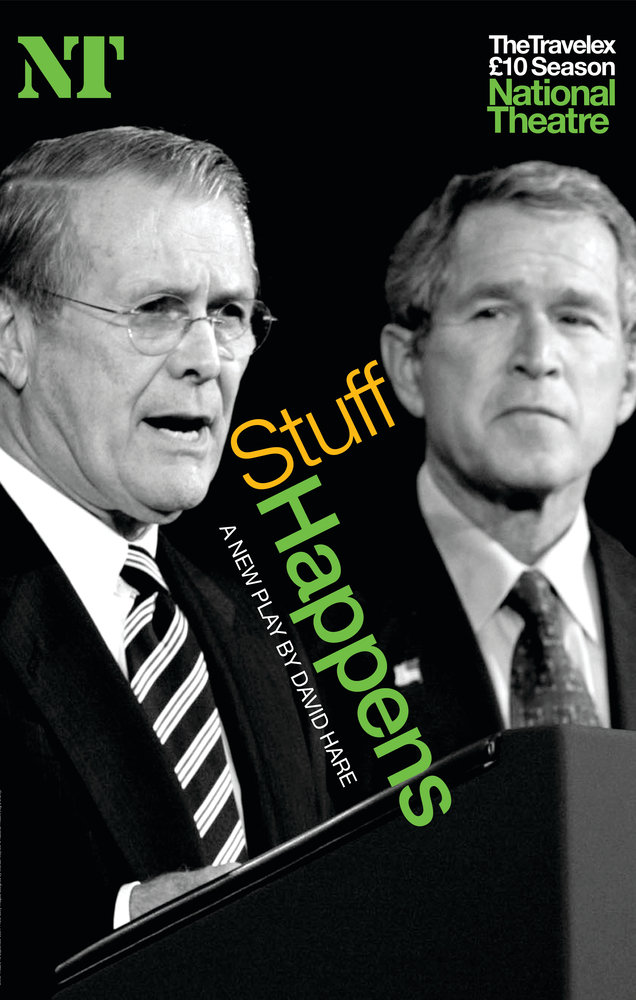
Firstly, Stuff Happens by David Hare, which premiered at the National Theatre in 2004.  A ‘recent history’ play, the title comes from Secretary of Defence Donald Rumsfeld’s reaction on being told that there was looting in Iraq after Saddam Hussein’s deposition.  Watching a recent history play is a strange business, presenting events that will have had an immediate impact on our lives.  The play considers the run-up to the Iraq War, and Hare does a great job of balancing factual information and dramatic action; public speeches and imagined private conversations.  He looks at the main government players in the US and UK, exploring the political manoeuvring that occurs when no-one’s too sure exactly what the fight is:

“Rumsfeld.  I liked what you said earlier, sir. A war on terror. That’s good. That’s vague.

Cheney.  It’s good.

Rumsfeld. That way we can do anything.”

This obfuscation through meaningless rhetoric seems to be part of the politics of our age.  In this instance, we know what it led to, and Stuff Happens could be a very bleak and cynical play.  However, I think Hare encourages scepticism rather than cynicism when it comes to politics, using our knowledge of how events played out to deepen our understanding of why stuff happens, presenting the person behind the politician. There is heightened dramatic irony running through imagined private dialogue like this:

“Blair. I’ve been thinking. I’ve had this idea. I need…I think it might help if we had some sort of dossier. A kind of dossier.”

The knowledge that this ‘sexed-up’ ‘dodgy dossier’ would haunt Blair’s remaining time in office means the audience/reader witnesses this tentative suggestion with a sense of dread.  It’s a tough job to make politics entertaining when you have a duty to those who have lived it to keep to the facts, but Hare balances it all beautifully, and creates an entertaining and thought-provoking piece that is responsible but not dogmatic.  There are even opportunities for some wry humour, in this instance from the mouth of Secretary of State Colin Powell:

“There’s an element of hypocrisy, George. We were trading with the guy!  Not long ago. People keep asking, how do we know he’s got weapons of mass destruction? How do we know? Because we’ve still got the receipts.”  

Secondly, another (less) recent history play, Democracy by Michael Frayn, which also premiered at the National, in 2003.  Set in West Berlin in 1969, it tells the story of Chancellor Willy Brandt, the first liberal-leaning Chancellor elected in Germany since before World War II, and his personal assistant Gunter Guillaume, who had begun life in East Germany, and was spying on the Chancellor for the Stasi.  The playtext describes the setting as:

“a complex of levels an spaces; of desks and chairs; of files and papers; also of characters, who mostly remain around the periphery of the action when not actually involved in it, listening or unobtrusively involved in their work”

This captures the bureaucracy and paranoia of Cold War government, the environment in which Willy Brandt tried to effect change whilst being a bit…ineffectual.

“Brandt. Let’s talk about it. See if we can’t find a solution that keeps everyone happy.

Schmidt. You can’t keep everyone happy, Willy! Not if you’re running a government!  We’ve got come to a decision!

Brandt. Thank you, Helmut.  What do the rest of us feel…?”

These days Germany is such a powerful world leader, it can be easy to forget the fragility of its post-war state.  Even in 1969 Brandt was faced with:

“Two Germanies, broken apart like the old shattered masonry. This is the material out of which we have to build the world we’re going to be living in tomorrow. This is the only material we possess – the two Germanies as they actually are. Riddled with doubts and suspicions on both sides.”

As the government tries to navigate a way forward, Brandt and Guillaume’s relationship adds to the complexity of the situation, as Guillaume’s Stasi handler observes:

“You and Willy. You’re like some old couple who’ve been married for forty years.  He goes down so you go down.  He comes up again and….”

Democracy is a subtle, intelligent study of people and politics in a time where nothing is straightforward.  Brandt and Willy distrust each other and rely on each other in a symbiotic relationship that defies easy definition.  It’s a play about politics but Democracy also succeeds on a very human level.

If the electioneering has left you feeling somewhat jaded about politics, let’s end by looking back to the politics of the past, noble statesmen concerning themselves with issues of great import…

“There shall be no more novels about incest. No, not even ones in very bad taste.” (Julian Barnes)

Trigger warning: this post contains discussion of upsetting sexual subject matter.  Please do not read if you are not an adult or if you will find such discussion traumatic.

I’ve picked a rather disturbing theme for my post this week, as you may have guessed from the title quote. I try and pick a theme based on what’s been happening at the time, and for me this week it’s incest.  I feel I should qualify that statement rather rapidly: I went to see Maxine Peake’s Hamlet – that Oedipal family drama to end all Oedipal family dramas – and then I saw A View from the Bridge with Mark Strong.

Then in my early modern literature class, someone pointed out that Tis Pity She’s a Whore (where a brother and sister are in a relationship) had warped her mind because when we read A King and No King (where a brother & sister struggle with their mutual attraction) she couldn’t see what the problem was & why they didn’t just get on with it.  Don’t get an education kids, it will put your moral compass on permanent fritz.

But if you can cope with the upsetting subject matter, there’s been some wonderful novels written about circumstances where incest occurs, so I hope you’ll stick with me.

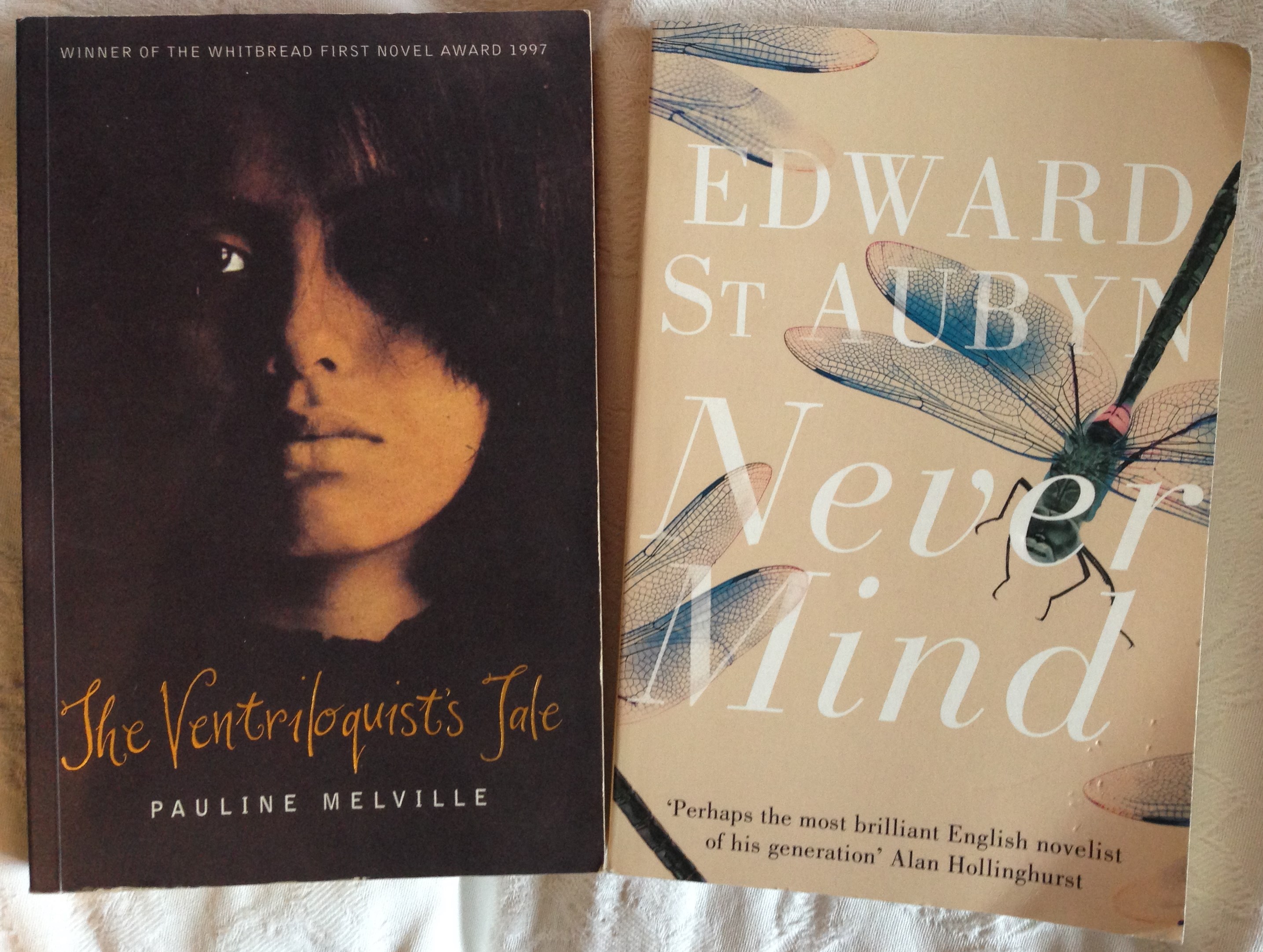
Firstly, Never Mind by Edward St Aubyn (1992).  This is the first of the Patrick Melrose quintet, St Aubyn’s series of autobiographical novels (the fourth, Mother’s Milk, was nominated for the Booker in 2006).  In this first novel , Patrick is five years old, living in France for the summer with his alcoholic mother and controlling, cruel father.  As Patrick explores the garden, creating adventures for himself, St Aubyn brilliantly evokes the microscopic view of a child:

“As Patrick approached the house, climbing as usual the right–hand flight of the double staircase because it was luckier, he turned into the garden to see if he could find the frog that lived in the fig tree.  Seeing the tree frog was very lucky indeed.  Its bright green skin was even smoother against the smooth grey skin of the fig tree, and it was hard to find it amongst the fig leaves which were almost the same colour as itself.  In fact, Patrick had only seen the tree frog twice, but he had stood still for ages staring at its sharp skeleton and bulging eyes…above all at the swelling sides which enlivened a body as delicate as jewellery, but greedier for breath.”

The third person narrative enables St Aubyn to shift between the various Melroses so that while the parents are reprehensible (the mother) and downright repugnant (the father) you understand why they are the way they are; how damaged they are and how they continue to inflict damage on all who surround them.

What makes it bearable is St Aubyn’s beautiful, intelligent prose; the delicate way he approaches the Melroses to capture this moment in family history.

“’What did you do today?’

‘Nothing,’ said Patrick, looking down at the floor.

‘Did you for a walk with Daddy?’ asked Eleanor bravely.  She felt the inadequacy of her questions, but could not overcome the dread of having them scantily answered.

Patrick shook his head. A branch swayed outside the window, and watched the shadow of its leaves flickering above the curtain pole.  The curtains billowed feebly and collapsed again, like deflated lungs.  Down the corridor a door slammed. Patrick looked at the clutter on his mother’s desk. It was covered in letters, envelopes, paperclips, rubber bands, pencils, and a profusion of different-coloured cheque books.  An empty champagne glass stood beside a full ashtray.”

SPOILER: And now, to quote the vampire Lestat, I’m going to give you the choice I never had. Never Mind is a great novel.  Edward St Aubyn is a hugely talented writer.  He was also repeatedly raped by his father as a small child and his novels are autobiographical.  In Never Mind, there is a scene where Patrick is raped by his father. I didn’t know this when I was reading the novel (I read the scene on a train, and had to get off at the next stop because I genuinely thought I was going to be sick), and I’m telling you so you can decide whether or not to read it. I would urge you to do as it is such a brilliant novel, but go in prepared.

Phew!  Let’s pause for a moment and go to a happy place:

giphy (1)

Secondly, The Ventriloquist’s Tale by Pauline Melville (1997) which won the Whitbread First Novel Award in 1997.  Set in Guyana and spanning most of the twentieth century, Melville uses the lives of generations of an Amerindian family to explore large themes: colonialism, the nature of love, religion and progress.  In contrast to Never Mind, this is a tale told with vivacity, serious but not depressing.

“Where was I? Oh yes. My grandmother.  She still refers with rage to a man called Charles Darwin who wandered through the region with the slow-motion frenzy of a sloth, measuring and collecting.  No one round here likes measurers, collectors and enumerators.  We cannot hoard in the tropics.  Use it or some other creature will eat it.  Sooner or later everything falls to the glorious spirit of rot with its fanfares of colours and nose-twisting stenches.”

The narrator/ventriloquist tells the story of the McKinnon family: Scottish Alexander McKinnon who builds a life in Guyana with 2 wives; his incestuous son and daughter; and the present day Chofy McKinnon, drawn back to Guyana through a love affair.

“It was confusing for McKinnon. He settled into the life well at one level, but every now and then he caught a glimpse of a world he did not understand at all.  He tried to discuss things with his father-in-law who was something of a philosopher and who explained to McKinnon that there was no point in trying to do anything about everyday life.  It was an illusion behind which lay the unchanging reality of dream and myth.”

These themes of The Ventriloquist’s Tale are heightened by the heady environment that challenges what is real:

“It was night and the deer was hiding somewhere in the tall grasses. Danny lay on the side of the sloping hill.  The rough grass under him felt like the pelt of an animal.  He almost imagined he could feel it breathing.”

Reading this novel engages all the senses: you can see, smell and taste all that is happening.  There’s a strong current of humour too; Melville has accomplished a novel that would be astonishing at any point in a writer’s career, but all the more so as a first novel.

001 (41)

“And therefore, since I cannot prove a lover/To entertain these fair well-spoken days,/I am determined to prove a villain” (Richard III)

Richard III is being buried today in Leicester Cathedral after his remains were discovered in the rather unlikely surroundings of a car park in the county in August 2012.  Controversial to the end, the reinternment of his remains has been delayed by legal wrangling between Leicester and York as to who should have the bones.  Richard III is one of history’s villains, often believed to have killed the sons of Edward IV to secure his own claim on the throne of England (significant crowds attended his funeral procession on Sunday, so maybe he’s been given the benefit of the doubt). This image is due in no small part to the enduring influence of Shakespeare’s portrayal in The Life and Death of Richard III (1591ish), helped along by Laurence Olivier’s 1955 film.

In the interests of balance I thought I would look at this play alongside a novel that seeks to rescue Richard’s reputation.

Richard is an unusual villain in Shakespeare, in that he is the only eponymous character to start his own play (I think…feel free to correct me in the comments!) as he comes on stage to proclaim:

“Now is the winter of our discontent
Made glorious summer by this sun of York”

He is also unusual in that he starts with a trochee – bear with me, I’m not going to get too technical & give you flashbacks to the horrors of Shakespeare at school. But I think this is worth pointing out; most characters speak in iambic pentameter (dee-DUM, dee-DUM etc). Richard comes out and seizes the stage with “NOW is…” (DUM-dee): he is in charge from the off.

What follows is the story of a consummate politician doing whatever he deems necessary to seize the crown.  Although he tries to persuade us that his disability (a curved spine, possibly a slightly weaker arm one side) means that through medieval ableism he is marked for villainy (the title quote I’ve used is a pun – he is determined in will and determined by fate) really no-one is less disabled that Richard, as the powerful opening shows us.  He manages to bend everyone to his will; he seduces Lady Anne within one scene, despite the fact that he killed her husband:

“Was ever woman in this humour woo’d?
Was ever woman in this humour won?
I’ll have her; but I will not keep her long.”

This is the bleak humour of Richard III – he plots to kill his fiancée even as he seduces her.  Often the play is described as a tragedy, but it’s really one of Shakespeare’s history plays and the tone is ambiguous: the last production I saw, with Mark Rylance in the lead, played it as a comedy as far as possible.

Richard’s machinations eventually catch up with him and he is defeated by Richmond (Henry VII) at the Battle of Bosworth, desperately crying out “A horse! A horse! My kingdom for a horse!” A villain indeed, but the audience, like Lady Anne, is seduced by him against our will and the stage is a poorer space when he’s not in it.

Secondly, Daughter of Time by Josephine Tey (1951).  It was Emmie’s review of another Josephine Tey novel that introduced to me to this author, and although I don’t normally read series’ out of order, I made an exception for Daughter of Time, as the Crime Writers’ Association voted it the greatest mystery novel of all time.

Inspector Alan Grant has broken his leg and is bored to abstraction away from his job at Scotland Yard.  His glamorous friend Marta suggests he try and solve a historical mystery to keep from going stir crazy. Captivated by a portrait of Richard III, he decides to investigate the mystery of the Princes in the Tower.

Grant’s team is not comprised of his usual fellow policeman, and they all have varying theories:

“Nurse Ingham thinks he’s a dreary. Nurse Darroll thinks he’s a horror.  My surgeon thinks he’s a polio victim. Sergeant Williams thinks he’s a born judge.  Matron thinks he’s a soul in torment.”

As he becomes more involved in the mystery, Grant repeatedly finds himself in opposition to the legend of Richard III:

“’Always a snake in the grass, if you ask me. Smooth, that’s what he was: smooth.  Biding his time.’

Biding his time for what? He wondered… He could not have known his brother Edward would die unexpectedly at the age of forty […]It was surely unlikely that a man busy with the administration of the North of England, or campaigning (with dazzling success) against the Scots, would have much interest in being ‘smooth’.  What then had changed him so fundamentally in so short a time?”

Grant needs an ally, and it arrives in the form of American academic Brent Carradine:

“He was a tall boy, hatless, with soft fair curls crowning a high forehead and a much too big tweed coat hanging round him in negligent folds…He brought over the chair, planted himself on it with the coat spread around him like some royal robe and looked at Grant with kind brown eyes whose luminous charm not even the horn-rims could dim”

Between the two of them, they start to piece together what they think happened as various powerful medieval families jostled for the crown. The more research they do, the less likely Richard-as-murderer seems to be:

“One could go through the catalogue of his acknowledged virtues, and find each of them, individually, made his part in the murder unlikely in the extreme. Taken together they amounted to a wall of impossibility that towered into fantasy.”

Tey does an excellent job of balancing academic arguments and historical fact with keeping the plot moving (the novel is only 222 pages).  Grant concludes his investigation on the day of his discharge home from hospital, convinced he has his man.  Let’s just say Shakespeare could never have dramatised the conclusion he comes to.

To end, I can’t help thinking that if Richard III had a chance to set the record straight, he’d choose to do so through the medium of song:

“Poetry: the best words in the best order.” (Samuel Taylor Coleridge)

Today is World Poetry Day. Of all the events taking place, I think my favourite is the opportunity to Pay with a Poem for your caffeinated beverage of choice.

As the concept of World Poetry Day is so epic, I thought I’d look at a poem from this genre to start.  This style of poetry seems to have fallen out of favour since it’s heyday in ancient Greece, but a notable exception is Derek Walcott’s Omeros (1990).  Loosely based on Homer’s Odyssey & Iliad, Omeros is set in Walcott’s home of St Lucia, telling the story of various inhabitants, including the fishermen Achille and Hector.

“Wind lift the fern. They sound like the sea that feed us

fisherman all our life, and the ferns nodded ‘Yes,

the trees have to die.’ So fists jam in our jacket,


cause the heights was cold and our breath making feathers

like the mist, we pass the rum.  When it came back, it

gave us the spirit to turn into murders.”

Written in terza rima (used in another epic, Dante’s Divine Comedy) Walcott manages an extraordinary feat in Omeros: a sustained long poem of stunning imagery and elegant writing which also tells a story.

“as I brushed imaginary sand from off my feet,

turned off the light, and pillowed her waist with my arms,

then tossed on my back.  The fan turned, rustling the sheet.


I reached for my raft and reconnected the phone.

In its clicking oarlocks, it idled, my one oar.

But castaways make friends with the sea; living alone


they learn to survive on fistful of rainwater

and windfall sardines. But a house which is unblest

by familiar voices, startled by the clatter


of cutlery in a sink with absence for its guest,

as it drifts, its rooms intact, in a doldrum summer,

is less a mystery than the Marie Celeste.

Walcott is also a deeply political writer, engaging with the history of the Caribbean and all that entails.

“Once, after the war, he’d made plans to embark on

a masochistic odyssey through the Empire,

to watch it go in the dusk […]


but that was his daydream, his pious pilgrimage.

And he would have done it, if he had had a son,


but he was an armchair admiral in old age,

with cold tea and biscuits, his skin wrinkled like milk”

Omeros is absolutely astonishing in its ambition, breadth, artistry and intellect. Derek Walcott was a worthy winner of the Nobel Prize in 1992.

Secondly, from breadth to brevity, Ezra Pound’s Alba.  If poetry is language stripped down to the essentials, Pound strips poetry back to the bare bones.  I think In a Station of the Metro is one of the most perfect pieces of writing I’ve ever read, but I chose Alba as it’s less well-known. OK, so he was a massive fascist, but I try and forget this as he distils language to such sparse beauty. An alba is part of the aubade tradition of poems, concerned with lovers parting at dawn.

“As cool as the pale wet leaves

                                     of lily-of-the-valley

She lay beside me in the dawn.”

That’s it.  The whole poem in its entirety.   I really hope you like it.

I realise I’ve chosen two poems written by men , so to redress the balance I’ll end with a retelling of part of another epic (Ovid’s Metamorphoses): the Poet Laureate Carol Ann Duffy reading ‘Mrs Midas’ from her collection The World’s Wife.

“Change is inevitable – except from a vending machine.” (Robert C. Gallagher)

Dear reader, it’s been so long.  Let’s just say working pretty much full-time while studying for my Masters as a full time student basically leaves time for oooh, nothing else at all. My brain is close to exploding with all I’m trying to cram into it. Put it this way: I’ve lost all capacity for nouns.  I can’t remember the name of anyone or anything.  Apparently this is a sign of dementia starting.  I’m trying to be positive and think it’s just a sign of my impending breakdown.

Anyhoo, it’s March now, and so I’ve decided that Spring has officially sprung.  I’m sick of winter, and although it’s cold and grey in old London town today, we’ve had at least 3 days where it’s been sunny & bright & I’ve had to remove my jacket as I’m too warm. There are daffodils, so it’s Spring, people!  Annoyingly, with this seasonal transformation comes exhortations from women’s magazines to transform your body into something called ‘bikini-ready’ or similar. Ugh. As a bibliophile I thought rather than attempting transformation, I would  read about instead.  Read about it seated in my favourite chair eating chocolate/cheese/chocolate topped with cheese while refusing to wear a bikini.

Firstly, possibly the most famous transformation story of all, The Strange Case of Dr Jekyll and Mr Hyde by Robert Louis Stevenson (1886). This is such a well-known story that I won’t bother outlining the plot.  Just in case you need a reminder though, here’s a visual summary from the 1931 film:

Dr Jekyll observes:

“It was on the moral side, and in my own person, that I learned to recognise the thorough and primitive duality of man; I saw that, of the two natures that contended in the field of my consciousness, even if I could rightly be said to be either, it was only because I was radically both” 

His potion suppresses his duality and lets forth the base Mr Hyde:

“He is not easy to describe. There is something wrong with his appearance; something displeasing, something downright detestable. I never saw a man I so disliked, and yet I scarce know why. He must be deformed somewhere; he gives a strong feeling of deformity, although I couldn’t specify the point. He’s an extraordinary-looking man, and yet I really can name nothing out of the way. No, sir; I can make no hand of it; I can’t describe him.”

The novella is not the most accomplished piece of writing but there are some well crafted passages:

“It was a fine, clear, January day, wet under foot where the frost had melted, but cloudless overhead; and the Regent’s Park was full of winter chirrupings and sweet with spring odours. I sat in the sun on a bench; the animal within me licking the chops of memory; the spiritual side a little drowsed, promising subsequent penitence, but not yet moved to begin.” 

When originally published, this Victorian novella no doubt spoke to anxiety about sexual drives which may have faded somewhat, but the metaphor still lends itself to inner turmoil and guilt, when Hyde is figured as “the ghost of some old sin, the cancer of some concealed disgrace”; or the personality change associated with drug/alcohol addiction, as Hyde has “the body of a self-destroyer”; or various dissociative/psychotic psychological disorders.  I think what makes this story so famous and enduring is that it captures an anxiety about who we are, and of what we are capable.  The terror of The Strange Case of Dr Jekyll and Mr Hyde is not in Hyde himself, but in the unsettling notion that Hyde is not strange, but in fact common to us all.

Secondly, a chance for me to indulge my on-going obsession with Angela Carter, and discuss ‘The Tiger’s Bride’ from The Bloody Chamber.  This collection of stories saw Carter reworking fairytales; an obvious choice for this post as the genre is filled with transformations – beasts into princes, wolves into grandmothers, wicked step-mothers into witches.  In ‘The Tiger’s Bride’ narrator’s father stakes her in a game of cards, only to lose.

“I watched with the furious cynicism peculiar to women whom circumstances force mutely to witness folly, while my father, fired in his desperation by more and yet more draughts of the firewater they call ‘grappa’, rids himself of the last scraps of my inheritance. When we left Russia, we owned black earth, blue forest with bear and wild boar, serfs, cornfields, farmyards, my beloved horses, white nights of cool summer, the fireworks of the northern lights. What a burden all those possessions must have been to him, because he laughs as if with glee as he beggars himself; he is in such a passion to donate all to The Beast.”

The Beast is the name given to the Lord of the manor, a man who smells of:

“potent a reek of purplish civet at such close quarters in so small a room. He must bathe himself in scent, soak his shirts and underlinen in it; what can he smell of, that needs so much camouflage?”

The narrator moves into his lair:

“A profound sense of strangeness slowly began to possess me. I knew my two companions were not, in any way, as other men, the simian retainer and the master for whom he spoke, the one with clawed fore-paws who was in a plot with the witches who let the winds out of their knotted handkerchiefs up towards the Finnish border. I knew they lived according to a different logic than I had done until my father abandoned me to the wild beasts by his human carelessness…I was a young girl, a virgin, and therefore men denied me rationality just as they denied it to all those who were not exactly like themselves, in all their unreason.”

This Angela Carter, and so things do not play out as tradition would dictate: there is no helpless heroine surrendering herself to a man in this tale:

“I squatted on the wet straw and stretched out my hand. I was now within the field of force of his golden eyes. He growled at the back of his throat, lowered his head, sank on to his forepaws, snarled, showed me his red gullet, his yellow teeth. I never moved. He snuffed the air, as if to smell my fear; he could not.

Slowly, slowly he began to drag his heavy, gleaming weight across the floor towards me.”

The transformation in the tale is two-sided and empowering. It is everything you would expect from Carter: weird, surprising, audacious, and above all skilfully written with beautiful, concise prose.

To end, a warning from The Librarians that you should never wish your life would transform to a fairytale:


“Let the little fairy in you fly!” (Rufus Wainwright)

December is a month of magic – at least, that’s how I choose to see it, rather than a month of biting winds, zero natural light, and weeping over the expanding credit card bills and waistlines that mark the holiday season.  No, it is a time of magic – fairies sit on top of trees, reindeer fly and strangers somehow shoot down chimneys and creep into kids bedrooms without being put on a register.  In honour of this time I thought I’d look at literature around fairies.

When I was growing up I loved the delicate drawings of Cicely Mary Barker’s Flower Fairies; the Poppy Fairy was my favourite because she looked a bit naughty.  I’m not sure what that says about me as a child….

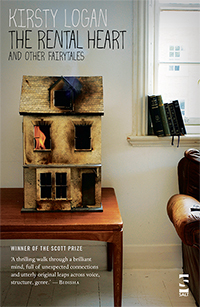
Firstly, The Rental Heart and Other Fairytales by Kirsty Logan (Salt Publishing, 2014).  I picked this up after reading Naomi’s review on her The Writes of Women blog. It was every bit as good as Naomi suggested. The twenty stories in this volume are united by fairytale themes, but also explorations of sexuality, gender, love and desire that demonstrate how the extraordinary can promote new ways of understanding the everyday.

9781907773754frcvr.indd

(Image from: http://www.saltpublishing.com/shop/proddetail.php?prod=9781907773754)

Logan plays with animating the inanimate and mechanising the organic to destabilise notions of identity.  So The Rental Heart sees a woman protect herself from heart-break, leasing mechanised versions of the muscle which she renews as needed. In Origami Rebecca constructs herself a paper lover; in Coin Operated Boys, Elodie rejects “Imperfect. Awkward. Repulsive…” human suitors for the titular machines, responding to their “calm, clean angles”, cool touch, and eyes “flat as a pond in summer”. In this way Logan shows how desire is manifold and defies easy categorisation, while exploring how we seek to control desire, and how denial of our humanity can lead to detachment from ourselves and others.

Extraordinarily, Logan’s startling use of images throughout her stories did not cause me to detach, but rather reveals new ways of perceiving that truly resonate. Choosing any page at random would give me a quote for this post, Logan is truly that good.

From Bibliophagy: “Standing pigeon-toed and bruise-kneed in the light from the fridge, his neck finally stops twitching. The words are waiting, cold as milk….He turns away so the moon is hidden behind next door’s chimney.  He lifts the words.  He shudders to think how smooth the vowels will feel along his oesophagus.  He swallows.”

From The Gracekeeper: “The widow thanked me afterwards with her damp swollen hands too tight on my wrists, speaking in fummels and haffs as if she could not get enough breath.  Her wedding ring dug into her finger, making the flesh bulge out at either side, and I wondered whether she would wear it until it engulfed: her own secret totem”

In stories such as Witch, Logan challenges the heteronormativity and misogyny inherent in so many fairytales, when the young woman wandering in the forest decides to stay put:

“She was honey on my tongue. She was the poison apple, the kiss that would wake me.  When she finally slid inside me, I knew the end of my story.  I never wanted to leave my bitch goddess warrior queen.  I knew what happily ever after was, and I wanted to be a wicked witch too.”

I’m so excited about Kirsty Logan after reading this collection, and eagerly await her first novel, published next year.

Secondly, it’s impossible to write a post about fairytales without mentioning Angela Carter.  She edited two volumes of the Virago Press’ books of fairytales, as well as writing her own short story collection along this theme, The Bloody Chamber (Gollancz,1979).  Carter’s stories are creepy and unsettling re-tellings of well-known tales, pulling the dark undercurrents of the fables to the fore.  Snow White is rewritten in The Snow Child as an incestuous tale of necrophilia, played out between a battling couple:

“Then the girl began to melt. Soon there was nothing left of her but a feather a bird might have dropped; a bloodstain, like the trace of a fox’s kill on the snow; and the rose she had pulled off the bush.”

In The Werewolf Little Red Riding Hood is far from helpless victim: “The child had a scabby coat of sheepskin to keep out the cold, she knew the forest too well to fear it but she must always be on her guard. When she heard that freezing howl of a wolf, she dropped her gifts, seized her knife and turned on the beast.

It was a huge one, with red eyes and running, grizzled chops; any but a mountaineer’s child would have died of fright at the sight of it. It went for her throat, as wolves do, but she made a great swipe at it with her father’s knife and slashed off its right forepaw.

The wolf let out a gulp, almost a sob, when it saw what had happened to it; wolves are less brave than they seem.”

The Bloody Chamber prompts a reconsideration of familiar tales that we imbue from childhood.  Carter is an intellectual force, funny and challenging; I was left thinking about these stories long after I’d read them.

“Remember, remember the 5th of November: Gunpowder, Treason and Plot!” (Traditional, British)

OK, so I’m a day late, but that’s practically on time compared to how late some of my other posts have been.  I’ve met my own low standards. 5 November is Guy Fawke’s Night in Britain, where we commemorate the foiling of an attempt to blow up the House of Lords and kill the king in 1605 by, er, setting fires and letting off fireworks. We used to burn effigy of the plotter Guy Fawkes (who was discovered with all the gunpowder) but that and kids asking you for “a penny for the guy” doesn’t seem to happen anymore – which is fine with me, it was a bit gruesome for my delicate sensibilities.

Anyway, the plotters were Catholic and wanted to kill the Protestant James I to put a Catholic monarch on the throne, so I thought this week I’d commemorate the plot through books rather than pyromania and look at work by Catholic writers.

Firstly, Ben Jonson, frenemy of Shakespeare, who actually had dinner with the plotters but somehow managed to duck suspicion and went on to become a writer for the court of James I. Jonson converted to Catholicism in 1598, while imprisoned for killing fellow playwright Gabriel Spencer in a duel (he’d previously been imprisoned for suspected sedition – he had quite the life). Jonson converted back to Anglicism in 1610, but the poem I’m going to look at sees him wrestling with his faith while still a Catholic.  Much of Jonson’s writing doesn’t carry well across the ages – he was heavily satirical and our knowledge of early seventeenth century politics and theatre-life has waned somewhat. However, this poem, written when his first son Benjamin died of plague aged just seven, captures such grief and pain as to be recogniseable today:

On My First Son (1603)

Farewell, thou child of my right hand, and joy;

My sin was too much hope of thee, lov’d boy.

Seven years tho’ wert lent to me, and I thee pay,

Exacted by thy fate, on the just day.

O, could I lose all father now! For why

Will man lament the state he should envy?

To have so soon ‘scap’d world’s and flesh’s rage,

And if no other misery, yet age?

Rest in soft peace, and, ask’d, say, “Here doth lie

Ben Jonson his best piece of poetry.”

For whose sake henceforth all his vows be such,

As what he loves may never like too much.

There’s a theory sometimes advanced that parents in this period were so used to losing their children that they met their deaths with equanimity.  Jonson’s poem shows how totally misguided this is.  He writes in heroic couplets, showing how deeply felt this is for him; the poem is epic in style, if not in length (the short length thereby reflecting his son’s short life).  Jonson finds himself tormented in faith rather than soothed by it; he knows he should be glad his son has “scap’d world’s and flesh’s rage” but can’t help feeling he has to pay for the sin of loving his son too much, and grieving the loss; he is left with the questions that form the middle of the poem, rather than answers.  The answer Jonson finds for himself means this is a poem that captures two tragedies – the death of the seven year old, and a father so consumed by pain that he wishes he had never known parenthood: “O, could I lose all father now!” determining to close off his feelings in future: “As what he loves may never like too much.” Jonson was egomaniacal about his work, so when he says “Rest in soft peace, and, ask’d, say, “Here doth lie/Ben Jonson his best piece of poetry.”” There is no higher acclaim he can give the seven year old. Truly heart-breaking.

Secondly, The Girls of Slender Means by Muriel Sparks (1963, Penguin, my edition 2013).  Like the titular girls, this novel is one of slender means, only 142 pages in my edition.  But although it is a short novel and very funny, it is not fluffy or disposable.  It tells the story of a group of women living in the boarding house the May of Teck Club, when “long ago in 1945 all the nice people in England were poor”.  Thus, the slender means, but they also have other slender means; the girls are obsessed with calories and being thin enough to attract a husband.  I would normally find this sort of behaviour intensely irritating, but it is testament to Spark’s writing that I didn’t – it’s 1945, options are limited for women, and they are using the means at their disposal to improve their lot.  They are pragmatic rather than vain and foolish.

“And they realized themselves in varying degrees, few people alive at the time were more delightful, more ingenious, more movingly lovely, and, as it might happen, more savage, than the girls of slender means.”

Selena is beautiful and promiscuous, trying to decide which of her lovers to marry; Joanna has abandoned romantic love for reciting poetry and giving elocution lessons, Jane is overweight (which she hates) and intellectual, and writes to famous authors in an attempt to get autographs for her strange employer.  I was quite fond of Dorothy:

“Dorothy could emit, at any hour of the day or night, a waterfall of debutante chatter, which rightly gave the impression that on any occasion between talking, eating and sleeping, she did not think, except in terms of those phrase-ripples of hers: ‘Filthy lunch.’ ‘The most gorgeous wedding.’ ‘He actually raped her, she was amazed.’ ‘Ghastly film.’ ‘I’m desperately well, thanks, how are you?’[…] It was some months before she was to put her head round Jane’s door and announce ‘Filthy luck. I’m preggers.  Come to the wedding.’”

As this passage shows, Sparks humour is acute, incisive, and packs a punch.  She captures dark circumstances and behaviour with such a light touch that is ultimately a lot more shocking than from within an unrelentingly bleak novel. We know that Nicholas Farringdon, drawn into the May of Teck circle, became a missionary and subsequently died in Haiti, but we don’t know what prompted the conversion.  As The Girls of Slender Means builds towards its denouement, Sparks doesn’t spell out the totality of the impact of the events in 1945.  The novel is more powerful for this; the women and Nicholas remain partly unknown: to themselves, to each other, and to the reader.

giphy

“In the Bible, God made it rain for 40 days and 40 nights. That’s a pretty good summer for Wales…I was eight before I realised you could take a cagoule off.” (Rhod Gilbert)

As a companion piece to my post on Scottish writers, I thought this week I would look at Welsh writers.  Had I been even vaguely organised, I would have posted this 2 days ago to coincide with Dylan Thomas’ centenary, but better late than never….Firstly, a poem by Dannie Abse, a prolific poet who died in September this year.

It’s so hard to describe Abse’s writing without resorting to clichés about Welsh writing; adjectives like lyrical force themselves to the fore.  Judge for yourself: in Poem and Message (1955), Abse uses the idea of a loved one “Out on the tormented midnight sea” finding solace in words, and the poem of love those words createYou can read the whole poem here.

“so from this shore of cold I write

tiny flashes in the Night.


Words of safety, words of love

a beacon in the dark”

[…]

one small luminous truth

of which our usual love was proof.

It reminds me of Shakespeare’s sonnet 116 whereby love “is the star to every wand’ring bark”. Abse uses simple language, and a familiar trope of love as a guiding light, to create a sense of love’s unquestionable power; it doesn’t need complex metaphors and obscure polysyllabic words to heighten it.  It ends with a beautifully direct couplet:

And I call your name as loud I can

and give you all the light I am.”

Secondly, and in direct contrast to Abse’s refined feeling, Submarine by Joe Dunthorne (Penguin, 2008).  Oliver Tait is 15 and lives with his parents in Swansea.  His father is depressed and his mother:

“I have not established the correct word for my mother’s condition.  She is lucky because her mental health problems can be mistaken for character traits: neighbourliness, charm and placidity.  I’ve learnt more about human nature from watching ITV’s weekday morning chat shows than she has in her whole life.  I tell her ‘You are unwilling to address the vacuum in your interpersonal experiences,’ but she does not listen.”

Oliver is entirely typical and entirely untypical of a teenager.  He is convinced of his own superiority, passively observes the bullying of his classmates, is desperate to lose his virginity to the pyromaniac Jordana, and makes up stories about his neighbours:

“‘I know Mr Sheridan quite well, Oliver. He’s a painter decorator,’ he says…..

‘Andrew, he has the eyes and overalls of a killer,’ I say.”

Oliver is an outsider in his own life, and his voice is detached while seeking to belong.  The teenage conundrum – wanting to be entirely different and entirely the same as everyone else.  Even Oliver’s beloved Jordana lets him down:

“She’s been sensitised, turned gooey in the middle.

“I saw it happening and I didn’t do anything to stop it.  From now on, she’ll be writing diaries and sometimes including little poems and she’ll buy gifts for her favourite teachers and she’ll admire scenery and she’ll watch the news and she’ll buy soup for homeless people and she’ll never burn my leg hair again.”

Submarine is hilarious and yet still achieves a sensitive evocation of the torturous time of adolescence.  I could have picked almost any page at random and found a quotable line. Yes, it’s that good.  Just one proviso: don’t read it on the train unless you want to be one of those annoying people trying to muffle snorts of laughter between the pages, which I totally was…

There was a film adaptation of Submarine (dir. Richard Ayoade) in 2011:

“I’m bi-winning.” (Charlie Sheen)

As a companion piece to my post on Booker nominees, I thought I’d celebrate Richard Flanagan’s The Narrow Road to the Deep North winning the 2014 Man Booker by looking at two previous winners. Hence bi-winning – see, Charlie Sheen makes sense, he just needs the right context….

success

Firstly, The Inheritance of Loss – Kiran Desai (Penguin, 2006) which won the 2006 Man Booker Prize. Desai’s prize-winning skill is evident from the first paragraph:

“All day, the colours had been those of dusk, mist moving like a water creature across the great flanks of mountains possessed of ocean shadows and depth. Briefly visible above the vapour, Kanchenjunga was a far peak whittled out of ice, gathering the last of the light, a plume of snow blown high by the storms at its summit.”

Sai has been schooled by nuns , and leaves to live with her grandfather and his cook in a damp, faded mansion at the foot of the Himalayas. All three live elsewhere in their minds.  The sad judge thinks more and more on his past in England, Sai is enamoured of her maths tutor, and the cook is preoccupied with his son Biju who is living the dream in America:

“Biju lay on his mattress and watched the movement of the sun through the grate on the row of buildings opposite. From every angle that you looked at this city without a horizon, you saw more buildings going up like jungle creepers, starved for light, holding perpetual half-darkness congealed at the bottom, the day shafting through the maze, slivering into apartments at precise and fleeting times …”

The reality is that Biju hops from one low-paid job to another, part of the unseen masses that keep the economy rolling, without a green card, without rights.  The rights of people form the background of the story, as the Gorkhaland movement gains momentum:

“The anger had solidified into slogans and guns, and it turned out they, they, Lola and Noni, were the unlucky ones who wouldn’t slip through, who would pay the debt that should be shared with others over many generations”

Lola and Noni are two elderly sisters, dreaming of genteel retirement, yanked into the present day by the forces of the oppressed demanding land rights.  Desai balances the personal and political perfectly, showing the effect on the individual and the nation with equal sensitivity:

“This was how history moved, the slow build, the quick burn, and in an incoherence, the leaping both backward and forward, swallowing the young into old hate. The space between life and death, in the end, too small to measure.”

“There they were, the most commonplace of them, those quite mismatched with the larger-than-life questions, caught up in the mythic battles of past vs. present, justice vs. injustice – the most ordinary swept up in extraordinary hatred, because extraordinary hatred was, after all, a commonplace event.”

As both individuals and nations struggle with notions of identity, intricately bound together yet inherently unstable, Desai demonstrates how the big questions in life exist simultaneously in the everyday and across the sweep of history.

Secondly, The Sense of an Ending by Julian Barnes (Jonathan Cape, 2011), which won the Man Booker in 2011.  This is a very different novel to The Inheritance of Loss, taking a brief (150 pages) look at a deliberately small life, lived quietly.

“And that’s life, isn’t it?  Some achievements and some disappointments.  It’s been interesting to me, though I wouldn’t complain or be amazed if others found it less so […] History isn’t the lies of the victors…It’s more the memories of the survivors, most of whom are neither victorious nor defeated”

Memory and its unreliability is a dominant theme in the book – Barnes demonstrates that there is no such thing as a reliable narrator.

“Who was it who said memory is what we thought we’d forgotten?  And it ought to be obvious to us that time doesn’t act as a fixative, rather as a solvent.  But it’s not convenient – it’s not useful – to believe this; it doesn’t help us get on with our lives; so we ignore it.”

The narrator in this instance is Tony, detailing two episodes in his largely uneventful life: the time around leaving school for university when his friend Adrian killed himself, and the present day where he has retired from work  and a legacy left to him prompts a re-evaluation of the past.  The Sense of an Ending is a melancholy book, as the title implies, but it feels real rather than outright depressing.  Tony is not admirable, but he’s not especially despicable either.  He is aware of his shortcomings and has achieved a resigned acceptance of them.  But this is not to suggest the novel is uneventful  – in a short space Barnes creates a narrative drive that carries you through to a powerful, unsettling ending.

Having been nominated three times previously and failed to grab the prize, I can’t tell you how much I hope this is how Barnes reacted when he finally won:

fantastic

“There are two seasons in Scotland: June and winter.” (Billy Connolly)

If you live in the UK, the news has been dominated by one story for weeks: the Scottish referendum.  On 18 September the Scottish people voted in favour of staying the union, but this wasn’t a vote for the status quo, and as such the news coverage continues, assessing the changes that are needed.  Prompted by this current affairs Caledonian focus, I thought I’d look at work by Scottish writers who engage with ideas of land and home, and how complex those fundamentals can be.

Firstly, a Booker-nominated debut novel, Our Fathers by Andrew O’Hagan (Faber & Faber, 1999).  This was a lesson to me to persevere with books, sometimes it pays off.  At first I found the story of male familial relationships utterly depressing:

“My father found it easy to hate his father; he had much more ease, in that sorry business, than his own son would ever have.”

The reason I stuck it out was because I’d read other novels by O’Hagan and I knew what a beautiful and sensitive writer he is.  Our Fathers is narrated by Jamie, son of Robert, grandson of Hugh.  The lives of the family are imbedded in the landscape of Glasgow, a landscape that Hugh is determined to change:

 “For years the city vibrated to the sound of diggers and pneumatic drills. Old powdery tenements fell to the ground. Whole townships cleared away.  It became part of the noise of Glasgow…there were half-chewed buildings on every street”

As an adult Jamie returns to Glasgow to visit the dying Hugh, from Liverpool where he has been trying to forget the past.  As Jamie returns to Scotland, he feels his way amongst the people, places and language that are at once entirely familiar and entirely apart:

 “The men at his table had similar faces.  Red and watery-eyed. All the trace of former good looks upon them. …The air was filled with their smoky laughter and the sound of the jukebox. Music, laughter, the shadows of words.”

 “‘Are the spirits high?’ I asked. And then all of a sudden I felt how foreign that phrase would sound… ‘Can he… can he thole the pain?’”

And what made Our Fathers initially so depressing for me was what made it ultimately so rewarding.  Out of pain, abuse, mistakes, recriminations and hardship comes forgiveness, wisdom, kindness and redemption:

 “I stood beside him, and listened to his life, and I held his hand, and I finally grew up”

It was an incredibly moving book, finely observed and insightful regarding the delicate meaning in moments that can barely be articulated.

Secondly, a poem by Kathleen Jamie, Here Lies Our Land.

Here lies our land: every airt

Beneath swift clouds, glad glints of sun,

Belonging to none but itself.


We are mere transients, who sing

Its westlin’ winds and fernie braes,

Northern lights and siller tides,


Small folk playing our part.

‘Come all ye’, the country says,

You win me, who take me most to heart.

It’s a short poem, and so I don’t want to analyse it to death, but I will just say I think the way Jamie creates a gentle, reflective tone through metre and language captures something fundamental and enduring; its language like the land she speaks of. You can read Kathleen Jamie’s thoughts on the poem and her writing process here.

To end, a man who shares my view on what Scotland’s finest export is (not counting Sean Connery):