Novella a Day in May 2026 – No.28

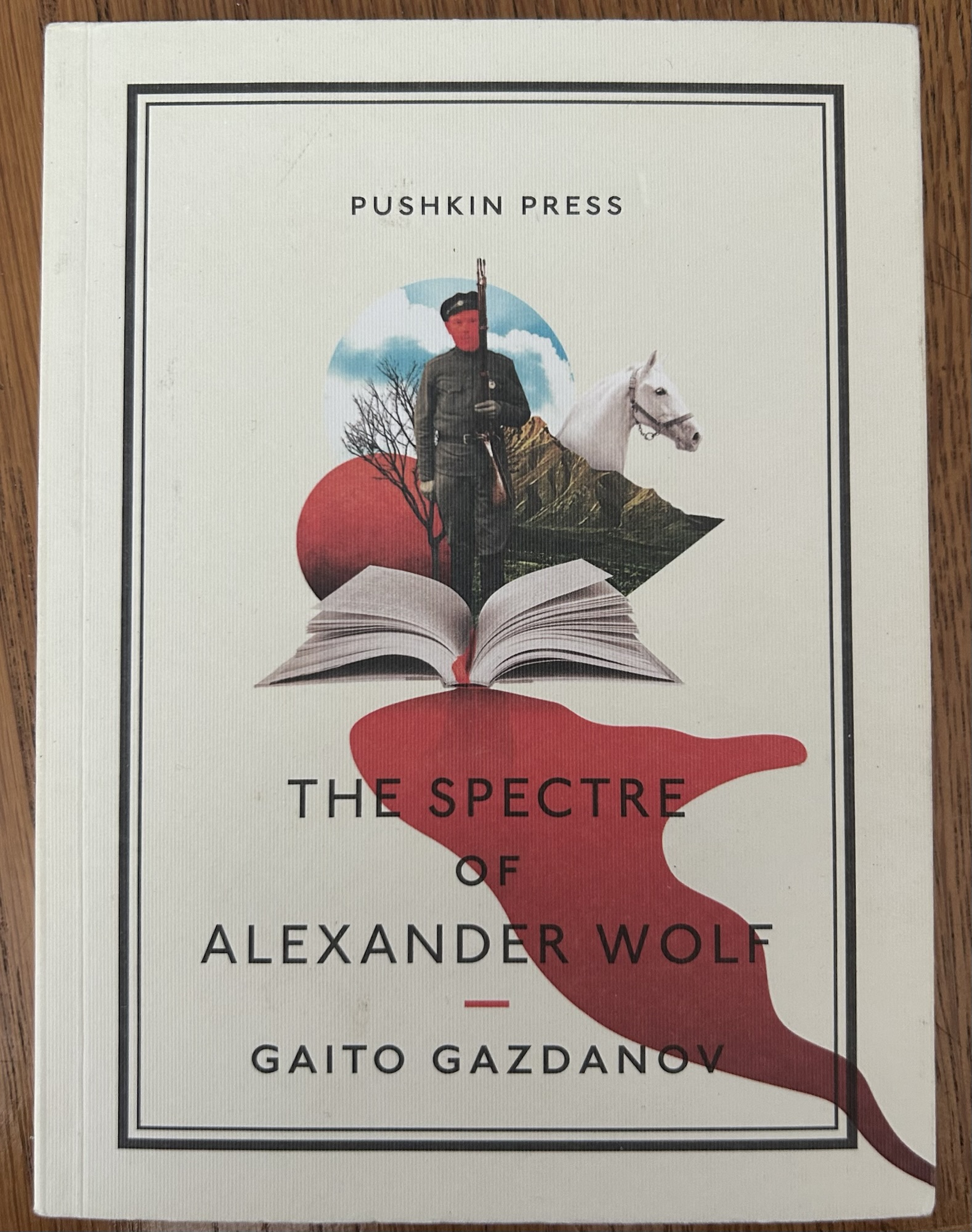
I really enjoyed Gaito Gazdanov’s The Buddha’s Return when I read it a few years ago, so I’m pleased to return to him with The Spectre of Alexander Wolf (1947-8, transl. Bryan Karetnyk 2013) published by Pushkin Press in one of their lovely smaller editions with French flaps.
It opens beguilingly:

“Of all my memories, of all my life’s in innumerable sensations, the most onerous was that of the single murder I had committed.”

This isn’t quite as it initially appears – the killing took place during the Russian Civil War. A man shoots the horse the narrator was riding, and in self-defence he shoots back. He then steals the other soldier’s white horse, later selling it and fleeing to Paris.

He is living in Paris and working as a journalist when he comes across a book of collected stories called I’ll Come Tomorrow by Alexander Wolf. Reading it, he is shaken by one of the stories, The Adventure of the Steppe in which the events above are described almost exactly.

As the book is written in English, when he is in London he visits Wolf’s publisher, who assures him:

“Mr Wolf is an Englishman; I’ve known him for many years and can vouch for that. What’s more, he’s never left England for more than two or three weeks at a time, which he spends mostly in France or Italy. He hasn’t travelled farther; I can say this with certainty.”

However, he is shaken on his return to France when he meets Voznesensky, a drunken acquaintance who has a copy of the book and claims to know the author. Voznesensky is incredulous at the thought of “Sasha Wolf, an Englishman!”

So who is Alexander Wolf? Was he the dead soldier? An Englishman who holidays in Italy? A Russian who lives in Paris?

Having set itself up as a possibly metaphysical detective story, the novel then takes a swerve into almost a completely different genre, detailing the narrator’s love affair with Yelena Nikolayevna.  She’s an enigmatic woman with a mysterious past (!) but gradually an intimacy begins to build, despite an “unnatural divide between the inner life and physical life that was so characteristic of her”.

The sudden shift is somewhat disconcerting but Spectre… remains very readable. Essentially the story is less about plot and more a consideration of where we look for meaning. The narrator channels his energy first into Wolf and then into Yelena, but ultimately he has to create his own meanings with his mortality a constant consideration:  

“I thought about how Wolf had become – and not so much Wolf personally as the very thought of him—the involuntary personification of everything dead and sad that existed in my life.”

By the ending, not everything is fully explained, although reader can piece events together. I think by leaving the plot unresolved, Gazdanov keeps Spectre…  as a philosophical consideration foremost, encouraging the reader to make their own meanings as the narrator needs to do.

I also think there is humour in it, I don’t think we’re supposed to take the narrator as seriously as he takes himself:

“Everything that my existence had comprised until now—regrets, dissatisfaction and a sense of the manifest futility of everything I did – began to seem very distant and alien to me, as though I was thinking of something that had taken place long ago.”

I realise I’ve been a bit vague, but Spectre… is an enigmatic and slippery book to both read and describe! It is an eloquent contemplation of its themes, so if you fancy those wrapped up in a few somewhat unresolved narratives then give it a try – I certainly enjoyed it a great deal.


“Never despise the translator. He’s the mailman of human civilization.”(Alexander Pushkin)

This week I thought I’d use Kaggsy and Lizzy’s #ReadIndies event to focus on one indie publisher, and finally get to four books that have long been languishing in the TBR. Pushkin Press “publish some of the twentieth century’s most widely acclaimed and brilliant authors” and they are one of my favourite indies, ever-reliable. Which hasn’t stopped four from their Collection series remaining unread by me for far too long!

Today I’m starting with The Buddha’s Return by Gaito Gazdanov (1949-50, transl. Bryan Karetnyk 2014). Gazdanov was a Russian writer exiled in France and this short novel, described by the publishers as “part detective novel, part philosophical thriller, and part love story” is set in Paris, as much as it is set anywhere – reality is not a consistent concept in this story at all.

The narrator is a student who is experiencing prolonged periods of hallucinations. He tells us from the start that he is an unreliable storyteller:

“Nowhere was there any logical pattern in this, and the shifting chaos clearly failed to present even a remote semblance of any harmonious order. And so, accordingly, at that point in my life, which was marked by the constant attendance of chaos, my inner existence acquired an equally false unwavering character.”

We slide back and forth between a recognisable reality of his poverty-stricken life in Paris and his disturbing, disorienting visions, without always knowing which is which. Early on in the novel he falls to his death from a sheer mountainside, later he is arrested and interrogated by the Central State. The government’s accusations of treason are entirely surreal and illogical, yet this is also what makes them horribly believable.

There is political commentary running through the novel, but the kaleidoscopic nature of the narrative means it is not a sustained satire on any particular country, ruler or party, but rather a wider condemnation:

“The ignorant, villainous tyrants who so often ruled the world, and the inevitable and loathsome apocalyptic devastation apparently inherent in every era of human history.”

Around halfway through, more of a plot emerges as Pavel Alexandrovich, an older man whom the student befriended, is murdered and his golden statuette of Buddha stolen. As the last person to see Alexandrovich alive, the student falls under suspicion. The real-life interrogation by the investigators has shades of the surreal fantasy interrogation by the Central State:

“If we can find the statuette, you’ll be free to return home and continue your research on the Thirty Years War, the notes on which we found in your room. I must say, however, that I completely disagree with your conclusions, and in particular your appraisal of Richelieu.”

As that quote shows, there is humour in The Buddha’s Return and this lightens a tale which has a lot of dark elements: visceral war scenes, squalor, and of course murder.

Apparently, The Buddha’s Return was originally published in instalments and I can see it would work well in this format. I enjoyed it but for me the more plot-driven second half arrived at just the right time, when I’d started to feel it was losing momentum. As it was I enjoyed this consistently surprising tale which still had enough recognisable humanity in it to be involving, and I’d be keen to read more by Gazdanov.

“I have a suspicion that you just dreamt the whole thing up. It’s because you read too much, eat too little and spare hardly any thought for the most important thing at your age: love.”