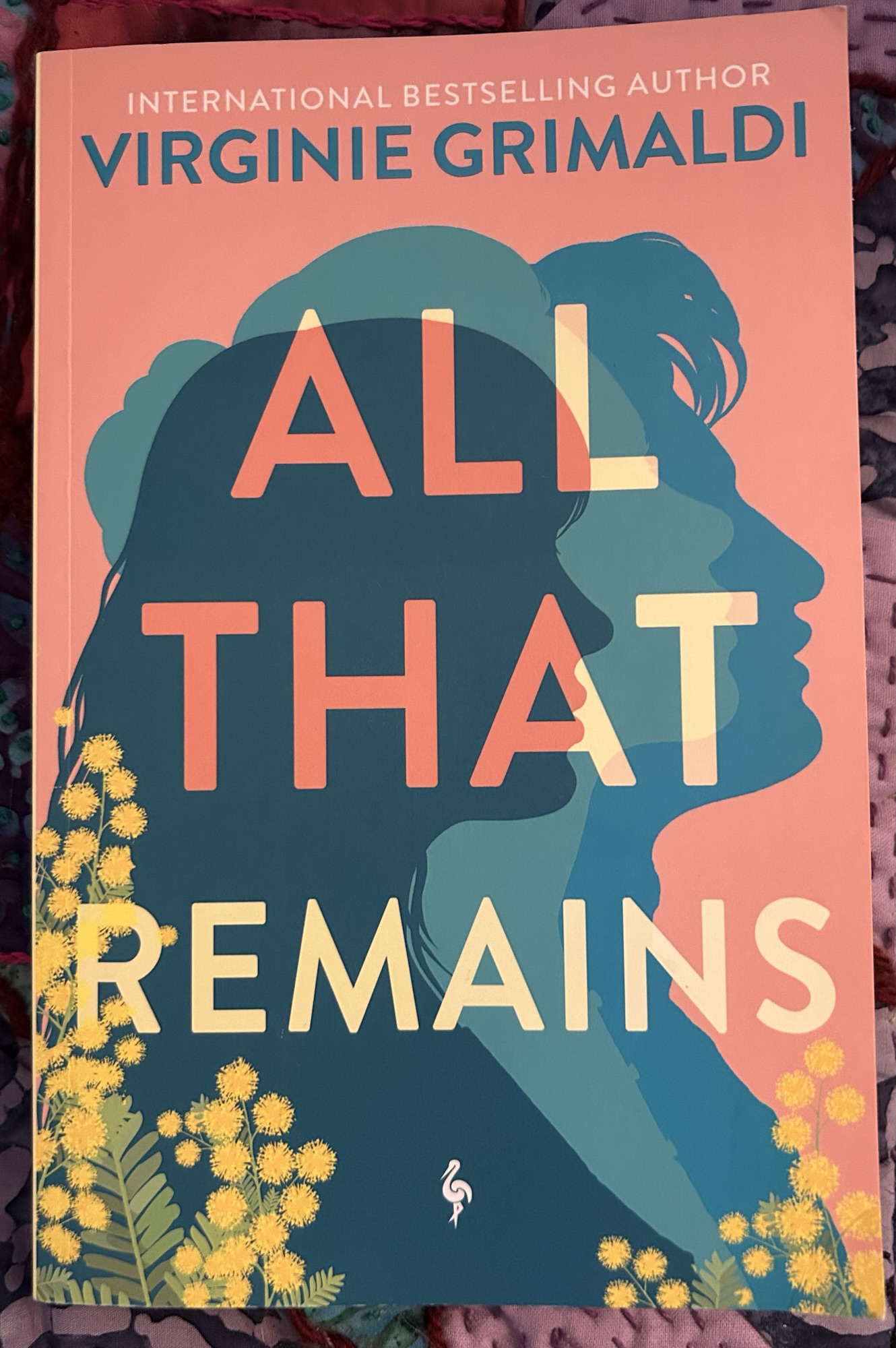
It was Claire at Word by Word whose blog post last year alerted me to All That Remains by Virginie Grimaldi (2022, transl. Hildegarde Serle 2025). This story of inter-generational friendship was so appealing, and it turned out to be a lovely read for Women in Translation Month 2026.

Jeanne’s husband of many years has died, leaving her spiralling through the disorientation of immense grief. Each day she visits him:
“That was her husband’s habit, cluttering up his stories with superfluous details. How often had she switched off while he was talking to her? Jeanne’s parents had taught her only to open her mouth when it was strictly necessary. And here she was, at seventy-four, telling a gravestone about the TV programme on the dangers of sugar that she’d watched yesterday.”
At the bakery near her house, eighteen-year-old Théo is an apprentice baker. Each chapter is headed with one of three character’s names and told from their point of view. I loved Théo’s voice, so bolshy and insecure. He goes to a karate class each week and tries to partner with younger boy Sam, who is still better than him at the martial art. One day his teacher takes charge of the pairs:
“Laurent, a guy who’s two heads taller than me and has shoulders I could do the splits on. Only the fenders are missing to mistake him for a 4×4. He’s not a man, he’s scaffolding. A wardrobe with feet and arms. But a large wardrobe, right, the sort Beyoncé would have.”
When Jeanne realises she needs to do something drastic or she risks losing the home she had with Pierre, she takes in lodgers. And so she ends up sharing her apartment with Théo and thirty-three year-old Iris.
At first Iris and Théo butt against each other almost like siblings:
“I left home at the same time as Theo, who is always as pleasant as a pap smear. From the very top step, I sensed I wasn’t going to reach the ground floor in a vertical position. My foot slipped without asking my permission, the rest of my body didn’t have time to register the information, it fell limply.”
But gradually the three of them feel-out how to live together. At first it is logistical adaptation, around meal times and use of the bathroom. Théo takes on Jeanne’s lack of housekeeping:
“I’ve seen some right messes, but on this scale, never. Every time I open a drawer, it looks like burglars have rifled through it. You’d never think it, entering the apartment … But don’t open the cupboard, unless you want your brow busted by a Breton bol.”
While Iris overcomes her apathy to Boudine, Jeanne’s dog.
Then slowly, they start to become friends. Watching the relationships grow between the three is undoubtedly feel-good, without being sentimental. All have secrets: Jeanne is seeing a psychic and receiving strange letters; Théo has left the children’s home where he largely grew up but has found his troubled past less easy to shake; and Iris is skulking around the city, working as a carer although she loved her vocation as a physiotherapist – why?
Together they learn all that friendship can offer, from the most surprising people in the most unlooked-for places. I found it genuinely moving, a comfort read without being saccharine or fantastical. A major contrivance occurs at the end but by that time I was so won over I couldn’t have cared less.
“My mother always preferred people with flaws to those without. She’d often say that two smooth surfaces slide over each other, whereas two dented surfaces catch on to each other and become stronger together. She wasn’t always wrong.”
A little gem.


Based on your review this does sound a gem – a charming comfort read, which is sometimes just exactly what a reader craves. I had not heard of this author before but I would definitely like to read it. I have noted it in my wish list notebook!
LikeLiked by 1 person
I hope you enjoy it if you get to it Sarah! It was a lovely comfort without being cloying, I raced through it.
LikeLike
This sounds so heartening. Definitely one for the list!
LikeLiked by 1 person
Great! I really hope you enjoy it.
LikeLike
This sounds lovely, Madame B. Sometimes you just need a feel-good book and if it can do that without descending into saccharine that’s a win!
LikeLiked by 1 person
That’s exactly it Kaggsy! It was a real treat to have an enjoyable comfort read and escape to Paris for a bit 😊
LikeLiked by 1 person
Love the quote from Theo – he sounds like a great character!
LikeLiked by 2 people
He really is! I loved his narration, so funny and vulnerable.
LikeLiked by 1 person
Well, that’s an unexpected praise. This author is tagged as romance, feel-good, women fiction and I tend to avoid these books.
Good to know she’s a better writer than I thought.
LikeLiked by 1 person
There’s no romance in the book, the focus is on friendship. It’s definitely feel-good though. A comfort read.
I would avoid books with those labels too, so I’m glad I didn’t know them, it would have put me off!
LikeLike
Yeah, sometimes it’s good to have a blind date with a book.
LikeLiked by 1 person
I like that idea!
And I’ve just remembered there is a romantic relationship in the book 🤣 but it’s definitely not the focus which is why I forgot! The focus is on the three people forming their friendship.
LikeLiked by 1 person
I read this last year and really loved it too. I thought the way she brought the trio’s stories together at the end masterful.
LikeLiked by 1 person
Great to hear you loved this too Annabel! Such a delightful read.
LikeLiked by 1 person
Feel-good without being too sentimental: a lovely balance then. It sounds pretty near perfect!
LikeLiked by 1 person
A good comfort read for sure!
LikeLike