Well, I didn’t read a comic novella to get over my Yonnondio trauma in the end, because my Wodehouse in the TBR was too long, and The Guardian published its list of the 100 Best Novels of All Time which had Jacob’s Room by Virginia Woolf (1922) on it. I’d put this aside to read sometime this month and so I took the list as a nudge to move it up the pile.
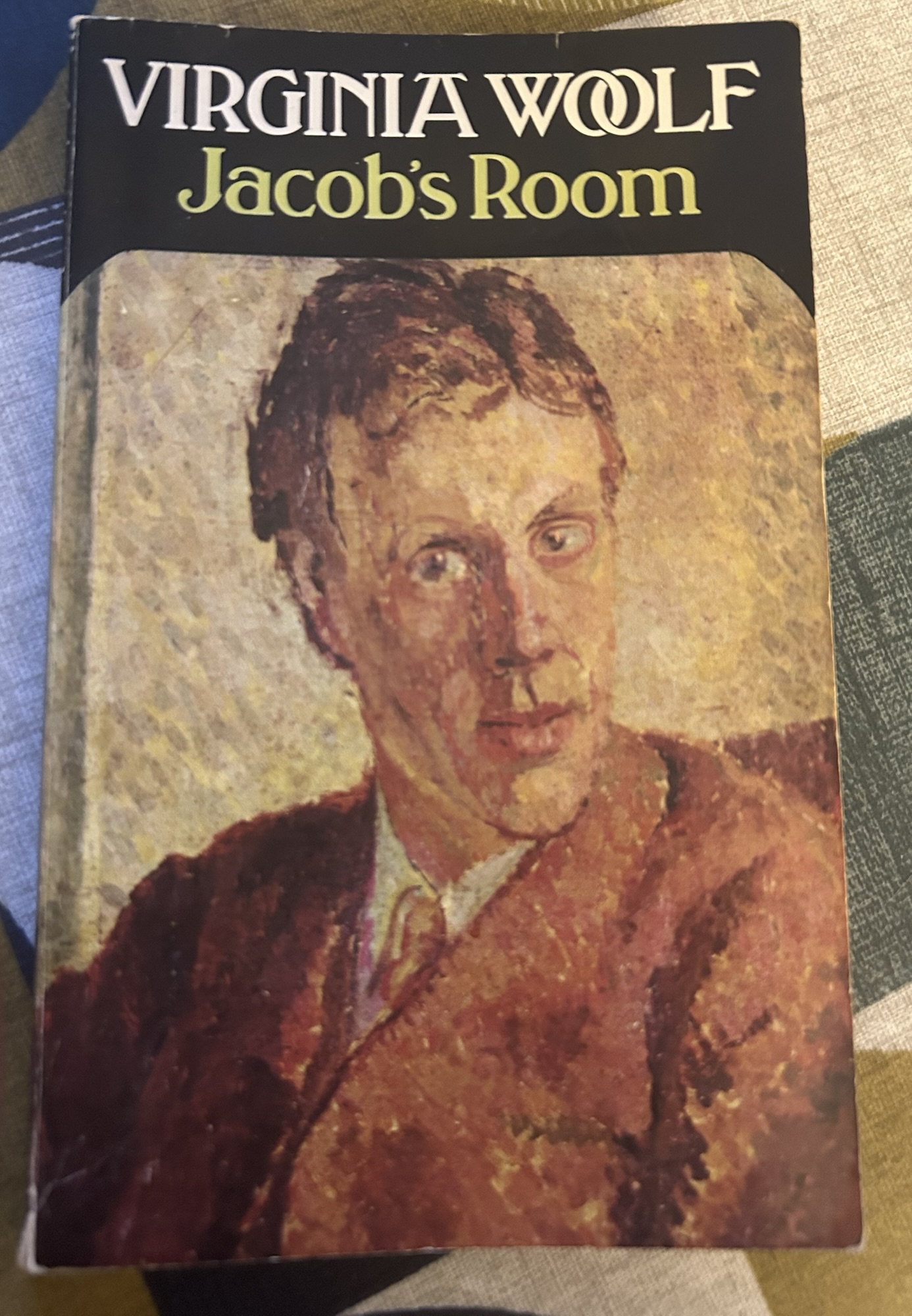
(I’m not sure how much longer my old Granada paperbacks are going to last, they’re very cheap. But I’m sentimental about them because they were the editions my mother – an enormous Woolf fan – had when I was growing up.)
Jacob’s Room portrays Jacob Flanders from childhood at the start of the twentieth century through to young adulthood at the timeof the First World War. It isn’t a character study though, as Jacob is shown obliquely, in impressionistic fragments, mainly through women in his life. Time collapses and viewpoints shift back and forth.
One of the more extensive portraits we have as readers, after a childhood holiday in Cornwall, is from a woman on a train Jacob catches to Cambridge:
“But since, even at her age, she noted his indifference, presumably he was in some way or other—to her at least—nice, handsome, interesting, distinguished, well built, like her own boy? One must do the best one can with her report. Anyhow, this was Jacob Flanders, aged nineteen. It is no use trying to sum people up. One must follow hints, not exactly what is said, nor yet entirely what is done—for instance, when the train drew into the station, Mr. Flanders burst open the door, and put the lady’s dressing-case out for her, saying, or rather mumbling: “Let me” very shyly; indeed he was rather clumsy about it.”
This is a recurring theme throughout the novel: women find Jacob attractive, his shy reticence drawing them in. Yet Woolf also shows his youthful callowness. He is an intellectual snob, but with so little meaningful experience to draw upon:
“For the moderns were futile; painting the least respectable of the arts; and why read anything but Marlowe and Shakespeare, Jacob said, and Fielding if you must read novels?”
Jacob is somewhat ambivalent towards women, although he has a sexual relationship with an artists’ model named Florinda. He seems indifferent to the attentions of Clara Durrant, someone more typically of his social circle:
““I like Jacob Flanders,” wrote Clara Durrant in her diary. “He is so unworldly. He gives himself no airs, and one can say what one likes to him, though he’s frightening because …” But Mr. Letts allows little space in his shilling diaries. Clara was not the one to encroach upon Wednesday. Humblest, most candid of women! “No, no, no,” she sighed, standing at the greenhouse door, “don’t break—don’t spoil”—what? Something infinitely wonderful.”
I love that detail, of Clara not wanting the recording of her feelings to spread beyond the confines of the allotted page. I feel like Woolf’s humour isn’t always given enough credit, and this also stood out to me as an example:
“Southampton Row, however, is chiefly remarkable nowadays for the fact that you will always find a man there trying to sell a tortoise to a tailor.”
Woolf’s portrayals of London are always so instantly recognisable, even 100 years on, but I must admit I’ve never noticed tortoises on Southampton Row.
I can imagine the enigma of Jacob at the centre of the novel could make for a frustrating read for some, but I thought it worked beautifully. Writing in 1922, Woolf was living among a generation that had seen countless young men cut down (foreshadowed with Jacob through his surname), and I thought she captured that loss so sensitively, the potential stopped short:
“And for ever the beauty of young men seems to be set in smoke, however lustily they chase footballs, or drive cricket balls, dance, run, or stride along roads. Possibly they are soon to lose it. Possibly they look into the eyes of faraway heroes, and take their station among us half contemptuously, she thought (vibrating like a fiddle-string, to be played on and snapped). Anyhow, they love silence, and speak beautifully, each word falling like a disc new cut, not a hubble-bubble of small smooth coins such as girls use; and they move decidedly, as if they knew how long to stay and when to go—oh, but Mr. Flanders was only gone to get a programme.”
I love how Woolf mixes the high-flown with the prosaic, in that passage where another artist’s model is reflecting on Jacob, and here too:
“But the thought saddened him. It’s not catastrophes, murders, deaths, diseases, that age and kill us; it’s the way people look and laugh, and run up the steps of omnibuses.”
For me, reading Woolf means you have to sink into her work – she is immersive, and you have to give yourself over to the experience. This was her third novel and while I thought it not quite as strong as some of her later work, I still loved it.
Jacob’s Room makes brave choices in having the central character remain so enigmatic, but in doing so Woolf captures something of the unknown that endures between people, as well as the devastation of a specific generation of men.
“But then, this is only a young woman’s language, one, too, who loves, or refrains from loving. She wished the moment to continue for ever precisely as it was that July morning. And moments don’t.”

