“I’m frightened of eggs” (Alfred Hitchcock)

This weekend has been the long Easter weekend in the UK.  I appreciate not everyone’s Christian (myself included) or that even if you are you might not necessarily celebrate Easter now but in May instead, or not at all.  So I don’t want to bang on about the festival itself at any great length, but I did use it as a starting point for this week’s choices.  I chose a book with references to bunnies in the title, and one about life & death, seeing as how its Easter and springtime, season of renewal.  Two ways to celebrate Easter with no associated risk of adult-onset diabetes (unless of course you tuck into chocolate eggs & simnel cake while reading them, behaviour which I couldn’t possibly endorse…)

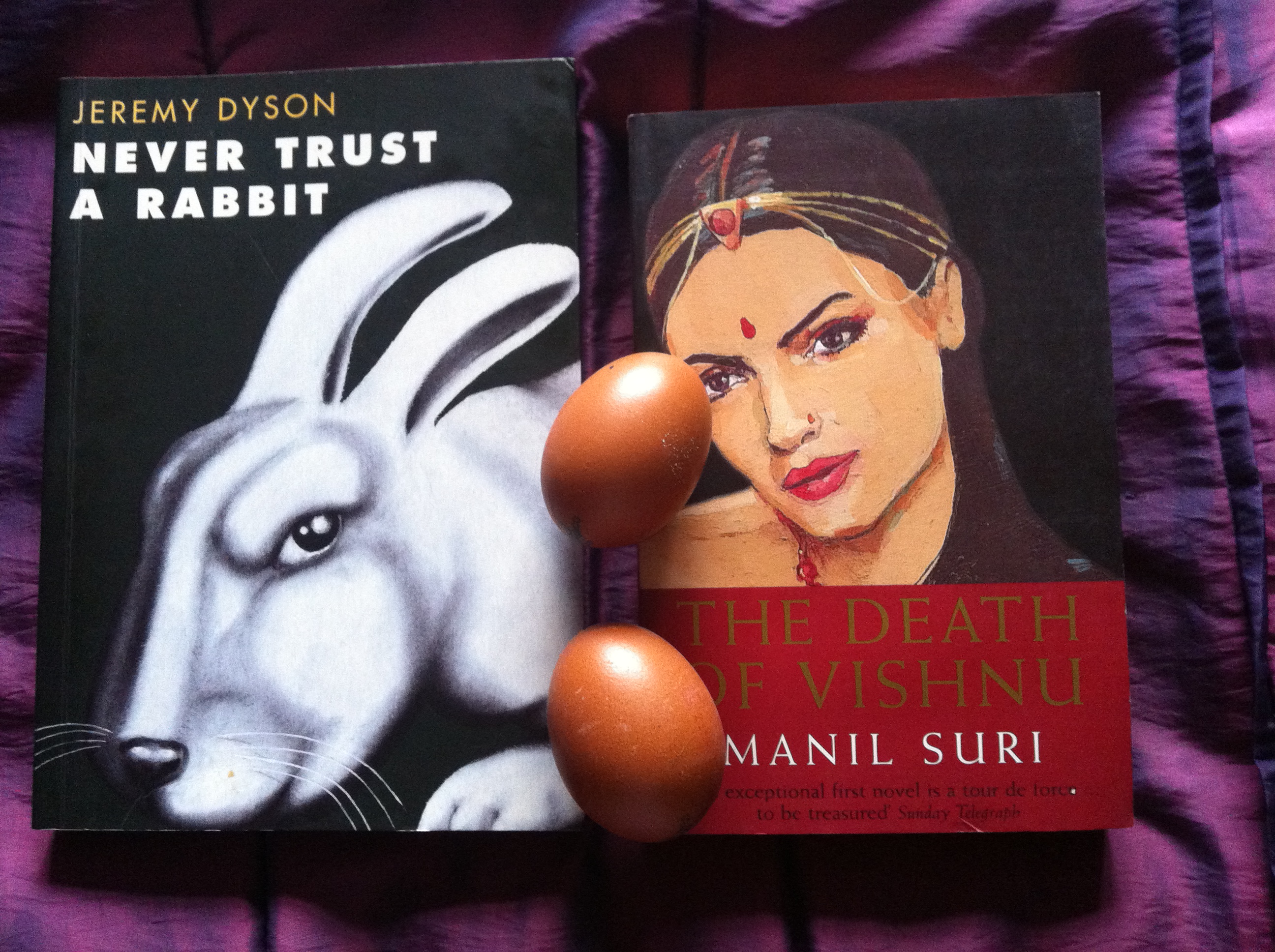
Firstly, Never Trust a Rabbit by Jeremy Dyson (Duck editions, 2000).  Dyson is one of the comedy quartet The League of Gentlemen.  I’m not sure how much success they had outside of the UK, so do forgive me if I’m about to tell you what you already know.  The League made three TV series set in the fictional village of Royston Vasey, where three of the four writers played various bizarre residents of the village (Dyson doesn’t enjoy appearing on screen).  They also made a feature film (The League of Gentlemen’s Apocalypse), in which they played themselves, and Michael Sheen played the role of Dyson.  The reason I mention the TV series is that is if you’re familiar with it, you’ll already have an idea of what to expect: the village production of The Sound of Music as directed by Dario Argento.  The book contains twelve short stories which present familiar situations but unnerve the reader as it gradually emerges that the reality we are dealing with is not exactly what we think we know.  My favourite was probably City Deep, set on the London Underground. It’s an environment I have to deal with regularly but that I try to avoid wherever possible, as I hate the idea of being trapped in a crowd in a tunnel underground.  Dyson perfectly captured the stifling, detached reality that the Tube offers and took it a step further, with a ghoulish, terrifying denouement that to a reluctant tube-user like myself seemed at once outrageous and entirely believable (the dark, hidden truth that I suspected was always there). But the stories aren’t resolutely parochial.  The longest story, The Engine of Desire, takes in several locations worldwide, as the sinister Jack Sleighmaker travels the globe to track down whatever item his extremely wealthy clients desire, by any means necessary.  Sleighmaker is an utterly reprehensible human being and his client is the equally despicable Prince Bandar, but Dyson’s writing is so well-paced and compelling that you find yourself reading on despite not rooting for any of the characters. I read this story in bed and found it so creepy I had to watch clips of kittens falling off things on YouTube before I could go to sleep.  The twelve stories in the collection are all equally strong, there are no weak links; they are also varied enough from one another to keep you entertained while still working together as a collection. (As a P.S to this, another member of The League is Mark Gatiss, whose novels about the gentleman spy Lucifer Box I discuss in the post “Having your book turned into a movie is like seeing your oxen turned into bouillon cubes” on 14 November 2012).

Secondly, The Death of Vishnu by Manil Suri. This novel tells the story of Vishnu, an odd-job man in a residential block, who sleeps on the landing, and now lies dying the same place.  An author’s note at the start of the novel tells you this is based on a true story: while the characters that surround Vishnu are fictional, Vishnu’s name, occupation, and the manner of his death are all true.  I’m still not sure how I feel about this: whether it seems cruel and uncaring, or whether as a Westerner I’m too used to seeing death made taboo, institutionalised and tucked away out of sight so we don’t have to deal with it or our own mortality, and to let a man die where he chooses, the place where he has always lived in full sight, is an acceptance of the process we all face.  The novel doesn’t offer easy answers, it instead presents things as they are and encourages us to recognise a common humanity, in its many guises.  Take the opening line: “Not wanting to arouse Vishnu in case he hadn’t died yet, Mrs Asrani tiptoed down to the third step above the landing on which he lived, teakettle in hand.” On the one hand this shows consideration, on the other, Mrs Asrani doesn’t want to wake Vishnu up because she doesn’t want to deal with him.  Things are not clearly defined in the novel, the characters are all flawed (Vishnu is an alcoholic who is bribed into doing his work by the residents) but they are fully drawn and entirely believable.  We learn about the residents of the block and their various intrigues, and about Vishnu himself as the ordinary events of the day mingle with his reminiscences about his life.  It seems apt to include his memory of Holi, as last week was Holi week:

“The light shines through the landing window. It plays on Vishnu’s face. It passes through his closed eyelids and whispers to him in red.  The red is everywhere, blanketing the ground, coloring the breeze.  It must be the red of Holi. He is nine, hiding behind a tree, fistfuls of red powder in each hand.”

The Death of Vishnu is beautifully written but in a simple style that allows the characters to breathe and readers to find their own way amongst them.

Here are the books with some non-chocolate eggs, so if you share Hitchcock’s phobia look away now:

Image

“Anyone who doesn’t take truth seriously in small matters cannot be trusted in large ones either.” (Albert Einstein)

Two days ago I went to a talk at the London Review Bookshop entitled The Real Jane Austen: A Life in Small Things with Paula Byrne and John Mullan. These two authors have both recently published works on Austen, and realised that they shared common ground in their consideration of the treatment of “small things” in her work, hence the joint talk.  I hadn’t read either of their books, but if they are as lively, learned and accessible in print as they are in person, and you are interested in Jane Austen, I would hazard a guess that seeking out their work would be time well spent.

So this got me thinking about the treatment of small things in literature and I came home to peruse my bookshelves and decide on which books to discuss in this post. I was struck by how many were suitable, how many look at the small things in our lives.  I suppose novels lend themselves to this – it is an intimate form, taking us inside people’s heads, but via our own internal voice.  The gap between ourselves and the story becomes almost imperceptible. Novels can detail the minutiae of life, and I often think that is where the intimacy is.  You know a person well when you know the small things.  A writer who knew the value of small things is oddly, a writer whose most famous work was epic.  James Joyce, author of Ulysses, used to document what he called epiphanies, to use in his work.  What exactly constitutes an epiphany and how to define it is a matter of debate, but I don’t think it matters that we can’t exactly say what they are. In Stephen Hero (an unpublished precursor to A Portrait of the Artist as a Young Man) Joyce defines epiphanies as “the most delicate and evanescent of moments”. Not all of his recorded epiphanies survive, but an oft-quoted one is as follows:

“The Young Lady-(drawling discreetly) … 0, yes … I was … at the … cha … pel …

The Young Gentleman- (inaudibly) … I … (again inaudibly) … I …

The Young Lady-(softly) … 0 … but you’re … ve … ry … wick … ed .”

The meaning that Joyce found in this delicate, evanescent moment cannot be known for sure, but the epiphanies show us that this great writer took small matters seriously and sought out their truth.

If you’ve given Ulysses a bash & given up, you are far from alone.  I only know one person who’s finished it.  But don’t let that put you off Joyce entirely.  Dubliners is a collection of 15 stories set in the Irish capital and is far more accessible than Ulysses.  Deceptively so, as the more you look into the stories the more complex and multi-layered they reveal themselves to be, a bit like the small things in life that we actually attach great meaning to. But the stories can be read easily and a lot gained from doing so, without even exploring their complexities.  They are written in groups of ages, starting off with tales of childhood, then young adulthood, progressing to the final story, The Dead. Eveline is the fourth story, (from the young adult group) and begins:

“She sat at the window watching the evening invade the avenue.  Her head was leaned against the window curtains and in her nostrils was the odour of dusty cretonne.  She was tired.”

In these opening three sentences Joyce evokes so much about Eveline’s situation through the small things: exactly why she is tired, why the curtains are dusty, and why she is looking out into the city become more apparent throughout the story, and these small things have a cumulative meaning of great significance.  But Joyce never explicitly states the epiphanies of his stories, leaving it instead for the reader to extract meaning.  The stories are determinedly small (like Austen’s “two inches of ivory”) but at the same time, by allowing readers to decide for themselves, Joyce ensures they are also limitless.

I saw Annie Proulx interviewed once and she said the short story was her favourite form as every word counts. Joyce described the style of Dubliners as one of “scrupulous meanness”, and he famously spent days constructing sentences: “the right words in the right order” (how did Ulysses ever get finished?), making every word count.  I think this is what makes him both the perfect observer and constructor of small things.

In keeping with the theme of this post, I’m only discussing one book this time.  There didn’t seem to be another one as perfect for this theme as Dubliners, so I decided it was clear I should keep the post a small thing in itself.  (There were lots of contenders though; I’ll have to work out how to squeeze them into another theme). And rather than a photo, this time I’ll leave you with a question raised in this video of one of the greatest moments in one of the greatest sitcoms: are small things really small, or just far away……?