“Shut up, I’m having a rhetorical conversation!” (Max Bialystock, The Producers, 1968)

This my contribution to the 1968 Club, running this week and hosted by Karen at Kaggsy’s Bookish Ramblings and Simon at Stuck in a Book. Do join in!
Firstly, The Quest for Christa T by Christa Wolf (trans. Christopher Middleton). This is the story of Christa’s life, told from the point of view of a schoolfriend who becomes reacquainted with Christa before leukaemia cuts her life short. The opening paragraph captures the concerns of the novel- the impossibility of ever truly knowing another person, and the fallacy of ever trying to capture them in order to portray them to others:

“The quest for her: in the thought of her. And of the attempt to be oneself. She speaks of this in her diaries, which we have, on the loose manuscript pages that have been found, and between the lines of those letters of hers that are known to me. I must forget my memory of Christa T – that is what these documents have taught me.  Memory puts a deceptive colour on things.”

Christa is an enigma. She is self-contained but within that is a resistance; having survived Hitler’s Germany she doesn’t readily conform to East Germany’s strictures:

“she was always tall, and thin, until the last years, after she’d had children. So there she was, walking along in front, stalking head-in-the-air along the curb, and suddenly she put a rolled newspaper in her mouth and let go with a shout: HOOOHAAHOOO – something like that. She blew her trumpet and the off-duty sergeants and corporals of the local defense corps stopped and stared and shook their heads at her.”

This is a watershed moment for the narrator, the point at which she notices Christa and begins to acknowledge her wonder at her friend. However, while Christa is compelling, she also lives a life that is completely ordinary. She grows up, gets married, has children, and works as a teacher.

“Christa T lived strenuously even when she seemed lackadaisical; that ought to be attested, though the point here cannot be attested, though the point here cannot be to justify her…she didn’t attempt to escape from it all, as many people were starting to do in those years. When her name was called: “Christa T!” – she stood up and went and did what was expected of her.”

Despite this, the quest is not one that can be fulfilled – at the end we are in the position of the narrator in that we don’t know who Christa T is either. This is Christa’s final resistance: she conformed exactly how she was supposed to under Nazism and communism, and yet the state, her friends, and the readers of her story cannot box her in.

“There it is again, the language of her sketches, there her voice is heard again.  Yet it will eventually have to stop; the moment is coming where the voice fails, and it can’t be interrupted. Some details pass me by, while I anticipate the end.”

The Quest for Christa T is fragmentary and non-linear, yet it still manages to be a satisfying whole. It is a subtle, beautifully written novel which allows for the reader’s intelligence to find their own meaning. But don’t just take my word for it, take David Bowie’s: The Quest for Christa T was one of his 100 must-read books.
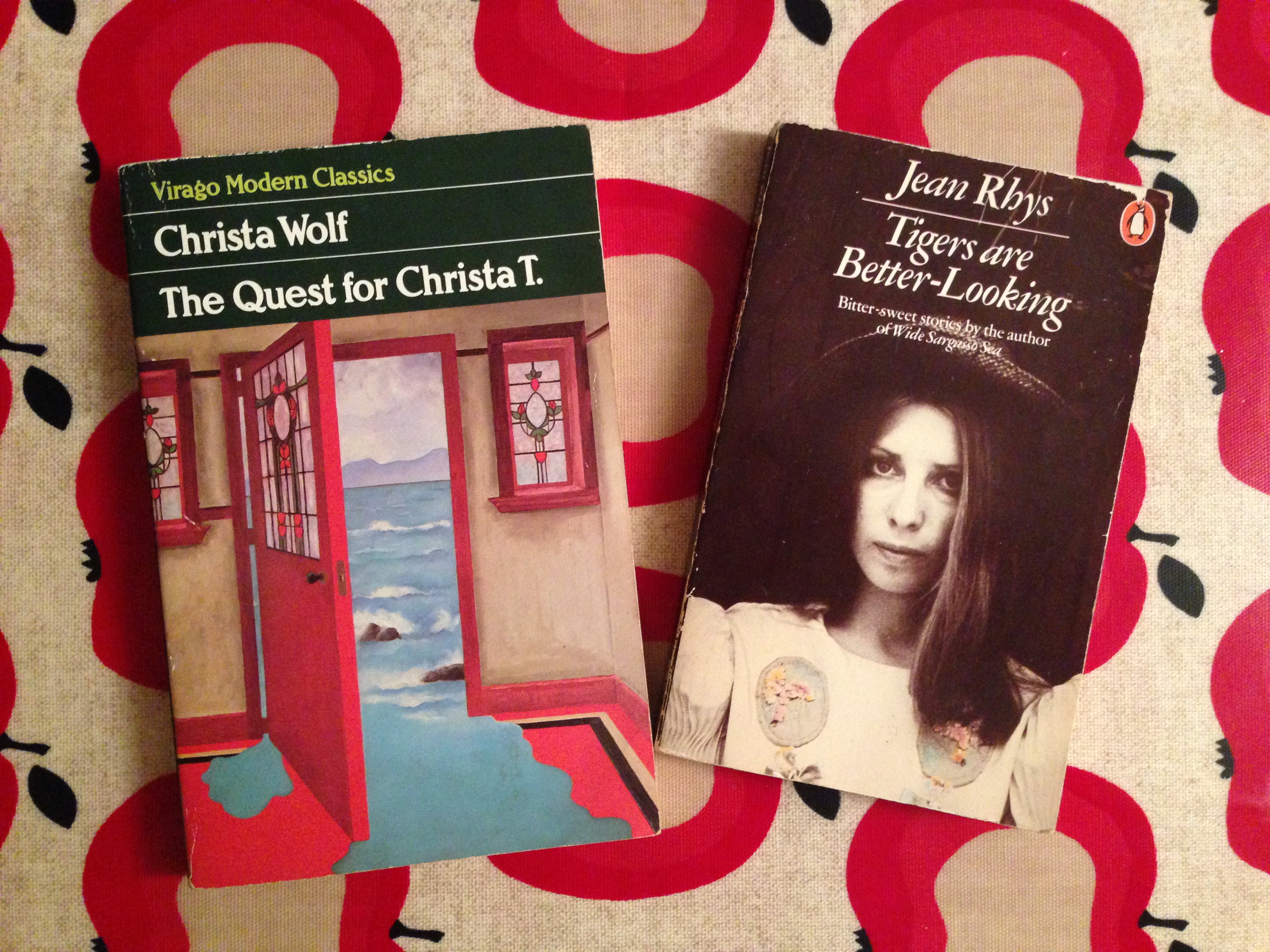
Secondly, the short story collection Tigers are Better-Looking by Jean Rhys, which features two collections, the first 8 stores collected under the titular tale, the last 9 printed from The Left Bank, originally published in 1927. The rest of The Left Bank stories were judged by Rhys to be too weak to merit republication. Surprisingly though, these were my favourite part of Tigers are Better-Looking. While I enjoyed the first selection of stories, I felt they weren’t as strong as Sleep It Off Lady, her final collection of short stories published 8 years after this, which I had greatly enjoyed. While The Left Bank stories are essentially sketches, I thought they had real verve so I’ll concentrate on this section. When read all together they give a wonderful sense of a particular city at a particular time. Rhys captures people with artful description:

Illusion “Miss Bruce was quite an old inhabitant of the Quarter […] one thought of her as a shining example of what character and training – British character and training – can do. After seven years in Paris she appeared utterly untouched, utterly unaffected, by anything hectic, slightly exotic or unwholesome. Going on all the time all round her were the cult of beauty and the worship of physical love: she just looked at her surroundings in her healthy, sensible way, and then dismissed them from her thoughts”

And she is equally adept at capturing relationships, such as that between a painter and ex-prostitute in Tea with an Artist:

“And then I remembered the way in which she had touched his cheek with her big hands. There was in that movement knowledge, and a certain sureness: as it were the ghost of a time when her business in life had been the consoling of men.”

Rhys often drew on her own life and there are certainly stories here that will be familiar to anyone who has read her work: depression and poverty in Hunger, the life she knew as a shop model in Mannequin, but she also broadens her gaze. There is a touching portrait of an old man and child in From a French Prison, a tragic love affair in La Grosse Fifi quite different from the dinginess and malaise that characterises the affairs she normally writes about.The longest story is Vienne, and here is where the shadow of war begins to loom over the Europe she has been portraying. A young couple, too sad to be Bright Young Things, desperately traverse the continent without quite understanding the danger, but knowing they must reach safety.

“We drank a still wine, sweetish, at dinner. It went to my head and again I could tell myself that my existence was a dream. After all it mattered very little where we went. Warsaw, London…London, Warsaw…..Words! Quite without the tremendous significance I had given them.”

I don’t think Tigers Are Better Looking is Rhys at her best, but there is still so much to enjoy in this collection, flashes of brilliance even when the stories aren’t as strong. She’s a wonderful writer and reading this has encouraged me to dig out the remaining novels of hers that I have yet to read.

To end, the UK number one this week in 1968. All together now: la, la, la, la, la, laaaaaaaaaa….

“Merry Christmas, Everyone” (Shakin’ Stevens)

After last week’s moany post, I have survived both work dos and I am in the Christmas spirit – joyeux noel!

animated-merry-christmas-image-0259

I even gifted to myself, in the shape of Karl Ove Knausgaard (if only) by going to see him interviewed for World Book Club, in the rather formal surrounds of the council chamber at the BBC (free wine! and crisps! so that’s where my licence fee goes – I approve). He was every bit as good-looking charming and erudite as I’d hoped so if you get a chance to listen to the show at some point (on in early January) I recommend it. And it warmed my post-Brexit heart to be part of such an international audience, so thank you BBC 🙂

Back to Christmas. At this time of seasonal over-indulgence, I’ve decided to exercise uncharacteristic restraint. Two Christmas stories, but both of them short stories, wee amuse-bouches that can easily be consumed by a brain threatening to slip into a vegetative state from the over-consumption of, well, everything really…

Firstly, the titular story from The Adventure of the Christmas Pudding and a selection of entrees by Agatha Christie (1960). Things begin in fine Golden Age form: Poirot is asked by a mysterious government-type to find a missing ruby that a foreign prince has mislaid on Blightly’s shores, in order to avoid an international incident. Poirot is hard to persuade and the government-type is close to losing his cool:

“Mr Jesmond made a peculiar noise rather like a hen who has decided to lay an egg and then thought better of it.”

Poirot decides to leave his lovely art deco flat (I want it! I want it!) once he knows his accommodation for Christmas has oil-fired central heating:

“Again Poirot shivered. The thought of a fourteenth-century English manor house filled him with apprehension. He had suffered too often in the historic country houses of England.”

I did enjoy that little swipe at the trope of country house mysteries.  Christie’s clearly having a great time writing this, evoking a traditional country house Christmas and then throwing everything at it, from faked murders to mysterious strangers to anonymous notes left for Poirot:

“Don’t eat none of the plum pudding. One as wishes you well.”

I think I’ve eaten that plum pudding. Of course, Poirot is on top of everything and speedily resolves murder, mystery, missing jewels and that most pressing of seasonal considerations: is the plum pudding safe?

Secondly, again the titular story of a collection, this time Christmas at Cold Comfort Farm by Stella Gibbons (1940), set in the time before her famous comic novel, and so the Starkadder family are in full disarray.

“The Starkadders of Cold Comfort Farm had never got the hang of Christmas, somehow, and on Boxing Day there was always a run on Howling pharmacy for lint, bandages, and boracic powder.”

In this short story we are treated to a portrait of Christmas at the farm, a Christmas no-one in their right mind would want. Nothing particularly happens, it is more a series of events over the course of the day to display the Starkadders in all their colourful, brutal, hilarious glory.  If you’re not familiar with the family from Cold Comfort Farm, well, firstly, away with you and read the comic treat! But if you decide to read the Christmas story first, all you need to know about the family can be gleaned from the idiosyncratic and truly disgusting charms which grace the Christmas pudding:

“Him as gets the sticking plaster’ll break a limb; the menthol cone means as you’ll be blind wi’ headache, the bad coins means as you’ll lose all yer mony, and him as gets the coffin-nail will die afore the New Year. The mirror’s seven years’ bad luck for someone, Aie! In ye go, curse ye!”

Gibbon’s driest humour is saved not for the family but for those around them, such as the vicar who has been guided to pay a Christmas Eve visit by the crate of British Port-type wine he saw being delivered to the farm (surely there’s not enough port wine in the world to get you through a festive visit with the Starkadders?) If you enjoyed Cold Comfort Farm there’s much to relish in this brief visit to the family.  A treat.

To end, proof if proof were needed, that my ‘taste’ in Christmas tunes is very much of an era.  The post began with the double-denim Welsh Elvis that is Shaky, and now ends with the greatest Christmas video ever (non-debateable). There will never come a day when I’ve seen this too many times, I love everything about it. The snow, the ski lodge, the mullets, the meaningful looks over the tinsel, the death stare down the dining table… enjoy 😀

UPDATE: It was announced on Christmas Day that George Michael had died. Rest in Peace George, and thank you for all the tunes xx

“She had books, thank Heaven, quantities of books. All sorts of books.” (Jean Rhys, Quartet)

This is a further (mini) contribution (not my usual two-work blog post) to Jean Rhys Reading Week, hosted by Jacqui at JacquiWine’s Journal and Eric at Lonesome Reader. Do check out their blogs and join in!

Jean Rhys

This time I’m looking at Sleep It Off Lady (1976) which is Rhys’ final collection of stories, published 3 years before she died. The stories are presented in a chronological order of the age of the protagonist, so it almost feels like a dipping into and out of someone’s life at various points; from the two young sisters living in Dominica in the first story Pioneers, Oh Pioneers to the young woman in Paris in Night Out 1925, to the elderly woman living alone in the titular penultimate story.

This approach is not dissimilar to her longer fiction, such as Good Morning Midnight, which used stream of consciousness to build up a picture of a life from fractured parts. All the things I enjoy in Rhys’ longer fiction are evident in her short stories. For example…

Her humour used to highlight a serious issue – such as mental illness encountered by repressed Edwardian Brits in the colonies:

“‘If,’ said Mr Eliot ‘the man had apologized to my wife, if he’d shown the slightest consciousness of the fact that he was stark naked, I would have overlooked the whole thing. God knows one learns to be tolerant in this wretched place. But not a bit of it. He stared hard at her and came out with: ‘What an uncomfortable dress – and how ugly!’ My wife got very red.  Then she said: ‘Mr Ramage, the kettle is just boiling. Will you have some tea?’” (Pioneers Oh Pioneers)

Her unblinking look at sexual politics which degrade women and empower men. This takes an even darker turn when she documents the sexual assault of a twelve year old (this is written very sensitively and not at all gratuitously, but neither does it let the reader off the hook – we can’t ignore what has happened):

“He talked of usual things in a usual voice and she made up her mind that she would tell nobody of what had happened. Nobody. It was not a thing you could possibly talk about. Also, no one would be believe exactly how it had happened, and whether they believed her or not she would be blamed.” (Good-bye Marcus, Good-bye Rose)

And her startling observations that disconcert yet articulate something fundamental:

“But it was always the most ordinary things that suddenly turned round and showed you another face, a terrifying face. That was the hidden horror, the horror everyone pretended did not exist, the horror that was responsible for all the other horrors.” (The Insect World)

I’m so glad I took part in Jean Rhys Reading week as it encouraged me to explore this writer much sooner than I otherwise might have done.  I’ve no idea why, having rated Wide Sargasso Sea so highly when I first read it in my teens, I allowed Rhys to slip off my radar. Her writing seems drawn directly from her life yet she is able to explore themes that you don’t need to be an ex-colonial, chorus girl, artist’s model, thrice-married Parisian who is friends with Ford Madox Ford to find meaning in (at least I assume so, since that’s basically my life in a nutshell).

“Very widespread now – heart condition.” (Sleep It Off Lady)

I’m really looking forward to reading the rest of her work, I only wish there was more of it.


“One benefit of summer was that each day we had more light to read by.” (Jeanette Walls)

A couple of weeks ago the news reported it was the busiest day for holiday getaways. And just in case there was any doubt that this was a British news story, it was delivered by a reporter standing next to a motorway, framed within a narrative context of extreme traffic jams, while the traffic behind her was disappointingly free-flowing. Brilliant. It’s the first bit of news that raised a smile from me after Brexit.

Sadly, my finances are as dire as ever so I will have to leave the joys of non-existent traffic jams to more solvent souls. Instead I looked to my TBR for some suitably summery titles and came up with two that by coincidence are both short story collections. So not quite the traditional holiday doorstop reading matter, but highly recommended nonetheless.

Firstly, Sunstroke by Tessa Hadley (2007), whose stories explore desire in various guises, showing how it is both extraordinary and everyday. The titular story looks at old friends Rachel and Janie, married with kids, committed to their lives yet willing to risk it all for a moment’s sexual excitement:

“Neither is exactly unhappy, but what has built up in them instead is a sense of surplus, of life unlived. Somewhere else, while they are absorbed in pushchairs and fish fingers and wiping bottoms, there must be another world of intense experiences for grown-ups.”

Hadley is very good at placing dramatic tension within these ordinary domestic details. Her settings and characters are wholly recogniseable, and it is this that makes her writing challenging: you can’t step away from it as something outside your experience. So even if you’ve never had an affair with your lecturer, tracked down the older woman who got away, or recreated the sexual betrayals of your parents within your own love life, as the protagonists of Hadley’s short stories have, it is difficult to claim that these experiences are entirely alien. Is it out of character behaviour, or is it that someone’s character is sublimated beneath the ordinary? Hadley questions how secure anything is, how sure we can be of the foundations of our lives, when in a moment, something can happen to change the narrative we’ve constructed:

“Even if we were good, if we were perfectly and completely chaste, we can’t control what happen in our imagination. So being good might only be another kind of lie.”

Hadley is a highly skilled writer. Often I found myself on finishing the stories thinking “Oh, that’s clever.” The collection works as a whole and the individual stories are exactly what the genre should be: powerful, contained, strengthened rather than weakened by their limited words. She’s also great at effective turns of phrase:

For a moment he was sure she could smell something on him, see something of the dazzle that was clinging to him, dripping off him, flashing round in his veins. But he saw her deliberately tidy that intimation away, out of consciousness. This was her husband, the man she knew. He was a physics teacher and competition-standard chess player, wasn’t he?”

Duran Duran taking a formal approach to their barging holiday along Birmingham's canal system
Duran Duran taking a formal approach to their barging holiday along Birmingham’s canal system

Secondly, The Shell Collector by Anthony Doerr (2002), written 12 years before the Pulitzer prize-winning All the Light We Cannot See. Having read this collection, I don’t think it’s too much to say the Pulitzer potential was already evident – this is a brilliantly written collection of stories, spanning several countries: Kenya, Liberia, the US,  Finland, Tanzania. In the titular story, a young boy loses his sight and discovers the love of his life:

“‘That’s a mouse cowry,’ the doctor said. ‘A lovely find. It has brown spots, and darker stripes at its base, like tiger stripes. You can’t see it, can you?’

But he could. He’d never seen anything so clearly in his life. His fingers caressed the shell, flipped and rotated it. He had never felt anything so smooth – had never imagined something could possess such deep polish. He asked, nearly whispering: ‘Who made this?’ The shell was still in his hand, a week later, when his father pried it out, complaining of the stink.”

As an adult, his quiet life collecting on the coast is disturbed by people wanting him to sting them with cone shells, convinced it will cure their various ills. It is a melancholy tale, about a search for meaning in the world, about loneliness and grief. Ultimately though, it is about resilience and love.

“He took the cone shell and flung it, as far as he could, back into he lagoon. He would not poison them. It felt wonderful to make a decision like this. He wished he had more shells to hurl back into the sea, more poisons to rid himself of.”

All eight stories in this collection are beautifully written; wise and moving. Even in such company, one of the stories which stood out for me was The Caretaker, about a Liberian refugee. Joseph Saleeby is not a particularly likable man when we first meet him: selfish, spoilt and making a living illegally. Then war breaks out, and he suffers horribly. He arrives in the US to claim refuge, deeply traumatised.  When the bodies of six whales are washed ashore, he takes their hearts and buries them on the estate where he is caretaker:

“He fills the hole, and as he leaves it, a mound of earth and muscle, stark amid a thicket of salmonberry with the trunks of spruce falling back all around it… he feels removed from himself, as though his body were a clumsy tool needed only a little longer. He parks in the yard and falls into bed, gore-soaked and unwashed, the door to the apartment open, the hearts of all six whales wrapped in the earth, slowly cooling. He thinks: I have never been so tired. He thinks: at least I have buried something.”

He starts growing fruit and vegetables on the plot of land and befriends the unhappy daughter of the owners. Things do not go well for Joseph as people don’t realise how mentally fragile he is, but his friendship with Belle endures:

“The girl saws a wedge from one of the halves. The flesh is wet and shining and Joseph cannot believe the colour – it is as if the melon carried light within it. They each lift a chunk of it to their lips and eat. It seems to him that he can taste the forest, the trees, the storms of the winter and the size of the whales, the stars and the wind. A tiny gob of melon slides down Belle’s chin.”

Doerr writes with delicacy but without sentimentality. His view is penetrating and unblinking, but compassionate. Just devastating.

To end, summer = Pimms, and this advert = another chance to acknowledge the enduring genius of Adam Ant:

“Honeymoon, keep a-shining in June” (By the Light of the Silvery Moon)

As a companion piece to my last post about marriage, I thought I would look this week at portrayals of honeymoons. Originally I planned to include On Chesil Beach by Ian McEwan but I ran out of time & wanted to re-read it in order to do it justice, as I remember it being very moving. So please don’t let my inadequacy prevent you from checking it out if you haven’t read it 😉 Onwards to honeymoon stories I’ve read more recently!

Firstly, Orkney by Amy Sackville (2013), which is an eerie, claustrophobic tale of a honeymoon taken on a remote Scottish island. Richard is a professor of English literature who is entranced by literary sirens and by his silver-haired wife, forty years younger than he, strange and unknowable:

“She is a tiny, perfect, whittled trinket found bedded in the sand, carved patiently, for comfort; she is a spined and spiky urchin with an inside smooth as polished stone, as marble; she is frond of pallid wrack, a coral swaying in the current, anchored to the sea-bed; she is an oyster, choking on grit, clutching her pearl to her.”

The unnamed wife is obsessed with the sea, taking long, lone walks by day and having water-filled nightmares by night:

And as she dreams her submarine dreams I lie beside her, a whale’s carcass, a wrecked ship, a vast ribcage in the dark blue deep; and she is a tiny luminescent silver fish, picking me clean, in and out of all that’s left of me, bare bones long since freed of flesh and rigging.”

Each chapter covers a day of their honeymoon, told from Richard’s perspective. This is not a plot-driven story as very little happens, in some ways it is quite a slight tale, but I found Sackville’s beautiful writing made it compelling and carried me along. The atmosphere gradually becomes more uncanny, with a sense that is not just Richard’s wife who is unknown, but that there are no certainties at all:

“An overcast, lowering sky this morning; the clouds have clotted through the night. Something gathering, brooding, out on the sea. A darkness spreading. The edges of my wife blur against the sky.”

Orkney is short novel about the stories we tell ourselves and each other, how we understand the world, and how what is real and unreal is not always clearly delineated:

“He tells her tales of the finfolk and selkies. Nothing can replace those first tales, which have coloured the cast of her thought, which have filled her nights with the sea, which are at least as real to her as anything she’s learned of the world since.”

Secondly, the short story Here We Are by Dorothy Parker (1931). A young couple are on a train, having been married “exactly two hours and twenty-six minutes”.  Most of the story is dialogue, and they come across as so terribly young and naïve.

“He sat down, leaning back against the bristled green plush, in the seat opposite the girl in beige. She looked as new as a peeled egg. Her hat, her fur, her frock, her gloves were glossy and stiff with novelty.”

They sit and talk about the day, the wedding, those they know, and bicker about silly things: hats, mainly.

“‘Hell, honey lamb, this is our honeymoon. What’s the matter?’

‘I don’t know,’ she said. ‘We used to squabble a lot when we were going out together and then engaged and everything, but I thought everything would be so different as soon as you were married. And now I feel sort of strange and everything. I feel so sort of alone.’”

Of course, what they are not saying is that the train is speeding them towards a hotel room, and they are terrified about what is going to happen once they are alone together.  The story is a masterclass in ‘show, don’t tell’ writing. Parker’s trademark acerbic wit is not to the fore – the story is gently funny, and I felt sorry for this unknowing couple marrying in such a different age, and desperately hoped it would work out for them.

Speaking of virgins:

The Tendrils of the Vine – Colette (Le Monde’s 100 Books of the Century #59)

This is part of a series of occasional posts where I look at works from Le Monde’s 100 Books of the Century.  Please see the separate page (link at the top) for the full list of books and an explanation of why I would do such a thing.

When I first started this challenge, I thought it would never be complete as I have commitment issues Wikipedia told me that Tendrils of the Vine had never been translated.  Yesterday in my favourite charity bookshop (handily located across the road from my flat, so I don’t have to stagger far with my heavy loads/nightmarishly located across the road from my flat – if you had a problem with drug addiction you wouldn’t live opposite a crack den) I picked up a huge volume of The Collected Stories of Colette for £3.50, and was very excited to see Tendrils of the Vine translated within it (by Herma Briffault – and I see Wiki no longer makes its fallacious claim).

In fact , Tendrils of the Vine, proclaimed A Fable in the title, is only 1000 words long and I may have been able to struggle through with my appalling French.  The difficulty is, being only 1000 words long, I really can’t say too much about it without spoilers, so this will be an uncharacteristically short post from me 🙂

The story begins in typical fable fashion, describing how the nightingale got his song:

“While he slept, the vine’s gimlet feelers – those imperious and clinging tendrils whose sharp taste, like that of fresh sorrel, acts a stimulant and slakes the thirst, began to grow  so thickly during the night that the bird woke up to find himself bound fast, his feet hobbled in strong withes, his wings powerless…”

The nightingale escapes, and sings relentlessly to keep himself awake through the Spring,  thereby avoiding the terrors of the vine.  I can’t say much more, except Colette then expands this into a truly creepy and oppressive tale. The fact that she does this in 1000 words within a pastoral fabulistic setting makes it like a short, sharp punch to the sternum. What a writer – I’m looking forward to reading the rest of my newly-acquired tome.

“We’ve all heard that a million monkeys banging on a million typewriters will eventually reproduce the entire works of Shakespeare. Now, thanks to the Internet, we know this is not true.” (Robert Wilensky)

Gong Hei Fat Choi! Happy New Year of the Fire Monkey! To celebrate the start of the Lunar New Year I thought I would look at writers from cultures and countries outside of China that also widely celebrate this event: a Hong-Kong born writer’s Philippines-set novel, and a Japanese writer, as the interwebs tell me Japan celebrates both the Gregorian and Lunar new years.  These will also be two more stops on my Around the World in 80 Books Reading Challenge, hosted by Hard Book Habit.

Firstly, Brownout on Breadfruit Boulevard by Timothy Mo (1995). I picked this up because it was enthusiastically recommended  in a lecture I attended on post-colonial literature. Brownout is set primarily in the Philippines, in the fictional city of Gobernador de Leon, where Victoria Init, admirer of Imelda Marcos, strives to extend her congressman husband’s power.

“Rubbish carts too dilapidated to carry the neat and frugal household wastes of Osaka had come from Japan; schoolbuses no longer fit to carry Korean children from Seoul; traffic lights , too laconic to blink longer at the soldierly traffic in Wellington would glare defeasance implacably red-eyed at the escaped lunatics behind the steering wheels of the Gobernador de Leon jeepneys. Traffic was absurdly heavy…you would stay in the same place a maximum of five minute before creeping on again…So what if it was only inches? Advance was cumulative; the achievement slow but palpable. In short, at the end of it you had made progress. Progress was Victoria Init’s idol. She would sacrifice everything and everyone at the feet of that stern shibboleth”

The second part of the novel deals with a conference of academics coming to the city, through which Mo is able to extend the portrait of corruption flourishing in the face of lazy indifference and self-interest far beyond the politicking Inits and a toothless journalist named Boyet. The visiting intellectuals have no understanding, wrapped up as they are in their own tiny worlds. Some are overtly derogatory to other cultures, others restraining themselves to sweeping racism:

“Filipinos don’t actually have a colonial chip on their shoulder…The ordinary pinoy likes America and Americans, in fact there’s nothing he’d like better than to be one. And as for the language of the oppressor issue, Holy Moses, they grow up speaking English. It’s as natural to them as…”

I think it speaks volumes that the sentence is unfinished by the speaker. As a satire Brownout doesn’t entirely work – there’s not really a character to care about, to anchor the narrative to or throw the corruption into sharp relief.  It’s a novel filled with characters, a broad portrait that for me could have done with being a little deeper.  However, Mo is a highly skilled writer and, as my lecturer suggested, Brownout is certainly interesting from a post-colonial point of view. It didn’t wholly capture me but I enjoyed it enough that it makes it onto this blog, where I only write about books I recommend.

Secondly, The Diving Pool by prolific Japanese writer Yoko Ogawa (trans. Stephen Snyder), a collection of three stories written in a beautiful, spare style. In the deeply unsettling titular story a young girl falls in love with her foster brother:

“Sometimes I wish I could describe how wonderful I feel in those few seconds from time he spreads his arms above his head, as if trying to grab hold of something, to the instant he vanishes into the water. But I never can find the right words. Perhaps it’s because he’s falling through time, to a place where words can never reach.”

The narrator lives with a large extended family where she is the only biological child.

“I can never hear the words ‘family’ and ‘home’ without feeling that they sound strange, never simply hear them and let them go. When I stop to examine them, though, the words seem hollow, seem to rattle at my feet like empty cans.”

It’s quite a feat that for a precise, beautifully eloquent writer such as Ogawa, she makes what is left unsaid and unacknowledged the dominant theme of the collection. The girl in The Diving Pool carries out horrible acts of cruelty without really knowing why; in Pregnancy Diary, a young woman is mesmerised and yet alienated by her sister’s pregnancy:

“I wonder how she broke the news to her husband. I don’t really know what they talk about when I’m not around. In fact, I don’t really understand couples at all. They seem like some sort inexplicable gaseous body to me – a shapeless, colourless, unintelligible thing trapped in a laboratory beaker.”

Again, the narrator does not behave well, indeed, behaves in a shocking way, with quiet malice. The inarticulate nature of the narrators makes their behaviour all the more unsettling, as it is presented through simple statements of fact, unadorned and unjustified.

In the final story, Dormitory, a young woman returns to the dorm building she stayed in as a student:

“I would hear it for the briefest moment whenever my thoughts returned to the dormitory. The world in my head would become white, like a wide, snow-covered plain, and from somewhere high up in the sky, the faint vibration began…I never knew how to describe it. Still, from time to time I attempted analogies: the icy murmur of a fountain in winter when a coin sinks to the bottom; the quaking of the fluid in the inner ear as you get off a merry-go-round; the sound of night passing through the palm of your hand still gripping the phone after your lover hangs up…”

Ogawa is a stunning writer, and in this final story, rather than a psychologically disturbed protagonist, she unsettles the reader by leading them down a well-worn narrative route, before abruptly destabilising it with a surreal and astonishing final image. Highly recommended.

“Change is inevitable – except from a vending machine.” (Robert C. Gallagher)

Dear reader, it’s been so long.  Let’s just say working pretty much full-time while studying for my Masters as a full time student basically leaves time for oooh, nothing else at all. My brain is close to exploding with all I’m trying to cram into it. Put it this way: I’ve lost all capacity for nouns.  I can’t remember the name of anyone or anything.  Apparently this is a sign of dementia starting.  I’m trying to be positive and think it’s just a sign of my impending breakdown.

Anyhoo, it’s March now, and so I’ve decided that Spring has officially sprung.  I’m sick of winter, and although it’s cold and grey in old London town today, we’ve had at least 3 days where it’s been sunny & bright & I’ve had to remove my jacket as I’m too warm. There are daffodils, so it’s Spring, people!  Annoyingly, with this seasonal transformation comes exhortations from women’s magazines to transform your body into something called ‘bikini-ready’ or similar. Ugh. As a bibliophile I thought rather than attempting transformation, I would  read about instead.  Read about it seated in my favourite chair eating chocolate/cheese/chocolate topped with cheese while refusing to wear a bikini.

Firstly, possibly the most famous transformation story of all, The Strange Case of Dr Jekyll and Mr Hyde by Robert Louis Stevenson (1886). This is such a well-known story that I won’t bother outlining the plot.  Just in case you need a reminder though, here’s a visual summary from the 1931 film:

Dr Jekyll observes:

“It was on the moral side, and in my own person, that I learned to recognise the thorough and primitive duality of man; I saw that, of the two natures that contended in the field of my consciousness, even if I could rightly be said to be either, it was only because I was radically both” 

His potion suppresses his duality and lets forth the base Mr Hyde:

“He is not easy to describe. There is something wrong with his appearance; something displeasing, something downright detestable. I never saw a man I so disliked, and yet I scarce know why. He must be deformed somewhere; he gives a strong feeling of deformity, although I couldn’t specify the point. He’s an extraordinary-looking man, and yet I really can name nothing out of the way. No, sir; I can make no hand of it; I can’t describe him.”

The novella is not the most accomplished piece of writing but there are some well crafted passages:

“It was a fine, clear, January day, wet under foot where the frost had melted, but cloudless overhead; and the Regent’s Park was full of winter chirrupings and sweet with spring odours. I sat in the sun on a bench; the animal within me licking the chops of memory; the spiritual side a little drowsed, promising subsequent penitence, but not yet moved to begin.” 

When originally published, this Victorian novella no doubt spoke to anxiety about sexual drives which may have faded somewhat, but the metaphor still lends itself to inner turmoil and guilt, when Hyde is figured as “the ghost of some old sin, the cancer of some concealed disgrace”; or the personality change associated with drug/alcohol addiction, as Hyde has “the body of a self-destroyer”; or various dissociative/psychotic psychological disorders.  I think what makes this story so famous and enduring is that it captures an anxiety about who we are, and of what we are capable.  The terror of The Strange Case of Dr Jekyll and Mr Hyde is not in Hyde himself, but in the unsettling notion that Hyde is not strange, but in fact common to us all.

Secondly, a chance for me to indulge my on-going obsession with Angela Carter, and discuss ‘The Tiger’s Bride’ from The Bloody Chamber.  This collection of stories saw Carter reworking fairytales; an obvious choice for this post as the genre is filled with transformations – beasts into princes, wolves into grandmothers, wicked step-mothers into witches.  In ‘The Tiger’s Bride’ narrator’s father stakes her in a game of cards, only to lose.

“I watched with the furious cynicism peculiar to women whom circumstances force mutely to witness folly, while my father, fired in his desperation by more and yet more draughts of the firewater they call ‘grappa’, rids himself of the last scraps of my inheritance. When we left Russia, we owned black earth, blue forest with bear and wild boar, serfs, cornfields, farmyards, my beloved horses, white nights of cool summer, the fireworks of the northern lights. What a burden all those possessions must have been to him, because he laughs as if with glee as he beggars himself; he is in such a passion to donate all to The Beast.”

The Beast is the name given to the Lord of the manor, a man who smells of:

“potent a reek of purplish civet at such close quarters in so small a room. He must bathe himself in scent, soak his shirts and underlinen in it; what can he smell of, that needs so much camouflage?”

The narrator moves into his lair:

“A profound sense of strangeness slowly began to possess me. I knew my two companions were not, in any way, as other men, the simian retainer and the master for whom he spoke, the one with clawed fore-paws who was in a plot with the witches who let the winds out of their knotted handkerchiefs up towards the Finnish border. I knew they lived according to a different logic than I had done until my father abandoned me to the wild beasts by his human carelessness…I was a young girl, a virgin, and therefore men denied me rationality just as they denied it to all those who were not exactly like themselves, in all their unreason.”

This Angela Carter, and so things do not play out as tradition would dictate: there is no helpless heroine surrendering herself to a man in this tale:

“I squatted on the wet straw and stretched out my hand. I was now within the field of force of his golden eyes. He growled at the back of his throat, lowered his head, sank on to his forepaws, snarled, showed me his red gullet, his yellow teeth. I never moved. He snuffed the air, as if to smell my fear; he could not.

Slowly, slowly he began to drag his heavy, gleaming weight across the floor towards me.”

The transformation in the tale is two-sided and empowering. It is everything you would expect from Carter: weird, surprising, audacious, and above all skilfully written with beautiful, concise prose.

To end, a warning from The Librarians that you should never wish your life would transform to a fairytale:


“Let the little fairy in you fly!” (Rufus Wainwright)

December is a month of magic – at least, that’s how I choose to see it, rather than a month of biting winds, zero natural light, and weeping over the expanding credit card bills and waistlines that mark the holiday season.  No, it is a time of magic – fairies sit on top of trees, reindeer fly and strangers somehow shoot down chimneys and creep into kids bedrooms without being put on a register.  In honour of this time I thought I’d look at literature around fairies.

When I was growing up I loved the delicate drawings of Cicely Mary Barker’s Flower Fairies; the Poppy Fairy was my favourite because she looked a bit naughty.  I’m not sure what that says about me as a child….

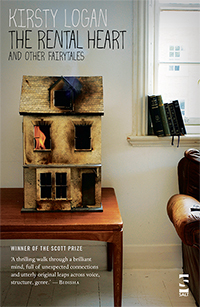
Firstly, The Rental Heart and Other Fairytales by Kirsty Logan (Salt Publishing, 2014).  I picked this up after reading Naomi’s review on her The Writes of Women blog. It was every bit as good as Naomi suggested. The twenty stories in this volume are united by fairytale themes, but also explorations of sexuality, gender, love and desire that demonstrate how the extraordinary can promote new ways of understanding the everyday.

9781907773754frcvr.indd

(Image from: http://www.saltpublishing.com/shop/proddetail.php?prod=9781907773754)

Logan plays with animating the inanimate and mechanising the organic to destabilise notions of identity.  So The Rental Heart sees a woman protect herself from heart-break, leasing mechanised versions of the muscle which she renews as needed. In Origami Rebecca constructs herself a paper lover; in Coin Operated Boys, Elodie rejects “Imperfect. Awkward. Repulsive…” human suitors for the titular machines, responding to their “calm, clean angles”, cool touch, and eyes “flat as a pond in summer”. In this way Logan shows how desire is manifold and defies easy categorisation, while exploring how we seek to control desire, and how denial of our humanity can lead to detachment from ourselves and others.

Extraordinarily, Logan’s startling use of images throughout her stories did not cause me to detach, but rather reveals new ways of perceiving that truly resonate. Choosing any page at random would give me a quote for this post, Logan is truly that good.

From Bibliophagy: “Standing pigeon-toed and bruise-kneed in the light from the fridge, his neck finally stops twitching. The words are waiting, cold as milk….He turns away so the moon is hidden behind next door’s chimney.  He lifts the words.  He shudders to think how smooth the vowels will feel along his oesophagus.  He swallows.”

From The Gracekeeper: “The widow thanked me afterwards with her damp swollen hands too tight on my wrists, speaking in fummels and haffs as if she could not get enough breath.  Her wedding ring dug into her finger, making the flesh bulge out at either side, and I wondered whether she would wear it until it engulfed: her own secret totem”

In stories such as Witch, Logan challenges the heteronormativity and misogyny inherent in so many fairytales, when the young woman wandering in the forest decides to stay put:

“She was honey on my tongue. She was the poison apple, the kiss that would wake me.  When she finally slid inside me, I knew the end of my story.  I never wanted to leave my bitch goddess warrior queen.  I knew what happily ever after was, and I wanted to be a wicked witch too.”

I’m so excited about Kirsty Logan after reading this collection, and eagerly await her first novel, published next year.

Secondly, it’s impossible to write a post about fairytales without mentioning Angela Carter.  She edited two volumes of the Virago Press’ books of fairytales, as well as writing her own short story collection along this theme, The Bloody Chamber (Gollancz,1979).  Carter’s stories are creepy and unsettling re-tellings of well-known tales, pulling the dark undercurrents of the fables to the fore.  Snow White is rewritten in The Snow Child as an incestuous tale of necrophilia, played out between a battling couple:

“Then the girl began to melt. Soon there was nothing left of her but a feather a bird might have dropped; a bloodstain, like the trace of a fox’s kill on the snow; and the rose she had pulled off the bush.”

In The Werewolf Little Red Riding Hood is far from helpless victim: “The child had a scabby coat of sheepskin to keep out the cold, she knew the forest too well to fear it but she must always be on her guard. When she heard that freezing howl of a wolf, she dropped her gifts, seized her knife and turned on the beast.

It was a huge one, with red eyes and running, grizzled chops; any but a mountaineer’s child would have died of fright at the sight of it. It went for her throat, as wolves do, but she made a great swipe at it with her father’s knife and slashed off its right forepaw.

The wolf let out a gulp, almost a sob, when it saw what had happened to it; wolves are less brave than they seem.”

The Bloody Chamber prompts a reconsideration of familiar tales that we imbue from childhood.  Carter is an intellectual force, funny and challenging; I was left thinking about these stories long after I’d read them.

“Everyone wants to be Cary Grant. Even I want to be Cary Grant.” (Cary Grant)

Happy (belated) Valentine’s Day!  In my post for Valentine’s Day last year (which was also late…) I pointed out that St Valentine is the patron saint for bee keepers, plague, epilepsy and against fainting, as well as for lovers.  Last year I wrote on bee-keeping and plague  but this year I’m going to be more romantic and tell you about the man in my life.  He’s always been there, but these last few weeks it’s like I’m seeing him with new eyes; now I’m obsessed and we spend hours together every day.  The title quote may have given it away: he’s Cary Grant.

Let me explain.  For my last paper before finals (FINALS!  I’ve just broken out in a cold sweat….) we were given some optional papers to choose from, and I chose Film Criticism.  We’ve been looking at Hollywood Golden Age, a genre Cary Grant sits astride like a tanned, debonair, mid-Atlantic-accented colossus.  Having watched soooooo many of films again (and again, and again) I have a new-found appreciation for this actor with his exquisite comic timing.  It’s not that I didn’t like him before, I just took him for (ahem) granted.  This is how good he is: I had to analyse a scene from a film, and I chose something from Bringing Up Baby.  It was 3 minutes 39 seconds long.  I spent an entire day watching and re-watching the scene.  Think about how many 3 minutes and 39 seconds there are in a day.  That’s how many times I watched it. At the end of  the day I was still laughing at his performance.  The man is a genius. 

Anyway, I thought for this post I would look at two of his favourite novels.  According to IMDB he was a voracious reader.  Do you think I can find out what he liked to read?  Google, thou hast failed me.  (Probably now I’ll be told that it’s really well-known that he loved Moby Dick or something, but I couldn’t find it). So instead I’ve chosen a James Bond novel as apparently the character was partly modelled on him and he was considered for the role in Dr No, and a short story by a writer who like Archie Leach was famous under a pseudonym.

Firstly, Casino Royale by Ian Fleming (1953).  I’ll be honest, I went into this novel with very low expectations.  Even the most avid Fleming fan will tell you that some of the novels are absolute bilge; apparently the quality of the Bond novels varies widely.  This was the first Bond novel written and the first one I’d read, and I was pleasantly surprised.  OK, Fleming isn’t a grand literary genius, but I doubt he ever proclaimed himself as such.  Casino Royale is a decently written spy story.  It’s quite different to the film, although similarities remain.   I was expecting a flashy, superficial story but it’s a bit more reflective than that.  It opens:

“The scent and smoke and sweat of a casino are nauseating at three in the morning.  Then the soul-erosion produced by high gambling – a compost of greed and fear and nervous tension – becomes unbearable and the senses awake and revolt from it.”

Bond has been sent to Royale-le-Eaux to take down a Russian spy, Le Chiffre, by bankrupting him at gambling.  This being the Cold War, of course the baddies are Russian, and there’s also the rather sinister SMERSH, a Russian covert group whose name means “death to spies” lurking in the background.  That’s the very simple premise of the story.  Along the way there are lingering descriptions of clothes, cars and food (Fleming was clearly something of a gourmand), but the presentation of Bond is more complex than I was expecting.  I don’t think the reader is supposed to wholly like him or trust him:

“His last action was to slip his right hand under the pillow until it rested under the butt of the .38 Colt […] Then he slept, with the warmth and humour of his eyes extinguished, his features relapsed into a taciturn mask, ironical, brutal and cold.”

Bond is more human than in the films (he vomits in the gory aftermath of an explosion). He’s also damaged and flawed, more in keeping with the later filmic representations.  Very much of its time, however, is the misogyny:

“These blithering women who thought they could do a man’s work.  Why the hell couldn’t they stay at home and mind their pots and pans and stick to their frocks and gossip and leave men’s work to the men.”

As well as this general sexism, there’s also a worryingly easy conflation of sex with violence:

“Bond saw luck as a woman, to be softly wooed or brutally ravaged, never pandered to or pursued.”

Truly obnoxious and offensive. But in Fleming’s defence I would say that he seems more emotionally intelligent than his protagonist and we’re not supposed to see Bond as a role model in this sense.  There’s also a good dose of humour in the novel which encourages us not to take Bond entirely as seriously as he takes himself:

 “Englishmen are so odd.  They are like a nest of Chinese boxes.  It takes a very long time to get to the centre of them.  When one gets there the result is unrewarding, but the process is instructive and entertaining.”

So, Casino Royale was better than I expected.  It’s attitudes to women and Eastern Europeans are dated and offensive but as I said, I don’t get the sense the novel fully endorsed the attitude of its protagonist.  It’s a quick, light read (although the descriptions of gambling dragged a bit in places) and for me it was good introduction to the Bond novels.

Secondly, The Celebrated Jumping Frog of Calaveras County (1867) by Mark Twain. What an irresistible title.  Twain was a fairly prolific short story writer, but this was only the second one he wrote.  You can read the full text of it here. It really is a very short tale, and shows how much can be done in so limited a space by an accomplished writer.  It opens:

In compliance with the request of a friend of mine, who wrote me from the East, I called on good-natured, garrulous old Simon Wheeler, and inquired after my friend’s friend, Leonidas W. Smiley, as requested to do, and I hereunto append the result. I have a lurking suspicion that Leonidas W. Smiley is a myth; that my friend never knew such a personage; and that he only conjectured that, if I asked old Wheeler about him, it would remind him of his infamous Jim Smiley, and he would go to work and bore me nearly to death with some infernal reminiscence of him as long and tedious as it should be useless to me. If that was the design, it certainly succeeded.

As you can see, Twain’s humour is at the forefront (if you hadn’t already guessed by the title) and the mix of the ridiculous (“Leonidas W Smiley is a myth”) and the dry (“as long and tedious as it should be useless”) makes the story hugely entertaining.  It’s certainly a confident writer who tells a tale he says will be tedious, and Twain does this not once but twice: “Simon Wheeler backed me into a corner and blockaded me there with his chair, and then sat me down and reeled off the monotonous narrative which follows this paragraph.”  Simon Wheeler’s story of a gambling addict (Jim Smiley) who will bet on anything is directly reported, and he has one of the distinctive Southern voices Twain is so famed for, such as when he’s recounting how Jim trains the titular frog:

“He ketched a frog one day, and took him home, and said he cal’klated to edercate him; and so he never done nothing for three months but set in his back yard and learn that frog to jump. And you bet you he did learn him, too. He’d give him a little punch behind, and the next minute you’d see that frog whirling in the air like a doughnut see him turn one summerset, or may be a couple, if he got a good start, and come down flat-footed and all right, like a cat.”

There are some lovely touches in this story.  I particularly liked the line: “Smiley said all a frog wanted was education” and the fact that the frog is endowed with the decidedly un-froggy full name of “Dan’l Webster”. A quick read that children and adults will enjoy.

To end, here is a clip from The Philadelphia Story, and just possibly the most charming 3 minutes and 46 seconds ever committed to celluloid.  Apparently the bit where Cary Grant says “excuse me” was ad-libbed & that’s why he & James Stewart are trying not to laugh. Enjoy!