Novella a Day in May #31

The final post of Novella a Day in May! It’s time for dancing Brad:

No-one is more surprised than me to be here. I never thought I’d manage to post every day for a month. Massive thanks to everyone who has read, liked, commented and shared these posts, you are all fab! I never expected people to read this blog on such a regular basis. I’ve really enjoyed my month of novellas and I hope I’ve managed to spread some novella love along the way.

The gender split in authors was fairly even: 15 female authors and 16 male. The novellas ranged across 3 centuries, from 1860 to 2017.

The shortest novella was Journey into the Past at 84 pages and the longest was After Claude at 206, because I cheated my own criteria by 6 pages. The average number of pages of the novellas was 142. None of them were actually this long, which goes to show there’s no such thing as average 🙂

It was a good opportunity to read some of my favourite publishers: I read 9 by Virago, 5 by Pushkin Press, and 2 by Peirene, as well as novellas published by AndOtherStories, and New York Review of Books.

I visited 13 countries including France 3 times (4 times if I count Jean Rhys) and Denmark twice. Two countries were new stops on my Around the World in 80 Books Reading challenge, hosted by Hard Book Habit: Libya and Kyrgystan. Thirteen novellas were in translation and the rest were by English, Irish and American authors. The southern hemisphere was sadly neglected, but this does give me a reason to justify even more novella reading 😉

And now the bit I found hardest: trying to pick out favourites. I planned to try and pick out a top 5 but it’s proved impossible. However, special mention has to go to William Maxwell, who I wrote about yesterday. I thought They Came Like Swallows was a work of restrained beauty. He had a perfect understanding of the novella and used sparse words to convey a story at its absolute essence. Not a word was wasted and no further words were needed. It’s made me keen to hunt down the rest of his work.

And now, onto my final choice! A novella that the blogosphere told me was great last year and then I forgot about until Susan’s post reminded me of the paperback release, so off to the library I went…

Mirror, Shoulder, Signal by Dorthe Nors (2016, trans. Misha Hoekstra 2017,188 pages)

Sonja is single, in her 40s, a translator of thrillers she finds gruesome and misogynistic. She is trying to build bridges with her distant sister, manage her massage therapist’s more esoteric suggestions, and learn to drive.

Sonja’s driving instructor Jytte screams instructions at her and won’t let her change gear, so she goes to see Folke, the head of the school,

“Sonja’s on the verge of tears. It happens unexpectedly; the sob sits in her throat and wants to come out. Folke’s hands move efficiently from side to side across the desk, and she longs to grasp one of them. Squeeze it, say ‘Thank you,’ from the heart. It doesn’t escape Sonja’s notice that she gets red in the face, because this sort of thing rarely happens. It almost never happens anymore – that someone wishes Sonja the best. She’s used to dealing with everything herself, and she’s reasonably good at it too.”

This captures much about Mirror, Shoulder, Signal: Sonja is muddling through life and doing it more or less competently, but she feels awkward and displaced. She’s from Jutland (Folke observes “All the Jutlander’s I’ve met are a bit quirky” and a Danish friend tells me this is a common stereotype ) but has lived in Copenhagen for years, long enough to not feel at home in either the countryside or the city. She’s doing OK but she could be doing better, struggling with “the things she cannot find the language to say and the people she most wants to say them to.”

Sonja’s a strong character and immensely likeable with all her idiosyncrasies. She goes her own way and always has, but reflects that this may cause more harm than good:

“Mom did me a disservice believing I could just be myself. If I hadn’t been allowed to, then I’d be sitting right now with the whole package, but that train’s left the station. And if anyone does, Mom should know that you have to adapt if you’re going to entangle yourself in an intimate relationship. Kate knows that too. And Dad.”

There’s plenty of humour in Mirror, Shoulder, Signal. Not only at Sonja’s slightly blundering way through life, but also at the madness of Jytte screaming out her driving lessons; the awkwardness between Sonja and Folke; the flaky assertions of Ellen, the masseuse. But it’s not a whimsical novel and much of the humour is pretty sharp:

 “while Sonja does miss her sister, at the same time it ignites in her a yearning for fire”

I really enjoyed the short time I spent with Sonja. Nothing much happens, as in much of life, but there is a believable character arc for Sonja whereby things remain unresolved but improving – a happyish, unsentimental ending which made me smile.

To end, normal service will now be resumed on this blog: intermittent, unnecessarily verbose posts on two books linked by a theme, most likely with a cheesy late 20th century pop song shoehorned in. Here’s one such video to ease us in, chosen in honour of the fact that while Novella a Day in May is now over, I’ve enjoyed it so much I’m wondering if I’ve got it in me to do it again next year… what better way to express this than through song, while dressed in a flared satin and spangles jumpsuit twinset? Take it away, Gloria…

Novella a Day in May #25

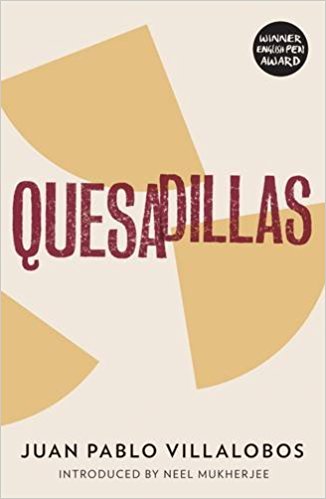
Quesadillas – Juan Pablo Villalobos (2012, trans. Rosalind Harvey 2013) 180 pages

Quesadillas is Juan Pablo Villalobos’ second novel, which I picked up having greatly enjoyed his first, Down the Rabbit Hole. Also, it’s published by AndOtherStories, who really are a wonderful publisher of contemporary, mainly translated, fiction. I highly recommend checking out their catalogue.

Back to Quesadillas. Like Down the Rabbit Hole, it is told from a child’s perspective, this time an older, more wordly child as Orestes (his father loves Greek mythology) is 13 years old. He lives with his five brothers, one sister and parents in a town where:

“there are more cows than people, more charro horsemen than horses, more priests than cows, and the people like to believe in the existence of ghosts, miracles, spaceships, saints and so forth.”

His mother insists the family is middle-class (unlikely as their home is “a shoe box with a lid made from a sheet of asbestos”) while his father swears profusely at the television:

“My father remained loyal to his healthy habit of insulting all politicians, applying a level of hostility in direct proportion to the devaluation of the peso.”

This is 1980s Mexico, where there is economic chaos and corrupt elections. Telling the tale from a 13-year-old’s point of view enables Villalobos to make astute political points about the impact of state mismanagement on the poor, without being overly didactic:

“ ‘we only have thirty-seven quesadillas and 800 grams of cheese left.’

We entered a phase of quesadilla rationing that led to the political radicalisation of every member of my family. We were all well aware of the roller coaster that was the national economy due to the fluctuating thickness of the quesadillas my mother served at home. We’d even invented categories – inflationary quesadillas, normal quesadillas, devaluation quesadillas and poor man’s quesadillas …. [in which] the presence of cheese was literary: you opened one and instead of adding melted cheese my mother had written the word ‘cheese’ on the surface of the tortilla”

Orestes’ twin brothers (no prizes for guessing they’re called Castor and Pollux) go missing and Oreo (as he’s known) sets off with older brother Aristotle to find them. Aristotle is convinced they’ve been abducted by aliens. After a fight, Oreo heads off alone and experiences life on the road. He manages to make money through peculiar means (there is a slight vein of magic realism running through the novella which explodes in all-out weirdness at the end) before returning home.

“What they were asking me to do was to start making up some lies that tallied with their idea of the world, damn it. But I hadn’t come home to tell the truth or learn to lie. I had come back because the class struggle had worn me out and I wanted to eat quesadillas for free.”

Quesadillas has a strong narrative voice in Oreo and it is funny, engaging and astute. The humour and surreal elements never obscure the portrayal of corruption or poverty. An entertaining and thought-provoking read.

Novella a Day in May #22

Under the Tripoli Sky – Kamal Ben Hameda (2011, trans. Adriana Hunter 2014) 104 pages

Under the Tripoli Sky by Kamal Ben Hameda is published by Peirene Press who specialise in publishing contemporary European novellas, aimed to be read in one sitting. Under the Tripoli Sky (written in French by a Libyan author now living in Holland) is part of their Coming of Age series. It’s also one more stop on my Around the World in 80 Books Reading challenge, hosted by Hard Book Habit.

Hadachinou is a young boy living in Libya before the revolution of 1969. The novella details his experience growing up in Tripoli surrounded by women: his mother, her friends, their daughters. Through a series of sketches he builds up an evocative, affectionate but unsentimental view of the lives of women where men are either absent or a drunken threat:

“My father, a solitary man given to prayer, shut himself away in the small bedroom at the back of the house when he came home from his shop or from the mosque. … As for Uncle Hadi, he spent nights in the company of other drunkards. ‘If their young wives want some fun and relaxation, they have to search for it elsewhere,’ Aunt Nafissa often commented, with her usual bitterness towards the male gender.”

The women don’t really notice Hadachinou and so he is given extraordinary access to their lives and experience.

“The tea ceremony was the only part of the day when my mother and her friends could live their lives in real time and tell their own stories. At last they could talk about dreams, longings and anxieties all in the same breath, and their bodies were at peace.”

He also moves across other boundaries in the city, attending mosque, synagogue and church. There is a sense of an exile looking back, and Tripoli with its heat, light, and bustling activity is beautifully realised. What also adds to a sense of Hadachinou recalling with longing, is the focus on food. This is not the story to read if you are on a diet. As homemakers, a great deal of the women’s lives are given over to preparing food, and Hadachinou describes the various meals in mouth-watering detail:

 “Signora Filomena would take us to the pizzeria, where each of us could salivate over his or her choice of either a pizza with tomatoes and oregano flavoured anchovies, or an ice-cream with a subtle vanilla taste set off by crunchy slivers of bitter chocolate. She herself preferred the bar opposite and its famous sandwiches: grilled sardines between two slices of crusty bread whose dough was impregnated with olive oil infused with garlic and red chillies.”

Peirene’s inclusion of this as a coming of age story is understandable. Hadachinou undergoes his circumcision early in the novella; he also experiences awakening sexual desire. But while he is moving towards adulthood, this is very much a portrait of a city and a community on the brink of enormous change. It is stunningly written, capturing a society about to be torn asunder.

“Another person’s eyes are your origins and your kingdom. But other people can’t see you if they’re blinded by their search for an illusion…”

Novella a Day in May #20

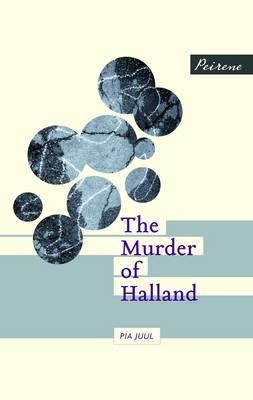
The Murder of Halland – Pia Juul (2009, trans. Martin Aitken 2012, 189 pages)

This novella is published by Peirene Press who specialise in publishing contemporary European novellas, aimed to be read in one sitting. The Murder of Halland is part of their Small Epic series.

The story opens with a domestic scene, Bess and her partner Halland watching a detective series before he goes to bed and she returns to her study to continue her work as a successful novelist. By the third page however, she is woken by a man at the door claiming he is arresting her for the murder of her husband: Halland has been shot dead in the town square outside their flat.

“The wet cobbles glistened in the morning light. Normally, the square would be deserted. Now it was filling with people. Roses bloomed against the yellow and whitewashed walls.”

While The Murder of Halland could be classed as a crime novel, I think this is misleading.  The focus is not on finding out who killed Halland but rather the grief of Bess as she ricochets around the small town in confusion, discovering Halland wasn’t quite who she thought he was and wondering if she is grieving in the right way.

“I could see why Halland had hung up the picture. It was our first year together and we were happy. Anyone could see that. At least I could, now. Halland’s hair had turned completely white during his illness, but here his long mane was dark and only just starting to turn in grey. I traced the sharp line of his nose with my finger, his full mouth. He was looking at me, saying something. What did we say to each other in those days? What did we ever say? I couldn’t remember us talking. Did we even say good morning? Yes, we said good morning.”

Bess’ detached narration makes The Murder of Halland an unsettling read. We know it was not a happy relationship, but we don’t know exactly why. We don’t know in what way Halland was ill. All Bess’ relationships seem to occur at a step removed: she has tense phone calls with her mother, a half-hearted reconciliation with her grandfather, an estranged daughter who arrives back in her life but they don’t explore what this means for either of them…

This strange detachment meant that I started to doubt Bess’ reliability as a narrator. When I read crime fiction it’s weirdly, for comfort, partly because I stick to Golden Age, and partly for all the ends to be tied up nice and neatly.  The Murder of Halland is not this type of novel. It leaves the reader with many more questions than answers, most of all through it’s “WHAT????” ending . Surprisingly, I didn’t think this made for an unsatisfactory read. The Murder of Halland is an intriguing character study at a moment of crisis, as complicated and unresolved as life itself.

Novella a Day in May #13

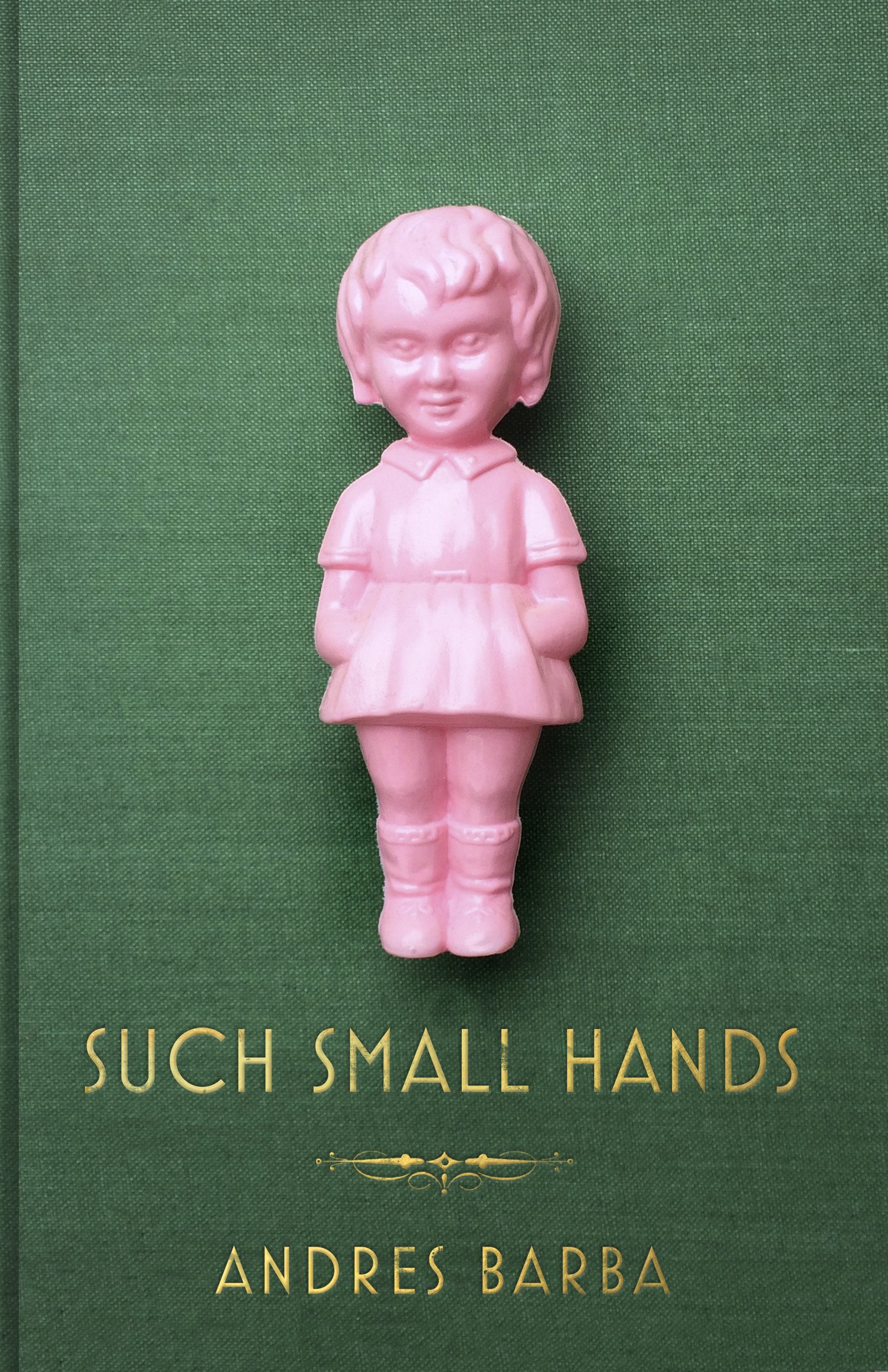
Such Small Hands – Andres Barba (trans. Lisa Dillman 2017) 101 pages

Well, this was super creepy. Institutionalised children *shudder*

Seven year old Marina is in a car accident.

“’Your father died instantly, your mother is in a coma.’ Lips pronounce them without stopping. Quick, dry words. They come in thousands of different, unpredictable ways, sometimes unbidden. Suddenly they just fall, as if onto a field. Marina’s learned to say them without sadness, like a name recited for strangers, like my name is Marina and I’m seven years old. ‘My father died instantly, my mother is in the hospital.’”

After her mother dies, Marina is sent to an orphanage, taking a doll given to her by the psychologist, which she has also called Marina. The other girls are both mesmerised and wary of Marina.

“Marina shrank and we grew. She stood alone, with her doll, by the statue of Saint Anne, watching us. Or was it the doll who was watching? We didn’t know who the doll really was. Because sometimes she looked like Marina, and she, too, seemed to have a hungry heart, and clenched fists close to her body, and she, too, was silent even when invited to join in; and she nodded her head back and forth, something we’d never seen a doll do before.  And she seemed persecuted and excluded, too.”

Neither Marina or the girls understand the relationships they forge. There is fear and eroticism mixed in with tentative gestures towards friendship. Marina’s scar from the accident is a source of wonder.

“‘You can’t feel it?’

‘No. Well, only a little.’

Desire passed through the girl, too. Like stagnant water that suddenly begins to drain, imperceptibly.

And devotion mixed in with the desire.

‘Do you want to touch it?’

‘Yes.’

But the girl didn’t react right away.”

Barba gradually builds the tension and develops the girls’ games into something deeply disturbing and sinister, but wholly believable (there is an afterword which explains the real-life inspiration for the story). This tale will haunt me for a long time.

Novella a Day in May #11

Journey into the Past – Stefan Zweig (1976 German publication; trans. Anthea Bell, 2009) 84 pages

Although I’ve since read and blogged about The Post Office Girl, this was the first Stefan Zweig I’d read and at first I wondered why everyone rated him so highly as a writer. Then I realised what he was doing in Journey into the Past was immensely clever.

It tells the story of a love affair between a student, Ludwig, and the wife of his employer, who is not named. The story begins with them on a train in the 1920s, and with Ludwig’s thoughts travelling back into the past to remember how they first met before the First World War separated them.

At first, I thought the description of the affair overblown and naïve.

“From that first meeting he had loved this woman, but passionately as his feeling surged over him, following him even into his dreams, the crucial factor that would shake him to the core was still lacking – his conscious realisation that what, denying his true feelings, he still called admiration, respect and devotion was in fact love  – a burning, unbounded, absolute and passionate love.”

At this point I was thinking Zweig perhaps wasn’t for me 😉

But as the story developed – they admit their love but it remains unconsummated, he goes abroad and then war breaks out, separating them for longer than they ever anticipated – it dawned on me that this style choice was entirely deliberate and conscious.  What Zweig shows us is a world before modern technological warfare, a world that was brutally torn apart. These naïve young lovers are part of a society, a life, that was utterly destroyed.

So although we know they are reunited, it is not with the same youthful self-obsession or indulgent love that they had previously.

“‘Everything is just as it used to be, don’t you think?’ she began, determined to say something innocent and casual, although her voice was husky and shook a little.  However he did not echo her friendly, conversational tone, but gritted his teeth.

‘Oh yes, everything.’ Sudden inner rage forced the words abruptly and bitterly out of his mouth. ‘Everything is as it used to be except for us, except for us!’”

Journey into the Past is not a depressing book despite portraying losses that are glimpsed and barely articulated. It is about the impact of international conflict on the lives of individuals in the smallest, most profound ways. Zweig questions whether those loses can be overcome, and I still don’t know what I think.

I feel foolish for my initial impression of this novella: I hadn’t realised I was in the hands of a master.

Novella a Day in May #8

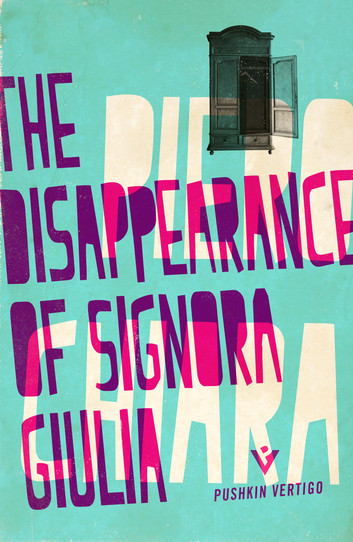
The Disappearance of Signora Giulia – Piero Chiara (1970, trans. Jill Foulston 2015) 122 pages

The Disappearance of Signora Giulia was initially published in an Italian newspaper as a serial and is now available in English translation thanks to Pushkin, as part of their Vertigo imprint. It is a quick, snappy crime thriller that does not aim for trite resolution but rather an exploration beneath the surface of a life to the murky depths.

Corrado Sciancalelpre is “blessed with a special form of intuition, that peculiar mental agility that enables great policemen to delve into the minds of criminals.”

Thankfully, he is also happy married and liked in the town in northern Lombardy where he works – no tortured alcoholic with a secret past here.

A powerful lawyer, Esengrini, asks Sciancalelpre to investigate the titular vanishing of his wife. Every Thursday, Guilia has been going to Milan to visit their daughter at boarding school, but now she has failed to return and two bags of her things are missing too. Sciancalelpre agrees and what follows is essentially a police procedural, but the short length of the story ensures the pacing remains tight.

Sciancalelpre is resolutely unsentimental but not without sympathy. The more he investigates, the more he feels for the missing woman:

“He didn’t say ‘Poor Signora Giulia to Esengrini when he visited him in his office every few days towards evening. With Esengrini, he spoke only of the undeniably disappointing results of a search conducted throughout the whole of Italy with Signora Giulia’s photo.”

It’s impossible to say much more about a crime novella without including spoilers. Suffice to say there are plenty of red herrings, people and relationships who are not what they seem. The Disappearance of Signora Giulia is a diverting read, when you’re in the mood for a crime novel you’ll finish quickly. It is not a simple tale though, and the resolution is a complex one that leaves questions unanswered. This wasn’t a source of frustration but rather felt realistic.

I really enjoyed this, Chiara’s first novel to be translated into English despite his huge popularity in Italy, and I hope there will be many more translations to follow.

Novella a Day in May #5

Cliffs – Olivier Adam (2005, trans. Sue Rose, 2009) 147 pages

Set over the course of a single night, Cliffs shows the enduring damage caused to the child – now a grown man – of a parent who dies by suicide.

The narrator is sitting on a balcony on the Normandy coast in the middle of the night, gazing at the cliffs where his mother died, while his partner and child lie sleeping in the room behind him. As he sits and smokes, he reflects on his life with his abusive father and his traumatised brother:

“We weren’t supposed to breathe move speak feel. We weren’t supposed to need anything, pocket money or comfort or affection or smiles or advice, we weren’t supposed to expect anything except the slaps, smacks or wallops he dealt out”

Later he meets other damaged souls, drawn together by a mutual recognition:

 “We’ve grown up in fear of our fathers, the troubled silence of our mothers, the empty space formed by abstract, imaginary places, without edge or centre.”

Cliffs isn’t a depressing book; it is a story of survival, of endurance even when we are irrevocably damaged by experience.

 “This way of life didn’t cure me of anything, it was merely possible when I couldn’t cope with any other kind of life, particularly the one I’d just left behind. It was a life of silence, space and absence, of maintaining an acute presence within objects, the shifting play of light, the still motion of water, the perfumes, the texture of the air. It was a life in which I finally found a niche, quiet but peaceful, a body filled with air and fog, a mind completely given over to the noise of the sea and the wind, the company of birds.”

Cliffs is beautifully written, but the beauty in no way detracts from the raw hurt experienced by narrator. It is an intense read, haunting and memorable.

Novella a Day in May #1

For a while now I’ve been enamoured of the novella. I enjoy sparse writing styles (not so good at this myself 😉) and at its best a novella gives us a narrative distilled to its essence for maximum impact. To spread novella love I’ve decided to post about a novella each day for the whole month. There’s no fixed definition of a novella so for my purposes I’ve decided its longer than 70 pages and shorter than 200. This will definitely work! It won’t peter out and die in a heap by 5 May at all! Onwards…

The Game of Cards – Adolf Schroder (trans. Andrew Brown, 2008) 143 pages

The Game of Cards  is not ostensibly gothic or a thriller, and yet it is both these things. The story of how student Markus Hauser is employed by Selma Bruhns for a week to put several trunks worth of letters into chronological order is truly creepy and suspense-filled.

Selma is a terse, uncommunicative employer, who lives in an old house with a vast number of cats at varying stages of disease. Markus is constantly at the point of leaving, unable to stomach the “stench” of the house, the feral occupants, his awkward employer and the seemingly pointless nature of his repetitive task:

“He squatted down between the piles of letters lying on the floor, but when her resumed his work…looking for the pile in which he was putting the letters from 1943, laying the pages of the letter on it and reaching out for the next one, he paused, as if he’d only just realised that he had absolutely no idea what he was doing”

Gradually however, Markus is drawn into the letters, all written to a woman named Almut.  Very little is given away, but Markus finds himself compelled to continue, without really understanding why.

 “Words from the letters that he had read came alive. He found himself in streets where he had never been, heard the shrieking and whistling of creatures that he could not see but whose presence he surmised, felt on his skin the burning sun whose strength he had never yet felt, saw a woman coming up to him who spoke in a language that he did not understand.”

This chronology is interspersed with the investigation being conducted by Superintendent Berger, who suspects Markus of having strangled Selma with her own scarf on his last day of work. Thus we are drawn into not only the mystery of who Almut is and why Selma is obsessively writing to her, but also who killed Selma and why. Schroder jumps between the two timelines without preamble and so the reader is drawn into the disorienting, imperfectly understood situation of the all the characters.

 “With a sudden move that took Markus by surprise, she threw the animal towards him, it crashed into his chest, and only because Markus reacted quickly and caught the animal could he prevent I from falling onto the ground.

‘You are working slowly and without much concentration,’ said Selma Bruhns, turning round and stepping into the house.”

There is also the question of what happened – and what the stake was – in the titular match between Markus and Selma…

The Game of Cards is a deeply disturbing read, and a powerful portrait of enduring psychological trauma. It will stay with me for a long time.

“No man is an island.” (John Donne)

I live on a tiny grey island. This year Spring has been even greyer than usual and it felt like winter had gone on for eleventy million years. Now the weather is overcompensating by being unseasonably warm for a few days (just in time for the London marathon – kudos to those hardy runners), and so I’ve decided to celebrate by looking at two novels set on warm islands. They are two more stops on my Around the World in 80 Books Reading challenge, hosted by Hard Book Habit, and I’m sure by the time I’ve posted this my home will be back to service-as-usual grey and we’ll all know where we stand.

Firstly, Salt by Earl Lovelace (1996), set in Trinidad where Lovelace was born and still lives. I read The Dragon Can’t Dance years ago and really liked it, but for some reason I hadn’t picked up a Lovelace since. Salt is primarily the story of Alford George, but it is also a story about Trinidad.

“Maybe that madness seized Columbus and the first set of conquerors when they land here and wanted the Carib people to believe that they was gods; but, afterwards. After they settle in the island and decide that, yes, is here we are going to live now, they begin to discover how hard it was to be gods.

The heat, the diseases, the weight of the armour they had to carry in the hot sun, the imperial poses they had to strike, the powdered wigs to wear, the churches to build, the heathen to baptise, the illiterates to educate, the animals to tame, the numerous species of plants to name, history to write, flags to plant, parades to make, the militia to assemble, letters to write home. And all around them, this rousing greenness bursting in the wet season and another quieter shade perspiring in the dry.”

Alford dreams of leaving the island and decides the way to do this is to speak ‘English’. Lovelace shows the legacy of colonialism and how the language of the colonisers is still associated with power and accomplishment.

“His thinking was in another language and he had to translate. He began to speak more and more slowly to make sure that his verbs agreed with his subjects, to cull out words of unsure origin and replace them with ones more familiarly English. Caribbean words like jook, mamaguy and obzocky all had to be substituted. He felt his meanings slipping away as he surrendered his vocabulary.”

However, as time goes on, Alford stays on the island, becomes a teacher, fights for his students rights and becomes embroiled in politics. His identity becomes more bound with contemporary Trinidad, and it’s then that he realises that emancipation has been a false promise:

“manoeuvre them into accepting not freedom but the promise of being set at liberty, with no more attention given to their years if degradation and captivity and abuse than if they had been dogs”

There is a plethora of other characters in Salt and I can barely scratch the surface here. They are drawn vividly and with affection, a cacophony of voices that pick up Lovelace’s themes of identity, home and meaning. They exist within a beautifully evoked Trinidad whereby Lovelace is able to explore his weighty themes without becoming overly didactic.

This post is ridiculously long and I don’t have time to explore Salt properly, but I did just want to mention this beautiful portrait of the elderly Miss May:

“And with the laborious delicacy choreographed by her pains eased herself down unto the step where the sun was brightest and rested there, her eyes shut, her breath inhaled, the metronome of her mind keeping time to the rhythm of her distress, trying to find within the music of her pain a space in which to breathe.”

I think that’s a stunning piece of writing. Lovelace writes with clarity and a unique voice, and he has important things to say:

“The tragedy of our time is to have lost the ability to feel loss, the inability of power to rise to its responsibility for human decency.”

Secondly, By Night the Mountain Burns by Juan Tomas Avila Laurel (2008, trans. Jethro Soutar 2014) who is from Equatorial Guinea, and whose parents are from Annobon Island. The island in the novel is unnamed but shares a location and a history of Spanish colonialism with Annobon.

“We were on our own out in the middle of the Atlantic Ocean. People had given up hope of the boat ever coming back – the boat from the place where our fathers were.”

The narrator recounts his experience of childhood on the island. He lives with his silent, remote grandfather.

“I can’t say for sure whether my grandfather was or wasn’t mad. I saw him through a child’s eyes and through such eyes it’s impossible to tell whether an adult man, who lives in your house and who you’ve been told is your grandfather, is mad or not.”

“The house was close to the beach. And not any old beach either but the big village beach. Yet despite being so close to the shore, grandfather had built the house with its back to the sea…everything faced the mountain.”

Women on the island own the land, while the men undertake the fishing. Things are not easy on the island – there is poverty at times, white people arrive and trade sex with women for cigarettes and kerosene – but things deteriorate significantly during the period the narrator is recalling. There is a bush fire, then cholera wipes out a huge proportion of the population, and there is a horribly violent instance of scapegoating.

 “Today, looking back, I see, or understand, that the incident and the cholera were part of the same sickness. And the cure for that sickness was beyond the reach of our adults for it was a sickness that was greater than them, and so it was able to dominate them. And on that island out in the middle of the Atlantic Ocean, nasty episodes unfortunately had to be explained somehow; something to satisfy people’s need for a cause.”

The island may be out in the middle of the Atlantic Ocean, and the faith of the people may be a mix of their traditional beliefs and Catholicism, but I felt what the narrator is speaking about was far from remote from me as a UK-based reader:

“For I know now that all people are not treated equally when it comes to apportioning blame for bad things that happen in communities. I know that, in this world of ours, how facts are judged depends on who’s doing the judging.”

I’m making this novel sound depressing, and it isn’t. The point of view of a child enables the story to be told but with a degree of distance that enables the reader to keep reading. This is not to suggest that Laurel obfuscates or pulls his punches. The brutal scapegoating is repeatedly returned to and described in detail. It is horrific. The repetitions of the story enable it to effectively capture the sense of reminiscences, and also how defining moments are those we return to time and again, informing our understanding of the past and who we are.

Towards the end we learn how this story is embedded within colonialism, and how what we are reading exists within this history. The narrator learned Spanish at school, a language that existed detached from meaning for him:

“We learned everything by heart, and I think that’s why we did it singing. In fact, although we sometimes saw books with the letters and pictures, I didn’t know that amapola, burro, cochino and dado were Spanish words for poppy, donkey, hog and dice, or that poppy, donkey, hog and dice were things we were supposed to have heard of. I didn’t know what any of them were, so I didn’t know the words were supposed to represent the letters and I didn’t associate the letters with the pictures in the books.”

As a result of this, he is able to tell his story to Spanish-speaking researchers who have come to the island:

“If this story becomes known, it will be because of some white people.”

Laurel writes with unrelenting power in beautiful prose about huge issues: society, colonialism, legacy, blame, belief. His writing is stunning and his anger palpable without overwhelming the narrative. Another great edition from And Other Stories, who are rapidly becoming one of my favourite publishers.

To end, following on from a post a few weeks back that led to Victoria, Lucy and I sharing our love of Dolly Parton, here is the legend herself singing about islands: