“Happiness is having a large, loving, caring, close-knit family in another city.” (George Burns)

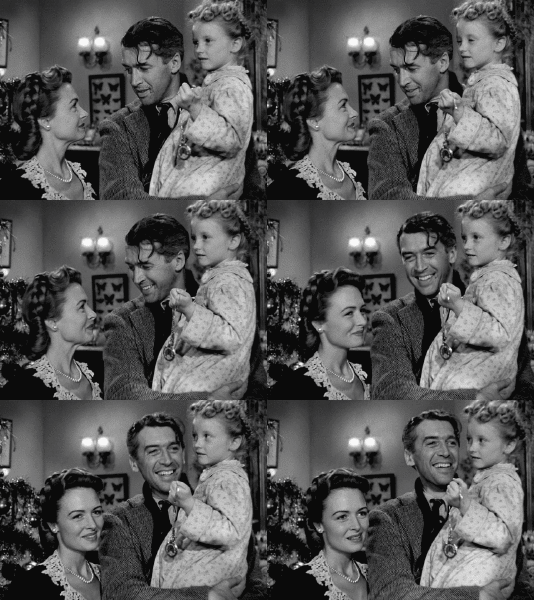
I hope you all had a wonderful Christmas! From my twitter feed, I know for some that means being as far away from relatives as possible 😉 If Christmas advertising were to be believed, we should all have families like this:

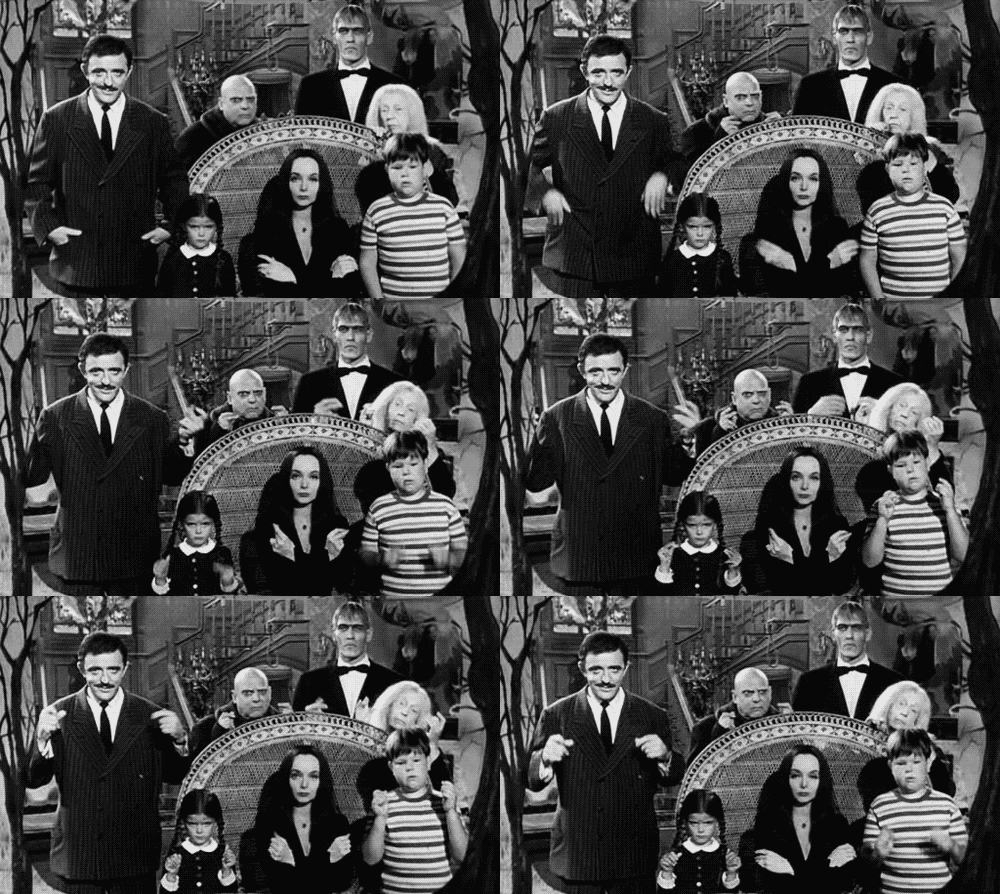
Whereas in fact the reality may be closer to this:

In which case I would say well done you, because I’m the only person alive who doesn’t like It’s a Wonderful Life *ducks for cover* whereas the Addams Family are awesome.  Whether you spent Christmas with George Bailey or Uncle Fester,  I thought this week might be a good time to look at families that are found in unexpected places.

Firstly, Plainsong by Kent Haruf (1999) which I picked up after loving Our Souls at Night so much and many bloggers recommended I start the Plainsong trilogy. All the things I enjoyed about Our Souls at Night were here: a gentle, unshowy voice, believable idiosyncratic characters, ordinary lives shown to have a delicate beauty.

Set in the fictional prairie community of Holt, Colorado, Plainsong focusses on a pregnant schoolgirl, Victoria Roubideaux, and one of her teachers, Tom Guthrie, who is splitting up with his wife. After Victoria is thrown out by her mother, another teacher, Maggie Jones, suggests to a pair of elderly brothers, Harold and Raymond McPheron, that they take her in.

“ You’re getting goddamn stubborn and hard to live with. That’s all I’ll say. Raymond, you’re my brother. But you’re getting flat unruly and difficult to abide. And I’ll say one thing more.

What?

This ain’t going to be no goddamn Sunday school picnic.

No it ain’t, Raymond said. But I don’t recall you ever attending Sunday school either.”

They offer Victoria a home, and the portrayal of their developing relationship with the young woman is just lovely. The brothers are set in their ways and unused to female company. Victoria is shy and unsure. The tentative gestures they make towards one another pay off and a tender, mutually nurturing affection develops.

“The brothers were watching her closely, a little desperately, sitting at the table, their faces sober and weathered but still kindly, still well meaning, with their smooth white foreheads shining like polished marble under the dining room light. I wouldn’t know, she said. I couldn’t say about that. I don’t know anything about it. Maybe you could explain it to me.

Well sure, Harold said. I reckon we could try.”

Meanwhile, Tom’s sons Ike and Bobby are struggling to come to terms with their mother’s depression and subsequent leave-taking. A similarly unexpected yet gentle cross-generational relationship develops between the boys and elderly, isolated Mrs Stearns who they know from their paper round.

“The timer dinged on the stove. They took the first oatmeal cookies out of the oven and now there was the smell of cinnamon and fresh baking in the dark little room. The boys sat at the table and ate the cookies together with the milk Mrs Stearns had poured out into blue glasses. She stood at the counter watching them  and sipped a cup of hot tea and ate a small piece of cookie, but she wasn’t hungry. After a while she smoked a cigarette and tapped ashes in the sink.

You boys don’t say very much, she said. I wonder what you’re thinking all the time.

About what?

About anything. About the cookies you made.

They’re good, Ike said.”

Plainsong is a gentle tale about all that human beings can give and be to one another, but it is not remotely sentimental or rose-tinted. Haruf shows, he doesn’t tell, with a restraint and subtlety that is easy to underestimate but is absolutely masterful. I find his writing incredibly moving. It’s going to be a real strain on my 2018 book buying ban not to rush out and buy the novels of his I don’t yet own.

Secondly, Sweet Bean Paste by Durian Sukegawa (2013, trans. Alison Watts, 2017). Again, this is a simply told tale of ordinary people, and it is truly heartwarming. The main protagonist is the decidedly unheroic Sentaro. He has a criminal record and is employed by people he owes money to. He sells dorayaki – pancakes filled with the titular paste – with no pride in or commitment to his work. One day Tokue, an elderly lady with a visible disability in her hands and face arrives in the shop:

“ ‘I had one of your dorayaki the other day. The pancake wasn’t too bad, I thought, but the bean paste, well…’

‘The bean paste?’

‘Yes. I couldn’t tell anything about the feelings of the person who made it.’

‘You couldn’t? That’s strange.’ Sentaro made a face as if to show how regrettable that was, though he knew full well his bean paste could to reveal no such thing.”

Sentaro employs Tokue on the understanding that she will not interact with the customers who he thinks will be put-off by her disability. Tokue’s delicious bean paste brings more customers to the shop and business begins to boom. As Sentaro and Tokue’s relationship develops, he begins to understand that she has survived Hansen’s disease (leprosy) but is still subject to significant stigma around the disease. One of the schoolgirl customers, Wakana, becomes very attached to Tokue, and they visit her at the asylum she continues to live in although the government has passed an act which means those with Hansen’s disease are no longer kept in isolation.

“Nevertheless human lives had been swallowed up by this place and for a hundred years, continually spurned. It felt to Sentaro as if the singular silence rose from the very earth beneath their feet, steeped as it was in sighs and regrets.”

Sweet Bean Paste is about living life to the full even when society is circumscribing it in cruel ways. It is about friendship’s power to heal and to empower. It is also about opening ourselves to experience the world in new and surprising ways, no matter our age. Tokue has an almost mystical relationship with her cooking, which enriches both her and those who consume her food.

“When I make sweet bean paste I observe closely the colour of the adzuki beans faces. I take in their voices. That might mean imagining a rainy day or the beautiful fine weather they have witnessed. I listen to their stories of the winds that blew on their journey to me.”

And so in the end, I think Sweet Bean Paste is about nourishment in all its forms; it is there for the taking if we have the wisdom to see it and the open hearts to embrace it.

To end, never let it be said that I shy away from the obvious:

“To appreciate the beauty of a snowflake it is necessary to stand in the cold.” (Aristotle)

Temperatures have dropped in the UK and I’m writing this after coming in from a surprise snow flurry, while Scotland’s had proper snow, so I think now it’s December & officially winter. My choices this week are suitably wintry in theme, but they’re not a big tome to curl up with on a winter’s day. I’m going through a prolonged novella phase at the moment and these are excellent examples of how much can be achieved in a short space.  They’re small, but powerful.

Firstly, A Life’s Music by Andre Makine (2001, trans. Geoffrey Strachan) which comes in at 106 pages. The narrator is stuck in a snowbound railway station awaiting the Moscow train:

“Suddenly everything is illuminated by a truth that has no need of words: this night lost in a void of snow; a good hundred travellers huddled here; each seems as if he were breathing gently upon the fragile spark of his own life; this station with its vanished platforms; and these notes stealing in like moments from an utterly different life.”

The notes come from a piano being played by an elderly gentleman, tears streaming down his face. When they finally board the train, he tells the narrator his story, and why the music makes him cry. It is a tale of war and persecution, and of shifting identities in order to survive:

“As a result of this fear, and the assiduity with which he copied the actions of others during those first few weeks, he did not feel as if he were engaged in combat. And when he was finally able to relax the constantly taut string within him, he found himself in the sin of a veteran soldier”

Makine is interested in human endurance, in cruelty, in love and in moments of transcendence. He is brilliant at using small moments to illuminate big themes.

“To his surprise he felt himself growing increasingly separate from the wind, the earth, the cold, into which he had almost merged. But more surprising still was this simple bliss: the warm line where the woman’s body touched his own at night. Just this line, a gentle, living frontier, more substantial than any other truth in the world.”

A Life’s Music is a haunting tale written by a master. Makine proves that you don’t need to write at length to create something substantial. Stunning.

Secondly, A Meal in Winter by Hubert Mingarelli (2012 trans. Sam Taylor 2013) which is only 138 pages long. The premise of A Meal in Winter is incredibly simple, and the themes it explores incredibly complex. Three German soldiers find a Jewish man when they are on patrol in Poland. They do not share a common language with the young man and they take him prisoner with ease . They then retreat to an abandoned cottage to cook their meagre rations on a freezing winter’s day before taking him back to their barracks to be shot.

“everything would be better once it was warmer. Smoking and eating in front of the stove! What could be better? We would smoke while we waited for the bread to thaw and for the cornmeal to cook.”

The focus on essential human need for food, warmth and shelter is a master stroke by Mingarelli. The men are human first, soldiers second. Will they recognise their common humanity with their terrified prisoner and what will it mean if they do?

Mingarelli is excellent at building characters, scenes and atmosphere in a few words, and the desperate situation for all concerned is brilliantly evoked, within a harsh, freezing landscape:

“Sky and earth had blurred into one, and there was no comfort to be found in either. While I packed the snow into our mugs, I wondered again how it was possible that we had once seen so many sunflowers here, and not so long ago either. The landscape had been so full of them, so completely covered, that it seemed their oil must have been flowing like a river somewhere.”

A Meal in Winter is a powerful and moving novella that does not offer simple answers; it has really stayed with me.

To end, I know it’s a  wee bit early for Christmas tunes, but I’ve chosen it because of the excellent snowy outfits. Remember kids: real fur is cruel, and spandex leggings are not suitable winter attire.

“Love does not dominate, it cultivates. And that is more.” (Johann Wolfgang von Goethe)

I’m managing to squeeze in one final post for German Literature month, hosted by Caroline and Lizzy.  Hopefully next year I’ll be better organised and able to participate some more, but for now I’m off to Austria, which is also another stop on my Around the World in 80 Books Reading Challenge, hosted by Hard Book Habit. Do join in with GLM next year or AW80Books, they’re great ways to read some wonderful books 😊

Firstly, The Post Office Girl by Stefan Zweig (trans. Joel Rotenberg 2008) which was found amongst his papers after he killed himself in 1942. This is a melancholy tale of the impact of war on individuals, in this instance the First World War. Christine is a titular provincial civil servant, who finds herself in her late twenties having only known penny-pinching and drudgery.

“The war stole her decade of youth. She has no courage, no strength left even for happiness.”

Christine is plucked out of her ordinary life by her aunt who is visiting the Swiss Alps. She invites Christine to stay and the naïve woman is enraptured by the whirlwind of new clothes, fine dining and bright young things of which she is suddenly in the midst.

 “All the world’s sweetness might be in this one thin straw of scalding ice. Heart thumping, fingers trembling avidly, she looks about for someone or something to receive her overflowing gratitude.”

Christine is transformed from a drudge into a beautiful young woman that people want to be with.

“In this instant, shaken to her very depths, this ecstatic human being has a first inkling that the soul is made of stuff so mysteriously elastic that a single event can make it big enough to contain the infinite.”

Then, just as suddenly, it is all taken away. Back in her small Austrian town she finds herself unable to cope with the poverty of the people, her home and her job. She meets Ferdinand, a soldier whose war wound means he is unable to continue his work as an architect. He is cynical of governments and bitter regarding his experience:

“In our Tartar village we didn’t know if Vienna was part of Bohemia, or maybe Italy. And we didn’t give a damn. All we cared about was stuffing a crust of bread down our throats and getting the lice out of our hair and finding some matches or tobacco sometime in the next five hours.”

For Christine, this man is soulmate, but these two souls are so damaged, so hurt and isolated, that they can only offer one another the bleakest kind of companionship.

“Christine was taken aback. The man beside her had said just what she’d been thinking all this time; he’d expressed clearly what she’d dully felt – the wish to be given one’s due, not to take anything from anyone, but to have some kind of life, not to be left out in the cold forever while others were warm inside.”

Zweig is unblinking in his portrayals of people, showing them with all their flaws, vanities and foibles, but still with great compassion. You feel for the characters precisely because they are so believably imperfect. The tyranny they face from the ruling class – either elected or via money – is presented as inescapable. The Post Office Girl is a novel about desperation, and how financial poverty can wear people down to a poverty of spirit. It is beautifully written and absolutely devastating.

In the Afterword of my edition William Deresiewicz suggests the novel is unfinished. I’m not sure I agree. I don’t know enough about Zweig’s style to argue my point forcefully, but to me, the ending occurs exactly where it should. It is perfect: sad but defiant, with so much unknown.

Secondly, The Piano Teacher by Elfriede Jelinek (1983, trans. Joachim Neugroschel 1988). Marina Sofia reviewed Jelinek’s volume of 3 plays In den Alpen for German Lit Month, do read her fascinating post which explains how controversial the author is in Austria due to her critique of Austrian society.  The Piano Teacher was the first of her novels to be translated into English and it was also adapted into a film in 2001, starring the wonderful Isabel Huppert and directed by Michael Haneke. I haven’t seen it but it looks a faithful adaptation:

I found The Piano Teacher an incredibly tough read. Jelinek does not pull her punches in any way. This tale of Erika, a woman living in a claustrophobic, abusive relationship with her mother, and her masochistic sexual desires seeking expression with one of her pupils is really hard going.

“They are enclosed together in a bell jar: Erika, her fine protective hulls, her mama.”

Jelinek creates the cruel, affectionate relationship between mother and daughter brilliantly. They are bound together in bitterness and a warped love.

“The daughter is the mother’s idol, and Mother demands only a tiny tribute: Erika’s life.”

Erika’s relationship with her mother and the abuse she suffers, and enacts, feeds into her sexual preferences, reminding me of The Blue Room. She is repressed (she shares a bed with her mother), and this expresses itself through the violence she metes out to her unsuspecting fellow commuters, and in one horrible instance, a pupil she is jealous of. She is a voyeur and attends peepshows and stalks couples in the park, but is incapable of becoming sexually aroused by what she witnesses. When a student, Klemmer, expresses an interest in her, the two begin a clumsy, stunted affair. It is no great love story:

“Klemmer is still concerned about that damned aged difference. However, he is a man, and that easily makes up for the ten years Erika has over him. Furthermore, female value decreases with increasing years and increasing intelligence. The technician in Klemmer computes all this data, and the bottom line of calculations reveals that Erika still has a wee bit of time before wandering into the tomb.”

The Piano Teacher is brutal. Jelinek’s imagery is disturbing, particularly around the sexual or body parts [the next quote is an example of this, don’t read if you think it will upset you, but I wanted to give a clear idea of a recurring theme in the novel]:

“Rot between her legs, an unfeeling soft mass. Decay, putrescent lumps of organic material. No spring breezes awaken anything. It is a dull pile of petty wishes and mediocre desires, afraid of coming true. Her two chosen mates will encompass her by crab claws: Mother and Klemmer.”

I was relieved to get to the end of The Piano Teacher, I don’t think I could have taken much more. Jelinek is a brilliant writer: her pacing and plotting are perfect and she has powerful things to say about the psychological warfare we wage on ourselves and others. But now I have to go and find a nice Golden Age crime novel with which to recover….

Regular readers will know that I do like to end on an 80s pop video and will shoehorn them into a post wherever possible. I’m delighted that my trip to Austria means I can end on this:

“A writer is somebody for whom writing is more difficult than it is for other people.” (Thomas Mann)

Well, I’m off to an unbelievably slow start with German Literature Month, hosted by Caroline and Lizzy, given that we’re more than halfway through the month and this is my first post. I’m hoping I’ll get some more posts in before the month is out, but clearly myself and productivity are not friends right now.

Firstly, The Glass Bees (Gläserne Bienen, 1957) by Ernst Junger (trans. Louise Bogan & Elizabeth Mayer, NYRB, 2000), which was frankly, completely terrifying. Generally I’m not one for sci-fi/speculative fiction and now I know why, because they scare me silly. Written in the 1950s, the story is set in an undisclosed time and place sometime in future. At the time of publication, my edition tells me it was dismissed as irrelevant. To which I can only respond:

And commend those critics for their optimism. See if you can find any contemporary parallels: a powerful and ruthless business man has developed advanced technology and uses this to assert control of society through media and entertainment. Now I think about it, a more appropriate David Tennant gif would have been:

The tale is narrated by Richard, a war veteran and ambiguous character, who is considering being employed by the Donald Trump/Rupert Murdoch hybrid business man Zapparoni as a security chief/spy on his workers:

“The people employed by Zapparoni were an extremely difficult lot. Engaged in a most peculiar kind of work – the handling of minute and often extremely intricate objects – they gradually developed an eccentric, over-scrupulous behaviour, and they developed personalities which took offense at motes in a sunbeam.”

Zapparoni uses microtechnology but he has also developed automatons who are more than human. There are those that look like him and enable him to be in more than one place at once, and those who are used to promote an idealised form through film and media:

“Thus one might say that these figures did not simply imitate the human form but carried it beyond its possibilities and dimensions…the movements and expressions indicated that nature had been studied and surpassed.”

Likewise, the titular bees are micro-robots much more efficient at collecting nectar than actual bees. This unstable reality is part of the novel’s overall feel of not being able to trust what you see and struggling to understand feelings that are evoked by such odd circumstances. Richard is a cavalry soldier, and as such is an anachronism, harking back to days of animal and human power when the world has moved on. He is virtually unemployable, which is what leads him to Zapparoni in the first place, wholly aware that if he takes the job, at some point he is likely to meet with an ‘accident’.

Events at his job interview are equally discombobulating, with the elderly Zapparoni living in surprisingly old-fashioned surroundings and sending Richard into the garden for a gruesome test. I won’t say much more for fear of spoilers as The Glass Bees is a short (209 pages in my edition), tightly written novel set over 2 days. It packs a lot into such a short space though, as Richard’s immediate experiences and reminiscences give much food for thought on the nature of human beings, their relationship with technology, how power is wielded, where morality lies… big questions which mean The Glass Bees certainly leads itself to re-reading.

It is not a bleak novel; there is an enduring faith in humankind:

“I came to recognise that one single human being, comprehended in his depth, who gives generously from the treasures of his heart, bestows on us more riches than Caesar or Alexander could ever conquer. Here is our kingdom, the best of monarchies, the best republic. Here is our garden, our happiness.”

However, this faith is constantly under assault and The Glass Bees acts as a stark warning on the human price of technological progress:

“Human perfection and technical perfection are incompatible. If we strive for one, we must sacrifice the other; there is, in any case, a parting of the ways. .. Technical perfection strives towards the calculable, human perfection towards the incalculable.”

I’m not sure we’ve really learnt the lessons The Glass Bees presents. As I said at the start, terrifying.

From a speculative future to a novel that shows the fallout of the recent past, The Emigrants (Die Ausgewanderten, 1992) by WG Sebald (trans. Michael Hulse, Harvill Press, 1996). The Emigrants is familiar territory for readers of  Sebald, dealing with displacement, memory and loss with a deceptively simple voice and a narrative that blurs the lines between fiction and autobiography, complete with illustrative photographs. Narrated by an emigrant who comes to England and settles in Manchester, its four sections tell the stories of different emigrants with whom he comes into contact. The first section, ‘Dr Henry Selwyn’ tells of his eccentric landlord.

“Dr Selwyn liked to be out of doors, and especially in a flint-built hermitage in a remote corner of the garden, which he called his folly and which he had furnished with the essentials. But one morning just a week or so after we had moved in, I saw him standing at an open window of one of his rooms on the west side of the house. He had his spectacles on and was wearing a tartan dressing gown and a white neckerchief. He was aiming a gun with two inordinately long barrels up into the blue.”

As this passage captures, the short section (around 20 pages) is both whimsical and yet with an underlying sense of something much more serious. It shows how, following the second world war, what we see on the surface belies the enduring damage and pain that persists.

The second section ‘Paul Bereytyer’ begins with a suicide. The narrator’s childhood teacher has lain on the train tracks and the narrator pieces together his past in an attempt to understand why. Paul is a quarter Jewish and during the war “out of blind rage or even a sort of perversion” he returns to Berlin and gets called up into the artillery. What is truly haunting in this section is that the clues to his end are there all along for those who knew him:

“Railways had always meant a great deal to him – perhaps he felt they were headed for death. Timetables and directories, all the logistics of the railways, had at times been an obsession with him… I thought of the stations, tracks, goods depots and signal boxes that Paul had so often drawn on the blackboard  and which we had to copy into our exercise books as carefully as we could.”

The third section tells the story of the narrator’s Great-Uncle Adelwarth who travels around the world but ultimately ends up in an institution. In the final section, ‘Max Ferber’, an artist tells the narrator the story of his mother and the impact of the holocaust on his family.

“Memory…makes ones head heavy and giddy, as if one were not looking back down the receding perspectives of time but rather down on the earth from a great height, from one of those towers whose tops are lost to view in the clouds.”

The Emigrants is an incredible novel. Sebald writes with simplicity yet great beauty, building a picture of enduring war wounds. He demonstrates how the legacy of conflict is still to be felt, if only we open our eyes to see it.

“I now sometimes feel that at that moment I beheld an image of death [it] lasted only a very short time, and passed over me like the shadow of a bird in flight.”

To end, the trailer for the most expensive German TV series ever made, apparently. It’s set during the Weimar Republic, I’m 4 episodes in and enjoying it so far (contains scenes of drug taking and sauciness):

“Bureaucracy is the death of all sound work.” (Albert Einstein)

Last week I looked at politics with a big P; this week I thought I’d look at politics with a small p, the civil servants and bureaucrats that keep the machine turning. Hence one novel about a postman and one about a clerk, and two more stops on my Around the World in 80 Books Reading challenge, hosted by Hard Book Habit.

Firstly, The Peculiar Life of a Lonely Postman by Denis Theriault (2005, trans. Liedewy Hawke, 2008) which I first heard about over at Naomi’s blog Consumed by Ink – do check out her review! This novella (108 pages) is a wee gem. It tells the story of Bilodo, the titular mail deliverer, who loves his job.

“He wouldn’t have wanted to swap places with anyone in the world, Except perhaps with another postman.”

He spends his days delivering mail and practising calligraphy, and his nights steaming open the (increasingly rare) personal letters which he subsequently delivers the next day. He is a loner who enjoys the drama of life at a step removed:

“Love in every grammatical form and every possible tone, dished up in every imaginable shape: passionate letters or courteous ones, sometimes suggestive and sometimes chaste, either calm or dramatic, occasionally violent, often lyrical, and especially moving when the feelings were expressed in simple terms, and never quite as touching as  when the emotions hid between the lines, burning away almost invisibly behind a screen of innocuous words.”

Eventually though, he comes to obsess about one correspondence only, that between Segolene, a teacher in Guadalupe, and Gaston, a Canadian poet, which takes place through an exchange of haikus. Gradually Bilodo’s life becomes narrower and narrower as he is convinced he is in love with Segolene:

“Bilodo dreamt, and wished for nothing else; he wanted only to continue on like this, to keep savouring the dazzling dreams and ecstatic visions Segolene’s words conjured up for him. His only desire was that the pleasant status quo might endure, that nothing would disturb his quiet bliss.”

Needless to say, the status quo does not endure. Rather Bilodo’s life starts to rapidly unravel and reconstruct in a way that challenges who he is and his sense of self. I can’t say too much more for fear of spoilers in such a short book, but it is a beautifully written tale that has stayed with me.  Miraculously, Bilodo seems sad and misguided rather than creepy and disturbing.  The haikus are a great touch and a surprising source of comedy as Bilodo tries his hand and fails miserably. It’s most certainly a peculiar tale, melancholy yet playful, and with a truly surprising ending.

Secondly, All the Names by Nobel Prize- winning author Jose Saramago (1997, trans. Margaret Jull Costa, 1999). Superficially at least, this has many similarities with The Peculiar Life of a Lonely Postman. A male loner becomes obsessed with a woman he has never met, and his life is increasingly consumed in the quest for knowledge of her, whilst remaining removed from the woman herself. But All the Names has a very different feel to it, almost fabulist and bordering on the surreal.

Senhor Jose works in the Central Registry for Births, Marriages and Deaths. He thinks of himself as elderly although he’s only in his 50s, and is a reliable, unobstrusive worker.

“the Registry contains a record of everything and everyone, thanks to the persistent efforts of an unbroken line of great registrars, all that is most sublime and most trivial about public office has been brought together, the qualities that make the civil servant a creature apart, both usufructuary and dependent on the physical and mental space defined by the reach of his pen nib.”

However, Senhor Jose secretly flouts the Registry’s rules, by compiling records of celebrities, tracking the events in their lives and using the Registry’s documents to do so. In such a regimented place where everyone follows numerous rules, customs and protocols, the increased use of file documents is noted. At this point though, Senhor Jose accidently takes the file card of a perfectly ordinary woman, and subsequently becomes obsessed with piecing together her life without arousing the suspicions of his monolith employer.

“One of the many mysteries in life in the Central Registry, which really would be worth investigating if the matter of Senhor Jose and the unknown woman had not absorbed all our attention, was how the staff, despite the traffic jams affecting the city, always managed to arrive at work in the same order, first the clerks, regardless of length of service, then the deputy who opened the door, then the senior clerks, in order of precedence, then the oldest deputy, and finally, the Registrar, who arrives when he has to arrive and does not have to answer to anyone. Anyway, the fact stands recorded.”

As Senhor Jose pieces together the woman’s history, Saramago is able to explore enormous themes around life, death, purpose, memorial, memory, the state and individual free will. He does so with such wit and humanity that it is never a heavy going, but rather a careful balance of compassion and absurdity which makes for an unsettling, though-provoking read.

“There was almost an absolute silence, you could scarcely hear the noise made by the few cars still out and about in the city. What you could hear most clearly was a muffled sound that rose and fell, like a distant bellows, but Senhor Jose was used to that, it was the Central Registry breathing.”

To end, I know Pete Burns is singing about vinyl not paper, but there are surprisingly few pop songs about administrative record-keeping:

“Let it snow!” (Dean Martin)

Or, you know, don’t.  A friend of mine from the east coast of America asked me last week why all the weather reports in the UK were focussing on snowmageddon when really, very little happened. A German colleague is baffled every year by our total inability to deal with anything above a flurry. I have no answers for them. What I do have, in honour of the snow that barely made an appearance last week, is novels where there is serious snow. Snow that means business. Snow you have to dig yourself out of. If only because then I get to include this gif:

199676-penguin-in-the-snow

Firstly Snowblind by Ragnar Jonasson (2010, tr.2015 Quentin Bates 2015). I’m not a huge reader of crime fiction set any time after the middle of the last century, but I was convinced by the enthusiastic reviews of FictionFan and Sarah from Hard Book Habit, and the promise that this was like a golden age crime novel but with a contemporary, Icelandic setting (the author translated Agatha Christie into Icelandic when he was 17).

Rookie copper Ari Thor Arason leaves Reykjavik and his girlfriend behind to take a posting in the remote town of Siglufjordur, in the far north of Iceland. A place so small you don’t need to drive to get around, and only accessible via a mountain pass.

“On the right were the snow white mountains, magnificent and formidable, while on the other side was a terrifying, sheer drop onto the expanse of Skagafjordur. One mistake on a patch of ice and there would be no tomorrow…he relaxed as the tunnel entrance finally approached. They had made it all the way in one piece. But his relief was short-lived. He expected a broad, well-lit modern tunnel, but what lay in front of him looked forbidding. It was a narrow single track. Ari Thor later learned it had been carved through the mountainside more than forty years ago when there were only a few tunnels in Iceland. It didn’t help that water dripped here and there from the unseen rock ceiling above. Ari Thor suddenly felt himself struck by a feeling he had never experienced before – an overwhelming claustrophobia.”

As Ari Thor settles into life in place where everyone knows everyone and no-one locks their doors, a local celebrity falls down some stairs whilst drunk and dies (or did he? or was he?) When a woman is found close to death, bleeding out in the snow in her garden, the police start to suspect that the two may be linked. As “every winter is a heavy winter in Siglufjordur”, the mountain pass is soon made unpassable through an avalanche, and so essentially what  Jonasson has done is use the snow to create a claustrophobic, tense, locked-room murder mystery (please commend me on my enormous restraint in avoiding snow-based puns like ‘chilling’ or ‘unsettling’, despite the fact it is both those things).

Snowblind is a short novel (252 pages in my edition) and so I can’t say much more without spoilers. What I will say is that it feels resolutely contemporary with references to the financial crash which devastated Iceland at the time (although for the once-busy port of Siglufjordur, “if there’s a recession here, it comes from the sea”) whilst at the same time being part of a tradition of non-gory, page-turning whodunits. Siglufjordur itself is wonderfully evoked, with a real sense of place created, whilst at the same time becoming a fictional other, and somewhat eerie.

“This peaceful little town was being compressed by the snow, no longer a familiar winter embrace but a threat like never before. The white was no longer pure, but tinged blood red.”

Secondly, Miss Smilla’s Feeling for Snow by Peter Hoeg (1992, tr. F David 1993) and one more stop on my Around the World in 80 Books Reading Challenge, hosted by Hard Book Habit (new year’s resolution from now on – stop being so euro-centric with this challenge). I distinctly remember all the hype around this novel when it first came out. Not that I’m slow on the uptake, but 24 years later, I’ve finally read it. These days we are awash with antisocial-genius detectives but back in the day Smilla Jaspersen may have been more of a novelty:

“I feel the same way about solitude as some people feel about the blessing of the church. It’s the light of grace for me.”

Smilla does need people, even if she doesn’t like to admit it, and when her neighbour, six year old  Isiah, falls to his death from a roof, she is galvanised to act:

“Isiah’s death is an irregularity, an eruption that produced a fissure. That fissure has set me free. For a brief time, and I can’t explain how, I have been set in motion, I have become a foreign body skating on top of the ice.”

Smilla, half-Greenlandic, can read the snow and she knows Isiah’s last footprints tell a different story to the one the authorities are spinning. This is a theme throughout the novel, which is as much a commentary on post-colonial power structures as it a detective story. Smilla has a history of far left political activism and is not easily cowed by those trying to silence her. I found her a believable, idiosyncratic heroine and really enjoyed her matter-of-fact voice:

 “The knives I keep in my apartment are just sharp enough to open envelopes with… I don’t need anything sharper. Otherwise, on bad days, it might easily occur to me that I could always go and stand in the bathroom and slit my throat. Against such a contingency it’s nice to have the added security of needing to go downstairs and borrow a decent knife from a neighbour.”

My quibble would be that I thought the story lost momentum a bit when Smilla left Denmark and journeyed towards Greenland; I think the return to the land of her childhood was inevitable so maybe it needed a heavier edit earlier in the novel. But overall, an intriguing premise for an intelligent mystery with a strong political message.

“Reading snow is like listening to music. To describe what you’ve read is to try and explain music in writing.”

To end, the unintentionally hilarious trailer for the film adaptation. So very earnest, so very heavy-handed 😀  (and yet still following the Hollywood tradition of whitewashing, unless Julia Ormond is part-indigenous Greenlander?)

“Whenever I think of the past, it brings back so many memories.” (Steven Wright)

I’m a month into my new job and the main effect it’s having is that my memory is shot to pieces. Trying to cram #allthefacts about one particular health condition into my head means all other knowledge has dribbled out of my ears. In fairness, my short and long-term memory has always been appalling and I used to claim I operated in a constantly shifting 3 hour window. This is currently down to about 30 minutes. Plus I got lost at Bank the other day, when I’ve lived in London MY WHOLE LIFE. And there’s a bloomin’ great building at Bank (guess which one) to help you orient yourself.

So to console myself this week I’m looking at novels which explore memory. Its inherently unreliable nature means memory is a gift to novelists who want to consider how we construct reality and decide who we are. (At the moment I’m happy if I manage to construct a sentence, never mind reality and coherent sense of self).

Firstly, The Housekeeper and the Professor by Yoko Ogawa (2003, tr. Stephen Snyder 2008).I’m a huge admirer of Ogawa and her spare, stunning writing. In this short novel she details the relationship between a young housekeeper, her son, and the Professor she works for, who since a car accident in 1975 has a memory which lasts 80 minutes, though his memory from before the accident is intact.

“At the end of my first day, I noticed a new note on the cuff of his jacket. ‘The new housekeeper,’ it said. The words were written in tiny, delicate characters, and above them a sketch of a woman’s face. It looked like the work of a small child…but I knew instantly it was portrait of me. I imagined the Professor hurrying to draw this likeness before the memory had vanished. The note was proof of something, that he had interrupted his thinking for my sake.”

These notes cover the Professor’s suit and give him an eccentric experience which belies his brilliant mind. He is talented mathematician who sees numbers everywhere. His housekeeper became pregnant at 18 and needed to work to support her child; she is intelligent but not highly educated. Gradually though, he is able to convey the magic of numbers to her and her mind relishes the new challenge:

“With my finger I traced the trail of numbers from the ones the Professor had written to the ones I’d added, and they all seemed to flow together, as if we’d been connecting up the constellations in the night sky.”

Meanwhile Ogawa is able to convey the magic of numbers to the reader. There is no-one more resistant to mathematics than me – I won’t even play soduku. Yet the Housekeeper’s response to the discoveries the Professor opens up for her is so creative and joyful that I found myself carried along:

“I wondered why ordinary words seemed so exotic when they were used in relation to numbers. Amicable numbers or twin primes had a precise quality about them, and yet they sounded as though they’d been taken straight out of a poem. In my mind, the twins had matching outfits and stood holding hands as they waited in the number line.”

The titular characters and the Housekeeper’s son – nicknamed Root as his flat head reminds the Professor of the square root sign – form a tender alliance. The Professor cannot remember them from one day to the next, and yet he changes their lives forever, through his love of numbers and how he uses these to reach out to people.  The novel is a love story, but not a romance.  It is about the love of friends, of family, of vocation. It contains tragedy but also endurance beyond such, with Ogawa’s sparse style bringing the story a great delicacy. I adored it.

“I thought of the Professor whenever I saw a prime number – which, as it turned out, was almost everywhere I looked: price tags at the supermarket, house numbers above doors, on bus schedules or the expiration date on a package of ham, Root’s score on a test. On the face of it, these numbers faithfully played their official roles, but in secret they were primes and I knew that was what gave them their true meaning.”

Secondly, The Sea by John Banville, which won the Booker Prize in 2005. I’m still a bit conflicted about how I feel about this one, but it’s given me food for thought and is undoubtedly well-written, so I decided to add it to this blog where I only write about books I like. The Sea is narrated by Max Morden, coming to terms with the recent death of his wife. He returns to the holiday cottage which in his childhood was rented by a family, the Graces’, while Max and his family had a nearby chalet.

“I approached the Cedars circumspectly. How is it in childhood everything new that caught my interest had an aura of the uncanny, since according to all the authorities the uncanny is not some new thing but a thing known, returning in a different form, a revenant?”

The Sea is an effective exploration of memory as Max’s memories of the childhood holiday are jumbled alongside those of his marriage and especially his wife’s final illness. Chloe and Myles Grace are twins who never quite reveal themselves to Max, although he begins a tentative romance with Chloe.

“Her hands. Her eyes. Her bitten fingernails. All this I remember, intensely remember, yet it is all disparate, I cannot assemble it into a unity.”

As Max remembers the events of that summer he is forced to reflect on his wider choices and the man he is, particularly as he is now single again.

“Life, authentic life, is supposed to be all struggle, unflagging action and affirmation, the will butting its blunt head against the world’s wall, suchlike, but when I look back I see the greater part of my energies was always given over to the simple search for shelter, for comfort, for, yes, I admit, it, for cosiness.”

So… my reservations about this novel are weirdly some of its strengths. It is written in considered, careful prose, expertly structured overall to build to a conclusion that reconciles past and present. But for me it almost felt too considered, too artful. Then I wondered if Max, insecure about his social background, was supposed to be a slightly ponderous man out to prove his own cleverness? I’m not sure, I would have to read another of Banville’s novels to know. There are certainly moments of wry humour to lift the narrative at moments:

“these days I must take the world in small and carefully measured doses, it is a sort of homeopathic cure I am undergoing”

I’m undecided about Banville at present but I’ll certainly give him another try. If you’ve read him I’d really appreciate enlightenment as to his style and other novels that would be worth a read? The reason The Sea made it onto this determinedly positive blog was the final line of the novel, the final image. It was so powerful, such a perfect end, so moving and insightful: a moment of pure brilliance.

To end, it had to be either this or Elaine Paige dressed as a giant feline. Ultimately I decided to have my memories misty-water-coloured rather than alone in the moonlight. Take it away, Babs:

“It’s the end of the world as we know it” (REM)

Kate from booksaremyfavouriteandbest suggested this week’s title & theme  – I think we all know why.

http-%2f%2fmashable-com%2fwp-content%2fuploads%2f2013%2f06%2fjohnny-depp-panics

Starting with an obvious choice, Signs Preceding the End of the World by Yuri Herrera (2009, tr. Lisa Dillon 2015), published by the wonderful &Other Stories Press – I wrote about another of their Mexican novels here. Herrera looks at the illegal immigrant experience through Makina, seeking out her brother at the behest of her mother, and desperate to return home.

“You’re going to cross and you’re going to get your feet wet and you’re going to be up against real roughnecks; you’ll get desperate of course, but you’ll see wonders and in the end you’ll find your brother, and even if you’re sad, you’ll wind up where you need to be.”

Makina’s journey is both physical and mythical.  As she travels through her homeland she has to ask men with pseudonyms for different types of help to get her across the border. The places she visits have similarly folkloric names: ‘The Place Where The Hills Meet’, ‘The Big Chilango’, ‘The Place Where People’s Hearts Are Eaten’ and across the border ‘The Place Where The Wind Cuts Like A Knife’. By not grounding Signs Preceding the End of the World in recognisable names and places, Herrera expands the simple journey to something much larger. Any tale of illegal immigration is going to have particular political resonances, but Herrera makes his heroine an Odysseus character and her trials a quest. While the tale is not surreal, there is a sense, as in myths and fables, that anything could happen:

“She looked into the mirrors: in front of her was her back: she looked behind but found only never-ending front, curving forward, as if inviting her to step through its thresholds. If she crossed them all, eventually, after many bends, she’d reach the right place; but it was a place she didn’t trust.”

Herrera is a writer who invents neologisms (definitely worth reading the interesting Translator’s Note for this novel) and so is fascinated by language. Through Makina’s journey he tracks the way that boundaries of countries, self and language are all permeable, and how this creates a modern, constantly shifting society:

“Makina senses in their tongue not a sudden absence but a shrewd metamorphosis, a self-defensive shift. They might be talking in perfect latin tongue and without warning begin to talk in perfect anglo tongue and keep it up like that, alternating between a thing that believes itself to be perfect  and a thing that believes itself to be perfect, morphing back and forth between two beasts until out of carelessness or clear intent  they suddenly stop switching tongues and start speaking that other one.”

Signs Preceding the End of the World is a fascinating, multi-layered novel, at once a story for our times but also engages with enduring, expansive themes. Hugely impressive.

And now I pause for thought to wonder if there are enough pictures of kittens in barrels to get me through a single news bulletin right now:

Secondly, Our Endless Numbered Days by Claire Fuller (2015) which I was alerted to last year by the many bloggers who loved this debut novel (written when the author was in her 40s – I must remember to tell my friend C who is coming to terms with the fact that she’s missed her window for those ‘30 Under 30’ type lists). I’m not going to buck the trend on this – I found it a compulsive read which I whizzed through to its gut-wrenching conclusion.

Peggy lives with her parents in the kind of north London middle-class bohemia that keeps Mini Boden in business.  Peggy doesn’t wear Mini Boden though, as it’s 1976 and her mother is busy being a concert pianist while her father gets into arguments with his friends in the North London Retreaters group. This collection of (male) survivalists are convinced nuclear war is imminent. A personal crisis forces Peggy’s father to act on his rhetoric, and he takes her to Germany, to live entirely isolated in “Die Hutte”, in the middle of a forest.  We know this fairytale has unravelled horribly from the opening line, told 9 years later by Peggy who is back in Highgate after a long absence:

“This morning, I found a black and white photograph of my father at the back of the bureau drawer. He didn’t look like a liar.”

The lie Peggy’s father told is astronomical: that the rest of the world has disappeared and they are the only two left living.

“ ‘We’re not going to live by somebody else’s rules of hours and minutes anymore,’ he said. ‘When to get up, when to go to church, when to go to work.’

I couldn’t remember my father ever going to church, or even to work.”

What follows is a narrative that moves back and forth between Peggy’s life in Die Hutte and that in 1985 Highgate with her mother and brother she never knew, Oskar. Fuller handles this extremely well, and I didn’t find the chopping back and forth disruptive or gimmicky. While not a thriller, Our Endless Numbered Days is definitely a page-turner, as Peggy’s comments drip-feed us information about what has gone on: there has been a fire, she has no hair, part of her ear is missing, her teeth are rotten, there is a man called Reuben involved in some way… and her father is no longer around.

The writing style is simple, and I found this a quick read, but the ideas are complex. Fuller is interested in the fantasies we tell ourselves and others in order to survive and the dangers inherent in not questioning these (insert heavy-handed political parallel here). She is interested in the price paid by powerless members of society when the powerful seek fulfilment by disregarding the needs of others (insert… well, you get the idea) and she is interested in the psychological fallout from childhood and our parents.  I saw the twists a mile off, and sometimes Peggy’s voice wavered, but this may have been intentional and it really didn’t matter. Peggy’s complex fairytale was both extreme and subtle, quite a feat.

“Oskar rapped his knuckles on the thick white ice which had risen like a soufflé out of a bucket hanging on a nail beside the back door. I recognised it, it was the bucket my father and I had used…Oskar laughed and turned the handle twisting it hard; his mouth twisting too with the effort. The tap snapped off. And for the first time since I had come home I cried – for the music, for Reuben, but most of all for the waste of a bucket.”

To end, goodbye to a poet and musician whose work is bringing me some comfort – as always – in these troubled times:

“I don’t like to be out of my comfort zone, which is about a half an inch wide.” (Larry David)

Last week I wrote about dystopian novels, and Kaggsy commented that when things are bad, comfort reading is the thing, particularly golden age crime. A sage suggestion – it offers the escape of another time, and the reassurance of puzzles being solved, things being put right. So this week’s post is all about comfort. The comfort of people being stabbed in the back with knives, and left to freeze to death in the snow.

Firstly, the golden age classic A Man Lay Dead by Ngaio Marsh (1934), the first of her novels featuring Chief Inspector Alleyn. I did enjoy this: a country house murder, a closed circle of suspects, class snobbery, unfounded paranoia about Bolsheviks; it was a perfect example of the genre 😀

Sir Hubert Handesley throws a party at his country house, to include a game of ‘Murder’ – you can probably guess what happens. During the time allotted to the game, a man who disappointingly, is never referred to as a cad or bounder though he is clearly both those things, is found stabbed in back, bleeding out next to the cocktail tray and the  dinner gong (love the incidental details of golden age mysteries!)  What’s more, the knife is Russian:

“‘Rum coincidence that the knife, your butler, and your guest should all be of the same nationality.’”

Enter Inspector Alleyn – dry of wit, Oxford of education, mysterious of background but suspiciously posh, not a man to be carried away by xenophobic paranoia, who sets about investigating the murder through an appealing mix of dogged attention to detail and flashes of flamboyance fuelled by his prodigious intelligence:

“‘As a rule,’ he observed, ‘there is much less to be gleaned from the clothes of a man with a valet  than from those of the poorer classes. “Highly recommended by successful homicide” would be a telling reference for any man-servant.’”

Ngaio Marsh’s authorial voice is similarly witty, making this novel a funny, entertaining puzzle.

“Mr Benningden was one of those small, desiccated gentleman so like the accepted traditional figure of a lawyer that they lose their individuality in their perfect conformation to type.”

A Man Lay Dead is perfectly paced (only 176 pages in my edition) and of course Alleyn gets his murderer, with a few red herrings along the way. I bought this as part of the perennially tempting collected sets from Book People, and I’m looking forward to working my way through the rest…

Secondly, a novel I’m including as part of Women in Translation month – head over to Meytal’s blog to read all about WITmonth. Under the Snow by Kerstin Ekman (1961, trans. Joan Tate 1996) is not a golden age novel, but it offers much of the same appeal, being a straightforward, non-gory whodunit. Reading in the midst of a UK summer (such as it is) it also offered me an escape into a wintry Lapland landscape, far away from real life and the daily news which currently evokes this reaction in me:

LmY5p (1)

One winter’s night in a remote northern village in Lapland, a mah jong party gets out of hand (as they so frequently do, those crazy mah jong players) and the art teacher of the local school, Matti, is found frozen to death in the snow. Police officer Torsson is called into this small community:

“just like Torsson, the chief of police of this mining town had originally come from the south. Having carried out his duties for thirty-five years among a taciturn breed in a country where the winter is five thousand and sixty-four hours long, he had lost some of the animation in his speech and the cheerfulness he associated with brightly lit shopping streets and apple blossom. He did not like to be disturbed.”

Torsson feels something is not right with Matti’s death, but can’t prove it. The story then jumps forward to the summer, when Matti’s friend David arrives in the area:

“Occasionally the road seemed to be leading up to heaven, the car climbing in growling second-gear up kilometre-long hills towards the empty sky…this July day was clear, the sky blue. The mountains seemed to him to be the most immobile and largest objects he had ever seen. Top marks to you, old chap, he thought, for David Malm travels round the world, painting, and he’s seen a thing or two”

David and Torsson form an unlikely partnership as they start exploring the events of the winter night in the midst of the relentless daylight of summer within the Arctic Circle. The overweight, steady, unemotional Torsson has been underestimated by the villagers but alongside the more flamboyant David progress is made. The mystery itself is straightforward (the novel is only just over 200 pages) but the atmosphere evoked by the extremes of light in the different seasons is fully utilised by Ekman to create an eerie, unsettling atmosphere.

“there is infinite patience up here. This is due to time, which thanks to the sun’s strange behaviour exists here in different proportions. A year is one long cycle of cold night and blistering light day. The celestial clock turns rather majestically when you live right underneath the pendulum.”

“Brevity is the soul of lingerie.” (Dorothy Parker)

Apparently you can have too much of a good thing.  This is not something I’ve experienced myself, but as it seems to be a truth universally acknowledged, I’ll go with it.  So even if you are an inveterate bibliophile there can be times when humungous, bicep-busting books can be off-putting, particularly if like me, you’re a non-Kindle using commuter.  You don’t want to be lugging The Count of Monte Cristo onto the train (or so my osteopath insists).  This week I thought I’d look at books that are small and perfectly formed: 1 novella and 1 short story collection that are little gems.

Firstly, Fair Play by Tove Jansson (1989 my edition trans. Thomas Teal 2007, 127 pages). Jansson is most famous for creating those weird hippo/mouse hybrid creatures the Moomins:

Recently I kept reading about how good her writing for adults is, so when I saw Fair Play in a bookshop I decided it was A Sign.  A Sign for me to spend money, which admittedly is what every bookshop says to me.  But Fair Play was worth every penny.  It is a beautifully observed, delicate portrait of two artistic women sharing a life together.  Jonna is a visual artist, Mari a writer:

“They never asked, “Were you able to work today?” Maybe they had, twenty or thirty years earlier, but they’d gradually learned not to.  There are empty spaces that must be respected  – those often long periods when a person can’t see the pictures or find the words and needs to be left alone.”

This is what Fair Play captures so well, the unspoken subtleties that exist in a long-term relationship, with the person you know better than anyone.  With a restrained lightness of touch, Jansson presents moments in time between the two women,  detailing events that seem simultaneously fleeting yet loaded with meaning.

“They hadn’t noticed the fog moving off….suddenly the sea was open and blue and they found themselves a long way out toward Estonia.  Jonna started the motor.  They came back to the island from a totally new direction, and it didn’t look the same.”

The novel has no ostensible plot, and there is no sense of time – each chapter could occur chronologically, or could be moving back and forth across the trajectory of their long relationship.  It doesn’t matter.  You finish the novel with the feeling of being allowed glimpses into two unique, intertwined lives, while understanding how we all essentially remain unknown.

“It’s gone so quiet,” Jonna said. “What did you think? Wasn’t that a good storm?”

“Very good,” Mari said. “The best we’ve had.”

Jansson’s writing is stark, yet beautiful. I will definitely be seeking out more by this writer.

Secondly, The Madman of Freedom Square by Hassan Blasim (2009, Comma Press, trans. Jonathan Wright, 90 pages). The cover of this collection includes a quote from The Guardian, proclaiming Blasim “perhaps the best writer of Arabic fiction alive”. Like Fair Play, this was the first time I’d read this author, and it seems like such an oversight as he has so much to say that is important.  Blasim is a deeply political writer, by which I mean not that he is polemical, but that he is engaged with how literature works within a wider society:

“Because literature in this country is literature that goes through phases. Since the fall of Saddam Hussein there have been incessant calls for writing to be intelligible, realistic, factual and pragmatic.  They are lamenting readers that don’t exist. They claim the writers of the past made the readers defect, whereas in fact for hundreds of years there were no readers in the broad sense of the word.  There were only hungry people, killers, illiterates, soldiers, villagers, people who prayed, people who were lost and people who were oppressed. Our writers seem to have grown tired of writing for each other.” (‘The Market of Stories’)

Blasim’s stories detail lives caught up in war: illegal immigrants, hostage experiences, propaganda- makers, asylum-seekers.  He is acutely aware of how stories are manipulated in this media-saturated world, and how there can be many truths held within the one story:

“This story took place in darkness and if I were destined to write it again, I would record only the cries of terror which rang out at the time and the other mysterious noises that accompanied the massacre. A major part of the story would make a good experimental radio piece.” (‘The Truck to Berlin’)

The short stories in The Madman of Freedom Square are all the more powerful for their brevity: there is a sense that in such unstable times, words are a luxury, and every one must count.  Certainly Blasim’s words count; his stories are powerful, extraordinary, bleakly funny on occasion, and deeply moving.

Back to frivolity: to end, a reminder that smaller is sometimes better (although frankly, when it comes to cookies, I’m still not entirely convinced…)