It feels somewhat inevitable that having been searching for my final read for Around the World in 80 Books, it turned out not to be tricky to source at all, but a book that had been languishing in the TBR for a while. Angel by Merle Collins (1987) explores politically turbulent years in Grenada through the life of the young titular character.
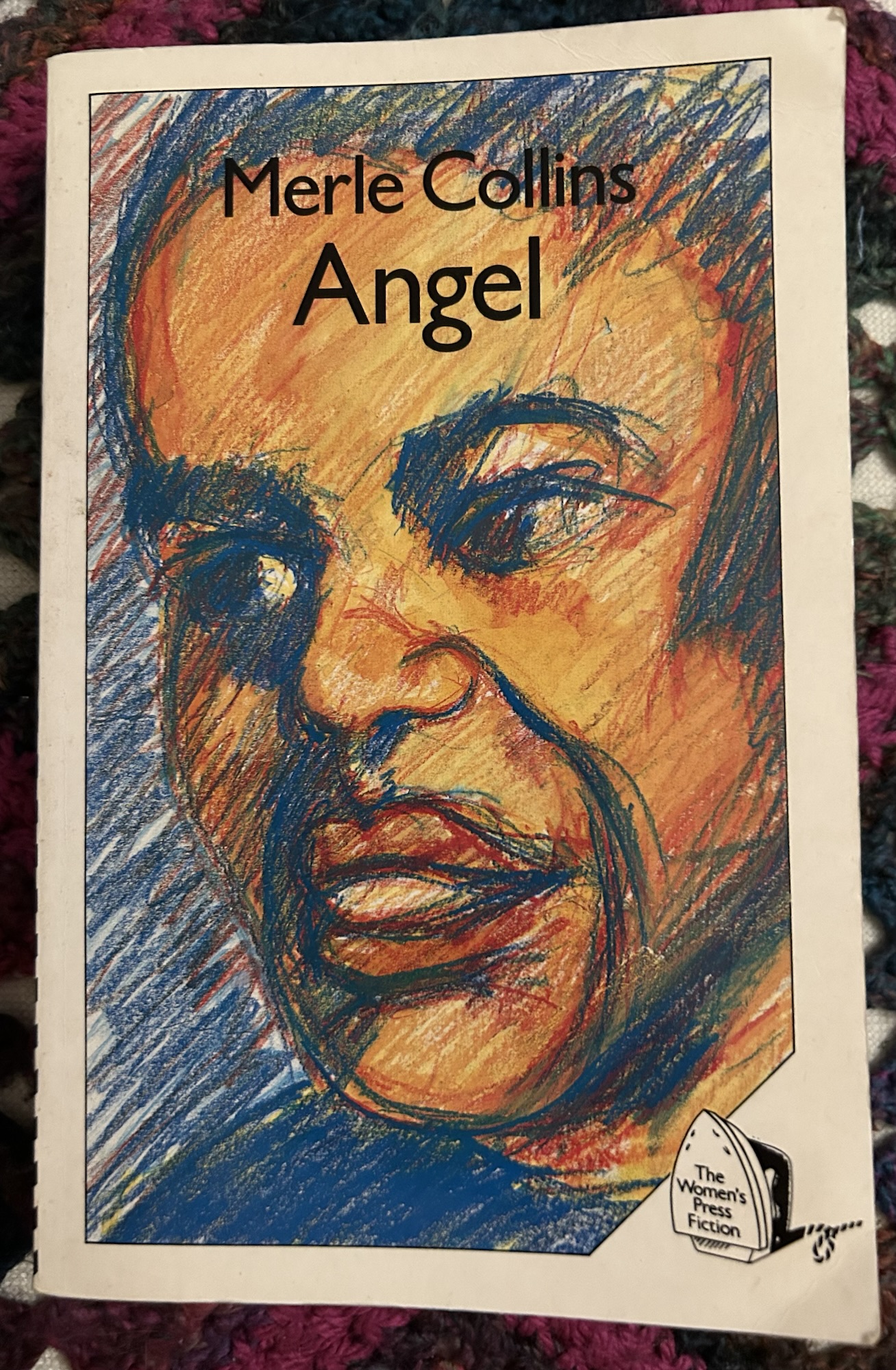
It opens with Angel in her mother Doodsie’s arms, as workers strike and set fire to the plantations.
“The men held their cutlasses firmly. Held up on Doodsie’s shoulder, Angel clung round her mother’s neck. Mother and child kept their eyes riveted on the fire, Angel wide-eyed, Doodsie suddenly very afraid as she saw the De Lisle plantation houses enveloped in flames, a burning glow in the red and sky.
Just under the hill from the crowd, Ma Ettie sat down in her house and secured the folds of her headtie.”
The strikers follow union boss Leader (based on Eric Gairy). Angel’s father Allan has great faith, but Doodsie is more sceptical. She was my favourite character – some attitudes of her generation but a fiercely intelligent, independent- spirited, hard-working woman, who does not have an easy life. Allan comes and goes, providing little money as it is spread between his children with other women. Meanwhile Doodsie raises her family and tries to enable the choices she has been denied.
“Doodsie looked across at her daughter as she combed her fingers through the doll’s blonde hair. She wondered what Angel would grow up to be. One thing if I have anything to do with it, she not going to have my kind of life. She thought of Simon, sleeping quietly inside. He looked so hurt if you ever shouted at him, you just had to shut up after a while. Angel, on the other hand, looked as though she wanted to find out how long you could go on shouting for. She wouldn’t take no for an answer when she decided she wanted something.”
As Angel grows up she is intelligent but somewhat unmotivated, passing her exams except for West Indian history, which she finds dull and not as interesting as British history. It is at university in Jamaica where she starts to think politically, both on an international level and a personal level when she stops ironing her hair.
“She remembered always that day during her first year at school, when one of the nuns who took a deep interesting her welfare told her she should ask her mother to have her hair ironed or straightened so that it would look decent. Angel had held her head down, her hands had fingered her tie, she had muttered some answer of assent, then slithered along the wall of the corridor around the corner to the notice board. She stood staring up at it through her tears, feeling untidy and stupid, rolling and unrolling the grey tie around her neck.”
Angel heads back to Grenada after she gets her degree, to teach. Grenada achieves independence from Britain, and the family are still divided over Leader, whose portrait Allan has on the wall, before Angel smashes it. Her younger brother Rupert is part of the revolution which overthrows Leader (based on the New Jewel Movement).
“‘Civil war is blood, Rupert.’
‘Which side you on, Angel?’
‘I not on no blasted side. Side talk is war talk.’
‘That is rubbish. That opportunist nonsense could only mean you not on the side of the people. Why you don take a stan? The ting that frighten me about you is dat you able to support everybody. You always balancin! That is pure opportunism! Dammit to hell, Angel! Follow you mind! Come down on one side!’”
Much of the novel is written in patois and I found this evocative and powerful, and straightforward to follow although there is also a useful glossary at the end for non-speakers.
The story finishes with the dramatic events of the US invasion, before shifting to symbolic scenes in Doodsie’s backyard, and with Angel at the Delicia river. It is a fitting end to a book that expertly balances the story of a Grenadian family alongside major national events, never losing sight of either but showing how they are completely interwoven.
To end, a song quoted several times in the novel:
Title quote from an interview on Caribbean Literary Heritage.


This sounds very powerful, and a great end to your literary world tour
LikeLiked by 1 person
It definitely meant I finished on a high! Such an impressive novel.
LikeLiked by 1 person
A big congratulations and welcome home after your round the world trip! 😊
And yet again you’ve demonstrated that every book (however long it’s been languishing there) has its day!
LikeLiked by 1 person
Thank you so much!
I’d combed through the TBR so many times for this challenge, I couldn’t believe there was still one I’d missed 🤣
LikeLike
Congratulations, that is an accomplishment! I’m very ignorant of Grenada’s history and I see this is a Women’s Press edition, so that’s two good reasons to get myself a copy!
LikeLiked by 1 person
Thanks Jane! It took me a looooong time so not a great achievement but a lot of fun!
I hope you enjoy this if you get a copy 😊
LikeLiked by 1 person
Sounds mightly powerful, Madame B, and what a great book to finish your project on – congratulations!!
LikeLiked by 1 person
Thanks Kaggsy! It was really powerful – a great way to finish!
LikeLiked by 1 person
Sounds like an excellent way to finish your travels! The patois looks reasonably easy to read from your quotes – sometimes the use of patois or dialect can make the reading so effortful that it becomes a struggle, but it doesn’t look like that’s the case here.
LikeLiked by 1 person
There’s more use of patois than I’ve probably indicated here, but I didn’t find it difficult or distracting. It worked really well.
It was a great way to finish the challenge!
LikeLiked by 1 person
Sounds excellent, and I love the Women’s Press edition, of course!
LikeLiked by 1 person
It is excellent – I love the edition too!
LikeLiked by 1 person
I think I have this on my shelf at the Internet Archive (her work is exceptionally hard to find here, even via ILL) so I’m looking forward to it. And a big congrats on your final selection for your years’ long project. Knowing now what you didn’t know when you undertook the project, is there anything you’d do differently?
LikeLiked by 1 person
I hope you enjoy it when you get to it Marcie!
Thanks so much! I think I would try and keep the momentum going a bit more, haha. And make more effort earlier on to try and find the translations that are less easy to source here.. But all in all I’m glad with how it worked out and I really enjoyed it 🙂
LikeLike