When Kaggsy and Simon announced the 1949 Club I went scurrying off to the TBR to see what I could find:
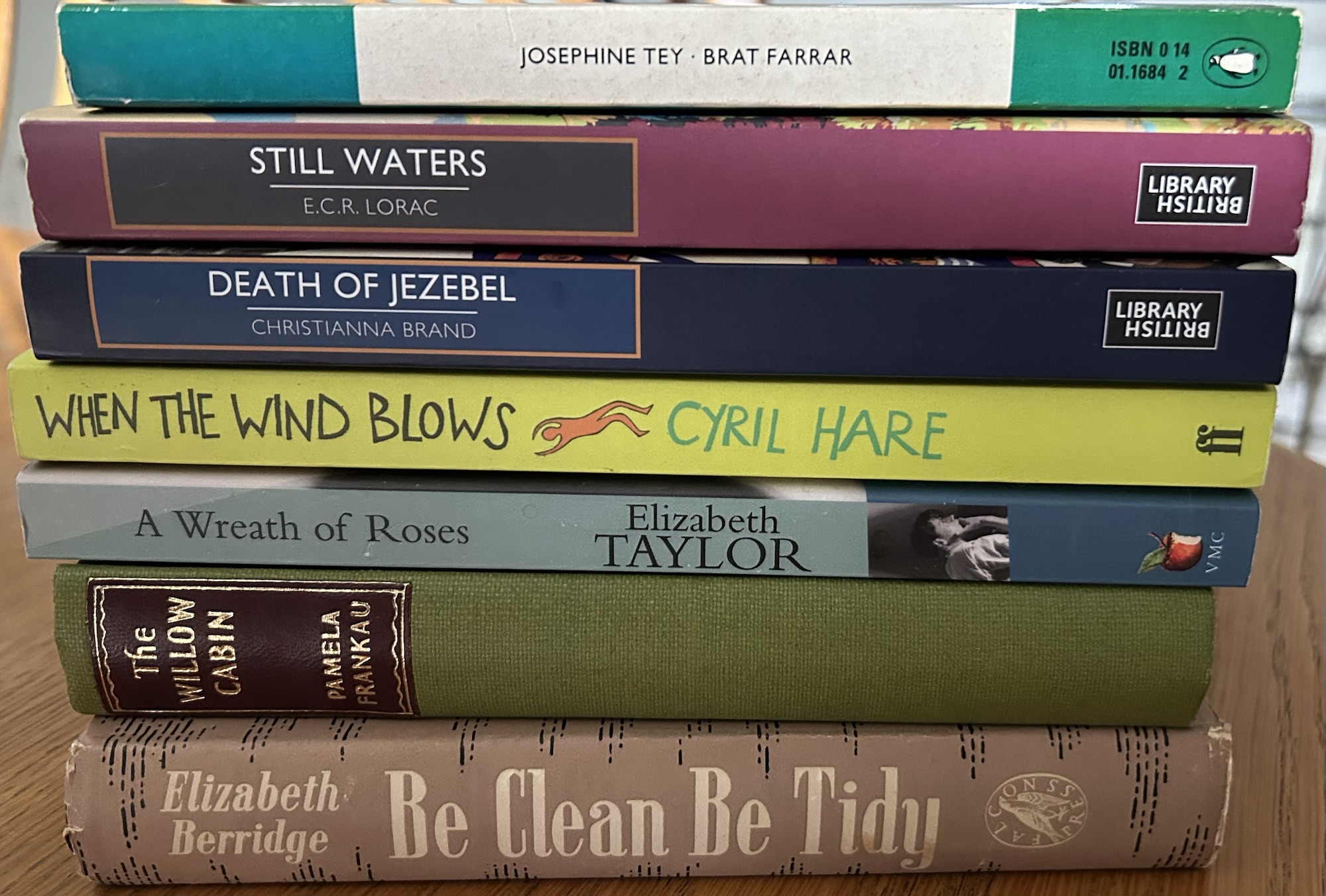
As it turns out, I missed one – I also have The Far Cry by Emma Smith. I’ve read some in preparation for the week and I’m hoping to read a few more throughout, although I won’t get to them all, so any suggestions gratefully received!
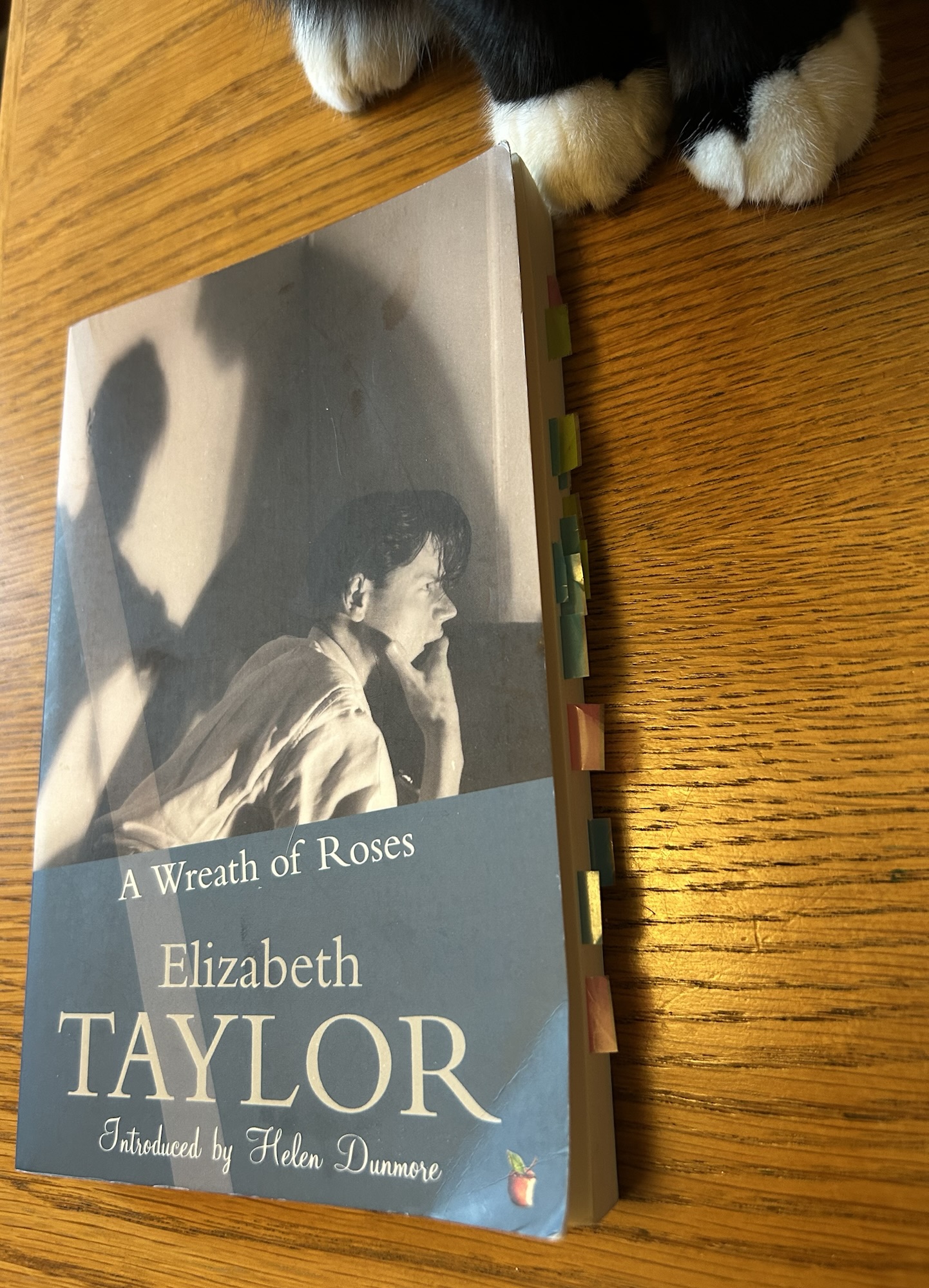
Knowing how highly JacquiWine rates A Wreath of Roses by Elizabeth Taylor, this was my first stop. I thought it was an absolute knock-out, and filled the short novel with page markers which I’ve tried to picture, but was impeded by Fred taking a great interest and headbutting my phone repeatedly, so this is the best I managed:
It opens:
“Afternoons seem unending on branch line stations in England in summer time. The spiked shelter prints an unmoving shadow on the platform, geraniums blaze, whitewashed stones assault the eye. Such trains as come only add to the air of fantasy, to the idea of the scene being symbolic, or encountered at one level while suggesting another even more alienating.”
And so I settled in, knowing I was in the hands of a masterful writer. On first reading I found it striking, now looking back on it I think it’s perfect. English summertime: so often memorialised, sentimentalised, filled with nostalgia for warm, temperate days… and immediately Taylor has identified spikes, shadows, assaults, alienation. It concisely and expertly introduces everything about A Wreath of Roses.
Camilla Hill is catching a train to spend her holiday with her schoolfriend Liz and Liz’s governess Frances, now a painter. On the way there she witnesses something shocking, and so she finds herself talking to the other witness, Richard Elton, a man she initially judged as too obviously good-looking and too young for her.
She also recognises that he is not entirely honest, as does Liz when she meets him:
“I thought he seemed to be acting. It was as if he had learnt the words by heart first. They seemed not to belong to him, nor to match the look in his eyes.”
Yet Camilla finds herself drawn towards him. Liz and Frances have both changed a lot since the previous year; Liz now has baby Harry and despite her protestations that “Marriage is such a sordid, morbid relationship!”, she and her husband Arthur, a vicar, reach renewed understanding. Frances is aloof, and is embracing “ferocity” in both her changing painterly style and her enormous bull mastiff dog Hotchkiss. But her arthritis is getting worse and she is fearful she will not paint for much longer:
“So intent was she on being a normal elderly woman, so much trouble did she take, that she would always rather be praised for her crab-apple jelly than her painting, for the first was a marvel in her, the other natural to her and inevitable.”
Camilla barely admits her sexual attraction to Richard, but it is there, as he manipulates her with dishonesty and dissembling. She scarcely believes his stories of wartime heroics, yet she is so desperate for change, romance and hope that she recognises her cognitive dissonance as she continues to seek him out.
“No man would understand what life is like for so many women. How can we take any of the things we want, that you expect to have—freedom, adventure, experience—without being taxed intolerably, or making ourselves ridiculous in other people’s eyes, or in our own?”
There is a constant sense of menace in A Wreath of Roses. Richard is clearly sinister and unpredictable, but there is anger in the domestic scenes too. The three women talk to each other quite brutally at times, even when they are not in disagreement. Camilla observes to Frances about Liz’s husband:
“Arthur seems to have a genius for cutting himself up into little pieces. He hands himself round among the ladies as if he were a plate of scones.”
When Morland Beddoes arrives, he simultaneously provides some relief but also racks up the tension. He is a gentle, quiet, observant middle-aged man and an admirer of Frances’ work. It’s a masterstroke by Taylor, as Beddoes recognises Richard’s danger and brings both the power and the vulnerability of kindness to the situation. The story remains entirely believable as it becomes unbearable.
I absolutely loved A Wreath of Roses. Every sentence is carefully crafted, yet the novel still flows and never feels overwritten. Taylor’s descriptive powers for scenes and acute insights with people mean she is precise and perceptive, without being cold. I’ve not done justice to her brilliance at all, but I’m delighted to have made such a memorable start to the 1949 Club.
“There are great paintings which offer everybody, and then there are lesser pictures which will reflect the light only here and there, rather capriciously, to individuals. Life itself shifts round a little and what we had thought all whiteness, or all darkness, flushes suddenly, from this new angle, with violet and green and vermillion.”


What a naughty cat you have!
LikeLiked by 1 person
Haha! He’s certainly very insistent!
LikeLike
My little Silky Terrier Amber knows how to get in the way too…
LikeLiked by 1 person
They wrap us around their paws 😊
LikeLike
This book gets Fred’s endorsement as well as yours, Jacquiwine’s and mine too; I read this for the club last week. I confess it has been on my shelves for a while, ever since I read the first page in a charity shop and could not resist. I think you have captured the book’s spirit really well. I thought it was quite a masterpiece with all the characters fully fleshed out and very believable. I certainly felt that sense of menace too and, without giving spoilers, I did think the bookending/inclusio with the beginning and the end was very clever and worked really well.
I’m not sure if I will attempt a separate review. Like you, I noted lots of wonderful paragraphs that really stood out but I am feeling its quite a weighty responsibility to attempt to do justice to such a perfect novel. Like eating chocolate makes me want more, I now crave more Elizabeth Taylor reads and rereads! (Although your Pym reading has also meant I reread Excellent Women and now am rereading Quartet in Autumn. So does one book and one blog post lead to so many more!).
LikeLike