Skin Deep – Antonia Lassa (transl. Jacky Collins) Blog Tour

After eleven years of blogging, it’s finally happening: I’m taking part in a blog tour 😀

And most delightfully, it coincides perfectly with my month of daily novellas. Skin Deep by Antonia Lassa (2023 transl. Jacky Collins 2023) comes in at 114 pages, making this Novella a Day in May 2023 – No.24.

One reason I don’t do blog tours usually is because I only blog about books I enjoy, so I can’t guarantee to take part. However, I trusted wonderful indie Corylus Books to see me right, and they did 😊 I thought Skin Deep was a great read.

It’s a challenge to have a detective story in so few words but the story didn’t feel diminished in any way by this. Yes, the solution is straightforward but I would much rather that than an overly convoluted, protracted story where I lose all sight of what’s happening and why on earth the person was killed in the first place.

Here is the blurb from Corylus Books:

“When police arrest eccentric loner Émile Gassiat for the murder of a wealthy woman in a shabby seaside apartment in Biarritz, Inspector Canonne is certain he has put the killer behind bars. Now he just needs to prove it. But he has not reckoned with the young man’s friends, who bring in lawyer-turned-investigator Larten to head for the desolate out-of-season south-west of France to dig deep into what really happened.

Larten’s hunt for the truth takes him back to the bustle of Paris as he seeks to demonstrate that the man in prison is innocent, despite all the evidence – and to uncover the true killer behind a series of bizarre murders.

Skin Deep is Antonia Lassa’s first novel to appear in English.”

All three protagonists are very believable and well-drawn. Although Canonne leaps to a lazy conclusion regarding the killer, he doesn’t doggedly stick to it. There is a lightness of touch in his portrait, including his contemplations of life and relationships, triggered by his missing tooth.

“The moment they went into the apartment, Canonne said to himself that they had got their man. The reason being that the place was impeccably tidy, more like the methodically kept home of a cold blooded serial-killer rather than a young man of twenty-six.”

This othering of Émile Gassiat because his lifestyle and sexual preferences don’t fit the stereotype of those of a good-looking young man is part of the wider themes in the book around difference and acceptance.

Larten is the perfect detective for the job in this regard, as he is comfortable with being viewed as Other and uses it to his advantage:

“Just as a small question-mark can alter the course and meaning of an entire sentence, no matter how complex and articulate it might be, Larten wanted those feminine touches that he included in his appearance or in his clothing, to act as a question mark at the end of each of the ‘sentences’ that constituted his identity. Something that would trouble others, getting them to question their own identity or fall for his charms. An invitation to dive into the unknown.”

He’s also a competent and driven detective who balances detailed investigation with an acute understanding of people.

“Larten could only add his own intuition, an argument that was not worth much in court but to which he clung. His intuition had failed him on very few occasions in his life, perhaps because he was a good wine taster.”

Skin Deep is such an accomplished crime novella. It balances poetic passages and societal commentary alongside characterization and plot with ease. Both the seedy seaside and cosmopolitan city were clearly evoked. I’m not a huge reader of contemporary crime and when I do read it, it is usually in translation – I would love to read a series of Larten novels as this camper-van dwelling wine enthusiast completely won me over.

Here are the stops from the rest of the tour, do check out the reviews for this great read:

Novella a Day in May #8

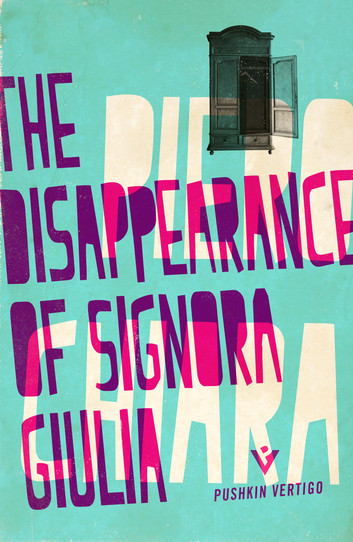
The Disappearance of Signora Giulia – Piero Chiara (1970, trans. Jill Foulston 2015) 122 pages

The Disappearance of Signora Giulia was initially published in an Italian newspaper as a serial and is now available in English translation thanks to Pushkin, as part of their Vertigo imprint. It is a quick, snappy crime thriller that does not aim for trite resolution but rather an exploration beneath the surface of a life to the murky depths.

Corrado Sciancalelpre is “blessed with a special form of intuition, that peculiar mental agility that enables great policemen to delve into the minds of criminals.”

Thankfully, he is also happy married and liked in the town in northern Lombardy where he works – no tortured alcoholic with a secret past here.

A powerful lawyer, Esengrini, asks Sciancalelpre to investigate the titular vanishing of his wife. Every Thursday, Guilia has been going to Milan to visit their daughter at boarding school, but now she has failed to return and two bags of her things are missing too. Sciancalelpre agrees and what follows is essentially a police procedural, but the short length of the story ensures the pacing remains tight.

Sciancalelpre is resolutely unsentimental but not without sympathy. The more he investigates, the more he feels for the missing woman:

“He didn’t say ‘Poor Signora Giulia to Esengrini when he visited him in his office every few days towards evening. With Esengrini, he spoke only of the undeniably disappointing results of a search conducted throughout the whole of Italy with Signora Giulia’s photo.”

It’s impossible to say much more about a crime novella without including spoilers. Suffice to say there are plenty of red herrings, people and relationships who are not what they seem. The Disappearance of Signora Giulia is a diverting read, when you’re in the mood for a crime novel you’ll finish quickly. It is not a simple tale though, and the resolution is a complex one that leaves questions unanswered. This wasn’t a source of frustration but rather felt realistic.

I really enjoyed this, Chiara’s first novel to be translated into English despite his huge popularity in Italy, and I hope there will be many more translations to follow.

“The clever men at Oxford/Know all that there is to be knowed./But they none of them know one half as much/As intelligent Mr. Toad!” (Kenneth Grahame, The Wind in the Willows)

I’m in Oxford at the moment, a city I love.  I thought I would look this week at novels set in Oxford, and although there are lots to choose from (I guess lots of writers chose to evoke their alma mater) I’ve picked two crime novels, as Oxford seems to encourage this type of story.  I’m not sure why this occurs, but maybe it’s because it’s seen as such a respectable institution and it’s fun to think of a seething mass of violence and intrigue below the calm façade. 

Firstly, The Case of the Gilded Fly by Edmund Crispin.  This was the first in a series of novels featuring the sleuthing Oxford don Gervase Fen, and is from the Golden Age of Detective fiction, written in 1944.  The opening paragraph struck a chord with me:

“To the unwary traveller, Didcot signifies the imminence of his arrival at Oxford; to the more experienced, another half-hour at least of frustration.  And travellers in general are divided into these two classes; the first apologetically haul down their luggage from the racks on to the seats, where it remains until the end of the journey, an encumbrance and a mass of sharp, unexpected edges; the second continue to stare gloomily out of the window at the woods and fields into which, by some witless godling, the station has been inexplicably dumped”

Well, the woods and fields may be much less evident, but otherwise… seventy years on and nothing changes.  Travelling on this train are Gervase Fen, his friend Sir Richard Freeman who is Chief Constable of Oxfordshire and wishes he was a don (while Fen wishes he was police officer) and various members of a drama group, who will return to London with their numbers somewhat diminished. Fen is a likeable, eccentric don, whose “normal overplus of energy …led him to undertake all manner of commitments and then gloomily to complain that he was overburdened with work and that nobody seemed to care”; he distracts himself on the train by wishing for “’A crime! …A really splendidly complicated crime!’ And he began to invent imaginary crimes and solve them with unbelievable rapidity.”

The first murder, of uber-bitch Yseult Haskell, takes place in a room in college close to Fen’s office, and so much to his delight he is distracted from his work on minor eighteenth-century satirists to investigate:

“His usually slightly fantastic naivety had completely disappeared, and its place was taken by a rather formidable , ice-cold concentration. Sir Richard, who knew the signs, looked up from his conference with the Inspector and sighed.  At the opening of the investigation, the mood was invariable, as always when Fen was concentrating particularly hard; when he was not interested in what was going on, he relapsed into a particularly irritating form of boisterous gaiety; when he had discovered anything of importance he quickly became melancholy […] and when an investigation was finally concluded, he became sunk in such a state of profound gloom it was days before he could be aroused from it.  Moreover these perverse and chameleon-like habits tended not unnaturally to get on people’s nerves.”

I’m not going to say too much about the plot as its nearly impossible not to give spoilers.  But if you think the eccentric Fen is someone you’d like to spend time with do look at The Case of the Gilded Fly.  I loved the dry, yet gentle humour in the writing, and it was a well-paced, easy read.  My favourite character however, was one of the minor players; unlike a lot of detectives, Fen does not have a complicated romantic life filled with encounters with unsuitable lovers, but is married to the brilliantly indulgent Mrs Fen:

“After she had greeted the Inspector with a slow, pleasant smile, Fen seized up the gun and handed it to her, saying:

‘Dolly, would you mind committing suicide for a moment?’

‘Certainly,’ Mrs Fen remained unperturbed at this alarming request, and took the gun in her right hand, with her forefinger on the trigger; then she pointed it at her right temple.

‘There!’ said Fen triumphantly.

‘Shall I pull the trigger?’ asked Mrs Fen.

‘By all means,’ he said absently, but Sir Richard surged up from his chair crying hoarsely: ‘Don’t! It’s loaded!’ and snatched the gun away from her.  She smiled at him. ‘Thank you, Sir Richard,” she said benignly, ‘but Gervase is hopelessly forgetful, and I shouldn’t have dreamed of doing such a thing.  Is that all I can do for you gentlemen?’”

What a woman. Next, a much more recent tale (2005) whose title tells you exactly what to expect: The Oxford Murders by Guillermo Martinez (trans. Sonia Soto). The novel is narrated by a postgraduate mathematics student, who shortly after arriving in England finds his landlady murdered, discovering the body at the same time as his hero, Professor Arthur Seldom “a rare case of mathematical genius”. The Professor is there because he received a note telling him that something would happen “the first of the series” followed with a mathematical symbol, a circle.  As more people die, Seldom continues to receive notes ending with symbols, and believes the murderer is taunting him specifically as he wrote a book on mathematics where he argues that “except in crime novels and films, the logic behind serial murders…is generally very rudimentary…the patterns are very crude, typified by monotony, repetition, and the overwhelming majority are based on some traumatic experience or childhood fixation”. Some serial killers may take that as a challenge…

The two start working together, using their academic approaches to try and decipher the logic of the murders.  There’s a lot of maths talk, but it’s not overwhelming even for someone like me whose dealings with numbers is limited entirely to their monthly budget.  The combination works well and doesn’t feel forced:

“There is a theoretical parallel between mathematics and criminology; as Inspector Petersen said, we both make conjectures.  But when you set out a hypothesis about the real world, you inevitably introduce an irreversible element of action, which always has consequences.”

Can they make their hypotheses apply in the real world and solve the symbolic series in time to prevent more murders?  What do the symbols really represent?  The Oxford Murders is a short novel and not particularly complex despite the setting in elite mathematics; it’s well written but if you’re a crime aficionado you may find it a bit too straightforward.

The Oxford Murders was made into a film a few years back; from this trailer I would say it’s a fairly faithful adaptation:

Here’s my attempt at a vaguely mathematical end: from the shaded area of a Venn diagram of Oxford and books, here is a picture of one of the most beautiful libraries you’ll ever see – the Radcliffe Camera in central Oxford.  The picture’s wonky because it was blowing a gale and I was up the top of the tower of St Mary the Virgin, where the wind was so strong I thought I, or at the very least my phone, was about to get whipped off the viewing balcony into the square below.  Thankfully we both made it back intact.

Image