“We say it instead of saying something else.” (Hanne Ørstavik, ti amo)

This post discusses end-stage cancer.

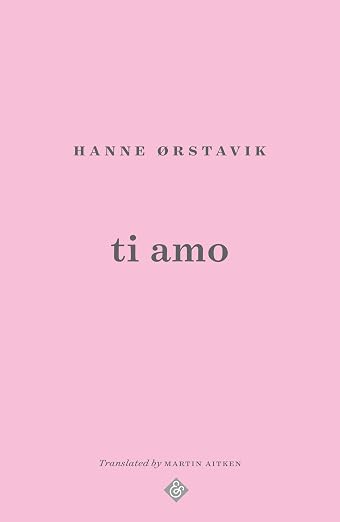
I’ve read two previous novellas by Norwegian author Hanne Ørstavik, Love (1997), and The Blue Room (1999). Both are incredibly tough reads about abusive parent/child relationships, but brilliantly written. Her portrayal of the pain in familial relationships is just as unflinching in ti amo (2020, transl. Martin Aitken 2022, 93 pages), but here she considers a loving romantic partnership, and what happens when one of the couple is facing end-stage cancer. It’s my first read for Novellas in November, hosted by Cathy at 746 Books and Bookish Beck and it’s given me a very strong start.

We are plunged immediately into the altered existence that the narrator and her partner are living (it is a novella, but autofiction) as they try to manage the last part of his life. There is both intimacy and distance:

“Once, I would reach out in the night to touch your skin, to place my hand on your back, your stomach, your thigh, anywhere at all, and there’d be connection, contact. […] But you are no longer in your body, I don’t know where you are. Awash in morphine, you drift in and out of sleep or languor, and we do not talk about death.”

The narrator writes about how she values truth so highly, and as a reader I thought this was visible in Ørstavik’s unflinching gaze across her work. In ti amo, she doesn’t shy away from portraying the physical indignities the person diagnosed suffers; these are very hard passages to read. Nor does she portray the narrator as a perfect, self-sacrificing angel. It felt incredibly, almost brutally honest, including acknowledgement of how what is written isn’t always entirely the truth.

The narrator’s striving for truth means she struggles with the obfuscation around prognosis. Her partner doesn’t want to know, which she respects, but she is also furious with the situation and the silence from the medical team:

“Why can’t we speak the truth? Why can’t we say things the way they are? Why do they have to hide your death from you? Do you really not want to know, not to be in contact with, not to feel, the truth of yourself?”

She also captures the constant anticipatory grief that she carries:

“I feel as if I’ve come home when I look into your eyes. The way I look into your eyes and at the same time, always, know that you’re going to die. It’s been you and me and death for so long now.“

It is an incredibly sad book, as you would expect, not least because the narrator explains how much she had to overcome in life to get to where she could enter a loving relationship. Having reached that point, she meets her Italian partner, and after just a few years, their time together will be over.

“I’ve always thought there was something contrived about it when people go on about being so sensitive to death, being afraid of death. How can they, I’ve always wondered, these living people? I’ve struggled so hard just to feel the heart beating in my chest, to feel there’s something there that’s alive inside me, and not just steel and stone.“

There are moments of ordinary, tender intimacy too, as the couple have to navigate a way to find touchpoints when one of their bodies is failing:

“We watched the birds, their comings and goings, and you know the names of all the various kinds, you tell me what they’re called in Italian. And we sit there looking out instead of at each other,”

I’ve never experienced the death of a partner. But I’ve witnessed a lot of moments in my work over 27 years, and from my outsiders view Ørstavik captured so much, writing tenderly, angrily and honestly about the experience.

“I can’t do anything to help you. I can’t do anything for myself either, apart from that, finish the novel. […] It’s my way of existing in the world, I make a space for myself”
Novella a Day in May 2022 No.13

Love – Hanne Ørstavik (1997, trans. Martin Aitken, 2018) 136 pages

It’s been six years since I read Hanne Ørstavik’s powerful novella The Blue Room and I had high expectations when I picked up Love from one of my favourite publishers AndOtherStories.

Like The Blue Room, Love features a dysfunctional parent/child relationship, although not one as determinedly destructive as Johanne and her mother in The Blue Room. Whereas that was suffocating and controlling, Jon and his mother Vibeke are almost at the opposite extreme with a child at risk of neglect.

I don’t have kids but I would say that having your eight year-old son roam the snowy streets in northern Norway alone in the depths of the night with no gloves on, while you prevaricate over whether to sleep with a man who picked you up at a funfair, is probably not the best parenting style…

Jon is waiting for his mother Vibeke to return from work. Tomorrow is his birthday and he believes she is going to bake him a cake.

“And then she comes, and he recognises the sound in an instant; he hears it with his tummy, it’s my tummy that remembers the sound, not me, he thinks to himself.”

Although in the same house and having dinner together, they’re not overly communicative. Vibeke has a shower and makes herself look good should she bump into her attractive work colleague in town. Jon leaves the house, returns again, then leaves again, with Vibeke only vaguely conscious of his whereabouts.

The town is far north and it has been snowing. Jon wanders the dark streets:

“Sounds become weightless in the cold. Everything does. As if he were a bubble of air himself, ready at any moment to float into the sky and vanish into the firmament.”

Meanwhile Vibeke has found the library closed, so she wanders round the newly arrived fairground. An attractive fairground worker picks her up and takes her back to his caravan.

“She feels like they share something now. It feels like pushing a boat from the shore, the moment the boat comes free of the sand and floats, floats on the water.”

We know Vibeke had Jon when she was young and that it has been the two of them for a while. However, Vibeke seems pretty oblivious not only to the safety of her son but to the feelings and motivations of other people. Despite being attracted to one another, the situation between Vibeke and the man never really takes off. She keeps holding back because she thinks that talking too much has hampered previous relationships.

“My mistake is to think too much when I talk, it slows everything down, repartee just isn’t there for me.”

However, there comes a point where you do actually have to communicate in some way. When they go to a bar and he chats to the barmaid, then disappears back inside leaving Vibeke in the car outside, she thinks:

“Maybe he’s working on keeping a hold on himself, and the control he thereby achieves is something he needs to cling to.”

Um, no. He’s just lost interest and moved onto the next pretty and more available girl.

Meanwhile Jon has spent some time with a schoolfriend (whose parents are happy to have him leave and wander back home alone at midnight) and ends up getting into a stranger’s car, which at least offsets hypothermia for a while.

Although remarkably self-possessed and bright, Jon is clearly suffering from his mother’s lack of care. He is trying to stop himself blinking and people comment it.

“He wishes no one noticed and that what was wrong with him was under his clothes or inside him.”

Throughout, he clings to the idea that Vibeke is at home baking him a birthday cake which I found completely heart-breaking.

The narrative of Love alternates between Vibeke and Jon almost paragraph by paragraph. This isn’t nearly as confusing as it sounds, it works well as the two of them have evenings that echo and reflect each other in surprising ways. They also both put themselves in risky situations and the story is tense and very believable. It’s a novella that creeps under your skin and stays there.

“She wishes she could read all the time, sitting in bed with the duvet pulled up, with coffee, lots of cigarettes and a warm nightdress on.”