“If you thought about the unthinkable long enough it became quite reasonable.” (Josephine Tey, Brat Farrar)

This is my second post for the 1949 Club hosted by Simon and Kaggsy and I’m continuing with a theme of sinister men…

Not so long ago I read Miss Pym Disposes by Josephine Tey and now I’m returning to her once again for Brat Farrar. I’m beginning to realise that Tey doesn’t seem to do traditional golden age mysteries! In Brat Farrar we know that the titular character is pretending to be the heir to a family fortune. So the mystery isn’t whether he is Patrick Ashby, missing since age 13 after the death of his parents, but rather, will he get away with it? And as readers, do we want him to?
Aunt Bee raised Patrick’s twin Simon, their sisters Eleanor and twins Ruth and Jane, after their parents died in a plane crash. At the start of the book she is reflecting on Simon about to come of age and inherit:

“But always there had been an Ashby at Latchetts; and they had done well by the land. Here and there came a ne’er-do-well—like her cousin Walter—but Providence had seen to it that the worthless quality had been confined to younger sons, who could practise their waywardness on subjects remote from Latchetts.

No queens had come to Latchetts to dine; no cavaliers to hide. For three hundred years it had stood in its meadows very much as it stood now; a yeoman’s dwelling. And for nearly two of those three hundred years Ashbys had lived in it.”

She also considers the difference between Simon and his – presumed dead – brother.

“All she really remembered, now she thought about it, was that he was solemn and kind.

Kindness was not a common trait in small boys.

Simon had a careless generosity when it did not cost him inconvenience; but Patrick had had that inner kindness that not only gives but gives up.”

It’s eight years since Patrick vanished; struggling actor Alec Loding knows the family and thinks he has found a way to make some money. I really enjoyed how Tey introduced this reprehensible character:

“He had a pink, collapsed face that reminded one of the underside of fresh mushrooms. The flesh hung away from his good Ledingham bones with a discouraged slackness, and the incipient pouches under his eyes detracted from their undoubted intelligence. Managers who had once cast him for gay young rakes now offered him nothing but discredited roués.”

He has spotted Brat Farrar’s resemblance to Simon, and therefore Patrick, and has offered to coach him in return for a regular salary once Brat inherits. Brat isn’t sure, but he is struggling to find the work he wants. This is an interesting choice for the 1949 Club, because Brat’s circumstances are directly informed by the post-war situation:

“It seemed that there were far more people interested in stable jobs in England than stables to accommodate them. The horse world contracted as the horse lovers expanded. All those men who had lost their main interest in living when the cavalry was put down were still hale and active, and besieged stable entrances at the mere whiff of a vacancy.”

Tey loved horse racing, and there is a lot about it in this novel. I hate it, so I must admit I skipped these passages. But even if you don’t mind racing, you may want to skim – I think her editor should have been more assertive!

Brat heads to the country pile and manages to convince most people most of the time that he is Patrick. He’s helped by the ambiguity of Patrick’s note: “I’m sorry, but I can’t bear it any longer. Don’t be angry with me. Patrick.” and the fact that similarly to Patrick, he is a lot more likeable than Simon. People want him to be Patrick.

“He had an odd feeling of identity with Patrick.

Even he himself noticed this, and found it strange. He should have been filled with guilt when he considered Patrick. But his only emotion was one of partisanship; almost of alliance.”

He also doesn’t overly struggle with guilt as he takes a strong dislike to his supposed twin:

“It was because there was something about Simon Ashby that repelled him. There was something unaccountable about Simon. There he sat, being light-hearted and charming, and there sat his relations and friends silently applauding his nobility and his courage. They were applauding an “act,” but they would all be staggered to know what an act Simon was really putting on for their benefit.”

And so ultimately, Tey is exploring the moral challenges that Val McDermid mentioned in her discussion of Miss Pym Disposes. Brat Farrar is pleasant, responsible and would make a good heir to run the estate. Simon is none of those things. But he is the rightful heir, and Brat Farrar is a con man who is using an intensely painful experience in a family to his own advantage. Tey positions the reader in a way that we question what we want the outcome to be, and why.

There’s also some nice gentle humour to enjoy, lightening what is essentially quite a dark tale. My favourite characters were stubborn, scruffy, horse-obsessed little Jane, and the bookish, seemingly naïve Rector, who made a surprise marriage to a beautiful debutante, and is more worldly than people give him credit for:

“”I know,” Nancy said, agreeing. “Like walking on jelly.”

“I was going to say picking one’s way over a bog, but I think the jelly is a better description.”

“Or one of those uneven floors at fun fairs,” the Rector said unexpectedly, as Bee took her leave.

“How do you know about fun fairs, George?” his wife asked.

“They had one at the Westover Carnival a year or two ago, I seem to remember. A most interesting study in masochism.”

“You see now why I have stuck to George,” Nancy said, as she walked with Bee to the garden gate. “After thirteen years I am still finding out things about him. I wouldn’t have believed that he even knew what a fun fair was. Can you picture George lost in contemplation of the Giant Racer?””

Brat Farrar was adapted as Paranoiac in 1963 by Hammer films. From this trailer I would say it’s a very loose adaptation indeed 😀

“As a psychologist she began to suspect she was a very good teacher of French.” (Josephine Tey, Miss Pym Disposes)

I dithered a bit about posting on Miss Pym Disposes by Josephine Tey (1946) as although I enjoyed it, I wasn’t really sure if I could recommend it onwards. It’s an unusual novel written by an established author of the era of golden age detectives, where the murder doesn’t take place until page 157 of 208. There’s also a lot of dated stereotyping and language so do bear that in mind if you decide to pick it up.

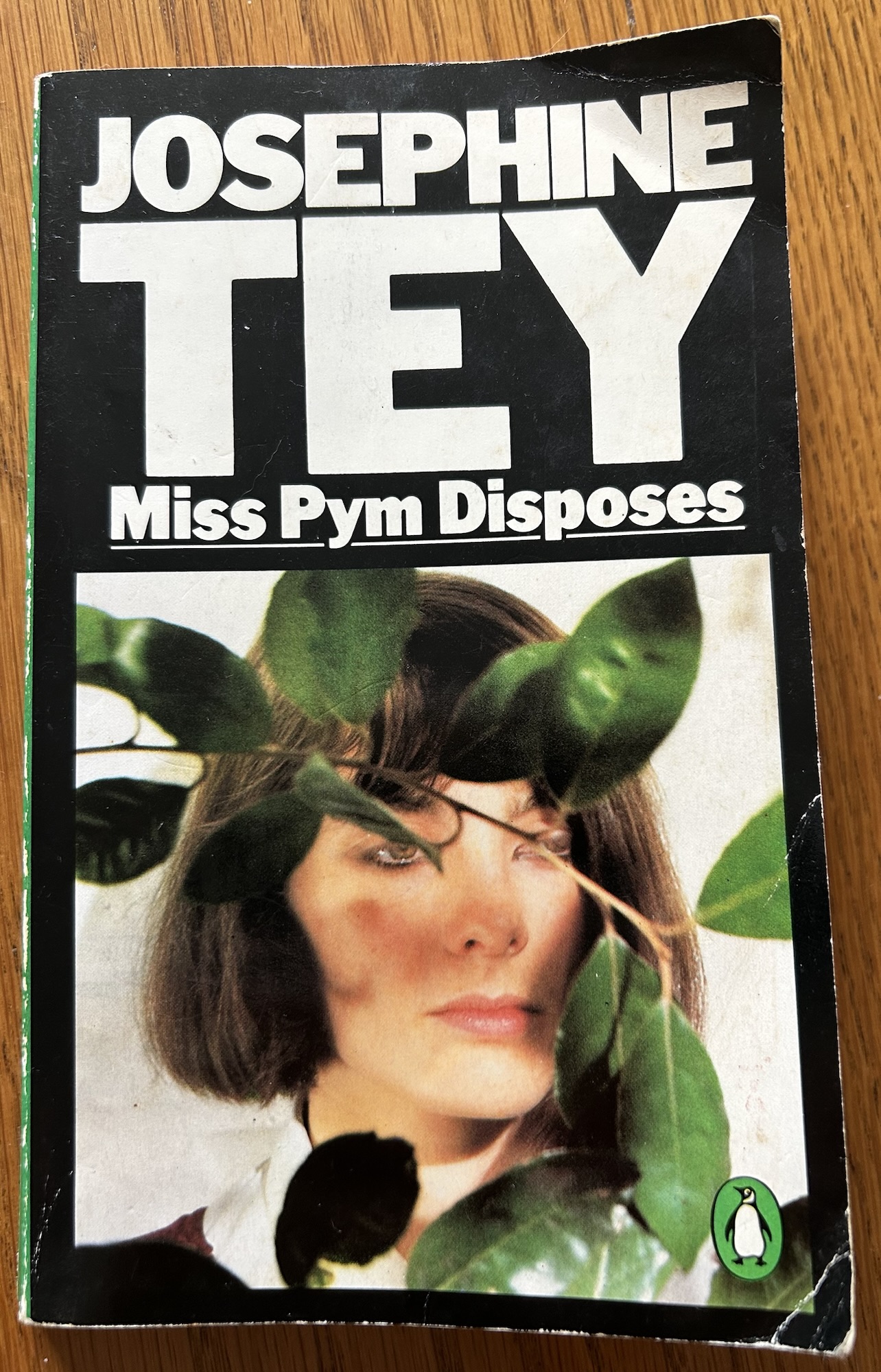
My edition is from what I think of as the golden age of soft-focus cheese from the Penguin art department, circa mid 1970s-1980s.

But it’s perfect for #SpinsterSeptember hosted by @pearjelly, set as it is in Leys Physical Training College for young ladies, where the teachers are single women, and with a titular character who is also a spinster. Lucy Pym initially works as a French teacher:

“But after four years of that her remaining parent had died, leaving her two hundred and fifty pounds a year, and Lucy had dried her eyes with one hand and given in her resignation with the other.

[…]

She read her first book on psychology out of curiosity, because it seemed to her an interesting sort of thing; and she read all the rest to see if they were just as silly. By the time she had read thirty-seven books on the subject, she had evolved ideas of her own on psychology; at variance, of course, with all thirty-seven volumes read to date. In fact, the thirty-seven volumes seemed to her so idiotic and made her so angry that she sat down there and then and wrote reams of refutal. Since one cannot talk about psychology in anything but jargon, there being no English for most of it, the reams of refutal read very learnedly indeed.”

I did enjoy Tey’s humour around Lucy leaving her job! Clearly she was highly sceptical of psychology though, which is quite surprising given that in many ways this is a psychological study. Much of the novel is spent building her cast of characters and the insular environment of the college.

“College was a bright gateway to the future for deserving youth; and if one or two found the gateway a hazard rather than an opening, then it was unfortunate but no reflection on the builders of the gateway.

“Like a convent,” Nash had said yesterday morning. “No time to think of an outside world.” That was true. She had watched a day’s routine go by. She had also seen the students’ two daily papers lying unopened in the common-room last night as they went in to supper. But a nunnery, if it was a narrow world, was also a placid one. Uncompetitive. Assured. There was nothing of the nunnery about this over-anxious, wildly strenuous life. Only the self-absorption was the same; the narrowness.”

Lucy is there because she was asked by old schoolfriend Henrietta to give a talk, and at first the 5.30am bell ringing and horrific institutional food means she plans to leave as soon as possible. But gradually she begins to enjoy herself, and decides to stay for the end of term gymnastic demo. She enjoys the company of the senior girls, including charismatic head girl Pamela ‘Beau’ Nash; her best friend, the accomplished but self-effacing Mary Innes; and Teresa Desterro who is there to study dance only and hone her considerable talent. There is also Barbara Rouse, who people are wary of although it’s not clear why, and is the favourite of the headmistress, also for reasons unclear.

“In the last few years [Lucy] had been ignored, envied, admired, kow-towed to, and cultivated; but warm, personal liking was something she had not had since the Lower Fourth said goodbye to her, with a home-made pen-wiper and a speech by Gladys Someone-or-other, shortly after her legacy. To stay in this atmosphere of youth, of liking, of warmth, she was willing to overlook for a space the bells, the beans, and the bathrooms.”

The girls are waiting to find out which jobs have been found for them by their headmistress, and there’s a shock when the plum job at “Arlinghurst. The school for girls, of course. A sort of female Eton.” goes to an unexpected candidate.

So, someone gets killed, and Lucy uses, I would say, one and a half pieces of flimsy evidence to work out who did it. But actually, I don’t think the puzzle element is of particular interest to Tey. There’s a great Backlisted podcast episode on this novel from back in 2021, with Val McDermid who is really enthusiastic about Miss Pym Disposes. She argues Tey is more interested in morality; the motivations of it and the conundrums around it, and I think she’s right. The reasons I find golden age detective novels a comfort read – a puzzle worked out neatly, justice and order restored – are not present here. The ending is really quite stark, and readers are unlikely to find the outcome reassuring although it is believable.

I do recommend Miss Pym Disposes, but surprisingly, not as one to be read when you’re in the mood for a golden age mystery!

To end, initially nothing sprung to mind for a suitable song, before I realised that because Teresa is Brazilian, I could include a legendary musician from that country, Caetano Veloso:

“Nothing puts things in perspective as quickly as a mountain.” (Josephine Tey)

Today for the 1952 Club hosted by Kaggsy and Simon I’m looking at another golden age mystery. The Singing Sands by Josephine Tey features her regular detective, Inspector Alan Grant. It was found in her papers after she died and published posthumously, which usually makes my heart sink, but the novel seems pretty complete so I hope it was as she planned.

You can come across all sorts prejudices and snobberies in golden age crime and The Singing Sands has a strong one running throughout, which admittedly I’ve not encountered before in the genre: Tey is a total snob about Scotland. As far as I can work out her rules are:

  1. Be Scottish
  2. But speak with an English accent (by which I assume she means RP – I doubt my south London tones would cut the mustard)
  3. Don’t be from the city
  4. Especially don’t be from Glasgow
  5. Be from the Highlands
  6. Don’t be a nationalist
  7. Really don’t be from Glasgow

I take great exception to her attitude to Glasgow – it’s a beautiful city full of friendly people. Every time I go I’m knocked out and I’m still giving serious consideration to moving there. In the end when I came across these attitudes I just rolled my eyes and skipped on, and it didn’t affect my enjoyment of the novel. But as a counterbalance I urge everyone to (re)visit wonderful Glasgow!

On with the novel! It opens with Grant struggling with his mental health and deciding to visit his cousin Laura (Lalla) and her family in the Highlands to recuperate. The background of what led to Grant reaching this point is never quite specified but he seems to be experiencing burnout/PTSD.

As he disembarks the train, the grumpy attendant is trying to rouse the passenger in berth B Seven. Grant realises he is dead, and his interest in faces (detailed extensively in The Daughter of Time which is where the title quote comes from but would have worked very well in this novel too) is piqued:

“What would bring a dark, thin young man with reckless eyebrows and a passion for alcohol to the Highlands at the beginning of March?”

He also picks up B Seven’s newspaper, which has some cryptic verse scribbled on it. Much as Grant tries to focus on his family and the fishing expeditions he had planned, his mind keeps being drawn back to B Seven. The verse leads him to visit some of the islands to identify the landmarks mentioned:

“There was nothing else in all the world but the green torn sea and the sands. He stood there looking at it, and remembering that the nearest land was America. Not since he had stood in the North African desert had he known that uncanny feeling that is born of unlimited space. That feeling of human diminution.”

Although his colleagues in London have identified the body and ruled accidental death, Grant thinks both these conclusions are questionable. Despite trying to recover from his work, he can’t let it go. He is aware that keeping his mind occupied can be useful, but it is a fine balance:

“Grant was very conscious that his obsession with B Seven was an unreasonable thing; abnormal; that it was part of his illness. That in his sober mind he would not have thought a second time about B Seven. He resented his obsession and clung to it. It was at once his bane and his refuge.”

We follow Grant as he heals, with the help of his beautiful environment, the understanding of his family, and his pursuit of the truth.

“But for B Seven he would not be sitting above this sodden world feeling like a king. New born and self-owning. He was something more than B Seven’s champion now: he was his debtor. His servant.”

The Singing Sands is not heavily plot-driven and the mystery is slight, but it is still an enjoyable read, if a slightly unusual approach to the genre. Grant’s dogged pursuit of the truth of a death which others seem quick to disregard makes him endearing, and there are lovely descriptions of the Highlands. It’s a quick read that doesn’t outstay its welcome, and it is compassionate in its portrayal of mental health.

“In matters where A was at spot X at 5:30pm on the umpteenth inst, Grant’s mind worked with the tidiness of a calculating machine. But in an affair where motive was all, he sat back and let his mind loose on the problem. Presently, if he left it alone, it would throw up the pattern that he needed.”

“And therefore, since I cannot prove a lover/To entertain these fair well-spoken days,/I am determined to prove a villain” (Richard III)

Richard III is being buried today in Leicester Cathedral after his remains were discovered in the rather unlikely surroundings of a car park in the county in August 2012.  Controversial to the end, the reinternment of his remains has been delayed by legal wrangling between Leicester and York as to who should have the bones.  Richard III is one of history’s villains, often believed to have killed the sons of Edward IV to secure his own claim on the throne of England (significant crowds attended his funeral procession on Sunday, so maybe he’s been given the benefit of the doubt). This image is due in no small part to the enduring influence of Shakespeare’s portrayal in The Life and Death of Richard III (1591ish), helped along by Laurence Olivier’s 1955 film.

In the interests of balance I thought I would look at this play alongside a novel that seeks to rescue Richard’s reputation.

Richard is an unusual villain in Shakespeare, in that he is the only eponymous character to start his own play (I think…feel free to correct me in the comments!) as he comes on stage to proclaim:

“Now is the winter of our discontent
Made glorious summer by this sun of York”

He is also unusual in that he starts with a trochee – bear with me, I’m not going to get too technical & give you flashbacks to the horrors of Shakespeare at school. But I think this is worth pointing out; most characters speak in iambic pentameter (dee-DUM, dee-DUM etc). Richard comes out and seizes the stage with “NOW is…” (DUM-dee): he is in charge from the off.

What follows is the story of a consummate politician doing whatever he deems necessary to seize the crown.  Although he tries to persuade us that his disability (a curved spine, possibly a slightly weaker arm one side) means that through medieval ableism he is marked for villainy (the title quote I’ve used is a pun – he is determined in will and determined by fate) really no-one is less disabled that Richard, as the powerful opening shows us.  He manages to bend everyone to his will; he seduces Lady Anne within one scene, despite the fact that he killed her husband:

“Was ever woman in this humour woo’d?
Was ever woman in this humour won?
I’ll have her; but I will not keep her long.”

This is the bleak humour of Richard III – he plots to kill his fiancée even as he seduces her.  Often the play is described as a tragedy, but it’s really one of Shakespeare’s history plays and the tone is ambiguous: the last production I saw, with Mark Rylance in the lead, played it as a comedy as far as possible.

Richard’s machinations eventually catch up with him and he is defeated by Richmond (Henry VII) at the Battle of Bosworth, desperately crying out “A horse! A horse! My kingdom for a horse!” A villain indeed, but the audience, like Lady Anne, is seduced by him against our will and the stage is a poorer space when he’s not in it.

Secondly, Daughter of Time by Josephine Tey (1951).  It was Emmie’s review of another Josephine Tey novel that introduced to me to this author, and although I don’t normally read series’ out of order, I made an exception for Daughter of Time, as the Crime Writers’ Association voted it the greatest mystery novel of all time.

Inspector Alan Grant has broken his leg and is bored to abstraction away from his job at Scotland Yard.  His glamorous friend Marta suggests he try and solve a historical mystery to keep from going stir crazy. Captivated by a portrait of Richard III, he decides to investigate the mystery of the Princes in the Tower.

Grant’s team is not comprised of his usual fellow policeman, and they all have varying theories:

“Nurse Ingham thinks he’s a dreary. Nurse Darroll thinks he’s a horror.  My surgeon thinks he’s a polio victim. Sergeant Williams thinks he’s a born judge.  Matron thinks he’s a soul in torment.”

As he becomes more involved in the mystery, Grant repeatedly finds himself in opposition to the legend of Richard III:

“’Always a snake in the grass, if you ask me. Smooth, that’s what he was: smooth.  Biding his time.’

Biding his time for what? He wondered… He could not have known his brother Edward would die unexpectedly at the age of forty […]It was surely unlikely that a man busy with the administration of the North of England, or campaigning (with dazzling success) against the Scots, would have much interest in being ‘smooth’.  What then had changed him so fundamentally in so short a time?”

Grant needs an ally, and it arrives in the form of American academic Brent Carradine:

“He was a tall boy, hatless, with soft fair curls crowning a high forehead and a much too big tweed coat hanging round him in negligent folds…He brought over the chair, planted himself on it with the coat spread around him like some royal robe and looked at Grant with kind brown eyes whose luminous charm not even the horn-rims could dim”

Between the two of them, they start to piece together what they think happened as various powerful medieval families jostled for the crown. The more research they do, the less likely Richard-as-murderer seems to be:

“One could go through the catalogue of his acknowledged virtues, and find each of them, individually, made his part in the murder unlikely in the extreme. Taken together they amounted to a wall of impossibility that towered into fantasy.”

Tey does an excellent job of balancing academic arguments and historical fact with keeping the plot moving (the novel is only 222 pages).  Grant concludes his investigation on the day of his discharge home from hospital, convinced he has his man.  Let’s just say Shakespeare could never have dramatised the conclusion he comes to.

To end, I can’t help thinking that if Richard III had a chance to set the record straight, he’d choose to do so through the medium of song: