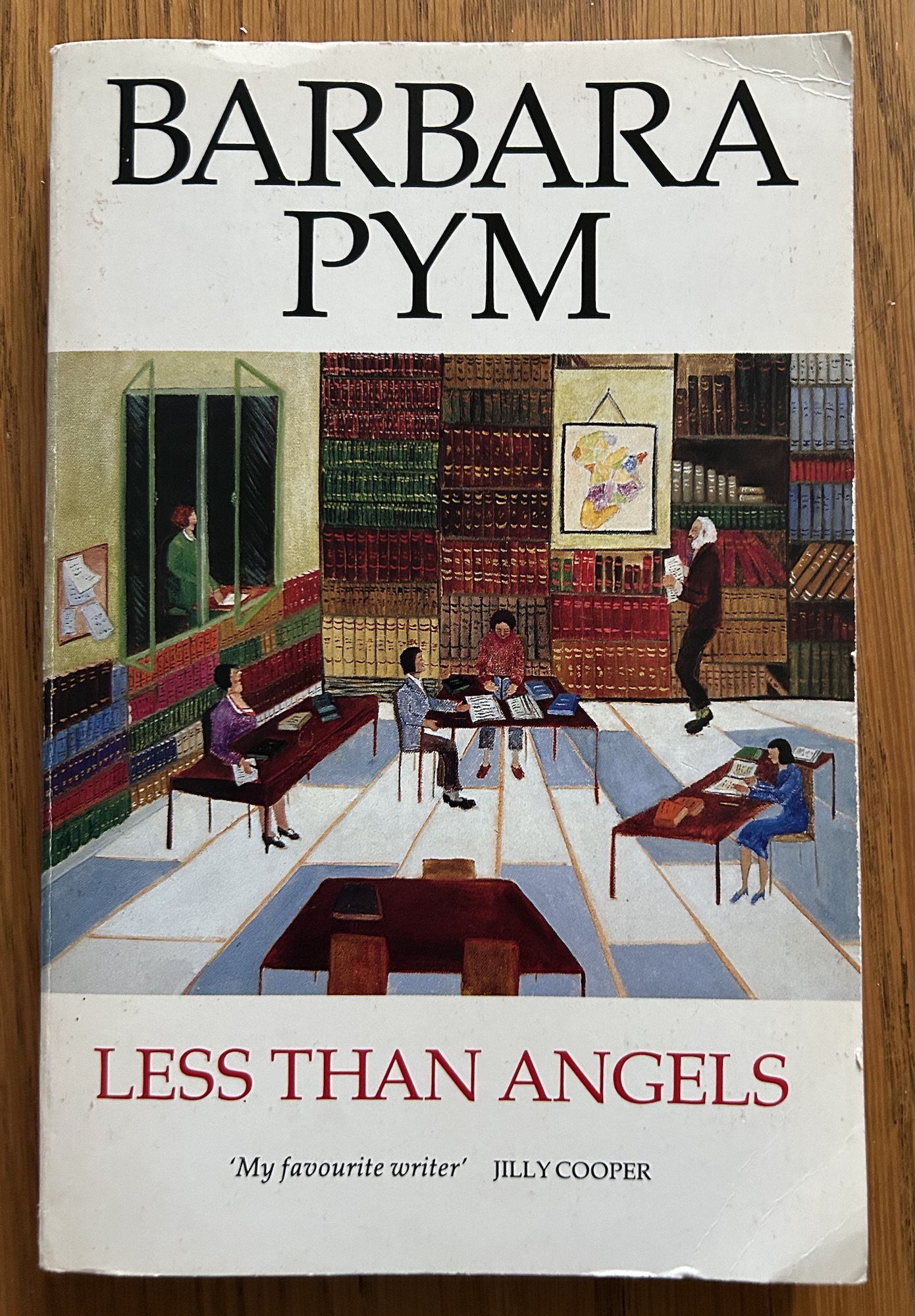
Earlier in this month of #SpinsterSeptember hosted by @pear-jelly, I read The Sweet Dove Died by Barbara Pym. I wanted to try and squeeze in another Pym before the end, and I really enjoyed reading Less Than Angels (1955), an earlier novel and more typical in tone, with its comic portraits of a group of anthropologists and their small dramas of daily life.
The novel opens with one spinster, Catherine Oliphant:
“she earned her living writing stories and articles for women’s magazines and had to draw her inspiration from everyday life, though life itself was sometimes too strong and raw and must be made palatable by fancy, as tough meat may be made tender by mincing.”
I wondered if that was a commentary by Pym on her own art? Who knows, but it was striking for its visceral imagery which felt untypical to me.
Meanwhile, Deirdre Swan is nineteen years old and living with her spinster aunt Rhoda and widowed mother Mabel.
“Deirdre was different, clever and moody, rather like she herself had been at the same age, before marriage to a good dull man and life in a suburb had steadied her.”
Deirdre is desperate for life to begin: to get away from the London suburb, to fall passionately in love rather than go on boring dates with suitably staid suitors. When she sees handsome young anthropologist Tom Mallow, she hopes there is opportunity for dramatic change. But Tom lives with Catherine…
“On the bus she wondered whether Tom had high principles, like Bernard. She was sure, somehow, that he had a delightful lack of them.”
In fairness to Deirdre’s suburb, it’s not entirely dull. Her neighbour is Alaric Lydgate, an anthropologist refusing to share his (likely useless) notes with Tom, closely observed by Mabel and Rhoda, confounding them by undertaking eccentric behaviour such as leaving rugs out on his lawn overnight.
Pym has a lot of fun exploring the department where Tom has returned after time overseas, where academics jostle for grants and wonder if they are spending time writing up interminable theses which will be forever unread.
She also draws parallels between daily life of women in post-war Britain and the more lauded anthropologists. Rhoda and Mabel are close observers of societal structure and ritual, and of a way of life that is disappearing rapidly. They just aren’t making a career from it. In fact, they feel guilty for not being serious-minded and instead borrowing novels from the library:
“And so it came about that, like many other well-meaning people, they worried not so much about the dreadful things themselves as about their own inability to worry about them.”
Tom, part of landed gentry, later wonders:
“When really, when one came to consider it, what could be more primitive than the rigid ceremonial of launching a debutante on the marriage market?”
We follow the department’s inhabitants for a time, their gentle professional and personal frustrations and triumphs. Less Than Angels is a quick read, expertly drawing the reader in to this small circle.
For Pym fans, there are references to other works here. Everard Bone and Mildred from Excellent Women are mentioned, and Catherine reflects:
“I’m not one of those excellent women, who can just go home and eat a boiled egg and make a cup of tea and be very splendid, she thought, but how useful it would be if I were! She thought wistfully of herself like this.”
To me this didn’t quite have the sparkle of that novel, or my favourite Pym so far, Quartet in Autumn. But there was still so much to enjoy here: the astute but compassionate characterisation, the close observation, the gentle humour. I’m so pleased to have got back to Pym throughout #SpinsterSeptember and it’s encouraged me not to leave it so long in future.
“What odd turns life does take! And how much more comfortable it sometimes was to observe it from a distance, to look down from an upper window, as it were, as the anthropologists did.”

