I’ve been meaning to get back to reading Barbara Pym, and what better time than #SpinsterSeptember, hosted by @pear-jelly. Pym fills her novels with ‘excellent women’ spinsters, although the character of Leonora Eyre in The Sweet Dove Died (1978) is a bit of a departure. Pym observed in a letter to Phillip Larkin “I didn’t try to make it so, but tended to leave out boring cosiness and concentrate on the darker side.”
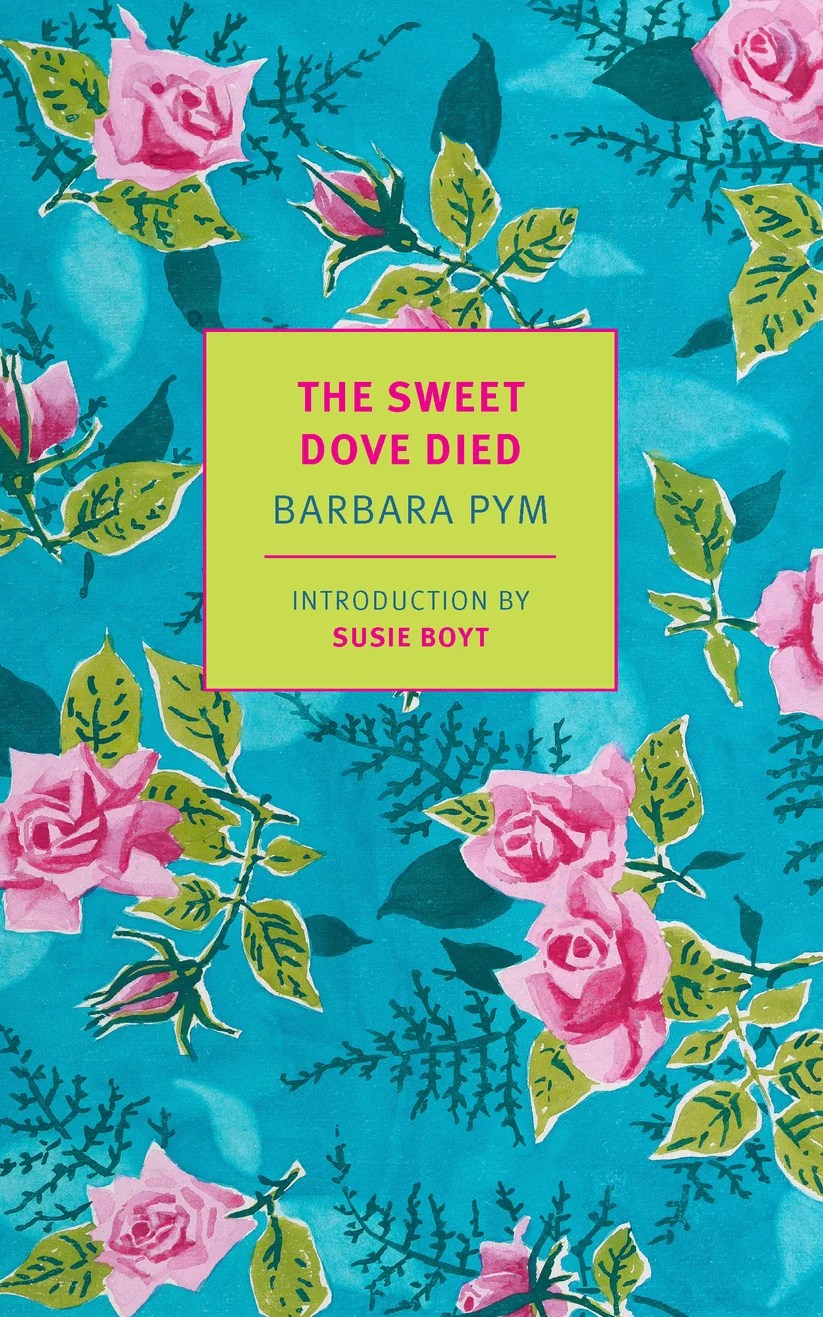
The novel opens with Humphrey Boyce, a middle-aged antique dealer and his young nephew James, helping Leonora Eyre from a Bond Street salesroom and taking her to lunch. Leonora has been overcome placing the winning bid for a Victorian flower book (!)
Everything about Leonora is performatively Victorian, summed up brilliantly in this description of her bedside table:
“Browning and Matthew Arnold—her favourite poets—took their place with her Guerlain cologne, a bottle of smelling salts, soft aquamarine paper tissues, a phial of brightly coloured pills to relieve stress and strain, and presiding over all these the faded photographs of a handsome man and a sweet faced woman in late-Victorian dress. Leonora had long ago decided that her grandparents were much more distinguished looking than her father and mother whose photographs had been hidden away in a drawer.”
Her romanticising of the bygone era doesn’t ever acknowledge that during that time, she would not have been allowed to inherit her parents estate or own property, two things which allow her to live out her entirely self-focussed twentieth-century life.
There is absolutely no generosity to Leonora, everything and everyone is about meeting her own needs. Thus as a love triangle of sorts emerges between the three, her motives are not inspired by who Humphrey or James are, but what they can do for her.
In fairness, James has no idea who he is either. He is in his twenties but remains curiously unformed, even allowing for his young age.
“James was not yet sure what he wanted from life, and had so far tended to avoid violent extremes of any kind.”
He has sexual dalliances with Phoebe, a young woman who he cares for very little, and Ned, a visiting American academic who is entirely uncommitted to him despite James wanting more. There is a lack of intimacy in James’ closest relationships, which is perhaps why he and Leonora are well-suited. She likes the flattery of an attentive younger man, but really wants very little else. Proud of her history of male suitors, none of them seem to actually have amounted to a relationship.
Aware she is losing her looks, Leonora still has admirers:
“One day, Humphrey flattered himself, she would become bored with the novelty of James’s youth and realise the more lasting qualities—virtues, almost—of a man nearer her own age who was tall and kept his figure and was bald only in the most distinguished kind of way.”
But even Humphrey is beginning to lose interest towards the end of the novel.
As we follow these curious three for a while, there is all of Pym’s brilliant social observation around English niceties and the exposure of character in the smallest of details. Yet there is more cruelty portrayed in this novel than I expect with Pym. Leonora behaves appallingly at times, and is truly unpleasant. Ned is in many ways her match, a young man at ease with hurting others to get what he wants. However, the author’s eye remains compassionate to them all, and so there is never a bitter taste left by what the reader witnesses. Rather it is all the foibles and follies Pym usually turns her attention to, but with a darker edge.
Although less humorous than some of her earlier novels, there is still humour to enjoy here, such as Humphrey’s vanity over his baldness, or the check he places on one flight of fancy:
“But he soon dismissed the picture from his mind as impossible and ludicrous. A woodland seduction scene between two middle-aged protagonists could only end in disaster.”
Towards the end, there is a real sense of impending, true sadness for Leonora, unless she mends her ways:
“She had always cared as much for inanimate objects as for people and now spent hours looking after her possessions, washing the china and cleaning the silver obsessively and rearranging them in her rooms.”
But Pym’s light touch remains, and so situations and people remain unresolved but not without hope.
This would be a great choice for a book group, as the characters remain somewhat enigmatic. No great insights or changes occur, their motivations and feelings oblique and unknown even to themselves. It would be interesting to hear a group discussion of how they each interpreted them…
I really enjoyed returning to Pym’s world, masterfully drawn, sharply observed, sympathetically portrayed without sentimentality. I’m hoping to get to Less Than Angels before the month is out!


Great to read your review of this as it is one that I have been considering for Spinster September myself. I have tried it before but remember not getting very far; somehow I couldn’t warm to, or feel engaged by, the characters in the way that I had done with other Pym novels.
Reading your comments makes me more likely to try this again, although I do sense some ambiguity in your summary; I feel you perhaps admired the writing rather than really enjoyed the story. Maybe that is me projecting my own conflicted feelings. Strangely, my library no longer has A Sweet Dove Died, even though it has all the other Pym novels. I wonder if that is a sign of its relative unpopularity.
LikeLiked by 1 person
I did enjoy it, maybe I’ve not conveyed my experience very well! I am tired today – I had an exhausting work event yesterday and deliberately chose to spend today doing nothing more energetic than battling wills with the cats as to who gets most sofa space 😀
I didn’t find the characters likable, but they are sympathetic (maybe not Ned!) Pym conveys them with understanding and no bitterness. I hope you enjoy this if you give it another try, I’ll be interested to hear how you find it.
LikeLike
I think you’ve succeeded in selling it to me!
Hope your day wrestling with the cats on the sofa has been restorative. My dog is also very indignant if he thinks he should have had first shout at the chair I’ve chosen!
LikeLiked by 1 person
Haha! Needless to say the cats are easily winning the battle here 😼😼
LikeLike
I managed to find a copy and finished this today. Thank you for prompting me to try it again. This time, I wondered what on earth my problem had been before! Despite it being distinctly darker than her earlier novels, I still loved this and found lots of humour too.
Although Leonora would not be someone I think I would find it easy to be friends with (although I could be the ugly old, friend as a foil!), I still cared about her and felt a lot of sympathy for her sadness and jealousy.
I wondered whether the sweet dove could apply to James as well as Leonora, who also seems a rather hapless, pathetic creature still mourning and missing his mother and weaving his tangled web of relationships.
This is my third Pym in just over a month and I still am in a very Pymish mood!
LikeLike
So interesting, Madame B! This is not a Pym I’ve read and it certainly does sound darker than her earlier books. She was always quite sharp with and about some of her characters, but the cruelty sounds new!!
LikeLiked by 1 person
It does feel different but still so much for Pym fans to enjoy! I think what she does well too, is portraying cruelty without doing it in a cruel way – you always feel her compassion as a writer for her characters.
LikeLiked by 1 person
That final quote is quite bleak although perhaps no more than Leonora deserves, or would even prefer!
LikeLiked by 1 person
Absolutely! I found it quite chilling, but maybe she’d be happiest that way…?!
LikeLiked by 1 person
What a wonderful review! I love Pym! Havent’ read this one.
LikeLiked by 1 person
Thanks so much! I hope you enjoy this one when you get to it.
LikeLiked by 1 person
I read this book not too long ago, while the characters weren’t exactly likable, I did admire Leonora for sticking to her guns and not settle for being second best, unlike her friend.
LikeLiked by 1 person
Yes, they’re not likable but so believable, they are compelling. It’s so well written.
LikeLiked by 1 person
This is an interesting one to be publishing in 1978, i.e. the era of shall-we-say noisy feminism, asserting the right of women to make their own choices from a vantage point of financial independence and equal opportunity?
There were still among us, in 1978, woman who were rendered permanently single by the Great War. Unmarried or widowed, for them there were just not enough men to have a choice to marry or not. Some of them revelled in it and some did not. I would venture to say that there were not many women who were single by choice, war or no war, and as you say, class differences impacted on that (inheritances and property ownership &c) and on career opportunities i.e. an education that fitted them for universities or careers that weren’t welcoming for women anyway.
So when you say there is romanticising, is that Pym consciously observing this reality and composing the novel for the reader to observe it too? I’ve not read her yet, so I’m curious about this?
LikeLiked by 1 person
Pym doesn’t romanticise anything here – she’s very pragmatic and clear-sighted.
Through the younger generation she shows how greater sexual freedom brings choice and exploration, but also that selfish people still hurt others.
Pym doesn’t take a view on any particular time or situation being better than another, she’s interested in the small moments of daily familiarity and relationships as they are.
Leonora romanticises the Victorian age, but she cherry-picks. She likes the romantic poetry and fussy fripperies of Victoriana, but wouldn’t dream of following the similarly privileged women of that time into the ideal of charitable good works – quite the opposite, she is mercenary towards someone vulnerable.
In some ways, Leonora’s ideal isn’t Victorian but medieval – she’d like to be the noble beauty admired from a distance while knights undertake tasks on her behalf…
LikeLiked by 1 person
Clearly, I must read Pym myself!
LikeLiked by 1 person
I hope you enjoy her Lisa!
LikeLiked by 1 person
I’ve loved what I have read of Pym so far. This sounds great too
LikeLiked by 1 person
I hope you enjoy this one when you get to it Cathy! It’s a slight departure but so well done.
LikeLike
I still have not read any Pym – clearly a gap! I also didn’t know that #SpinsterSeptember was a thing – trying to think if I have any books in my September stack that would fit…
(sort of related: a joke that my husband is in on: I frequently introduce him as ‘my current husband’, just to keep him on his toes. Note that we have been married for 27 years…).
LikeLiked by 1 person
#SpinsterSeptember is good fun – I hope you can find some books to fit! Pym is really enjoyable, I hope you like her if you give her a try.
Haha! No harm in keeping him on his toes, even after 27 years 😀
LikeLike
I’ve loved all the Pym that I’ve read but not this one and like you I keep meaning to get back to her, thanks for the encouragement!
LikeLiked by 1 person
I hope you enjoy this one when you get to it Jane! I’m very pleased to have finally got back to her.
LikeLiked by 1 person
A lovely review of what still feels like an underrated Pym in the grand scheme of things, (I read it last year and loved it!) The melancholic feel is very pronounced, isn’t it? Definitely a post-wilderness novel…all those rejections must have taken their toll…
I love the passages you’ve chosen here, especially the one that starts with “She had always cared as much for inanimate objects…”. It’s so indicative of Leonora’s character.
LikeLiked by 1 person
Yes, definitely has that feel of a post-wilderness novel! Maybe its underrated because its not entirely typical of her.
Glad you enjoyed the quotes! That one about Leonora did make me wonder what the future held for her…
LikeLike
Oh dear, so remaining a spinster was a tragedy for her? How depressing. On the upside, isn’t Patricia Routledge, another spinster, marvellous? I hope she didn’t come to see her spinster state as tragic too.
LikeLiked by 1 person
I don’t think so, but I’ve not read the humungous biography of her that is languishing in the TBR! My impression was she quite liked living with her sister and her cats, and then being recognised professionally in the end.
Dame Patricia is one of a kind!
LikeLiked by 1 person
I liked this one too. She’s very observant of people’s foibles.
LikeLiked by 1 person
So glad you liked this one! She really is closely observant, it’s so impressive.
LikeLiked by 1 person
This is a wonderful book, though as you say, sharper about her heroine and darker than some of her others.
LikeLiked by 1 person
Great to hear you like this too Liz! It does feel different in tone but I really enjoyed it.
LikeLiked by 1 person
Pingback: “On the whole it seems to be English women who don’t marry.” (Barbara Pym, Less Than Angels) | madame bibi lophile recommends