Unfortunately I didn’t have time to finish The Willow Cabin during Kaggsy and Simon’s marvellous 1949 Club, but I’m catching up now! This was my first Pamela Frankau and I’m so glad the Club prompted me to pick this up, because a basic summary would not especially appeal to me: a young woman enters into an affair with a still-married-but-separated older man, then the war starts… So far, so meh. But The Willow Cabin is a mature and interesting exploration of adult relationships, far beyond the central romance.
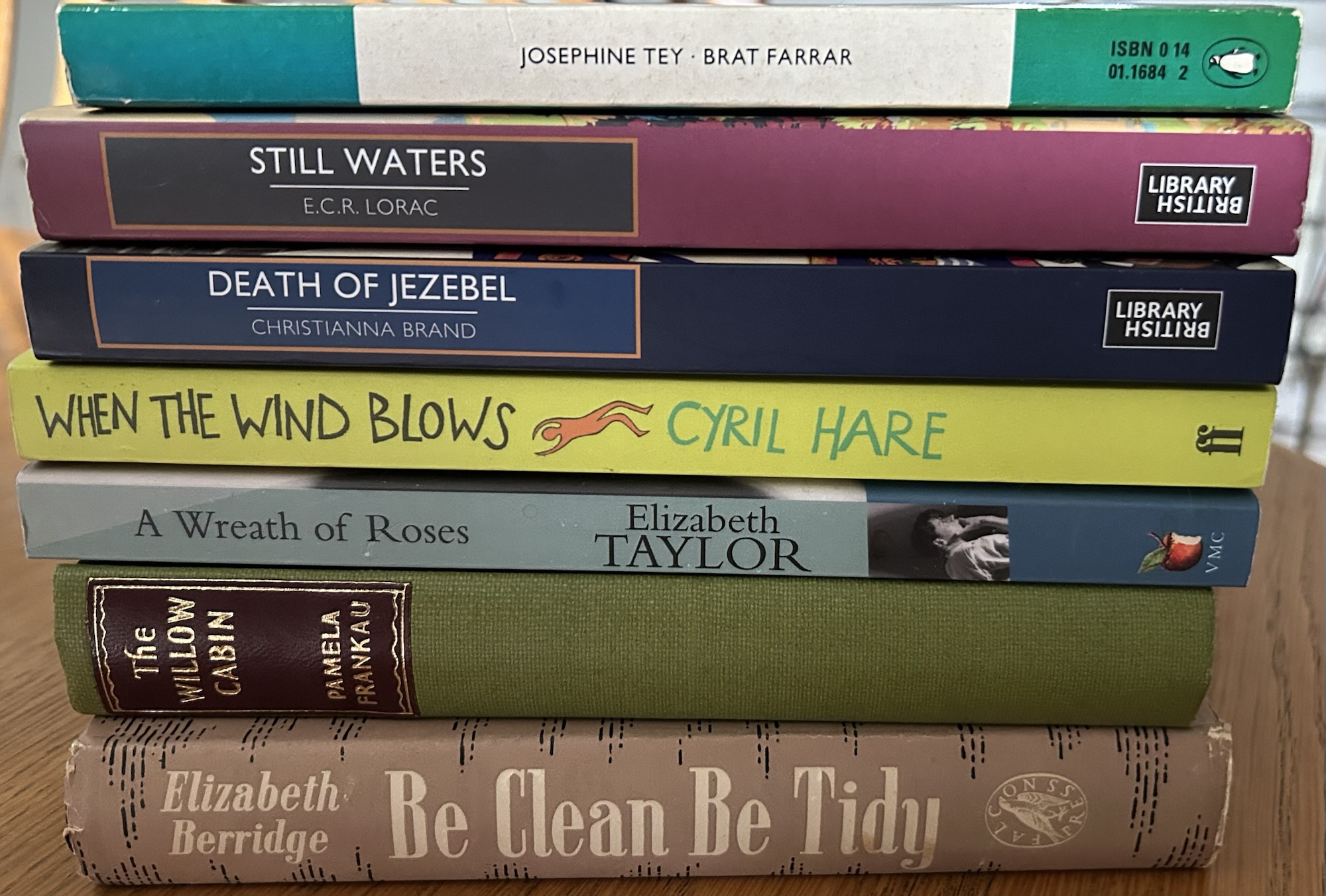
At the start we have a Prologue dated 1936, where young actor Caroline Seward is twenty-two years old and unhappy at home. She is unconventionally attractive, and pretty sweary (although her language seems mild to a twenty-first century reader.) At an afterparty she meets Michael Knowle, a married surgeon in his late thirties…
In Time Stolen we are in 1939 and the affair between the two is well-established. Caroline has matured, having had to face the realities of loving a man who will not divorce his wife, despite their living apart.
“Slowly, she had learned to rage in secret and to weep alone. She had learned to hide from him the small worries that he begged to be allowed to share. She had discovered early that she could make him laugh, and it became an obligation always to make him laugh, to save the funny things for him and hand them over, as toys to a child, at the day’s end. She had cured herself of questioning him, rebuking him and sulking at him.”
Their circle of friends is accepting, and Frankau demonstrates brilliantly how there is always the shadow of a third person in their relationship, Mercedes Knowle. Mercedes remains unknowable, as Michael will not discuss her, and people have widely differing opinions of her. Michael’s loyal sister Dorothy believes:
“Mercedes was a woman, and Mercedes was therefore to be blamed…. Michael’s sins she saw always in proportion. They were male, with his virtues.”
Huh! While Jay, Caroline’s professional collaborator, warns her:
“You know, of course, that Michael could get his divorce anytime that he wanted it; that his martyred attitude is a superb piece of bluff. That, being Michael, he is completely devoted to his career and completely set in the pattern that he has made. He has, at the moment, just enough freedom to suit him. You protect him from Mercedes and Mercedes protects him from you. A nice balance. Neither can encroach too far.”
I have to say this chimed with my sceptical twenty-first century reading of the situation. But really the focus isn’t on the relationship. Michael remains a somewhat unformed character, and I think this is entirely deliberate. Frankau’s interest in The Willow Cabin lies with the women (the title quote is from a love speech in Twelfth Night, but it is spoken by one woman (Viola in disguise) to another woman, Olivia, as part of a love triangle with Lord Orsino.) Frankau considers the effect of the relationship on Caroline, rather than evoking the relationship itself. And a huge part of that is her idea of Mercedes.
My favourite sections were the last two: The Calendar of Long Hours which covers 1943 to 1944, followed by Time Harvested, 1948.
During the war, Caroline works for the ATS, separated from Michael who is an army surgeon. A standout scene for me was a group of friends waiting for Caroline in a London bar, with the Blitz raging outside.
“He could see nothing ahead for any of them, the tight little circle of temporarily-favoured persons to whom all this was important. ‘It is the last spring; the guillotine is coming down. And after that it won’t matter who loves and who is unloved; … How foolish not to be able to be happy now, when there was so little time left.’”
It is a sad scene, made all the more poignant by the overlay of social ease. The war has made them all cynical. Dennis observes:
“’Need we have D-Day? I’ve had several of those. All I want is to do is to stay here and drink this reasonable gin and watch the top of the steps for Caroline.’”
Then later on, Caroline remarks on the terror of flying bombs:
“’I still don’t know why these things appear to have shattered my morale. I never minded the quaint, old fashioned Blitz.’”
The callowness of some of the characters which made them not entirely likable in the earlier sections now seems a marker of youth, gone forever although they are still so young. It is one of so many losses which Frankau evokes without sensationalism or sentimentality.
After the war, Caroline is touring a successful play in the USA, where Mercedes now lives, having nearly died in France and still struggling with the aftermath the conflict on her health.
“Where was she, the tough crusader responsible for this wrecked body? Absent tonight. There was only the image of the younger person who had failed.”
And so the two women eventually meet, and it as a subtle, complex and affecting as the rest of The Willow Cabin had led me to expect.
“‘Your Michael isn’t mine, nor mine yours. And there was, I imagine, a Michael whom we neither of us knew.’”
To end, the source of the title quote:

