“Heroes came and went these days. When they were gone, it seemed they were gone forever.” (Olivia Manning, Friends and Heroes)

Earlier this year Marcie and I decided to buddy read Olivia Manning’s Balkan trilogy, with The Great Fortune (1960) in June, The Spoilt City (1962) in August, and finishing with Friends and Heroes (1965) in October. I’ve just managed to get the final volume read in time!
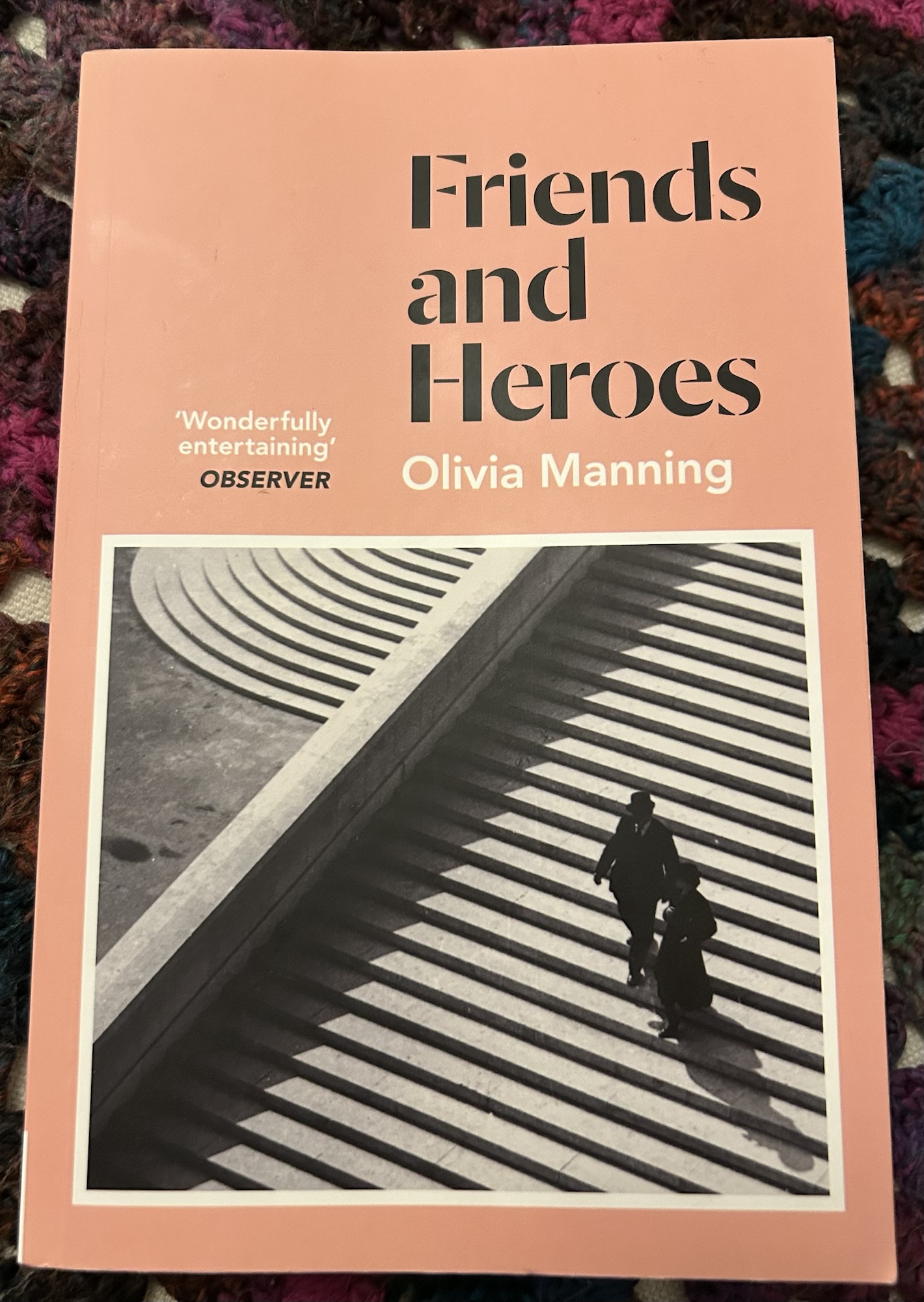
At the start of the novel, Harriet Pringle has left behind war-torn Bucharest and made it to Athens. She is anxiously waiting for her husband Guy to join her:

“She glanced about her, bewildered by her safety, unable to believe in a city so becalmed in security and comfort. Her nerves reacted still to the confusion of their last months in Romania.”

Guy does manage to escape and reach her, but as his work arrangements with the British Council were for Cairo, he finds himself somewhat adrift, compounded by old adversaries Lush and Dubedat conspiring to keep their positions of minor power in education, and Guy well away from it all. For relentless extrovert Guy, this is challenging:

“Throwing himself into one occupation or another, he had managed to keep anxiety on the periphery of consciousness; now, without employment, without friends, without money, he was trying to follow his old escape pattern. But there was no route open to him.”

The faultlines always so apparent in the Pringles’ marriage start to become real cracks in Friends and Heroes. Harriet needs intimacy and to be prioritised, Guy is not uncaring but he is entirely unable to provide either of these things:

“He loved her, but his love must be taken for granted. If she put it to the proof according to her needs, she found herself sacrificed to what he saw as a more important need: his need to be free to do what he wanted to do.”

Guy is also not so generous that he values other people for their differences. Alan Frenwen is a sweet, socially awkward man, who loves Greece and his little dog Diocletian. Guy disregards him as he cannot provide the political echo chamber and admiration Guy needs. Instead, he has an intense friendship with the generally unpleasant Ben Phipps, because they can slap each other on the back regarding their shared communist beliefs.

Manning is very good at portraying unlikeable characters. Three books in and I’m still not especially keen on either Guy or Harriet, or their circle. Yet they are so recognisable and believable, young and out of their depth personally and politically.

“This was a world in which only the ignorant could be happy.”

Even my favourite character, Prince Yaki, remains thoroughly reprehensible, forever sponging off people. Except he has finally sold his Hispano-Suiza and so for once has money:

“In funds, he had no need of friends. When he could buy his own food, he ate well and ate alone.”

Terrible! Yet at times he is a good friend to Harriet, and I do find him irrepressible despite his constant proclamations of being “poor Yaki”.

We spend time with this community as they wait to see if Greece will be pulled into the war, wondering if they should leave, and if so, where to go. The tension builds as the situation worsens in world politics and in the Pringle’s marriage; the first leading to soldiers swamping the city and a handsome one of these named Charles Warden threatening the second.

I had a sense in Friends and Heroes of Manning really growing in accomplishment as a writer. The interweaving of the Pringles marriage portrait alongside vivid descriptions of Greece and the growing threat of invasion is finely balanced. The characterisation of well-established figures becomes more complex, and there are two scenes in particular of true sadness, highlighting the human destruction both physically and spiritually during war.

“Pale and unhappy, he returned to his books, wanting to hear no more. Harriet pitied his disillusionment, but had no patience with it. Reality was not to be altered by an inability to recognise fact.”

Friends and Heroes builds to a long, tense final chapter as the Pringles try and decide how severe the threat is to them if they stay, and if they want to evacuate to Egypt how on earth they will even manage it. I thought it was brilliantly done and the Levant trilogy is absolutely on my 2027 reading list!

(I can see on Goodreads that some readers found the Balkan trilogy too long, which makes me think it is best to continue with spacing the books out a bit. Reading as Marcie suggested in alternate months meant I didn’t find them overlong at all. So now I just need to work out which months will be Levant months…)

“War was the time when mediocrities came to the top and better men must rot or die in the conflict.”

To end, of course Bowie, but I thought I’d be marginally less predictable and choose Seu Jorge’s version:

“If you get depressed about being the second-best team in the world, then you’ve got a problem.” (Julius Erving)

The Booker 2014 shortlist has been revealed (admittedly way back on 9 September, but what I lack in efficiency I make up for in enthusiasm). Inevitably the spotlight falls on the winner, but it’s an achievement to even make it as far as the shortlist:  I thought this week I would look at two books that were nominated, but didn’t win. (Note to nominees – practice your losing face):

HarryPotter-Snape-Clapping

Firstly, from 2006 when Kiran Desai’s The Inheritance of Loss won,  In the Country of Men by Hisham Matar (Penguin, 2006).

004 (5)

ITCOM is narrated by 9 year old Suleiman, who lives in Libya in 1979 and is witness to political and personal circumstances that he cannot hope to understand.

“Concern. I think that was what I craved. A warm steady unchangeable concern.  In a time of blood and tears, in a Libya full of bruise-checkered and urine-stained men, urgent with want and longing for relief, I was the ridiculous child longing for concern.”

Instead of the concern he craves, Suleiman gets half-truths, bound up in love and warped by conflicting loyalties.  His father is frequently absent, leaving Suleiman with his mother, whose “medicine” is bought in bottles, under the counter from the local baker, causing her to become giggly and unfocused:

“If love starts somewhere, if it is a hidden force that is brought out by a person, like light off a mirror, for me that person was her.  There was anger, there was pity, even the dark warm embrace of hate, but always love and always the joy that surrounds the beginning of love.”

Gradually it emerges that Suleiman’s father is opposing the state, and he returns home only to rapidly pack a bag before the sinister men in the white car, who take away fathers for public executions, arrive:

“There they were, the two people I loved the most, the two people I was certain would do anything to keep the truth from me”

Within this environment, Suleiman struggles to find his way, and does not always behave well.  Even as he is violent and destructive, you understand it comes from a position of being frustrated, scared and disempowered by the secrets within his home and the subterfuge outside it.

 “I couldn’t wait to be a man. And not to do all the things normally associated with manhood and its licence, but to change the past…”

ITCOM is a wise book, beautifully written, which tackles huge themes around the interdependence between personhood and nationhood in a deceptively simple way. I think it is a novel I will have to return to: despite being less than 250 pages it is so rich in ideas one reading doesn’t do it justice.

“Perhaps doubt is worse than grief, certainty more precious than love.”

Secondly, from 2008 when Aravind Adiga’s The White Tiger won, The Clothes on their Backs by Linda Grant (Virago, 2008).

005 (2)

This novel shares common ground with ITCOM, in that it is also set in the 1970s, and looks at issues of identity and immigrant experience. Vivian lives with her parents in a flat off the Marylebone Road, and the past is a closed book.

“There were a thousand questions I wanted to ask, about my mother and father  and about their past in Budapest as young people without a care in the world, before they became the reclusive refugees who hid behind their front door and were timidly grateful for any kindness.”

In comparison to her quiet, timid parents is Vivian’s Uncle Sandor, who makes a brief, dramatic appearance in her childhood, and then, like so much else, is never spoken of. He is a slum landlord, a pimp, unapologetic and unafraid, and Vivian finds herself both drawn to him and repulsed by him.

“Because my parents never answered any questions about the past […] I learned to stop asking, and eventually I forgot all about wanting to ask. Suddenly, a treasure chest opened and out spilled all these precious objects.  I was full of everything my uncle had told me; it was not only my parents who suddenly acquired an additional dimension (time) but me too.  In my past there were rabbis and plums and grapes and wine. Everything was different now. I felt like I’d eaten a horse.”

What Sandor gives Vivian is a deeper identity, something more complex and difficult than she’d been raised to, by her parents who she only realises are Jewish by deduction, and who had her baptised because “there was nothing they liked more than official documents with their names on which they could show the authorities, if called on to do so”.

Bound up with Vivian’s experience of her past is her experience of the present, 1970s London, with its post-war population of refugees and veterans, and disaffected youth joining racist movements, their clothes displaying their allegiance.  Clothes are a strong theme in the book, as Vivian experiments with different looks, realising clothes can express and conceal both your body and who you are:

“My clothes acted as a kind of carapace, an armour with which I protected my soft, inner body.”

“Sometimes you put on a new dress and it becomes you, it is your flesh and blood”

Thus, identity, like clothes and bodies, is a changeable entity, where you can choose what you show others, but cannot always control what they see.

The Clothes on their Backs explores identity throughout a period when there was the possibility to be self-made, but the past exerted a powerful hold.  It considers the essential need to survive, and the high prices that can be paid for that need.  It’s a compelling read peopled with vivid, complex characters.

To end, a video to show a time when coming last provided an example of the greatest dignity and courage.  Derek Redmond was tipped for a medal in the 400m at the 1992 Olympics. Then his hamstring snapped…