Halfway through NADIM 2026! I’m frankly amazed, having only really decided to go ahead on 30 April. I’m still not sure I’ll finish as I’ve home renovations this week and two very busy work weeks coming up, but honestly I’m taking the halfway point as a win in itself!
The Faber Editions series seem to choose their titles impeccably, and Emily Holmes Coleman’s only novel, A Shutter of Snow (1930) is another powerful, haunting choice. (Or good book to take a snooze next to, according to my cat.)
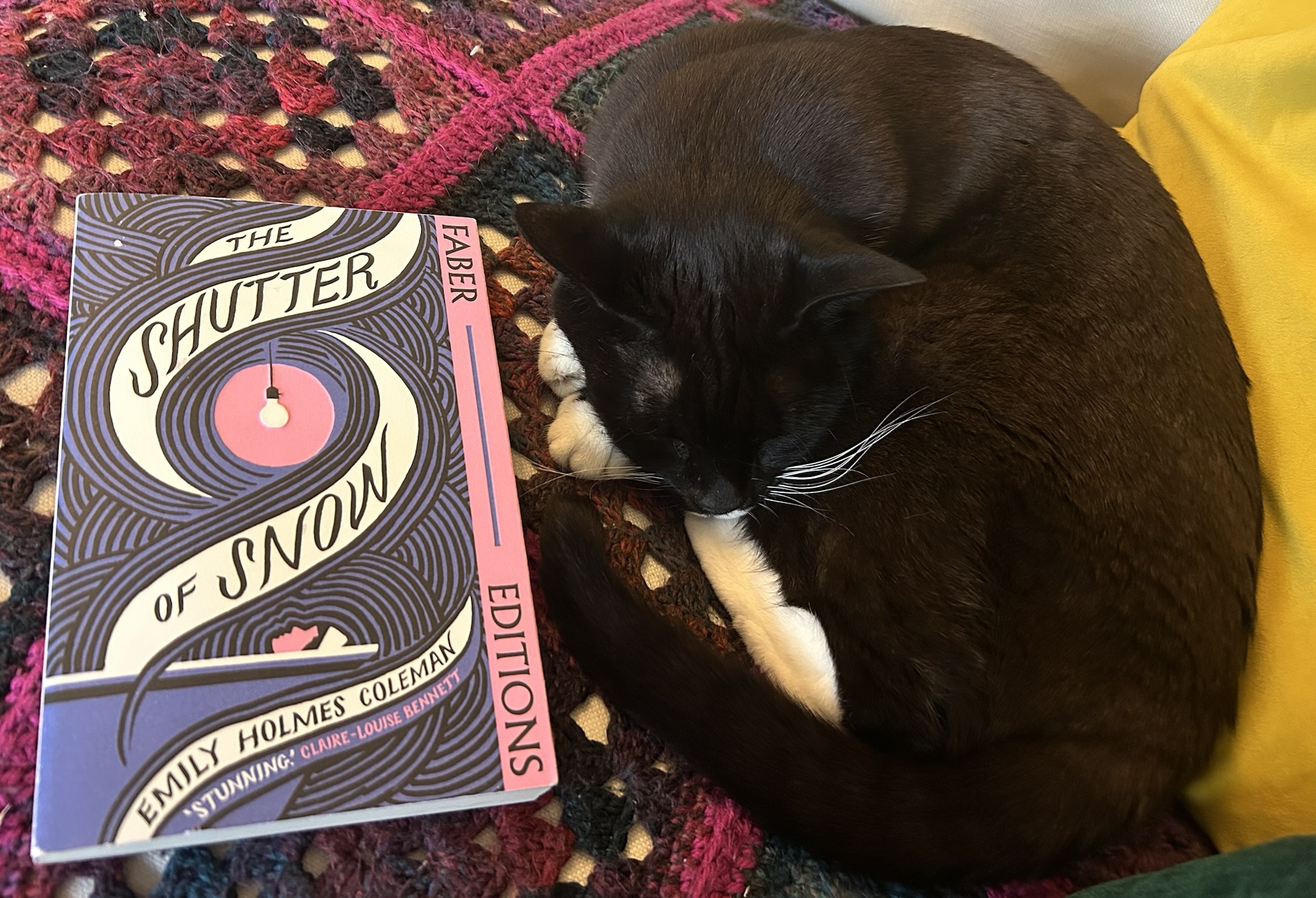
Emily Holmes Coleman drew on her own experience to detail Marthe Gail’s post-partum psychosis, from when she is admitted to a residential mental health unit up until she feels well enough to return home again. It is a disorienting, visceral narrative that places the reader alongside Marthe as she struggles with reality in a setting where avoiding it seems an entirely reasonable thing to do.
Marthe’s admission to the ward is told in a confusion of images, jumbled sentences which jump rapidly between subject and object, baffling yet also evoking perfectly the despair and violence of her arrival.
“The keys jangled from the waists of the nurses. They rattled like silver dish pans and swung chanting high like death songs. They were brittle and ice cold and had faces of stagnant riders from the snow. They were proud, and deliciously ate their indifference.”
At some point in that passage I think the ‘they’ subject changes from the keys to the nurses, but Marthe is so completely displaced it is by no means certain.
Telling the story from Marthe’s point of view but in the third person – occasionally first person – brilliantly conveys her rapidly shifting perspectives and slight detachment from what is happening. Trying to keep up with her means the reader struggles to keep track and maintain a viewpoint, just as Marthe does.
Here she is anticipating a visit from her seemingly supportive husband, but he does insist on her being silent/passive, which perhaps explains Marthe’s seeming ambivalence here:
“He was coming today. It would be some time before the red lights. He would come stalking in the door with his gentle hands and would smile at everything she said. He would look up from under his eyebrows and demand to know what she meant. He would have purple sandals and a crown of laurel. He would bring her a casket of roses and she would crush them on the floor. And there would be under his coat to the little snow-haired baby with clenched hands.”
That quick shift to violence consistently – yet unpredictably – occurs with Marthe. She will be calm and seemingly content, before suddenly spiralling and lashing out.
But she is subject to violence too, including state endorsed violence. There are numerous episodes of her being restrained, bound repeatedly in strips of cloth and blankets, attacked by other patients, and also forcibly medicated. The Shutter of Snow is a very difficult read, both structurally and in terms of subject matter.
But there is humour in the novel too, particularly in interactions with the medical professionals:
“Dr Brainerd said Marthe earnestly, just because I’ve got a toxic exhaustive psychosis is that any reason why I have to be treated like a dog?
Who told you you had a toxic exhaustive psychosis? said Dr Brainerd. You think I have anyway said Marthe, and someday you’ll be rather astonished when you find out what it’s all about. I don’t think I’ll lend your husband anymore books said Dr Brainerd.”
The lack of punctuation and speech marks there is indicative of the whole book, contributing to sense of an askew narrative without becoming entirely incomprehensible. The novel steadily becomes more coherent, reflecting Marthe’s gradual recovery.
The Shutter of Snow is a fully immersive read, where you sink into Marthe’s world of institutionalised reality, delusion, dream, fantasy. It is extraordinary in how it brings Marthe’s experience to the reader. Emily Holmes Coleman is a stunning writer and on the strength of this I wish she’d written more.
“The only thing to do is to put hammers in the porridge and when there are enough hammers we shall break down the windows and all of us shall dance in the snow.”
 madame bibi lophile recommends
Well done on getting this far through the month, and thank you! This one sounds quite gruelling
LikeLiked by 1 person
Thanks Susan! It is a tough read for sure, especially when Marthe is being restrained. But her clear movement towards wellness carries things forward in quite a positive way, although it is incremental.
LikeLiked by 1 person
Past half-way big congratulations! I’ve enjoyed every post and already have a tbr/wishlist to keep me reading until the end if the year I think!
I actually have owned a copy of this book for over a year as I wanted to read it since Jacqui reviewed it. I had steeled myself to think I would be able to cope with it (it’s more than 15 years since I went through a traumatic post partum episode and I imagine I would not be able to read it closer to a similar experience). After reading your review, I dug my copy out of its shoebox (yes, I have run out of bookshelves so I’m improvising storage for books!) and it has been moved onto one of the current tbrs!
Wishing you a smooth renovation and I hope it does not hinder your reading too much.
P.S Your cat is very very sweet in that photo. Perhaps they like the cover design?
LikeLiked by 1 person
Thanks so much Sarah! I hope you enjoy the ones you decide to read from this month.
I’m really sorry to hear of your experience. I very much hope there would be little you recognise in the novella. How anyone recovered in the circumstances the author describes is unbelievable.
I can very much relate to improvised bookshelves and different TBR piles!
I’m also hoping the renovations go smoothly – always such a drag but fingers crossed…
He is a little sweetie! Maybe you’re right about the cover design, although I think the fact that it was just where I’d been sitting and was nice and warm for him had an influence too 😀
LikeLike
Half way is a win for sure and I agree with you about the Faber Editions, I’ve only read a few but I see it as a go-to list!
LikeLiked by 1 person
It really is!
LikeLiked by 1 person
You’re doing amazingly well, Madame B – I couldn’t do this for a month! And a great choice for today. I have a Virago copy of this which I haven’t read for decades but I remember reading it and The Yellow Wallpaper around the same time and being very shaken!
LikeLiked by 1 person
Thanks Kaggsy! This does fit thematically with The Yellow Wallpaper and I can absolutely see why they would leave you shaken! Both so powerful.
LikeLiked by 1 person
Whenever I read a review of this book, I think ‘I would love that’… but I actually did read it years and didn’t like it 😀 I think I found the splintering of the language too jarring. But I am clearly missing out on something!
LikeLiked by 1 person
Well, we can’t love everything we read! Some books just don’t chime with us as readers. Most recently for me it was The Tin Drum by Günter Grass – so highly rated and I couldn’t get anywhere with it at all!
LikeLike
Well done on reaching the halfway mark, and for getting through this one! 😉
LikeLiked by 1 person
Haha! Thank you FF!
LikeLiked by 1 person
Well done! Lots of great choices so far
LikeLiked by 1 person
Thanks Cathy!
LikeLiked by 1 person
I read this around the same time that I read one of the Persephone books which deals with a similar theme (not naming it because it’s a spoiler) and now I can’t ever keep the two of them straight; it’s as though the two books have become one in my mind! As for novels which allow the language to change, reflecting the main character’s changing view of the world, Samantha Harvey’s debut The Wilderness is like that, and I just loved it. (Not the same theme, otherwise.)
LikeLiked by 1 person
I can see how that could happen!
I’ve not read the Harvey, but I’m hoping to get to Orbital this month at some point…
LikeLike
I’m glad you got so much out of this one, which, so you say, is an emotionally challenging but immersive read. One of those books when the style and subject matter seems to be working in perfect harmony to maximise the effect.
LikeLiked by 1 person
Yes absolutely Jacqui. The way she creates the narrator’s voice is brilliantly done.
LikeLike