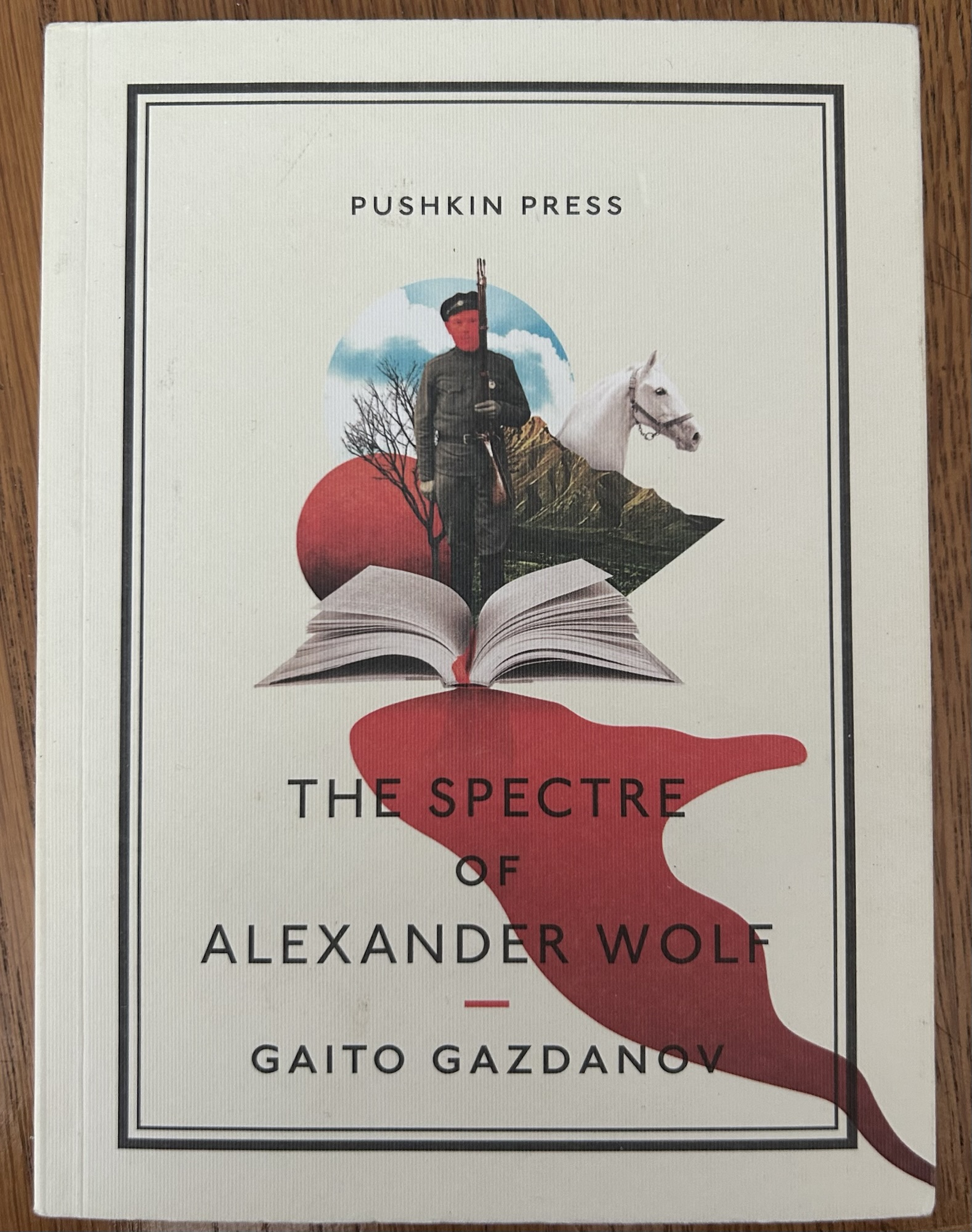
I really enjoyed Gaito Gazdanov’s The Buddha’s Return when I read it a few years ago, so I’m pleased to return to him with The Spectre of Alexander Wolf (1947-8, transl. Bryan Karetnyk 2013) published by Pushkin Press in one of their lovely smaller editions with French flaps.
It opens beguilingly:
“Of all my memories, of all my life’s in innumerable sensations, the most onerous was that of the single murder I had committed.”
This isn’t quite as it initially appears – the killing took place during the Russian Civil War. A man shoots the horse the narrator was riding, and in self-defence he shoots back. He then steals the other soldier’s white horse, later selling it and fleeing to Paris.
He is living in Paris and working as a journalist when he comes across a book of collected stories called I’ll Come Tomorrow by Alexander Wolf. Reading it, he is shaken by one of the stories, The Adventure of the Steppe in which the events above are described almost exactly.
As the book is written in English, when he is in London he visits Wolf’s publisher, who assures him:
“Mr Wolf is an Englishman; I’ve known him for many years and can vouch for that. What’s more, he’s never left England for more than two or three weeks at a time, which he spends mostly in France or Italy. He hasn’t travelled farther; I can say this with certainty.”
However, he is shaken on his return to France when he meets Voznesensky, a drunken acquaintance who has a copy of the book and claims to know the author. Voznesensky is incredulous at the thought of “Sasha Wolf, an Englishman!”
So who is Alexander Wolf? Was he the dead soldier? An Englishman who holidays in Italy? A Russian who lives in Paris?
Having set itself up as a possibly metaphysical detective story, the novel then takes a swerve into almost a completely different genre, detailing the narrator’s love affair with Yelena Nikolayevna. She’s an enigmatic woman with a mysterious past (!) but gradually an intimacy begins to build, despite an “unnatural divide between the inner life and physical life that was so characteristic of her”.
The sudden shift is somewhat disconcerting but Spectre… remains very readable. Essentially the story is less about plot and more a consideration of where we look for meaning. The narrator channels his energy first into Wolf and then into Yelena, but ultimately he has to create his own meanings with his mortality a constant consideration:
“I thought about how Wolf had become – and not so much Wolf personally as the very thought of him—the involuntary personification of everything dead and sad that existed in my life.”
By the ending, not everything is fully explained, although reader can piece events together. I think by leaving the plot unresolved, Gazdanov keeps Spectre… as a philosophical consideration foremost, encouraging the reader to make their own meanings as the narrator needs to do.
I also think there is humour in it, I don’t think we’re supposed to take the narrator as seriously as he takes himself:
“Everything that my existence had comprised until now—regrets, dissatisfaction and a sense of the manifest futility of everything I did – began to seem very distant and alien to me, as though I was thinking of something that had taken place long ago.”
I realise I’ve been a bit vague, but Spectre… is an enigmatic and slippery book to both read and describe! It is an eloquent contemplation of its themes, so if you fancy those wrapped up in a few somewhat unresolved narratives then give it a try – I certainly enjoyed it a great deal.
 madame bibi lophile recommends
Definitely happy to give this one a go. It sounds intriguing.
LikeLiked by 1 person
Great! I really hope you enjoy it. I was worried this review was so badly written I’d put people off 😁
LikeLiked by 1 person
Not at all!
LikeLiked by 1 person
I imagine this was a difficult one to summarise but you’ve sold it to me by highlighting the narrator’s quest for meaning and existential anxieties. Another one for my list; I really am going to have enough books on my tbr for the rest of the year!
LikeLiked by 1 person
Hooray! So glad it appeals. It’s an unusual one but very engaging.
LikeLike
These Pushkin Press editions are invariably little gems 🤩
LikeLiked by 1 person
They really are!
LikeLiked by 1 person
I don’t know if this one is for me, but congratulations on your month, nearly done now!
LikeLiked by 1 person
Thanks so much Cathy!
LikeLiked by 1 person
Another winner, I do love these Pushkin editions!
LikeLiked by 1 person
Me too!
LikeLiked by 1 person
You’re right, it *is* enigmatic and I suspect that’s deliberate. Gazdanov was such a wonderful author and I’m so glad Pushkin brought out so many of his books in English!
LikeLiked by 1 person
Great to hear you’re a fan Kaggsy! I’m certainly grateful to Pushkin for the two I’ve read.
LikeLiked by 1 person
A lovely reminder of a very enigmatic book! I have very fond memories of reading this, but because it pre-blog, I have no notes to refer to. You’re tempting me to take it for another spin at some point, particularly as your comments about its slippery nature are spot on!
LikeLiked by 1 person
Great to hear you liked this one too Jacqui! I’d be really interested to hear how you find it if you decide on a re-read.
LikeLike
It seems like “A Search for Meaning” is a certain type of novella, isn’t it. And sometimes it’s as though the theme is right there, and other times it’s as though you get pulled through a number of scenes and then you realise that was what was happening the whole time.
LikeLiked by 1 person
Yes, the theme is there but not the answers. It’s very clever.
LikeLike