I really wanted to join in with the review-along for Lady Audley’s Secret by Mary Elizabeth Braddon (1862), as it’s a long-standing part of Mount TBR. Novellas a Day in May meant it was beyond me to post on 1 June, but here is my late entry!

The titular woman is introduced to the reader as a penniless but beautiful governess, Lucy Graham:
“Wherever she went she seemed to take joy and brightness with her. In the cottages of the poor her fair face shone like a sunbeam […] and when she tripped away, leaving nothing behind her (for her poor salary gave no scope to her benevolence), the old woman would burst out into senile raptures with her grace, beauty, and her kindliness, such as she never bestowed upon the vicar’s wife, who half fed and clothed her. For you see, Miss Lucy Graham was blessed with that magic power of fascination, by which a woman can charm with a word or intoxicate with a smile. Every one loved, admired, and praised her.”
Is it me or is there some sly humour there? This woman elbowing her way into the cottages of the poor, assuming that to bask in her presence is payment enough? I don’t think Braddon takes a humorous approach generally to this sensation story, but maybe there’s a bit happening…
Lucy catches the eye of Sir Michael Audley, windowed and stinking rich, so of course they are married. But here Lucy’s charms find their limit, with spiky step-daughter Alicia who is only a few years younger:
“She is a vain, frivolous, heartless little coquette,” said Alicia, addressing herself to her Newfoundland dog Caesar, who was the sole recipient of the young lady’s confidences; “she is a practiced and consummate flirt, Caesar; and not contented with setting her yellow ringlets and her silly giggle at half the men in Essex, she must needs make that stupid cousin of mine dance attendance upon her. I haven’t common patience with her.”
The stupid cousin is feckless Robert Audley:
“Sometimes, when the weather was very hot, and he had exhausted himself with the exertion of smoking his German pipe, and reading French novels, he would stroll into the Temple Gardens, and lying in some shady spot, pale and cool, with his shirt collar turned down and a blue silk handkerchief tied loosely about his neck, would tell grave benchers that he had knocked himself up with over work.”
However, when Robert’s friend George Talboys disappears on a visit to Audley Court, Robert can’t shake off his feeling that something is deeply amiss, and begins to investigate.
“The lazy bent of his mind, which prevented him from thinking of half a dozen things at a time, and not thinking thoroughly of any one of them, as is the manner of your more energetic people, made him remarkably clear-sighted upon any point to which he ever gave his serious attention.”
This pulls him into a convoluted tale, whereby George had abandoned his wife and baby to seek his fortune in Australia, fully expecting her to be patiently waiting after three and a half years in which he didn’t contact her once. On his return, George found his wife had died and his son was being raised by his father-in-law, a man who spends all his money on alcohol.
Robert soon realises that the new Lady Audley may be involved with George Talboys’ disappearance…shocker! The secret is quickly worked out by the reader and we watch as Robert tries to unravel her history and prove what has happened to his friend.
His investigation will see him uncover murder, arson, thefts, lies, manipulations, impersonations, conspiracies… well, it is a sensation novel after all!
The exploration of women’s roles in Lady Audley’s Secret is interesting. Lucy is constantly referred to as beautiful, doll-like, with a halo of golden curls. She revels in material wealth, but like a child.
“Her fragile figure, which she loved to dress in heavy velvets, and stiff, rustling silks, till she looked like a child tricked out for a masquerade, was as girlish as if she had just left the nursery. All her amusements were childish. She hated reading, or study of any kind, and loved society. Rather than be alone, she would admit Phoebe Marks into her confidence, and loll on one of the sofas in her luxurious dressing-room, discussing a new costume for some coming dinner-party; or sit chattering to the girl with her jewel-box beside her, upon the satin cushions, and Sir Michael’s presents spread out in her lap, while she counted and admired her treasures.”
But what is also made clear is that this love of money has grown from a background of poverty. Lucy knows what it is to be poor, and she never wants to be that way again. The way to ensure this, is to use her looks and marry for money. In Victorian society that is the best use of her resources.
Meanwhile Alicia enjoys being sporty and active, and is rubbish at running a household. She seems to spend a lot of time being furious, which seems borne of frustration that she doesn’t have a lot of options as to what to do with her sharp mind and talents, as well as Robert’s failure to realise she is in love with him.
There’s some anti-women rhetoric in the novel too, mainly from Robert, but this seemed a source of humour and I felt Braddon was more on the side of questioning the limited choices for women at the time. I also found among the sensation, a nudge towards compassion and moderation, particularly in the character of George’s father, the wonderfully named Harcourt Talboys:
“There were no shady nooks in his character into which one could creep for shelter from his hard daylight. He was all daylight. He looked at everything in the same broad glare of intellectual sunlight, and would see no softening shadows that might alter the sharp outlines of cruel facts, subduing them to beauty. I do not know if I express what I mean, when I say that there were no curves in his character—that his mind ran in straight lines, never diverging to the right or the left to round off their pitiless angles. With him right was right, and wrong was wrong. He had never in his merciless, conscientious life admitted the idea that circumstances might mitigate the blackness of wrong or weaken the force of right. He had cast off his only son because his only son had disobeyed him, and he was ready to cast off his only daughter at five minutes’ notice for the same reason.”
All in all I enjoyed Lady Audley’s Secret, but it was repetitive and overlong. This is a bit of an unfair criticism; like many Victorian ‘baggy monsters’ it was serialised and the repetition was to get readers up to speed/remind them of what had gone before. But reading it as a 376 page novel with teeny-tiny type meant I felt it could have easily stood to lose 100 pages.
However, it was also a ripping yarn, an interesting portrait of various aspects of Victorian society written in a readable style, had some lovely descriptions (if repeated too often) and some complex characterisation in Lady Audley. I’m so pleased the read-along meant I finally got to this one.
Here is Fiction Fan’s Review which also has the links to other bloggers who were much more organised than I am and posted on time!


Totally agree about it being overlong and repetitive, but I’m so glad you enjoyed it overall, as did I! I loved Alicia – I felt she was the woman Braddon herself probably most identified with. And I did think she had quite a lot of sly humour between the lines. I’ve read quite a few of her horror stories, and while I wouldn’t call her a feminist in the modern sense, there’s always that aspect of women being trapped by society’s limitations, and it feels personal. I could have forgiven Lucy her first transgression quite easily on that basis, but she did go pretty far over the line in the end! 😉 Glad you were able to join in!
LikeLiked by 1 person
Thanks for prompting me to finally read this one FF! I really enjoyed it.
This is the first Braddon I’ve read so its interesting to hear how her horror stories highlight trapped women too. I agree, I wouldn’t call her a feminist in the modern sense, but I felt she was definitely aiming to get a few points across about the lack of choices available.
Yes, Lucy really did push things a bit far 😀
LikeLiked by 1 person
Pingback: Review-Along! Lady Audley’s Secret by Mary Elizabeth Braddon | English Classic – FictionFan's Book Reviews
I enjoyed reading your review and being reminded of this one. I agree with your criticisms – it is long and could have easily have been shorter and even better. I read it in the winter which I think suits baggy Victorian Gothic novels better.
I was right – your post NADIM book was a chunkster!! Very glad to see your ultra reading month did not spoil your appetite!
I have been beavering away collecting many titles from last month but my June reading has started slowly. Still, in the meantime, I like looking at the tantalising piles!
LikeLiked by 1 person
Yes, it would be a perfect winter read!
I always expect NADIM to burn me out a bit, but somehow it never does 😊
I also like gazing at my book piles – they never seem to get any smaller!
LikeLike
So interesting, Madame B! I started this once, but lost the impetus – I wasn’t quite grabbed enough to keep going and maybe it’s the bagginess you highlighted here. It’s a shame, because I think it would be my sort of thing. One day perhaps…
LikeLiked by 1 person
I think you do have to be in the right mood Kaggsy! As Sarah mentioned in her comment, maybe one to try as the nights start drawing in…
LikeLiked by 1 person
Oh, I didn’t think this one was nearly as repetitive and over-long as some of the other books I’ve read from this genre and period.
LikeLiked by 1 person
Good to hear you liked this one!
LikeLiked by 1 person
I’m looking forward to this and the ‘shockers’!, one for my next classics club list
LikeLiked by 1 person
Oh great! I hope you enjoy it Jane 😊
LikeLiked by 1 person
I think I can safely give this one a miss. I can see the ‘previously on Lady Audley’s Secret’ recaps might become quite tiresome in a single volume. However, it’s no longer squatting on Mount TBR so that’s a win!
LikeLiked by 1 person
Haha! Always satisfying to shed one from the TBR – although somehow the pile never gets any smaller…
LikeLiked by 1 person
I really enjoyed your review of this! As I mentioned yesterday, it’s been on my ‘must get around to’ list for the longest time, ever since I was in my twenties, I think! And that’s an interesting point about some of the repetitiveness being a function of the serialisation – in fact, I’m now wondering whether it might be a good one to listen to on audio!
LikeLiked by 1 person
Thanks Jacqui! It was languishing in my TBR forever too. I think it could work really well on audio – I’ll be interested to hear how you find it!
LikeLike
Pingback: Lady Audley’s Secret by Mary Elizabeth Braddon | Kelly's Thoughts & Ramblings
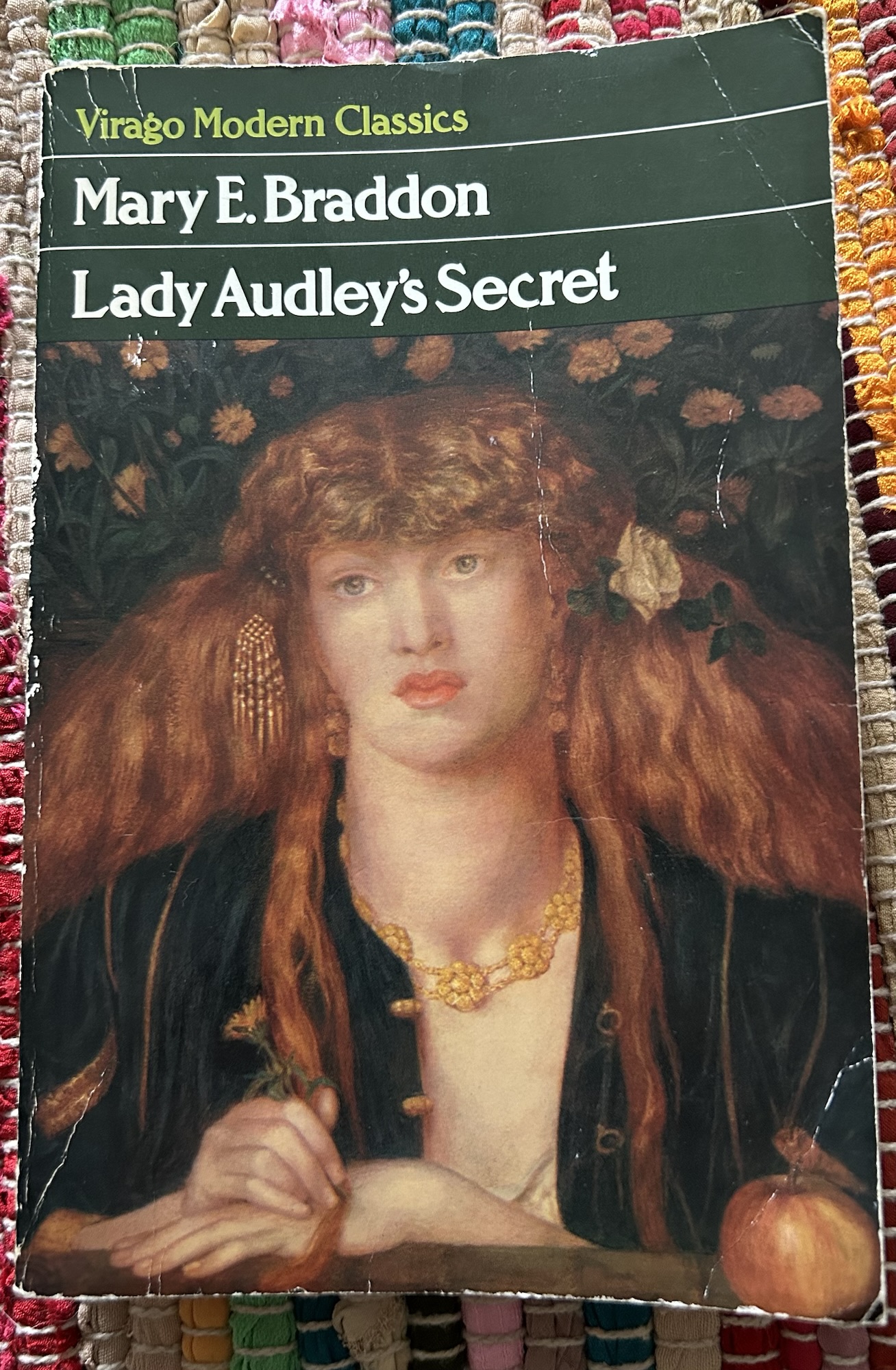
Lady Audley was a perfect example of a character I “loved to hate”. The copy I read had no photo on the cover. The woman on the cover of yours is NOT how I pictured Lady Audley!
LikeLiked by 1 person
Absolutely! I think they chose the cover art because she was compared to a pre-Raphaelite painting a few times, but that portrait is not how I imagined her at all.
I also found an itv adaptation from 2000 which cast Neve McIntosh as Lady A – she looks almost the exact opposite of how Lucy is described!
LikeLiked by 1 person
Lovely review! I found the book to be overly long too, but still enjoyed the descriptive writing style.
LikeLiked by 1 person
Thank you! I did enjoy the descriptive writing especially at the beginning, before it became a bit repetitive!
LikeLiked by 1 person
Pingback: Lady Audley’s Secret by Mary Elizabeth Braddon | Rose Reads Novels